From Surf Wiki (app.surf) — the open knowledge base
St Bartholomew's Hospital
Hospital in the City of London

Hospital in the City of London
| Field | Value |
|---|---|
| name | St Bartholomew's Hospital |
| org_group | Barts Health NHS Trust |
| image | Barts-main-entrance.jpg |
| caption | The King Henry VIII Gate at Barts was completed in 1702 |
| location | West Smithfield, London, England |
| coordinates | |
| healthcare | National Health Service |
| type | Teaching |
| speciality | |
| standards | |
| emergency | No |
| affiliation | Barts and The London School of Medicine and Dentistry |
| beds | 387 |
| founded | |
| closed | |
| website | |
| other_links | |
| pushpin_map | United Kingdom London City of London |
| pushpin_map_caption | Shown in the City of London |
| mapframe-zoom | 14 |
| mapframe-stroke-colour | #5555ff |
| mapframe-stroke-width | 3 |
| mapframe-shape-fill | #00ffff |
| mapframe-shape-fill-opacity | 0.1 |
the hospital in London
| mapframe-zoom = 14 | mapframe-stroke-colour = #5555ff | mapframe-stroke-width = 3 | mapframe-shape-fill = #00ffff | mapframe-shape-fill-opacity= 0.1
St Bartholomew's Hospital, also known as Barts, is a teaching hospital located in the City of London. It was founded in 1123 by Rahere, and is currently run by Barts Health NHS Trust.
History
Early history
Barts was founded in 1123 by Rahere (died 1144, and entombed in the nearby Priory Church of St Bartholomew the Great), a favourite courtier of King Henry I. The dissolution of the monasteries did not affect the running of Barts as a hospital, but left it in a precarious position by removing its income. It was refounded by Henry VIII in December 1546, on the signing of an agreement granting the hospital to the Corporation of London.
The hospital became legally styled as the "House of the Poore in Farringdon in the suburbs of the City of London of Henry VIII's Foundation", although the title was never used by the general public. The first superintendent of the hospital was Thomas Vicary, sergeant-surgeon to King Henry, and an early writer on anatomy.
From 1839 to 1872, the mortality reports show that surgical trauma and postoperative infection were the greatest causes of death. Tuberculosis, however, remained the most fatal nontraumatic cause of death. Nurses were expected to work 12 hours a day, and sometimes 14, with meal breaks in 1890. They had 2 weeks annual holiday. Upon the creation of the National Health Service in 1948, it officially became known as St Bartholomew's Hospital.
Buildings
Barts is the oldest hospital in Britain still providing medical services which occupies the site it was originally built on, and has an important current role as well as a long history and architecturally important buildings. The Henry VIII entrance to the hospital continues to be the main public entrance and features a statue of Henry VIII above the gate.
Its main square was designed by James Gibbs in the 1730s. Of the four original blocks, three survived; they include the block containing the Great Hall and two flanking blocks that contained wards. The first wing to be built was the North Wing, in 1732, which includes the Great Hall and the canvas paintings by William Hogarth. The South Wing followed in 1740, the West in 1752 and finally the East Wing in 1769. In 1859, a fountain was placed at the square's centre with a small garden.
St Bartholomew's Hospital has existed on the same site since its founding in the 12th century, surviving both the Great Fire of London and the Blitz. Its museum shows how medical care has developed over this time and explains the history of the hospital. Part-way around the exhibition is a door which opens on to the hospital's official entrance hall. On the walls of the staircase are two canvases painted by William Hogarth, The Pool of Bethesda (1736) and The Good Samaritan (1737). Hogarth was so outraged by the news that the hospital was commissioning art from Italian painters that he insisted on painting the canvases without a fee, as a demonstration that English painting was equal to the task. The Pool of Bethesda is of particular medical interest, as it depicts a scene in which Christ cures the sick: display material on the first floor speculates in modern medical terms about the ailments from which Christ's patients in the painting are suffering. The canvases are to be restored in 2023, with a grant from the National Lottery Heritage Fund.
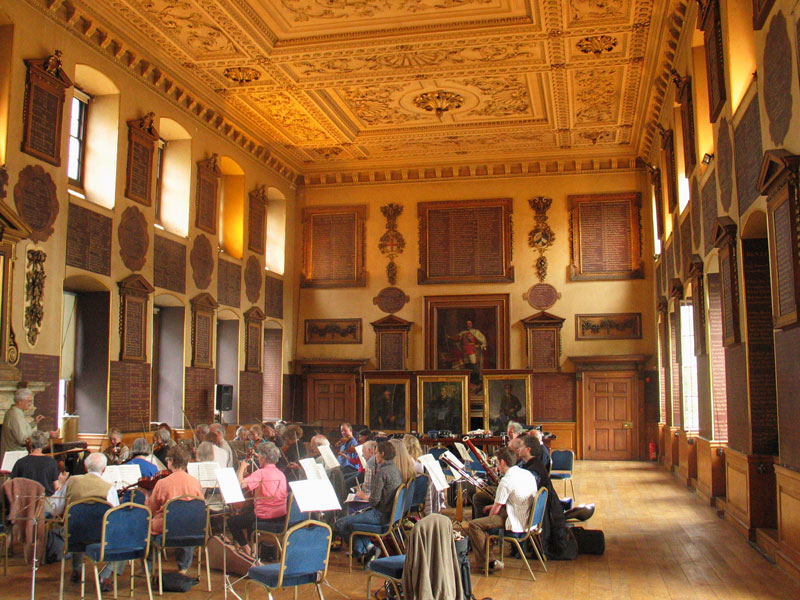
The room to which the staircase leads is the hospital's Great Hall, a double-height room in Baroque style. Although there are a few paintings inside the Great Hall, nearly all are on movable stands: the walls themselves are mostly given over to the display of the very many large, painted plaques which list, in detail, the sums of money given to the hospital by its benefactors.
After the Dissolution of the Monasteries, the hospital precincts of the ancient priory were redesignated as an Anglican ecclesiastical parish, with St Bartholomew-the-Less becoming the parish church – a unique situation amongst English hospital foundations. St Barts-the-Less is the only survivor of five chapels originally within the hospital's estate, the others failing to survive the Reformation. The church has a 15th-century tower and vestry, and its connections with the hospital can be seen not only in its early-20th century stained glass window of a nurse, a gift from the Worshipful Company of Glaziers, but also in commemorative plaques adorning its interior.
Throughout the whole of the 19th century, the Hardwick family were major benefactors of the hospital. Thomas Hardwick Jr. (1752–1825), Philip Hardwick (1792–1870), and Philip Charles Hardwick (1822–1892) were all architects/surveyors to Barts Hospital. Philip Hardwick, a Royal Academician, was also engaged in the rebuilding of the Church of St Bartholomew-the-Less in 1823 and donated the fountain in the hospital's courtyard.
By 1872, Barts contained 676 beds. About 6,000 in-patients were admitted every year, as well as 101,000 out-patients. The average income of the hospital was £40,000 (derived chiefly from rents and funded property) and the number of governors exceeded 300.
Threatened closure


In 1993 the Tomlinson Review of London hospitals concluded that there were too many hospitals in central London and recommended that the service should be delivered closer to where people lived. Barts was identified as a hospital with a catchment area that had a low population and the hospital was threatened with closure. A determined campaign was mounted to save the hospital by the Save Barts Campaign, supported by staff, residents, local MPs and the City of London Corporation.
Some facilities were retained, but the accident and emergency department closed in 1995, with facilities relocated to the Royal London Hospital (a hospital in the same trust group, but a couple of miles away in Whitechapel). A minor injuries unit was established at Barts for small cases (which often represent a significant part of the workload of A&E services) but urgent and major work goes to other hospitals.
Redevelopment
.jpg)

A plan was formulated for Barts to develop as a centre of excellence in cardiac care and cancer. The plan came under threat when it was announced that the works would be procured under a private finance initiative contract; the Save Barts campaign continued to protest. The opposition subsided and a new Barts Heart Centre and new cancer care facilities were created. The Queen Mary Wing was demolished and the façade of the George V building was retained within a new hospital building. A new main entrance was established on King Edward Street. The three James Gibbs blocks were refurbished and car parking was removed from the area. The works, which were designed by HOK and undertaken by Skanska at a cost of circa £500 million, were completed in early 2016.
Barts continues to be associated with excellence at its medical school's significant research and teaching facilities on the Charterhouse Square site. Barts, along with the Royal London Hospital and London Chest Hospital, was part of Barts and The London NHS Trust. There are 388 beds in Barts and 675 beds in the Royal London. These hospitals amalgamated with Whipps Cross and Newham hospitals on 1 March 2012 to form the Barts Health NHS Trust.
Nuffield Health
In 2018, Nuffield Health, a not-for-profit healthcare organisation, was granted planning permission to redevelop the former pathology and residential staff quarters building into a new private hospital. It is the only private hospital in the City of London, and has 48 beds and 4 operating theatres. It opened in 2022, at a cost of £60 million. It is physically and operationally separate from the rest of the hospital, and known as Nuffield Health at St Bartholomew's Hospital. In autumn 2025, Nuffield Health announced that they were selling back the lease of Nuffield Health at St Bartholomew's Hospital to Barts Health NHS Trust, with the handover planned for December 2025. The site will be repurposed by Bart's Health as a dedicated breast cancer centre of excellence, to be opened in early 2026.
Teaching

In 1843, St Bartholomew's Hospital Medical College was established to train medics although considered to have been started by John Abernethy when the hospital built a theatre for his lectures at the beginning of the century. In 1995 the college, along with that attached to the Royal London, merged into Queen Mary University of London, but maintains a distinctive identity. It is now known as Barts and The London School of Medicine and Dentistry. It occupies some space at the Barts site in Farringdon, with a presence a short walk away at Charterhouse Square. The main preclinical teaching domain of the medical school is at Whitechapel in the award-winning Blizard Building.
The present School of Nursing and Midwifery was formed in 1994 from merging the Schools from St Bartholomew's Hospital and the Royal London Hospital to become the St Bartholomew School of Nursing & Midwifery. In 1995 the new School was incorporated into the City University. Both Schools have a strong and respected history dating back over 120 years and have produced many nurse leaders and educators. The School has since been incorporated into the School of Health Sciences, City University London.
Notable staff
- Ethel Gordon Fenwick, Matron 1881–1887
- Isla Stewart, Matron 1887–1910
- Rachel Annie Cox Davies CBE, night sister, home sister and sister of Faith Ward (1896-9); first secretary of the League of St. Bartholomew's Nurses and founding member of the Royal College of Nursing
- Beatrice Cutler Assistant Matron 1907-1920 and founding member of the League of St. Bartholomew's Nurses
- Kathleen Halpin (1903–1999), public servant and feminist
- Mary Harfield 1879–1970, nurse and archaeologist
- Annie Sophia Jane McIntosh, Matron 1910–1927, trained between 1897 and 1899 at The London Hospital under Matron Eva Luckes. McIntosh then worked as a Sister in Matron's office, and as an Assistant Matron between 1899 and 1910. During the First World War she was a member of the War Office Committee for the Supply of Nurses and Principal Matron, 1st London General Hospital in Camberwell.
- Pamela Hibbs CBE OBE FRCN DScHon 1935–2021 qualified at St. Bartholomew's in 1958 gaining the finalist gold medal. Hibbs held varied posts and in 1976 was seconded to improve the failing Hackney Hospital. In 1978 she had a key role in planning for the new Homerton Hospital. In 1994 on the merger of Barts and the Royal London Hibbs was appointed as Chief Nurse across the Royal Hospitals Trust, she retired in 1997.
- Evelyn Marguerite [known as Margot] Turner DBE, RRC (1910–1993), student nurse (1931–1934) then staff nurse (1934–1936), later Matron-in-Chief of Queen Alexandra's Royal Army Nursing Corps (QARANC) and Director, Army Nursing Services (1964–1968) and was Colonel-Commandant of QARANC from 1969 to 1974.
Hospital museums
St Bartholomew's Hospital museum tells the historical narrative of the hospital and its work in caring for the sick and injured. The museum collections include historic surgical instruments, sculptures, medieval archives, and works of art, including paintings by William Hogarth. The museum is located under the North Wing archway. It closed in September 2023 for renovation works, expected to last through 2024. The collections are searchable on the Barts Health NHS Trust online catalogue, which contains information on over 50,000 entries and covering an 800-year span.
Also on the site is the Barts Pathology Museum, which has over 4,000 medical specimens on display and has been described by CNN as one of the "world's 10 weirdest medical museums". The museum is open only by appointment and for special events. Both museums are part of the London Museums of Health & Medicine group.
Sherlock Holmes and Dr Watson
A chemical laboratory at Barts was the location of the initial meeting of Sherlock Holmes and Dr. Watson in Arthur Conan Doyle's 1887 novel A Study in Scarlet. Barts was Watson's alma mater. This fictional connection led to a donation by the Tokyo "Sherlock Holmes Appreciation Society" to the Save Barts Campaign in the 1990s.
In 2012, the final episode of the second series of the BBC drama Sherlock, "The Reichenbach Fall", had Holmes appearing to have deliberately leapt to his death from the roof of St Bartholomew's as a surrogate for the waterfall of the original story "The Final Problem". The hospital was again used as the location for the resolution to Holmes' faked suicide, in the first series three episode "The Empty Hearse".
Transport
London Buses routes 4, 8, 17, 25, 45, 46, 56, 59, 63, 76, 100, 153, 172, 242, N8, N63 and N76 serve the hospital, with bus stops located outside or near the hospital. The nearest Underground stations are Barbican and Farringdon on the Circle, Hammersmith & City and Metropolitan lines and St Paul's on the Central line. Farringdon is also served by Thameslink trains.
Patient entertainment
Since 2022 Bedrock Radio (a registered charity) broadcasts to St Bartholomew's Hospital and wider Barts Health Trust. Bedrock replaced Whipps Cross Hospital Radio (WXHR) who formally served the Trust from 1969 to 2022.
Arms
References
References
- (20 November 2018). "Number of beds".
- [http://www.british-history.ac.uk/report.aspx?compid=45108 ''St Bartholomew's Hospital''], ''Old and New London'': Volume 2 (1878), pp. 359–363. Retrieved 30 January 2009
- It was here that [[William Harvey]] conducted his research on the circulatory system in the 17th century, [[Percivall Pott]] and [[John Abernethy (surgeon). John Abernethy]] developed important principles of modern surgery in the 18th century, and [[Ethel Gordon Fenwick. Mrs Bedford Fenwick]] worked to advance the nursing profession in the late 19th century.James O. Robinson, "The Royal and Ancient Hospital of St Bartholomew (Founded 1123)", ''Journal of Medical Biography'' (1993) 1#1 pp. 23–30
- Thomas R. Forbes, "Mortality at St. Bartholomew's Hospital, London, 1839–72", ''Journal of the History of Medicine and Allied Sciences'' (1983) 38#4 pp 432–449
- (1960). "A History of the Nursing Profession". Heinemann.
- "St Bartholomew's Hospital, London". National Archives.
- "Statue: Henry VIII statue". London Remembers.
- (20 October 2010). "Hogarth at St Bartholomew's Hospital". Spitalfields Life.
- Sherwood, Harriet. (11 January 2023). "William Hogarth works at London's oldest hospital to be restored". The Guardian.
- "Gallery of Images". Barts Great Hall.
- [http://www.aim25.ac.uk/cats/51/5163.htm ''St Bartholomew the Less parish''] (AIM25) accessed 30 January 2009
- "St Bartholomew's Hospital including St Bartholomew-the-Less Church". London Gardens.
- The population of the City had fallen since the turn of the century; and by 1991 was less than 6,000 people – mainly residents of the [[Barbican Estate. Barbican]] and office caretakers. The hospital also served the south of the [[London borough]]s of [[London Borough of Islington. Islington]] and [[London Borough of Camden. Camden]].
- Bernard Tomlinson's ''Report of the Inquiry into the London Health Service'' (HMSO 1993)
- (18 February 1999). "Closing Barts: community and resistance in contemporary UK hospital policy".
- ''Major to minor: the closure of Bart's A&E department has overshadowed a parallel development at the London hospital – the opening of a nurse-led minor injuries unit'' Cassidy, Jane ''[[Nursing Times]]'' (1995)
- [http://www.timesonline.co.uk/tol/news/uk/article789032.ece ''Billion-pound hospitals plan faces collapse'']{{dead link. (September 2024)
- "Barts Health - Barts Heart Centre".
- [http://www.bartshealth.nhs.uk/our-services/services-a-z/c/cancer/ Barts Cancer Centre] {{webarchive. link. (19 February 2016)
- [http://www.bartsandthelondon.nhs.uk/newhospitals/proposals_for_barts.asp ''Proposals for Barts''] (Barts and The London) accessed 3 February 2009
- "HOK: Barts Heart Centre". Design Curial.
- (7 December 2015). "Skanska sells London hospital stakes". The Construction Index.
- "Barts Cancer Research UK Centre".
- (3 April 2012). "When three hospital trusts become one". The Guardian.
- "City of London grants planning permission for Nuffield Health at St Bartholomew's".
- "Update on Nuffield Health at St Bartholomew’s Hospital".
- "East London to get dedicated breast cancer centre".
- Barts was involved in the criminal activities of the [[London Burkers]] in 1831, as one of the hospitals where 'cadavers of unknown provenance' were accepted by surgeons for anatomy training.
- (6 June 2005). "Mr Blobby goes to hospital". The Guardian.
- Garner, Richard. (24 June 1997). "Fall in, Angels!; St Bart's Bid to Beat Shortage of Nurses". The Mirror.
- McCormack, Steve. (20 November 2008). "Caring for Others Gives You Options". The Independent.
- "About the School of Health Sciences". City University.
- "Always-caring-always-nursing/ethel-fenwicks-story".
- Anonymous. (3 August 2022). "Ethel Gordon Fenwick 1857-1947".
- Hector, Winifred. (1973). "Mrs Bedford Fenwick". [[Royal College of Nursing.
- Anonymous. (3 August 2022). "Stewart, Isla".
- Anonymous. (3 August 2022). "Our History".
- Yeo, Geoffrey. (1995). "Nursing at Barts: A history of nursing service and nurse education at St Bartholomew's Hospital, London.". [[Alan Sutton Publishing]].
- "An Appreciation : Rachael Annie Cox-Davies, CBE RRC and Bar"]. The Nursing Times. 40 (46): 771 – via Women's Studies Archive RCN Historic Nursing Journals.
- (1942). "The Passing Bell". The Nursing Record.
- "Kathleen Mary Halpin: Tape Three".
- Hull, Linda. (2018-09-10). "Mary Harfield - Trowelblazers".
- Anonymous. (3 August 2022). "Photographs: Matron and Superintendent of Nursing Miss Annie McIntosh".
- Rogers, Sarah. (2020). ""McIntosh, Annie Sophia Jane, (1871–1951)"". Oxford Dictionary of National Biography.
- Rogers, Sarah (2022). 'A Maker of Matrons'? A study of Eva Lückes's influence on a generation of nurse leaders:1880–1919' (Unpublished PhD thesis, University of Huddersfield, April 2022)
- Annie Sophia Jane McIntosh, Register of Probationers; RLHLH/N/1/6, 6; Barts Health NHS Trust Archives and Museums, London.
- For probationer’s application form see: Nurse Probationers files; RLHLH/N/8/7– Annie McIntosh; Barts Health NHS Trust Archives and Museums, London
- Annie Sophia Jane McIntosh, Register of Sisters and Nurses; RLHLH/N/4/1, 208; Barts Health NHS Trust Archives and Museums, London.
- (May 2021). "Pamela Hibbs CBE OBE FRCN DSc (Hon) 1935 - 2021".
- "Turner, Dame Evelyn Marguerite [Margot] (1910–1993), military nurse".
- Smyth, John. (1970). "The Will to Live:the Story of Dame Margot Turner DBE, RRC.". Ulverscroft..
- "St Bartholomew's Hospital Museum - Barts Health NHS Trust".
- "About the Catalogue". Barts Health NHS Trust.
- "About us - Pathology Museum".
- "World's 10 weirdest medical museums".
- "Medical Museums".
- Conan Doyle, Arthur. (1887). "''A Study in Scarlet'', chapter one". [[Wikisource]].
- [https://www.theguardian.com/society/2006/dec/13/guardiansocietysupplement4 "Campaign for Bart's still has a bite"] Mike Gould ''[[The Guardian]]'' 13 December 2006
- (1 January 2014). "Sherlock: filming the way Holmes faked his death for The Empty Hearse". The Telegraph.
- "St Bartholomew's Hospital". Barts Health NHS Trust.
- "BEDROCK RADIO - Charity 1180476".
- Watson, Mathew. (2022-11-30). "Hear Bedrock Radio in more Hospitals in East London.".
- "WHIPPS CROSS HOSPITAL RADIO - Charity 285733".
- "St Bartholomew's Hospital". Heraldry of the World.
This article was imported from Wikipedia and is available under the Creative Commons Attribution-ShareAlike 4.0 License. Content has been adapted to SurfDoc format. Original contributors can be found on the article history page.
Ask Mako anything about St Bartholomew's Hospital — get instant answers, deeper analysis, and related topics.
Research with MakoFree with your Surf account
Create a free account to save articles, ask Mako questions, and organize your research.
Sign up freeThis content may have been generated or modified by AI. CloudSurf Software LLC is not responsible for the accuracy, completeness, or reliability of AI-generated content. Always verify important information from primary sources.
Report