From Surf Wiki (app.surf) — the open knowledge base
St. Albans School (Washington, D.C.)
American private prep school
American private prep school
| Field | Value | |
|---|---|---|
| name | St. Albans School | |
| image | Saint_Albans_logo.jpg | |
| image_size | 220px | |
| motto | ||
| motto_translation | For Church and For State | |
| streetaddress | 3001 Wisconsin Ave NW | |
| city | Washington, D.C. | |
| country | United States | |
| zipcode | 20016 | |
| ceeb | 090165 | |
| established | ||
| type | Private, Day & Boarding, College-prep | |
| religion | Episcopal | |
| gender | All male | |
| headmaster | Jason F. Robinson | |
| grades | 4–12 | |
| teaching_staff | 69.6 (FTE) (2015–16) | |
| ratio | 8.5 (2015–16) | |
| enrollment | 591 (2015–16) | |
| accreditation | MSA AIMS MD-DC | |
| publication | {{Plainlist | |
| team_name | Bulldogs | |
| colors | Blue and White | |
| athletics_conference | Interstate Athletic Conference | |
| DCSAA | ||
| campus_type | Urban | |
| sister_school | National Cathedral School | |
| website | ||
| coordinates |
the college preparatory school in Washington, D.C.
- The Bulletin (alumni magazine)
- The Saint Albans News (official newspaper)
- Albanian (yearbook)
- Gyre (literary magazine)
- Ventoux (history magazine)
- Grace (homily anthology)
DCSAA St. Albans School (STA) is an independent college preparatory day and boarding school for boys in grades 4–12, located in Washington, D.C. The school is named after Saint Alban, traditionally regarded as the first British martyr.{{cite web | access-date = May 31, 2025 }}
The school enrolls approximately 570 day students in grades 4–12, and 30 additional boarding students in grades 9–12. It is affiliated with the National Cathedral School and the co-ed Beauvoir School, all of which are located on the grounds of the Washington National Cathedral. All the affiliated schools named are members of the Protestant Episcopal Cathedral Foundation.{{cite web | access-date = May 31, 2025 }}
History
Early years
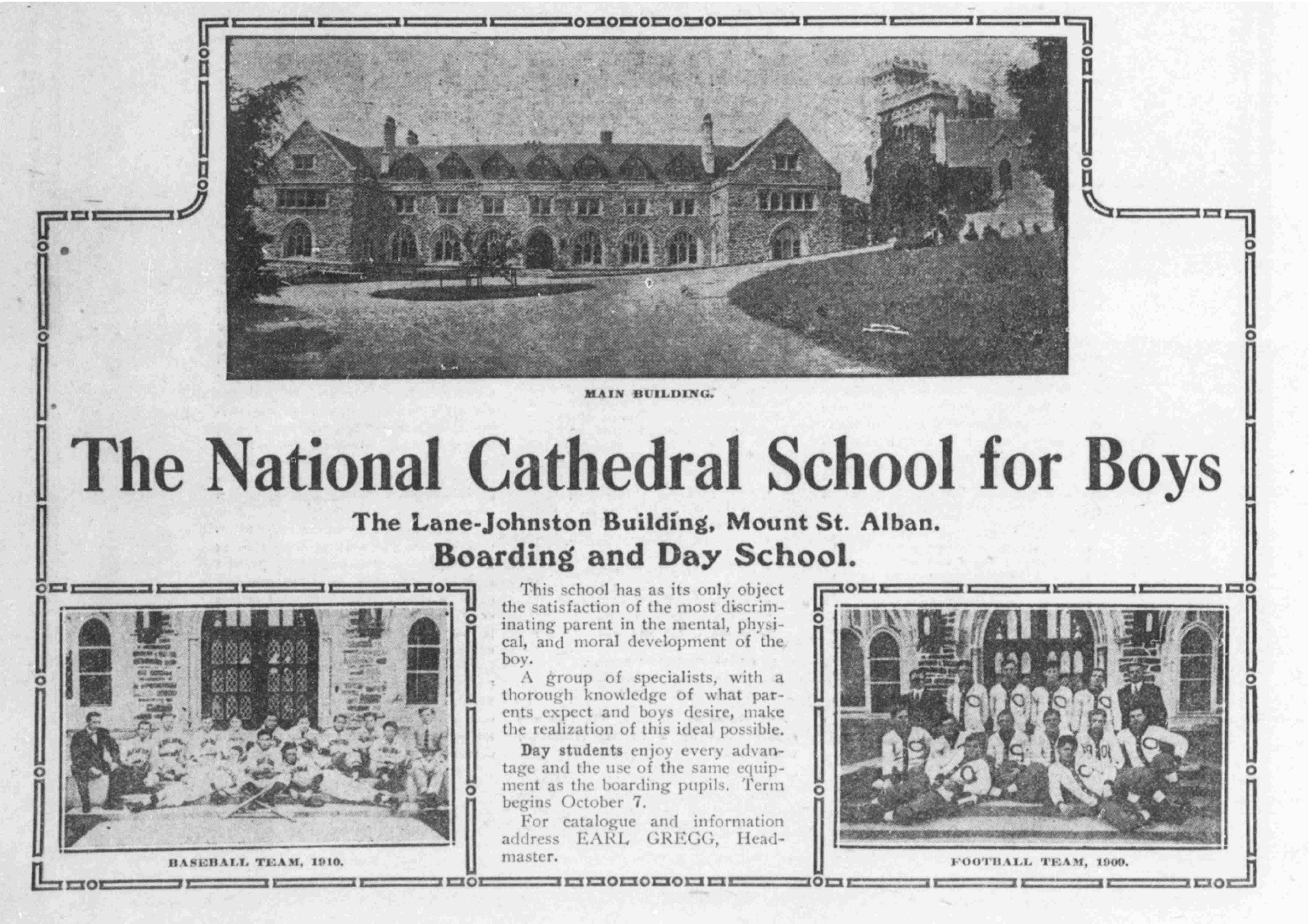
The principal investment for St. Albans was bequeathed by Harriet Lane Johnston, the niece and first lady of President James Buchanan and prominent Washington socialite. A devout Episcopalian throughout her life, Lane Johnston added a codicil to her will in 1899 directing the establishment of a boys school on the grounds of the Washington National Cathedral “in loving memory of [her] sons.” A subsequent codicil four years later raised the endowment to $300,000 (nearly $11 million in 2025 dollars), and stipulated that half of the funds should be used for the building’s construction, and the other half for the education of the boy choristers at the Washington National Cathedral.
Soon after her death in 1903, a site was chosen for the Lane-Johnston Building, and the foundation stone was laid in June 1905. By 1907, construction was virtually complete on the new building, which housed everything—classrooms, the dining hall, the headmaster’s study, and a 40-bed dormitory—but the chapel: the Bishop of Washington repurposed an adjacent repository for cathedral furnishings into the Little Sanctuary, adding a bell tower and an archway.{{cite book
St. Albans, called the National Cathedral School for Boys until 1914, officially opened its doors in October 1909, with 34 students registered. Enrollment rose to 59 by the end of the first academic year, and surpassed 100 by the end of the second. A large portion of these initial students had transferred from a grammar school in Wisconsin, following their teacher and coach, Earl Lamont Gregg, who became the first headmaster of St. Albans. The school also received a boost in enrollment following the collapse of the Washington School in 1911, headquartered near the present location of Sidwell Friends School. Facing cramped accommodations during its second year, St. Albans subsequently purchased a nearby Queen Anne-style mansion left vacant by the defunct institution to house its Lower School.
Throughout the remainder of Gregg’s term, the school continued to expand. St. Albans attracted numerous teachers and coaches, offering a variety of course offerings and varsity sports to students of all forms. The school’s track program received national attention during this period, largely attributed to sprinter Brooke Brewer. Although membership in the Episcopal Church was not required to attend the school, three-fourths of the student body belonged to the faith and several faculty members were clergy members. The school also required attendance at two daily services for boarders. Additionally, several traditions appeared during these early years that continue to this day: an end-of-year field day, consisting of a blue team and a white team; student elections of prefects; and the donation of a stained-glass window by each graduating senior class to the school’s refectory.{{cite book
Although most graduates during the school’s early years matriculated to the Ivy League and other highly esteemed universities, St. Albans struggled to retain students in its Upper School, with many transferring to well-established boarding schools in New England. Efforts to fill the upper forms included reducing the tuition for boarding students. In addition to the already liberal scholarships for athletes, choir boys, and the children of clergy, the school’s finances consistently ran at a deficit, and in 1915, Gregg resigned upon request of the Bishop.{{cite book
William Howell Church was appointed the next headmaster of St. Albans, and promptly oversaw substantial financial reforms to resolve the school’s debt. Church also implemented a rigorous academic program to raise the educational standard at St. Albans, introducing compulsory college board exams and eliminating athletic scholarships. Student retention in the Upper School, however, remained an issue through the end of Church’s tenure.
Challenges continued to mount for the school in the latter half of the 1910s. Several teachers were called to action during World War I, joining 80 former students who served, and the influenza pandemic resulted in over a hundred cases among students and forced the school to close its doors for two weeks. Notwithstanding these setbacks, St. Albans emerged in the 1920s with much stronger academic and extracurricular records, attracting a handful of students from prominent Washington social and political families, especially in the Lower School. The choral program remained a focal point and continued to draw a large cohort of boy choristers, despite the two hours of daily rehearsal, four weekly evensongs, and three Sunday services, all on top of school work. Other students wrote for the school’s two newspapers, The Albanian and The Albanac. The publications evolved into their modern iterations—a yearbook of the same name and The Saint Albans News, respectively—early in the next decade.{{cite book
By 1928, the increasing traffic on Massachusetts Avenue proved dangerous for Lower School students, who had to cross the street to attend chapel and meals. The school contracted Ralph Adams Cram, an architectural consultant for the Cathedral, to conceive plans for a new Lower School building. The three-story facility was completed within a few years and contained new classrooms, faculty living quarters, and music practice rooms.{{cite book
Maturation and Adaptation
Due to failing health, Church resigned in 1929 and was succeeded by Albert Hawley Lucas, then a priest and vice principal at Episcopal Academy in Philadelphia. Although much of the school’s religious and academic character predated his tenure, Lucas ushered in a conscious emulation of English public schools, keeping in tradition with the school’s name. St. Albans during Lucas’s two decades sought to emphasize a classical education—with greater focus on mathematics, languages, and history than on social sciences—and the development of character through rigorous, compulsory athletics.
St. Albans was largely unaffected by the Great Depression due to its location in the nation’s capital. Some parents struggled to pay tuition, but the government domination of the city spared many of its residents from the economic slump of the next decade. In fact, faculty and student enrollment grew during this period, both doubling in size by the start of the Second World War. Lucas also managed to find funding for the Activities Building—designed by Waldron Faulkner—which housed a basketball court, a newsroom, carpentry shops, and a library upon its completion at the end of the decade.{{cite book
An era of intense political upheaval, the decade also yielded the establishment of the Government Club in 1934, among the oldest continuously operating clubs at the school. Divided into Liberal and Conservative parties, the club regularly debates prominent political issues and hosts speakers of national relevance. Notable members include Vice President Al Gore ’65, Senator Michael Bennet ’83, and Representative Harold Ford Jr. '88, all presidents emeriti of the Liberal party.{{cite news | access-date = May 31, 2025}}{{cite book
St. Albans, like most institutions, drastically evolved in the wake of the attacks on Pearl Harbor. By September 1942, 10 faculty members (out of roughly 30) and 125 alumni were already in service, and the school offered new courses in auto mechanics and model aircraft construction. Many students took summer school classes to accelerate their education and attend college early. In the end, 14 alumni died during the war.
Although the remainder of the Lucas years were dominated by the necessity of rebuilding the faculty after the war, the headmaster managed to gain substantial financial independence for St. Albans from the Protestant Episcopal Cathedral Foundation (PECF), establishing an independent board of governors in 1946. Despite the historically hands-off nature of the PECF concerning St. Albans, Lucas sought to avoid future conflict regarding the autonomy of the school to make its own financial decisions. The PECF still retains ultimate decision-making ability—as it does for all institutions on the Close—but it has since very rarely strayed from the verdict of the board.{{cite book
Lucas retired in 1949, and asked Charles Martin to succeed him as headmaster. Martin, who taught with Lucas at Episcopal Academy, had left academia a few years earlier to become the rector at an Episcopal church in Burlington, Vermont, but was persuaded to accept the position at the urging of Lucas and many St. Albans faculty members. The new headmaster was known for his bulldogs, which replaced the saints as the school’s new mascot over the course of his tenure.
Martin immediately set out to expand the school’s facilities. With 375 students crammed into accommodations built for 250, Martin developed plans for a five-story addition to the southeast end of the building housing the Lower School, set to contain science laboratories, new classrooms, an art studio, and an expanded refectory. Although funding and post-war supply shortages resulted in two stages of construction over the course of the 1950s, the addition rounded out today’s True-Lucas Building.{{cite book
St. Albans was by no means isolated from the worldly events of the 1950s. The names of several students, in relation to their fathers, were implicated in the investigations by Senator Joseph McCarthy. One student, the son of Army Secretary Robert Stevens, ended up in a fist fight with several of his classmates. Upon the outbreak of the Korean War, St. Albans also developed contingency plans in the event of a nuclear attack. Among them was the crypt of the Cathedral, which was subsequently stocked with emergency supplies.{{cite book
Modernizing St. Albans
In 1952, the PECF passed a unanimous resolution calling on the three schools under its jurisdiction to admit “children of all races.” With the exception of a few white-passing children of foreign diplomats, the student body at St. Albans had been historically all-white; no records indicated that there had ever even been a non-white applicant. Yet, following the Cathedral’s suggestion, St. Albans implemented a gradual schedule of integration in 1954, becoming one of the first independent schools in the region to desegregate. The school’s first black student, Frank Snowden, entered sixth grade in 1957.
Although some were concerned about parental backlash regarding integration, St. Albans continued to attract the children of prominent Washington business and political families. At one point, the children of four senators and nine representatives simultaneously attended the school. A few of these influential parents even sat on the board. The school’s track record for college matriculation also boosted its national reputation; thirty-six percent of graduating seniors were accepted to Harvard University in 1957.{{cite book
The school added a new library, theater, and renovated playing fields in the 1960s, accommodating its gradually increasing enrollment. Efforts to expand financial aid also opened the school’s doors to more students of diverse backgrounds. An increasing number of students had divorced parents or lacked ties to the church. In 1970, St. Albans implemented a program called “Risk” to bring in students from underrepresented neighborhoods in the city, now known as the Skip Grant Program.
Students were undoubtedly influenced by the social trends of the era, with more willingness to rebuke teachers regarding dress code and academic standards. For a few years, students replaced the traditional prefects with a more democratic student council. Some students and teachers even considered eliminating grades. Student responses to the Vietnam War, by contrast, were relatively muted because draft eligibility could be postponed by student deferments.{{cite book
As the 1970s progressed, St. Albans modernized its curriculum. It offered new courses in ecology, African history, economics, comparative literature, and more. The school also lowered the number of religious courses required to graduate and offered fewer compulsory chapel services each week. Traditional language, religion, and history courses still remained popular, however, despite the new electives.{{cite book
In 1971, NCS proposed to St. Albans that the schools consolidate their administrative structures into “one coeducational school environment … on the Cathedral Close,” citing the benefit of shared resources and increasing competition from well-funded public schools. Martin, wary about the large size of a merged school and wage differences between St. Albans and NCS faculty, expressed reservations. Others on the board were more concerned about losing the character of an all-boys school. Evidently, the two schools never merged, but they expanded their coordinate academic and athletic offerings throughout the decade, building upon the already co-ed chorus and theater programs.{{cite book | access-date = May 31, 2025 }}
Martin retired in 1977, with a new gymnasium and academic building—called the Steuart Building—under construction.{{cite book
Throughout the 1990s, Mullin managed to significantly raise faculty salaries to the highest median among independent schools in the region, competing with the wages given to local public school teachers. He also renovated the aging Lane-Johnston and True-Lucas buildings. Yet, with donations lethargic and expenditures high, St. Albans entered 1997 with substantial financial difficulties. Combined with other strategic disagreements, the Board of Governors forced Mullin to resign in June of that year. The decision was highly controversial; many faculty members threatened to resign.{{cite book
John McCune, longtime history teacher and Upper School head at St. Albans, emerged from retirement to serve as the school’s headmaster between 1997 and 1999. McCune was widely seen as a unifying force, helping to bridge the deep divisions that emerged during the previous few years. He rebuilt the Board of Governors (all members resigned after the Mullin resignation), increased fundraising levels, and restored normality at the student and faculty level.{{cite book
Zebulon Vance Wilson was selected in 1999 as the seventh headmaster of St. Albans. In his first few years, Wilson developed a teaching mentorship program for faculty, established the School of Public Service, and expanded elective course offerings. He also spearheaded the school’s two largest capital campaigns, each of which raised tens of millions of dollars for the school.{{cite book
Recent Years
In 2010, St. Albans opened its new Upper School building, Marriott Hall, to celebrate the school’s centennial. The firm Skidmore, Owings, and Merrill designed the building, which received considerable media attention.{{cite news | access-date = May 31, 2025}}[[File:St. Albans Marriott Hall.jpg|thumb|Marriott Hall in 2025]]
In the wake of the confirmation hearings of Supreme Court Justice Brett Kavanaugh, St. Albans received criticism for sexist slurs in the 2015 edition of The Albanian, its yearbook. The school has since made efforts to increase accountability.{{cite news | access-date = May 31, 2025}}
In 2018, St. Albans, along with seven other area private schools, announced it was phasing out Advanced Placement courses from its curriculum by 2022.{{cite news | access-date = May 31, 2025}} The United States Department of Justice launched an investigation into whether the collaboration was a violation of the Sherman Act, and the schools subsequently “disavowed” the agreement. St. Albans continues to offer AP courses in science, math, and foreign languages.{{cite web | access-date = May 31, 2025 }}
Jason Robinson was appointed headmaster in 2018.{{cite web | access-date = May 31, 2025 }}
Finances
Tuition and Financial Aid
For the 2025–2026 school year, St. Albans charged day students $56,966 and boarding students $80,308 for tuition. In 2016, Business Insider listed St. Albans as among the most expensive boarding schools in the United States.{{cite web | access-date = May 31, 2025 }}

St. Albans offers a need-blind admissions policy. It allocated over $5.8 million in financial aid during the 2023–24 school year, and distributes grants based on family income. The school states that the average aid grant is 65% of tuition.
The school follows a strictly need-based allocation of financial aid, with the exception of stipends for boy choristers in the Lower School and cathedral acolytes in the Upper School.{{cite web | access-date = May 31, 2025 }}
Endowment
In 2018, the school’s financial endowment stood at $90 million.{{cite web | access-date = Jun 8, 2025
Academics
St. Albans has long held a reputation for its academic intensity and competition among students.{{cite news | access-date = May 31, 2025}} Since the school’s founding, dozens of students matriculate to Ivy League universities and similarly ranked schools each year.{{cite book | access-date = May 31, 2025}} The class of 2023 had a median composite ACT score of 33.{{Citation
The school reports that its average class size is 13 students.{{cite web | access-date = May 31, 2025 }}
Curriculum
St. Albans has a traditional curriculum, placing an emphasis on the humanities—especially English, history, and languages—while also offering numerous courses in STEM subjects. It is rooted in the Episcopal pedagogical tradition, and as such religion courses are required in both Lower and Upper Schools. The school also values giving teachers more autonomy in the classroom, and as such teaching styles range from conservative to innovative.{{cite book
In the Lower School, St. Albans focuses on developing the students’ learning skills. Students are required to take math, English, history, science, and language classes all five years, and other obligatory classes—music, art, ethics, theater—vary semester to semester. Spanish instruction is mandatory in Forms C, B, and A (grades 4-6), while students may opt to take other languages in Forms I and II (grades 7-8), including French, Latin, and Chinese (although most students continue with Spanish).{{cite book
.jpg)
The Upper School has similar requirements, requiring three years of study in each of the core subject areas, and four in English. The school also requires two semesters of arts-related coursework—art classes, chorus, orchestra, or theater—and two semesters of religion, taken in a student’s freshman and senior years. St. Albans also offers dozens of elective courses in all subjects, and a few students pursue independent studies with faculty members if they exhaust course offerings in a certain department. The school also offers AP courses in science, math, and languages, and honors courses in all subjects but English.{{cite book
Since the 1970s, St. Albans has offered a coordinate program with NCS. Chorus, orchestra, and theater are co-ed starting in Form I, and students may take electives at either school beginning in Form III. Beginning in Form V, all English courses, including the required American literature course, are coordinate.{{cite web | access-date = May 31, 2025 }}
Grading
GPA is calculated based on an unweighted, 100-point scale, taking into account numerical grades from each course. The passing grade is a C, or 70%.{{cite web | access-date = May 31, 2025 }}
College Admissions
Although college admissions have grown increasingly meritocratic and put an emphasis on diversity, St. Albans remains comparatively successful in its college matriculation statistics. The school reports that 68 students went on to attend Ivy League schools between 2019 and 2024, and another 76 matriculated to UChicago (37), Georgetown (13), Boston College (11), UVA (9), and Duke (6).{{cite web | access-date = May 31, 2025 }}
In 2004, the Wall Street Journal found that, among U.S. schools, St. Albans had the 11th-highest success rate in placing students in 10 selective universities.{{cite news | access-date = May 31, 2025}}
Travel
St. Albans offers several foreign travel programs, seeking to expand its students’ “knowledge of [the] world and their place in it.” The school has exchange partnerships with six schools on four continents, giving students the opportunity to swap places with an international student for a few months. Students are typically selected by their deans to pursue these programs.{{cite book
The school also offers 13 endowed fellowships that enable students to pursue an extracurricular area of study, travel, or a social service project over the summer. Students typically apply for these programs at the spring semester, and present their learnings at a school assembly the following fall. Select fellowships include funding for students to work at a non-profit in Africa, conduct laboratory research, or produce art for display in the school.{{cite book
Roughly one in two students travel abroad on school-sponsored trips before they graduate.{{cite book
Service
St. Albans requires 60 hours of volunteer community service before students enter their senior year. Half of those hours must be completed within the DC area and be from approved organizations, including retirement homes or food banks.{{cite web | access-date = May 31, 2025 }}
Faculty
The school’s average faculty tenure is 12 years. Roughly 80% have advanced degrees.{{cite web | access-date = May 31, 2025 }}
St. Albans sponsors a writer-in-residence each year, who teaches English classes while developing their work.{{cite book
Notable faculty include:
- Donna Denizé, English teacher
- Benjamin Hutto, choral director{{cite book
- Michael McCarthy, chorister program director{{cite web | access-date = May 31, 2025 }}
- Norman Scribner, organist
- Curtis Sittenfeld, writer-in-residence
Athletics
St. Albans offers 14 interscholastic sports teams at varsity, junior varsity, and middle school levels; several non-competition athletic programs; and physical education classes for fourth and fifth grades. Athletics are required for all students, although seniors may skip one season.{{cite web | access-date = May 31, 2025 }}
The school competes in the Interstate Athletic Conference (IAC), a league of independent schools in the Washington area. Other members include Georgetown Preparatory School, Bullis School, Episcopal High School, Landon School, and St. Stephen's and St. Agnes School.{{cite web | access-date = May 31, 2025 }} Landon is historically the school’s main athletic rival.{{cite book
Since 2019, St. Albans has won IAC championships in cross-country, soccer, ice hockey, tennis, golf, and track and field.{{cite web | access-date = May 31, 2025 }} The school’s cross-country team is one of the most successful in the Mid-Atlantic region. It has won every IAC championship since 2009, and in 2024, won the DCSAA postseason championship, came in second in the Nike Southeast Regionals, and got 18th place in the Nike Cross Nationals.{{cite web | access-date = May 31, 2025 }}{{cite web | access-date = May 31, 2025 }}{{cite web | access-date = May 31, 2025 }}
Several sports are co-ed with NCS, including cross-country, track and field, swimming, crew, and voyageur (rock climbing, kayaking).
Campus
St. Albans is situated on the 59-acre close of the Washington National Cathedral, sharing the grounds with the National Cathedral School, Beauvoir School, and the facilities of the Protestant Episcopal Cathedral Foundation.{{cite web | access-date = May 31, 2025 }} The school is located in the Cathedral Heights neighborhood of Northwest Washington, D.C., and sits at the crossroads of Massachusetts Avenue and Wisconsin Avenue, two major arteries into downtown Washington.
The Close is situated atop Mount Saint Alban, which overlooks a substantial portion of the Washington, D.C., skyline. Walking towards the school, the Washington Monument and Capitol Building are visible, as well as other notable landmarks.{{cite web | access-date = May 31, 2025 }}
Academic Facilities
- The Lane-Johnston Building is the school’s original academic building, built in 1908. It holds most of the school’s administrative and admissions offices, classrooms, the refectory, and the dormitory.[[File:Lane-Johnston Building.jpg|thumb|The Lane-Johnston Building]]
- The True-Lucas Building houses all Lower School classrooms, a music room, and Upper School science laboratories. First built in 1928, the building was expanded in the 1950s and 1990s.
- The Steuart Building, built in 1975, holds Upper School classrooms, art studios, the IT department, a robotics lab, and a chorus practice room.
- Marriott Hall contains Upper School classrooms, faculty offices, and the school’s bookstore. It was constructed in 2009 for the school’s centennial anniversary.
- The Ellison Library was constructed in 1968 and contains thousands of books, a recording studio, and study space.
- Trapier Theater is located directly underneath Ellison Library and hosts a variety of performing arts events.
Athletic Facilities
- The Activities Building contains two basketball courts, a weight room, a wrestling room, locker rooms, and the Kellogg Room: classroom and home to the school’s Government Club. The building was constructed in 1938 and renovated in 2024.[[File:Skyline from Washington National Cathedral.jpg|thumb|Sports fields, tennis courts, and the Activities Building (right, green roof) as viewed from the National Cathedral]]
- The Lawrence Pool, an indoor pool with six 25-yard lanes.
- The Steuart Field, a full-sized football field surrounded by a 400-meter track.
- The Satterlee-Henderson Field, a combined baseball diamond and practice field.
- The St. Albans Tennis Center, with seven clay tennis courts.
- Students use the Agnes Underwood Athletic Center at NCS for rock climbing, dance, and indoor track.
Other Notable Places
- The Little Sanctuary was originally a repository for cathedral furnishings, and was converted into the school’s chapel in 1909. It was most recently expanded in 2025.{{cite web | access-date = May 31, 2025 }}
- Senior Circle, a traffic circle located in front of the Lane-Johnston Building. At its center is a Glastonbury thorn, said to be a planted trimming from a tree in Somerset, England.[[File:St. Albans Glastonbury Thorn.jpg|thumb|The Glastonbury Thorn]]
- The Olmsted Woods, designed by Frederick Law Olmsted Jr., sits between the school’s academic and athletic fields and contains walking paths and an outdoor amphitheatre.
Student Life
During the 2024–2025 school year, St. Albans reported that 566 day students and 27 boarding students were enrolled at the school. Across all grades, 43% are students of color.{{cite web | access-date = May 31, 2025 }}
Extracurriculars
Most students participate in extracurricular activities. The school has six active student publications, of which a few have won awards.{{cite web
- The Saint Albans News, the school's oldest newspaper
- Gyre, a literary magazine
- Grace, an anthology of chapel talks
- The Albanian, the Upper School yearbook
- The Exchanged, an independent newspaper published jointly with NCS{{cite web | access-date = September 22, 2025 }}
- Ventoux, a history magazine{{cite web | access-date = September 22, 2025 }}
The school reports that it has other clubs, including Model U.N., a history club, a fishing club, and a knitting club.{{cite web | access-date = May 31, 2025 }}
St. Albans has won national recognition for various student extracurricular teams. Its robotics team is in the top 4% in the world, and has competed at the VEX Robotics world championships the past four years.{{cite web | access-date = May 31, 2025 }} Additionally, St. Albans has competed on the game show It’s Academic several times in the past few years.{{cite episode | air-date = June 3, 2023
Traditions
St. Albans has a dress code. Students are required to wear a jacket and tie, although dress shoes are no longer required.{{cite web | access-date = May 31, 2025 }}
All students and faculty members eat together in the school’s refectory each day. Students are assigned randomized seating every few weeks, and are encouraged to engage with peers in older and younger grades.{{cite web | access-date = May 31, 2025 }}
The Upper School student council is composed of three prefects from each grade and five from the senior class, with a head prefect elected by the entire Upper School. Students also elect vestry members from each grade to run chapel services. Seniors are encouraged to give chapel talks to the student body during their final year at the school.{{cite book
The boy chorister program remains an integral part of the Lower School, with around a dozen singers each year.{{cite web | access-date = May 31, 2025 }} For non-choristers, music remains an important part of the school. The Upper School chorale—combined with NCS—often has as many as 160 singers, although numbers have decreased since the COVID-19 pandemic. Orchestra, jazz band, and a cappella are similarly popular.{{cite web
School Motto, Prayer, and Hymn
The school’s motto, Pro Ecclesia et Pro Patria, is Latin for “for church and for state.” Many within the St. Albans community consider the unofficial motto to be “choose the hard right over the easy wrong,” coined by the school’s fourth headmaster, Canon Charles Martin.{{cite news | access-date = May 31, 2025}}[[File:Cathedral from St. Albans School.jpg|thumb|Students have chapel services in the Little Sanctuary and the Washington National Cathedral]]
Michael Collins ‘48, Apollo 11 astronaut, carried a copy of the St. Albans school prayer with him on his journey to the Moon.{{cite web | access-date = May 31, 2025}} It reads as follows:
"Vouchsafe thy blessing, we beseech thee, O Lord, upon this school and upon all other works undertaken in thy fear and for thy glory; and grant that all who serve thee here, whether as teachers or learners, may set thy holy will ever before them, and seek always to do such things as are pleasing in thy sight; that so both the Church and Commonwealth of this land may benefit by their labors, and they themselves may attain unto everlasting life; through Jesus Christ our Lord. Amen."
The school hymn, “Men of the Future, Stand,” has four verses and is sung to the tune of “Diademata.” {{cite AV media
Other Academic Programs
School of Public Service
Founded in 2002, the School of Public Service is a four-week, co-ed residential summer program that aims to instill a greater appreciation for public policy and government.{{cite book | access-date = May 31, 2025}}
In popular culture
In season 3, episode 6 of the sitcom The Unbreakable Kimmy Schmidt, the character Duke Snyder asserts he was “linebacker at St. Albans School for Boys and their Nannies.”{{cite episode | air-date = May 19, 2017
Notable alumni
File:Al Gore, Vice President of the United States, official portrait 1994.jpg|Vice President Al Gore File:Michael Bennet Official Photo.jpg|Senator Michael Bennet File:Evan Bayh official portrait.jpg|Senator Evan Bayh File:Michael Collins (S69-31742, restoration).jpg|Astronaut Michael Collins File:Jeffrey Wright by Gage Skidmore 3.jpg|Actor Jeffrey Wright File:Bill Marriott 1998.jpg|Hotelier Bill Marriott File:Jonathan Ogden Headshot.jpg|NFL Player Jonathan Ogden
- Jonathan Agronsky '64, journalist and author
- Malcolm Baker '87, professor at Harvard Business School and former Olympic rower
- Evan Bayh '74, former United States Senator for Indiana
- Ralph Becker, mayor of Salt Lake City
- John Bellinger '78, Legal Adviser of the Department of State (2005–2009)
- Odell Beckham Jr., current NFL Wide Receiver, attended 7th grade after his home town was struck by Hurricane Katrina.
- James Bennet, '84 former editor-in-chief of the Atlantic Monthly magazine
- Michael Bennet '83, United States Senator for Colorado
- James Boasberg '81, District Judge on the United States District Court for the District of Columbia
- Joshua Bolten '72, former White House Chief of Staff
- Nicholas Boggs '92, biographer
- William L. Borden '38, executive director of United States Congress Joint Committee on Atomic Energy
- Matt Bowman '09, pitcher in Major League Baseball
- Brooke "Untz" Brewer '16, Former NFL athlete and world class sprinter
- Clancy Brown '77, actor and former chairman of the board of Brown Publishing Company
- Olin Browne '77, golfer
- Garnett Bruce '85, opera director
- Neil Bush '73
- Josh Byrnes, baseball administrator
- Goodloe Byron '45, Congressman
- John Casey '57, novelist
- Michael Collins '48, Apollo 11 astronaut
- Walter J. Cummings Jr., Solicitor General of the United States from 1952 to 1953; judge on the United States Court of Appeals for the Seventh Circuit
- Jonathan W. Daniels '18, White House Press Secretary, author
- Eli Whitney Debevoise II '70, United States executive director of The World Bank
- Brandon Victor Dixon '99, Tony-nominated Broadway actor
- Peter Feldman '00, commissioner of the U.S. Consumer Product Safety Commission
- George M. Ferris Jr. '44, president of the firm Ferris Baker Watts
- Adrian S. Fisher, diplomat and lawyer, Legal Adviser of the Department of State (1949–1953)
- Miles Fisher '02, television and film actor
- Harold Ford Jr. '88, former United States Congressman, Fox News contributor, and current head of the Democratic Leadership Council
- Rodney Frelinghuysen '64, United States Congressman from New Jersey
- David Gardner '84, co-founder of The Motley Fool
- Tom Gardner '86, co-founder of The Motley Fool
- James W. Gilchrist, politician
- Al Gore Jr. '65, the 45th Vice President of the United States.
- Donald E. Graham '62, newspaper chairman
- Ernest Graves Jr. '41, lieutenant general, former director of Defense Security Cooperation Agency
- Frederick Hauck '58, astronaut
- Bill Hobby '49, Lieutenant Governor of Texas 1973–1991
- Jesse Hubbard '94, professional lacrosse player
- Danny Hultzen '08, baseball pitcher, 2nd overall pick of the 2011 Major League Baseball draft by the Seattle Mariners
- Brit Hume '61, Fox News television anchor
- Reed Hundt '65, former FCC Chairman
- Prince Feisal bin Al Hussein of Jordan '81, son of King Hussein and Princess Muna al-Hussein, and the younger brother of King Abdullah II.
- David Ignatius '68, Washington Post columnist, author of Body of Lies
- Uzodinma Iweala '00, author
- Jesse Jackson Jr. '84, Congressman
- Bo Jones '64, publisher
- Thomas Kean '53, former governor of New Jersey, chairman of the 9/11 Commission, attended 4th and 5th grades
- Randall Kennedy '73, professor
- John Kerry, United States Secretary of State
- Nick Kotz '51, journalist, author, and historian
- Damian Kulash '94, rock singer
- Hamilton Leithauser, musician
- Nick Lowery '74, football player
- J. W. Marriott Jr. '50, billionaire
- Ethan McSweeny, theater administrator
- Arthur Cotton Moore '54, architect
- Bill Oakley '84, media professional
- Jonathan Ogden '92, football player (Baltimore Ravens), Pro Football Hall of Fame
- Jameson Parker, actor
- Laughlin Phillips '42, museum director
- David Plotz '86, writer and editor
- Ben Quayle, Congressman
- Manny Quezada, basketball player
- Justin Rockefeller '98, political activist
- James Roosevelt, Congressman
- Kermit Roosevelt III '88, novelist and law professor
- Mark Roosevelt '74, academic administrator
- Alex Ross '86, music critic
- Luke Russert '04, journalist,
- Hib Sabin '53, sculptor and educator
- Barton Seaver '97, chef and author
- Timothy Shriver '77, chairman of Special Olympics
- Burr Steers, director of the film Igby Goes Down
- William R. Steiger '87, chief of staff of the United States Agency for International Development
- Russell E. Train '37, former director of the EPA, founder/chairman emeritus of World Wildlife Fund
- James Trimble III '43, baseball player and marine, killed in action at Iwo Jima
- Ian Urbina '90, journalist, The New York Times, senior investigative reporter, and director of The Outlaw Ocean Project.
- Gore Vidal, author and writer, attended and went on to graduate from Phillips Exeter Academy
- Peter Jon de Vos '56, former United States Ambassador to Mozambique, Cape Verde, Guinea-Bissau, Liberia, Tanzania, and Costa Rica
- John Warner, former United States Secretary of the Navy, five-term Senator from Virginia, attended a summer session
- Josh Weinstein '84, former executive producer of The Simpsons
- Jonathan Williams, poet, founder of The Jargon Society
- John C. White '94, educator
- David Whiting, journalist and film agent, who mysteriously died during production of The Man Who Loved Cat Dancing, was expelled in his junior year.
- Thomas Wilner '62, lawyer at Shearman & Sterling who represented Guantanamo Bay detention camp detainees
- Craig Windham, NPR radio journalist
- Robert Wisdom '72, actor, played Bunny Colvin on HBO's The Wire
- Jeffrey Wright '83, Emmy and Tony Award-winning actor
- Joon Yun '86, physician and hedge fund manager
- Jeffrey Zients '84, director of the U.S. Office of Management & Budget, first Chief Performance Officer of the United States
References
References
- "At a Glance".
- "DR. ALBERT LUCAS, A CHURCH LEADER; Head of Episcopal School in Capital 20 Years Dies". The New York Times.
- (1963). "The Albanian (Yearbook 1963)".
- (22 July 1992). "Area Olympians". [[The Washington Post]].
- Lamb, David. (27 August 1996). "Keynoter Bayh Represents a New Era for Democrats : He's a fiscal conservative who is tough on crime and moderate on social issues. His Midwest address doesn't hurt either.". Los Angeles Times.
- Vogel, Chris. (May 1, 2006). "Prep Schools of the Power Brokers". [[Washingtonian (magazine).
- (April 16, 1980). "Ralph E. Becker Jr. Engaged to Nancy Hayworth Whiteley". [[The Washington Post]].
- (January 11, 2010). "Shaping Foreign Policy in Times of Crisis: The Role of International Law and the State Department Legal Adviser". Cambridge University Press.
- Armstrong, Kevin. (September 12, 2015). "End Zone: Odell Beckham Jr.'s amazing catch made him a household name... but what's next for the Giants star?". New York Daily News.
- Bradley, David. (March 1, 2006). "On March 1, the Atlantic Media Company's Chairman named James Bennet as The Atlantic's next editor.". The Atlantic Monthly.
- Boo, Katherine. (January 15, 2007). "Expectations".
- Layton, Lyndsey. (21 January 2015). "At Senate education hearing, ties between panel, witnesses". [[The Washington Post]].
- "District Judge James E. Boasberg".
- Abramowitz, Michael. (September 29, 2008). "Josh Bolten, On The Record". [[The Washington Post]].
- Huff, Donald. (May 16, 1992). "St. Albans Wears IAC Crown". The Washington Post.
- Gregg Herken, ''Counsels of War'', Knopf, 1985, p. 10.
- Wagner, James. (May 27, 2016). "St. Albans alum Matt Bowman makes his return to D.C.". [[The Washington Post]].
- (13 June 1915). "Skating Developed Runner; Washington Flier Attributes His Ability to Use of the "Rollers."". [[The New York Times]].
- "Clancy Brown". [[MSN.
- "PGATour.com Olin Browne Career".
- Page, Tim. (15 August 2002). "Sizzling Opera Taken Out of Deep Freeze". [[The Washington Post]].
- Justice, Richard. (12 September 1999). "A Local Boy Goes West to Scout for Indians". [[The Washington Post]].
- "BYRON, Goodloe Edgar". United States House of Representatives.
- Carlson, E. Mary. (10 December 2007). "'U.Va. Profiles' Features Award-Winning Author John Casey". UVA Today.
- (June 17, 1999). "Michael Collins- Apollo 11 Command Module Pilot". [[Space.com]].
- Honan, William H.. (2 May 1999). "Walter J. Cummings, 82, Dies; Appellate Judge Since 1966". [[The New York Times]].
- Daniels, Jonathan Worth. (March 9–11, 1977). "Oral History Interview with Jonathan Worth Daniels". University of North Carolina.
- (5 March 1978). "Eli Debevoise 2d Will Wed Heidi Herrington". [[The New York Times]].
- Ritzel, Rebecca. (10 June 2016). "Maryland native is hoping second time's the charm at this year's Tony Awards". [[The Washington Post]].
- Rasmussen, Frederick N.. (October 22, 2008). "George M. Ferris Jr.". The Baltimore Sun.
- Smith, J. Y.. (19 March 1983). "Adrian Fisher Dies". [[The Washington Post]].
- Peppard, Alan. (December 3, 2001). "Fate of Texas in their ears". The Dallas Morning News, Inc..
- White, Jack E.. (December 10, 2002). "Harold Ford Jr. Reaches For the Stars".
- "FRELINGHUYSEN, Rodney P.". United States House of Representatives.
- (23 July 2009). "Nobody's Fool". Northern Virginia Magazine.
- "James W. Gilchrist, Maryland State Delegate". Maryland State Archives.
- Jones, Alex S.. (25 October 1992). "Al Gore's Double Life". [[The New York Times]].
- O'Connell, Jonathan. (January 26, 2014). "Former Washington Post CEO Don Graham to move Graham Holdings to Rosslyn". [[The Washington Post]].
- (26 May 2019). "Ernest Graves obituary". [[The Washington Post]].
- Zito, Tom. (21 June 1983). "Hauck At the Helm". [[The Washington Post]].
- Hobby, William P.. "A Guide to the William P. Hobby, Jr., Papers, 1866, 1895-2015". University of Texas.
- (November 29, 2006). "No. 11: Jesse Hubbard '98". [[The Daily Princetonian]].
- Schotz, Andrew. (24 April 2020). "Cubs pitcher and Bethesda native Danny Hultzen talks about his MLB draft and career". Bethesda Magazine.
- Kurtz, Howard. (April 19, 2006). "Moving to the Right". [[The Washington Post]].
- Hume, Brit. (14 November 2013). "Glory Days". Washingtonian.
- (October 30, 2000). "Few in No. 2 Spot Have Been As Involved in Policy as Gore". [[The New York Times]].
- "His Royal Highness Prince Feisal Ibn Al-Hussein". Hashemite Kingdom of Jordan.
- (October 23, 2000). "Schooled in Picking 'the Hard Right Over the Easy Wrong'". International Herald Tribune.
- Smith, Dinitia. (November 24, 2000). "Young and Privileged, but Writing Vividly of Africa's Child Soldiers". [[The New York Times]].
- Johnson, Dirk. (December 14, 1995). "Victory His, Jesse Jackson Jr. Heads to Congress". [[The New York Times]].
- Farhi, Paul. (27 October 2011). "Boisfeuillet 'Bo' Jones Jr. to leave Post Co. for MacNeil/Lehrer Productions". [[The Washington Post]].
- Weeks, Linton. (16 June 2004). "An Indelible Day". [[The Washington Post]].
- Lambert, Craig. (15 April 2013). "Black, White, and Many Shades of Gray". Harvard Magazine.
- Schudel, Matt. (April 28, 2020). "Nick Kotz, author and Pulitzer Prize-winning journalist, dies at 87". [[The Washington Post]].
- (May 5, 2010). "Viral Return: OK Go at the 9:30 Club". [[The Washington Post]].
- (2006-05-08). "Running a Different Race {{!}} PopMatters".
- Wilbon, Michael. (25 November 1981). "Nick Lowery: St. Albans to the NFL". [[The Washington Post]].
- Binkley, Christina. (19 May 2005). "As Succession Looms, Marriott Ponders Keeping Job in Family". The Wall Street Journal.
- Kleiman, Jaime. (2006-07-01). "The Irresistible Rise of Ethan McSweeny".
- Conroy, Sarah Booth. (16 August 1981). "Arthur Cotton Moore's Designs on Washington". [[The Washington Post]].
- (July 10, 2018). "Portland Fast-Food Blogger Bill Oakley Is Maybe Best Known For His Writing On "The Simpsons"". Willamette Week.
- (March 9, 2021). "Simpsons vet and Instagram fast food critic Bill Oakley adds "high-end" toymaker to résumé". A.V. Club.
- Klingaman, Mike. (July 22, 2007). "Brains, brawn keep Jonathan Ogden man among boys". The Baltimore Sun.
- [https://timesmachine.nytimes.com/timesmachine/1969/06/04/90109645.pdf "Anne Davis Betrothed to Francis Parker 2d"], ''The New York Times''; June 4, 1969; accessed March 4, 2012
- Bernstein, Adam. (January 26, 2010). "CIA officer and art museum chairman Laughlin Phillips, 85, dies". [[The Washington Post]].
- Plotz, David. (12 August 2000). "St. Albans School". Slate Magazine.
- Feinberg, Lawrence. (24 June 1989). "Private Schools for Pol's Kids". [[The Washington Post]].
- El-Bashir, Tarik. (23 January 2004). "Quezada's Street Smarts Light Up D.C.". [[The Washington Post]].
- Rothstein, Betsy. (13 December 2005). "Political engagement: the next generation". The Hill.
- "ROOSEVELT, James". United States House of Representatives.
- Elder, Charles. (1 June 1989). "PEOPLE". [[The Washington Post]].
- Kruger, Leondra R.. (June 9, 1994). "Roosevelt". The Harvard Crimson.
- (November 19, 2007). "Express 5: Alex Ross on Classical Music". [[The Washington Post]].
- Yao, Laura. (June 18, 2008). "At St. Albans, Bidding Russert Farewell". [[The Washington Post]].
- Gangelhoff, Bonnie. (15 May 2017). "Hib Sabin {{!}} The Long Game". Southwest Art Magazine.
- Axelrod, Susan. (15 June 2014). "Newly minted Maine chef spreads word on sustainable seafood". Press Herald.
- (December 8, 1985). "Linda Potter To Wed Timothy Shriver". [[The New York Times]].
- Kilday, Greg. (August 9, 2012). "Gore Vidal Remembered By Nephew Burr Steers". The Hollywood Reporter.
- (September 11, 1986). "City's National Merit Scholarship Semifinalists Are Announced". [[The Washington Post]].
- Eilperin, Juliet. (17 September 2012). "Russell E. Train, former EPA head, dies at 92". [[The Washington Post]].
- "James Trimble". Baseball in Wartime.
- Daly, Michael. (2 August 2012). "Gore Vidal's Great Love, Baseball Prodigy James Trimble". The Daily Beast.
- Sonner, Tim. (1989-09-28). "Free from pain, St. Albans' Urbina regains momentum". [[The Washington Post]].
- (June 15, 2008). "Peter de Vos - Obituary". Sun Journal.
- Romano, Lois. (30 October 1984). "John Warner, On His Own". [[The Washington Post]].
- Waxman, Sharon. (7 October 1999). "That's Show Buzz". [[The Washington Post]].
- "Jonathan Williams (1929–2008)".
- "STA Alum John White '94 Named Louisiana's New Superintendent of Schools". St. Albans School.
- Agronsky, Jonathan. (August 31, 2020). "Who Was That Masked Man? Something About David Whiting".
- Bernstein, Adam. (4 February 2000). "St. Albans's 'Mr. True'". [[The Washington Post]].
- Langer, Emily. (29 February 2016). "Craig Windham, anchor for two decades of NPR's hourly newscasts, dies at 66". [[The Washington Post]].
- Erickson, Amanda. "Actor Robert Wisdom '76 Brings Depth to His Roles". Columbia Today.
- Hoban, Phoebe. (August 18, 1996). "One Artist Imitating Another". [[The New York Times]].
- Kunkle, Fredrick. (9 September 2014). "California investor offers $1 million in contest to help unlock key to fountain of youth". [[The Washington Post]].
- (22 December 2013). "Jeff Zients helped salvage HealthCare.gov. Now he'll be Obama's go-to guy on economy.". [[The Washington Post]].
This article was imported from Wikipedia and is available under the Creative Commons Attribution-ShareAlike 4.0 License. Content has been adapted to SurfDoc format. Original contributors can be found on the article history page.
Ask Mako anything about St. Albans School (Washington, D.C.) — get instant answers, deeper analysis, and related topics.
Research with MakoFree with your Surf account
Create a free account to save articles, ask Mako questions, and organize your research.
Sign up freeThis content may have been generated or modified by AI. CloudSurf Software LLC is not responsible for the accuracy, completeness, or reliability of AI-generated content. Always verify important information from primary sources.
Report