From Surf Wiki (app.surf) — the open knowledge base
SS Stella (1890)
Passenger ferry wrecked off the Casquets in 1899

Passenger ferry wrecked off the Casquets in 1899
| Field | Value |
|---|---|
| section1 | {{Infobox ship/image |
| image | SS Stella.jpg |
| image_caption | Stella |
| section2 | {{Infobox ship/career |
| country | United Kingdom |
| flag | |
| name | Stella |
| owner | London and South Western Railway |
| registry | Southampton |
| route | Southampton – Channel Islands |
| builder | J & G Thomson, Clydebank |
| original_cost | £62,000 |
| yard_number | 252 |
| launched | 16 September 1890 |
| completed | October 1890 |
| identification | *UK official number 97219 |
| fate | Wrecked, 30 March 1899 |
| section3 | {{Infobox ship/characteristics |
| tonnage | , |
| length | 253.0 ft |
| beam | 35.1 ft |
| depth | 14.8 ft |
| decks | 1 |
| power | 360 NHP |
| propulsion | *2 × screws |
| speed | 19+1/2 kn |
| capacity | 712 passengers |
| crew | 43 |
| notes | sister ships: , |
-
code letters LWKQ
-
2 × triple expansion engines
Stella was a passenger ferry in service with the London and South Western Railway (LSWR). She was built in Glasgow in 1890, and wrecked in 1899 off the Casquets during a crossing from Southampton to Guernsey.
Building and registration
In 1890 J & G Thomson Ltd at Clydebank in Glasgow built a set of three sister ships for the LSWR: , and Stella. Stella was yard number 252, and was the last of the three to be launched and completed. A Miss Chisholm launched Stella on 15 September 1890. The ship was completed that October. Her registered length was 253.0 ft, her beam was 35.1 ft and her depth was 14.8 ft. Her tonnages were and .
Stella had twin screws, each powered by a three-cylinder triple expansion steam engine. Between them her two engines were rated at 360 NHP
Stella could carry 712 passengers and carried 754 lifejackets, 12 lifebuoys and her lifeboats could carry 148 people. Stella was built for the LSWRs Southampton – Channel Islands service.
The LSWR registered Stella at Southampton. Her United Kingdom official number was 97219 and her code letters were LWKQ.
Shipwreck
On Maundy Thursday, 30 March 1899, Stella left Southampton for Saint Peter Port, Guernsey carrying 147 passengers and 43 crew. Many of the passengers were travelling to the Channel Islands for an Easter holiday or returning home there during the Easter break. Stella departed Southampton at 11:25 and after passing The Needles proceeded at full speed across the Channel. Some fog banks were encountered and speed was reduced twice while passing through these. Approaching the Channel Islands, another fog bank was encountered, but speed was not reduced. Shortly before 16:00, the fog signal from the Casquets Lighthouse was heard and the Casquets came into view directly ahead. Captain Reeks ordered the engines full astern and attempted to turn away from the rocks. Stella scraped along two rocks, and then her bottom was ripped open by a submerged granite reef.
Stella sank in eight minutes. Four lifeboats were successfully launched, while a fifth capsized. The women and children first protocol was observed, although one stewardess, Mary Ann Rogers, gave up her lifejacket and refused a place in a lifeboat. The capsized lifeboat was later righted by a freak wave and 12 people managed to climb into it. Four of these died of exposure during the night. The eight remaining survivors were rescued by the French Naval tug Marsouin.
One lifeboat, with 38 survivors on board, had a cutter in tow with 29 survivors on board. These two boats were sighted at 07:00 on 31 March by the LSWR steamship Vera. They were picked up and landed at St Helier, Jersey. The other cutter, with 24 survivors on board, had a dinghy in tow with 13 survivors on board. They were picked up by the Great Western Railway (GWR) steamship Lynx, sailing from Weymouth to St Peter Port. In all, 86 passengers and 19 crew died in the sinking.
Famed English opera soprano Greta Williams, who was a passenger on the Stella, was hailed as a heroine for comforting the ship's frightened survivors as they awaited their rescuers. A poem by William McGonagall, published just after the shipwreck, contained the lines:
But the sufferings of the survivors are pitiful to hear,
And I think all Christian people for them will drop a tear,
Because the rowers of the boats were exhausted with damp and cold;
And the heroine of the wreck was Miss Greta Williams, be it told.
She remained in as open boat with her fellow-passengers and crew,
And sang "O rest in the Lord, and He will come to our rescue";
And for fourteen hours they were rowing on the mighty deep,
And when each man was done with his turn he fell asleep.
Two Channel Islands divers discovered Stellas wreck in June 1973. It lies in 49 m of water south of the Casquets.
Inquiry
The Board of Trade's inquiry into the wreck opened at the Guildhall, Westminster on 27 April 1900 and lasted six days. It was alleged that Stella had been racing against the GWR ship. This allegation was rejected by the LSWR. Although the inquiry could not come to a definite conclusion about whether there had been racing or not, blame was placed entirely upon Captain William Reeks for continuing at full speed in the fog.
This finding gave forty bereaved families cause to sue the LSWR for compensation. The company and their insurers went to great lengths to avoid paying out, but an eventual finding by the Court of Appeal resulted in a series of awards being made to individuals, at considerable cost to the LSWR.
Memorials

Channel Islands
A metal plaque at St Peter Port Harbour commemorates the wreck of Stella.
Liverpool
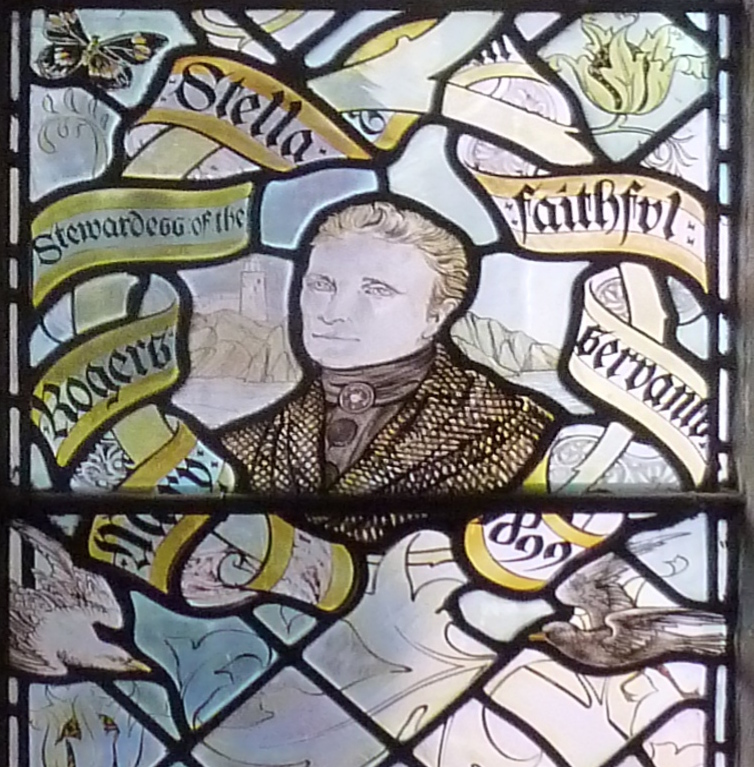
In Liverpool Cathedral, Mary Ann Rogers is one of eight women commemorated in a stained glass window in the Staircase Window of the Lady Chapel. The other seven women are Anne Cecile, Grace Darling, Agnes Jones, Anna Hinderer, Alice Marvel, Louisa Stewart and Kitty Wilkinson.
London
Mary Ann Rogers is commemorated on the "Memorial to Heroic Self Sacrifice" in Postman's Park, London.
Southampton
The Stella Memorial in Southampton commemorates the shipwreck, and particularly the actions of Mary Ann Rogers. The memorial was paid for by public subscription. Amongst the subscribers were Lady Montagu of Beaulieu, Earl Grey and the Duke of Westminster. A total of £570 was raised, of which £250 went to Mary Ann Rogers' family and the rest was spent on the memorial.
References
References
- "Stella". Caledonian Maritime Research Trust.
- (1897). "Lloyd's Register of British and Foreign Shipping". [[Lloyd's Register]].
- and gave her a speed of {{convert. 19+1/2. kn
- Simpkin, Jake. "S.S. Stella Disaster".
- "Stella". Simplon Postcards.
- (1 April 1899). "Disaster in the Channel".
- McGonagall, William. (1899). "The Wreck of the Steamer ''Stella''". McGonagall Online.
- "The Stella". Dive Guernsey.
- (1899). "BOT Wreck Report for 'Stella'". Port Cities Southampton.
- "The Wreck of the Stella - Titanic of the Channel Islands". Guernsey Museums & Galleries.
- "Stamp Issue Feb 2019". Guernsey Post.
This article was imported from Wikipedia and is available under the Creative Commons Attribution-ShareAlike 4.0 License. Content has been adapted to SurfDoc format. Original contributors can be found on the article history page.
Ask Mako anything about SS Stella (1890) — get instant answers, deeper analysis, and related topics.
Research with MakoFree with your Surf account
Create a free account to save articles, ask Mako questions, and organize your research.
Sign up freeThis content may have been generated or modified by AI. CloudSurf Software LLC is not responsible for the accuracy, completeness, or reliability of AI-generated content. Always verify important information from primary sources.
Report