From Surf Wiki (app.surf) — the open knowledge base
Sri Lankan Tamil nationalism
Ideology of Sri Lankan Tamil people

Ideology of Sri Lankan Tamil people
Sri Lankan Tamil nationalism is the conviction of the Sri Lankan Tamil people, a minority ethnic group in the South Asian island country of Sri Lanka (formerly known as Ceylon), that they have the right to constitute an independent or autonomous political community. This idea has not always existed. Sri Lankan Tamil national awareness began during the era of British rule during the nineteenth century, as Tamil Hindu revivalists tried to counter Protestant missionary activity. The revivalists, led by Arumuga Navalar, used literacy as a tool to spread Hinduism and its principles.
The reformed legislative council, introduced in 1921 by the British, was based on principles of communal representation, which led the Tamils to realize that they were the minority ethnic group and that they should be represented by a member of their own community. It was under this communal representation that Tamil national awareness changed to national consciousness—a less passive state. They formed a Tamil political party called the All Ceylon Tamil Congress (ACTC). In the years leading to Sri Lankan independence, political tension began to develop between the majority Sinhalese and minority Tamil communities as the ACTC, citing the possibility of the majority Sinhalese adopting a dominant posture, pushed for "fifty-fifty" representation in parliament. This policy would allot half the seats in parliament to the Sinhalese majority and half to the minority communities: Ceylon Tamils, Indian Tamils, Muslims and others.
After Sri Lanka achieved independence in 1948, the ACTC decided to merge with the ruling United National Party (UNP). This move was not supported by half of the ACTC members and resulted in a split—one half of the party decided to merge with the UNP and the other half decided to leave the party altogether, forming a new Tamil party in 1949, the Federal party. Policies adopted by successive Sinhalese governments, and the 1956 success of the Sinhalese Nationalist government under Solomon Bandaranaike, made the Federal Party the main voice of Tamil politics. Increased racial and political tension between the two communities led to the merger of all Tamil political parties into the Tamil United Liberation Front. This was followed by the emergence of a militant, armed form of Tamil nationalism.
Before independence
Early beginning
The arrival of Protestant missionaries on a large scale to Sri Lanka (then called Ceylon), beginning in 1814, was a primary contributor to the development of political awareness among Tamils.-- This revival movement also set the stage for modern Tamil prose.
The success of this effort led the Tamils to think confidently of themselves as a community and prepared the way for their awareness of a common cultural, religious and linguistic kinship in the mid-nineteenth century.{{cite journal
Communal Consciousness
Great Britain controlled the whole island by 1815, and unified the country administratively in 1833 with a legislative council that acted as advisor to the Governor. The council was composed of three Europeans and one representative each of the Sinhalese, the Sri Lankan Tamils, and the Burghers.{{cite journal
Development
Historic changes occurred in 1931: the reformed legislative council was eliminated, and the Donoughmore Commission, which rejected communal representation, was formed. Instead, the Commission introduced universal franchise, in which representation was proportionate to percentage of population. The Tamil leadership strongly opposed this plan, realizing that they would be reduced to a minority in parliament. Many Sinhalese were also against the idea of universal franchise for all castes. G.G. Ponnambalam publicly protested the Donooughmore Commission and proposed to the Soulbury Commission, which had replaced the Donooughmore Commission, that roughly equal numbers of congressional seats be assigned to Tamils and to Sinhalese in the new independent Ceylon being planned, but his proposal was rejected. From the introduction of the advisory council, through the Donoughmore Commission in 1931, to the Soulbury Commission in 1947, the primary dispute between the elite of the Sinhalese and Tamils was over the question of representation, not the structure of the government. This issue of power-sharing was used by the nationalists of both communities to create an escalating inter-ethnic rivalry which has been gaining momentum ever since.
Ponnambalam's advocacy of Tamil nationalism was paralleled by a similar Sinhalese nationalism of Sinhala Maha Sabha, led by future Prime Minister Solomon Bandaranaike. This created tension between the two leaders and caused the exchange of verbal attacks, with Ponnambalam calling himself a "proud Dravidian". This interethnic and political stress led to the first Sinhalese-Tamil riot in 1939.(see Riots and pogroms in Sri Lanka)
After independence
All Ceylon Tamil Congress
Later the ACTC decided to adopt a new policy: "responsive cooperation" with "progressive-minded Sinhalese". Yet in 1948, Ponnampalam decided to merge the ACTC with the ruling United National Party (UNP), although he had stated earlier that the UNP was not progressive-minded. The merge was not supported by the entire party, and it ended up splitting the ACTC in half, with one faction merging with D.S. Senanayake's UNP and the other, led by S.J.V. Chelvanayakam, deciding to leave the party altogether and advocated for equal rights, 100% opportunities for Tamils without any racial barrier. In 1948, Ponnampalam voted in favour of one of several bills, later known as the Ceylon Citizenship Act which disenfranchised Indian Tamils ("Hill Country Tamils"). Although he did not vote for the other bills in the Ceylon Citizenship Act, because of his silence in parliament the Tamil public believed that he was not committed to Indian Tamil rights. The ACTC remained the major Tamil political party until 1956, when the Federal Party took over that position.{{cite journal
Federal Party
In 1949, a new Tamil party, called the Federal Party ("Ilankai Thamil Arasu Kadchi"), was organized by the people who broke away from the ACTC. Led by Chelvanayakam, it gained popularity among the Tamil people because it advocated Tamil rights. Its popularity was also due to the party's opposition to the Ceylon Citizenship Act and the Sinhala Only Act.{{cite journal It was against this backdrop that the Bandaranaike-Chelvanayakam Pact was signed in July 1957, but pressure from the opposition and extremist groups forced Bandaranaike to abolish the pact. After the assassination of Bandaranaike, another pact was signed in 1965 between Chelvanayakam and Dudley Senenayake called the Dudley-Chelvanayakam Pact, but this agreement, like the Bandaranaike-Chelvanayakam pact, was never implemented. The UNP was defeated in the 1970 election and replaced by the United Front (UF), led by Sirimavo Bandaranaike, the widow of Solomon Bandaranaike.
The new government adopted two new policies that discriminated against the Tamil people. First, the government introduced a double standard for admission grades to universities, requiring the Tamil students to achieve higher grades than the Sinhalese students.{{cite journal
Tamil United Liberation Front
The Tamil United Liberation Front (TULF) was formed when the Tamil political parties merged and adopted the Vaddukoddai Resolution, named after the village, Vaddukoddai, where it was developed. In the 1977 election, TULF became the first Tamil Nationalist party to run on a separatist platform. It gained a majority of the votes in the north and east, won 18 seats, and became the largest opposition party in parliament. The Vaddukoddai Resolution had a profound effect on Tamil politics—the parliamentary system was soon to be replaced by guns. TULF tried to refashion itself as the political division, negotiating an agreement with the executive president of Sri Lanka at that time, J.R. Jayewardene. This agreement, known as the District Development Councils’ Scheme, was passed in 1980, but TULF rejected it because J.R. Jayewardene had not agreed to let TULF have the five District Ministerships in the five Tamil districts where TULF received the most votes. The Sixth Amendment was passed in 1983, requiring Tamils in parliament and other public offices to take an oath of allegiance to the unified state of Sri Lanka. It forbade the advocating of a separate state, and consequently TULF members were expelled from parliament for refusing to take the oath.
Militant groups
Main article: Sri Lankan Tamil militant groups, List of Sri Lankan Tamil militant groups
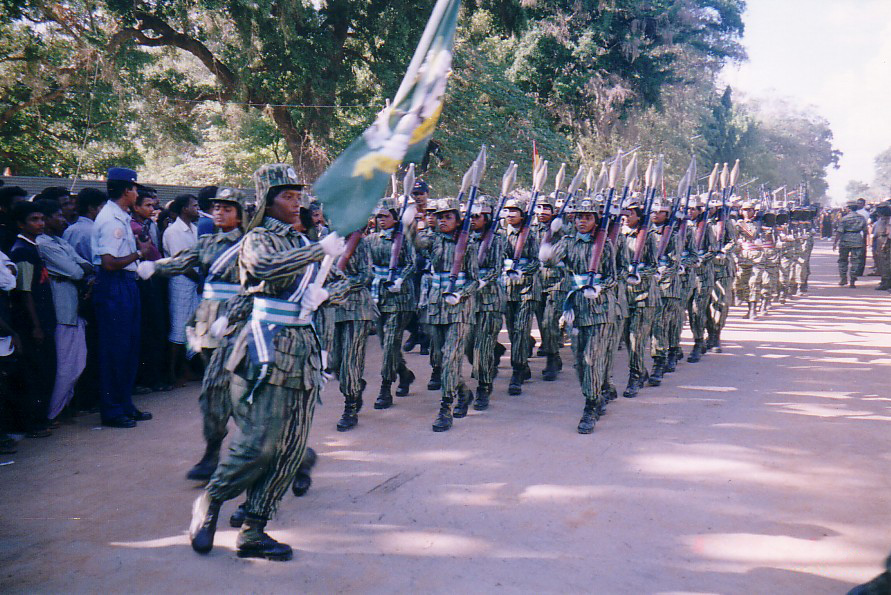
Of these five dominant groups, the LTTE was the most solidly nationalistic Tamil resistance organization. Furthermore, because of its policies, constructive Tamil Nationalist platform, and desire for national self-determination, the LTTE was supported by major sections of the Tamil community. It had established a de facto state in the areas under its control, called Tamil Eelam, and had managed a government in these areas, providing state functions such as courts, a police force, a human rights organization, and a humanitarian assistance board.{{cite journal
Notes
References
References
- Russell, J.. (1982). "Communal politics under the Donoughmore Constitution". Tissara Publishers.
- Wilson, A.J.. (1994). "S.J.V. Chelvanayagam and the Crisis of Sri Lankan Nationalism 1947–1977". Hurst & Co.
- Roberts, Michael. (2004). "Essay". Journal of South Asian Studies.
- The activities of missionaries from the [[American Board of Commissioners for Foreign Missions]], [[Methodists]] and [[Anglican]] churches led to a revival among Tamils of the Hindu faith. Arumuga Navalar led a Hindu religious revivalist and reformist movement as a defensive response to the threat to their native culture posed by the British colonial and missionary activities. He translated literary works to encourage the use of the Tamil Language and spread Hindu [[Saiva]] principles. Navalar's efforts to revive Hinduism, the predominant religion of the Sri Lankan Tamil people, influenced Tamils who built their own schools, temples, and societies, and who published literature to counter that of the missionaries. Thus, by 1925 nearly 50 schools, including the [[Batticotta Seminary]], were fully functioning.<!-- cannot find this reference C. D. Vellupillai, "History of the American Ceylon Mission", Jaffna 1932, Ch. 1
- Russell, J.. (1982). "Communal Politics under the Donoughmore Commission, 1831–1947". Tissara Publishers.
- Russell, J.. (1982). "Communal politics under the Donoughmore Constitution". Tissara Publishers.
- Gunasingam, Murugar. (1999). "Sri Lankan Tamil nationalism: A study of its origins". MV Publications.
- Wilson, A.J.. (2000). "Sri Lankan Tamil Nationalism: Its Origins and Development in the Nineteenth and Twentieth Centuries". University of British Columbia Press.
- De Silva, K.M.De Silva. (2005). "A History of Sri Lanka". Penguin.
- De Silva, K.M.. (1972). "The Ceylon National Congress in Disarray, 1920–1921". Ceylon Journal of Historical and Social Studies.
- Gunasingham, M.. (1999). "Sri Lankan Tamil nationalism: A study of its origins". MV Publications.
- [[Hansard]], 1935, Col. 3045
- Full report in the "Hindu organ", 12 June 1939
- The ACTC advocated a "fifty-fifty" policy, in which fifty percent of the seats in parliament would be reserved for Tamils and other minorities, the remaining fifty percent going to the Sinhalese. Which means 50% of the opportunities [education (university seats), employment, etc.) should be allocated to minorities. According to the ACTC this was a necessary defensive measure to prevent unwarranted dominance by the Sinhalese. In 1947, Ponnambalam warned the Soulbury Commission about this potential problem, and presented the ACTC's solution, which he called a "balanced representation". This fifty-fifty policy was opposed by a Muslim minority and sections of the Tamil community. [[D. S. Senanayake]], the leader of the Sinhalese political groups, allowed Ponnambalam full control over presentations before the Soulbury Commission, prevented Sinhalese nationalists such as Solomon Bandaranaike from taking the stage, and avoided the eruption of acrimonious arguments. But the Soulbury commission rejected the charges of discrimination against the Tamils, and also rejected the fifty-fifty formula as subverting democracy.Report of the Soulbury Commission, London (1965)
- Tambiah, S.J.. (1986). "Sri Lanka: Ethnic Fratricide and the Dismantling of Democracy". IB Tauris & Co Ltd.
- Russell R. Ross. "Tamil Alienation". Library of Congress.
- DBS Jeyaraj. "TULF leader passes away". Hindu News.
- Wilson, A.J.. (1988). "The Break-up of Sri Lanka: The Sinhalese-Tamil Conflict". C. Hurst & Co. Publishers.
- Wilson, A.J.. (2000). "Sri Lankan Tamil Nationalism:Its Origins and Development in the Nineteenth and Twentieth Centuries". C. Hurst & Co. Publishers.
This article was imported from Wikipedia and is available under the Creative Commons Attribution-ShareAlike 4.0 License. Content has been adapted to SurfDoc format. Original contributors can be found on the article history page.
Ask Mako anything about Sri Lankan Tamil nationalism — get instant answers, deeper analysis, and related topics.
Research with MakoFree with your Surf account
Create a free account to save articles, ask Mako questions, and organize your research.
Sign up freeThis content may have been generated or modified by AI. CloudSurf Software LLC is not responsible for the accuracy, completeness, or reliability of AI-generated content. Always verify important information from primary sources.
Report