From Surf Wiki (app.surf) — the open knowledge base
Sremski Karlovci
Settlement in Serbia
.jpg)
Settlement in Serbia
| Field | Value |
|---|---|
| native_name | sr-Cyrl |
| native_name_lang | sr |
| official_name | Sremski Karlovci |
| settlement_type | Town and municipality |
| image_shield | COA Sremski Karlovci.png |
| image_skyline | {{multiple image |
| border | infobox |
| perrow | 1/2/3/2/2 |
| total_width | 260 |
| align | center |
| caption_align | center |
| image1 | Vidikovac Sremski Karlovci 8295 10.jpg |
| caption1 | Panorama of Sremski Karlovci |
| image2 | Magistrat - panoramio (3).jpg |
| caption2 | Sremski Karlovci City Hall |
| image3 | Patriarchate Court in Sremski Karlovci 04.jpg |
| caption3 | Palace of the Patriarchate |
| image4 | Saborna crkva - panoramio (1).jpg |
| caption4 | Cathedral of St. Nicholas |
| image5 | Rimokatolička crkva Sv. Trojstva (Sremski Karlovci) 8230 05.jpg |
| caption5 | Church of the Holy Trinity |
| image6 | Church of the Blessed Virgin Mary in Banstol 08.jpg |
| caption6 | Church of the Blessed Virgin Mary |
| image7 | Karlovačka gimnazija 15.7.2018 013.jpg |
| caption7 | Karlovci Gymnasium |
| image8 | Karlovačka bogoslovija Sv. Arsenije 8284.jpg |
| caption8 | Clerical High School of Saint Arsenije |
| image9 | Сремски Карловци.JPG |
| caption9 | Four Lions Fountain |
| image10 | Kapela mira 8380 35.jpg |
| caption10 | Chapel of Peace |
| image_map | Municipalities of Serbia Sremski Karlovci.png |
| map_caption | Location of the municipality of Sremski Karlovci within Serbia |
| coordinates | |
| subdivision_type | Country |
| subdivision_name | Serbia |
| subdivision_type1 | Province |
| subdivision_name1 | Vojvodina |
| subdivision_type2 | Region |
| subdivision_name2 | Syrmia |
| subdivision_type3 | District |
| subdivision_name3 | South Bačka |
| subdivision_type4 | Municipality |
| subdivision_name4 | Sremski Karlovci |
| parts_type | Settlements |
| parts_style | para |
| p1 | 1 |
| leader_party | SNS |
| leader_title | Mayor |
| leader_name | Dražen Đurđić |
| area_blank1_title | Municipality |
| area_blank1_km2 | 49.76 |
| area_footnotes | |
| elevation_m | 87 |
| population_footnotes | |
| population_as_of | 2022 census |
| population_blank1_title | Town |
| population_blank1 | 7872 |
| population_blank2_title | Municipality |
| population_blank2 | 7872 |
| population_density_blank1_km2 | auto |
| timezone | CET |
| utc_offset | +1 |
| timezone_DST | CEST |
| utc_offset_DST | +2 |
| postal_code_type | Postal code |
| postal_code | 21205 |
| area_code_type | Area code |
| area_code | +381(0)21 |
| blank_name | Car plates |
| blank_info | NS |
| website |
Sremski Karlovci (Сремски Карловци, ) is a town and municipality located in the South Bačka District of the autonomous province of Vojvodina, Serbia. It is situated on the banks of the Danube, 8 km from Novi Sad. According to the 2022 census results, it has a population of 7,872 inhabitants. The town has traditionally been known as the seat of the Serbian Orthodox Church in the Habsburg Monarchy. It was the political and cultural capital of Serbian Vojvodina after the May Assembly and during the Revolution in 1848.
Name
In Serbian, the town is known as Sremski Karlovci (Сремски Карловци), in Croatian as Srijemski Karlovci, in German as Karlowitz or Carlowitz, in Hungarian as Karlóca, in Polish as Karłowice, in Romanian as Carloviț and in Turkish as Karlofça. The former Serbian name used for the town was Karlovci (Карловци), which is also used today, albeit unofficially. The name of the town in Serbian is plural.
Geography
The town is situated along the Danube River, about 12 km from Novi Sad and 75 km from Belgrade, in the geographical region of Syrmia. The town of Sremski Karlovci is the only settlement in the municipality.
History
Ancient, medieval and early modern history
In ancient times, the Romans maintained a small fortress at this location. The town was first mentioned in historical documents in 1308 with the name Karom. The medieval fortress of Karom was built on the ruins of the ancient Roman one. Until 1521, Karom was a possession of Hungarian noble families, of whom the most well known were Báthory and Morović.
In 1521, Turkish military commander Bali-beg conquered Karom under the Ottoman Empire's invasion of Europe. During the next 170 years, the town was part of the Ottoman Empire. The Slavic name for the town – Karlovci, was first recorded in 1532/33. During Ottoman rule, the town was still predominately Serbian in ethnicity, with the smaller part of population composed of Muslims. According to the Ottoman defterler from 1545, the population of Karlovci numbered 547 Christian (Serb) houses. The city also had three Orthodox churches and a monastery. From 1557, it belonged to Eparchy of Belgrade and Srem of the Serbian Patriarchate of Peć.
Habsburg Monarchy
Between 16 November 1698 and 26 January 1699, the town of Karlovci was the site of a congress that ended the hostilities between the Ottoman Empire and the Holy League, a coalition of various European powers including Habsburg monarchy, Poland, Venice and Russia. The congress produced the Treaty of Karlowitz. It was the first time a round table was used in international politics.
After this peace treaty, the town was considered part of the Habsburg monarchy and was included in its Military Frontier. According to 1702 data, the population was composed of 215 Orthodox and 13 Catholic houses. By 1753, the population of the town numbered 3,843 people, of which 3,110 were classified as ethnic Serbs.
The town was the spiritual, political and cultural center of the Serbs in the Habsburg Monarchy. The Metropolitan of the Serbian Orthodox Church resided here. In the early 21st century, the Serbian Patriarch retains the title of Metropolitan of Karlovci.
The town had the earliest Serb (and Slavic in general) gymnasium (Serbian: gimnazija/гимназија, French: lycée), founded on 3 August 1791. Three years after this, the Orthodox seminary of Sremski Karlovci was founded here. It was the second-oldest Orthodox seminary in the world (after the Spiritual Academy in Kyiv), and it still operates.


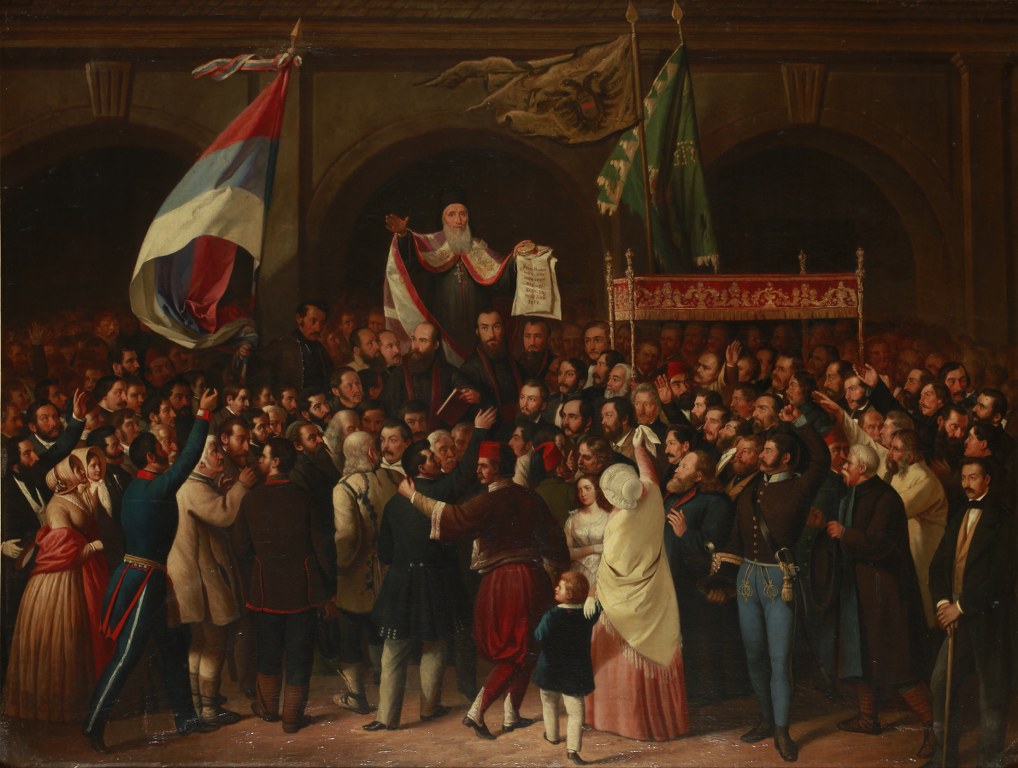
At the Serb National Assembly in Karlovci in May 1848, Serbs declared the unification of the regions of Srem, Banat, Bačka, and Baranja (including parts of the Military Frontier) into the province of Serbian Vojvodina. In the late 18th century, the Habsburg monarchy had invited numerous settlers from Bavaria and southern Germany into some of these regions along the Danube, in order to repopulate the area and re-establish agriculture after the effects of the Ottoman invasion and disease. The Germans, who became known as Danube-Swabians, were allowed to keep their language and Catholic religion. For more than a century, they had fairly autonomous settlements.
The first capital of Serbian Vojvodina was in Karlovci; it was later moved to Zemun, Veliki Bečkerek, and Temišvar. At the same time the title of the Orthodox Metropolitan of Karlovci was raised to that of Patriarch.
When Serbian Vojvodina was in 1849 organized as the new province named Voivodeship of Serbia and Banat of Temeschwar, the town of Karlovci was not included into this province. It was returned to the administration of the Military Frontier (a Petrovaradin regiment that was part of Slavonian Krajina). With the abolition in 1881 of the Military Frontier, the town was included in Syrmia County of Croatia-Slavonia, the autonomous kingdom within Kingdom of Hungary and Austria-Hungary.
An Orthodox Patriarchate of Karlovci operated after 1848 in Karlovci until 1920, after World War I. At that time, the position was joined with the Metropolitanate of Belgrade to form the united Serbian Orthodox Church, in what was then the Kingdom of Yugoslavia.
Between 1921 and 1944 the Palace of the Patriarchate was the seat of the administration of the Russian Orthodox Church Outside Russia.
Yugoslavia and Serbia (1918–onward)
In 1918, the town became part of the Kingdom of Serbs, Croats and Slovenes (also known as the Kingdom of Yugoslavia). In the summer of 1921, the town's former Palace of the Patriarchate was used as the residence of Russian metropolitan Antony (Khrapovitsky). Together with some refugee bishops from Russia, he organised what a few years later was instituted as the Holy Synod of the Russian Orthodox Church Outside Russia (ROCOR). (Some critics called this ecclesiastical body the Karlovatsky Synod (), or ″Karlovatsky group″, also known in English as Synod of Karlovci.)
In 1922, the town became the headquarters of Russian White émigrés under the leadership of General Pyotr Nikolayevich Wrangel. In 1924 he set up the Russian All-Military Union, designed to include all Russian military émigrés the world over. Many emigres went to western Europe, especially France, and to the United States. A monument to Wrangel, sculpted by Vasiliy Azemsha, was unveiled in September 2007 in Karlovci.
Between 1929 and 1941, the town was part of Danube Banovina, a province of the Kingdom of Yugoslavia. During World War II (1941–1944), after Nazi Germany's invasion of eastern Europe, the town was occupied by forces of the Axis powers. It was attached to the Independent State of Croatia. During that time its name was changed to Hrvatski Karlovci. After the end of the war, most ethnic Germans were expelled from eastern Europe.
Between 1980 and 1989, Sremski Karlovci was one of the seven municipalities of the city of Novi Sad.
In January 2021 PM Igor Mirović announced a reconstruction of the facades of historically important buildings in Sremski Karlovci.
Demographics

|1948|5350 |1953|5618 |1961|6390 |1971|7040 |1981|7547 |1991|7534 |2002|8839 |2011|8750 |2022|7872 According to the 2011 census, the municipality of Sremski Karlovci has 8,750 inhabitants.
Ethnic composition of the municipality of Sremski Karlovci:
| Ethnic group | Population | % |
|---|---|---|
| Serbs | 6,820 | 77.94% |
| Croats | 576 | 6.58% |
| Hungarians | 182 | 2.08% |
| Yugoslavs | 71 | 0.81% |
| Germans | 63 | 0.72% |
| Montenegrins | 41 | 0.47% |
| Slovaks | 29 | 0.33% |
| Macedonians | 25 | 0.29% |
| Rusyns | 16 | 0.18% |
| Slovenes | 15 | 0.17% |
| Romani | 14 | 0.16% |
| Russians | 11 | 0.13% |
| Others | 969 | 11.07% |
| Total | 8,750 |
Economy

.jpg)
The following table gives a preview of total number of employed people per their core activity (as of 2017):
| Activity | Total |
|---|---|
| Agriculture, forestry and fishing | 11 |
| Mining | 4 |
| Processing industry | 282 |
| Distribution of power, gas and water | 1 |
| Distribution of water and water waste management | 39 |
| Construction | 27 |
| Wholesale and retail, repair | 222 |
| Traffic, storage and communication | 71 |
| Hotels and restaurants | 125 |
| Media and telecommunications | 23 |
| Finance and insurance | 8 |
| Property stock and charter | 2 |
| Professional, scientific, innovative and technical activities | 31 |
| Administrative and other services | 92 |
| Administration and social assurance | 220 |
| Education | 284 |
| Healthcare and social work | 18 |
| Art, leisure and recreation | 14 |
| Other services | 66 |
| Total | 1,537 |
Politics
Until 1989 Sremski Karlovci formed one of the urban municipalities of the city of Novi Sad. After Novi Sad merged six of its municipalities into one Novi Sad municipality, the municipality of Sremski Karlovci held a referendum to separate from Novi Sad, and established a separate municipality independent from Novi Sad. Although Sremski Karlovci lies in Syrmia region, the municipality belongs in South Bačka District, and not in the Syrmia District, because of its close proximity to Novi Sad.
In the Serbian local elections held on 24 April 2016, Sremski Karlovci elected a new municipality parliament, ending the rule of the DS in the town. Nenad Milenković, of the Serbian progressive Party, was elected as the new mayor of the municipal parliament.
Schools
- Gymnasium of Karlovci
- Clerical High School of Saint Arsenije
- Faculty of management
- College of Applied Studies in Management and Business Communication
Buildings and structures
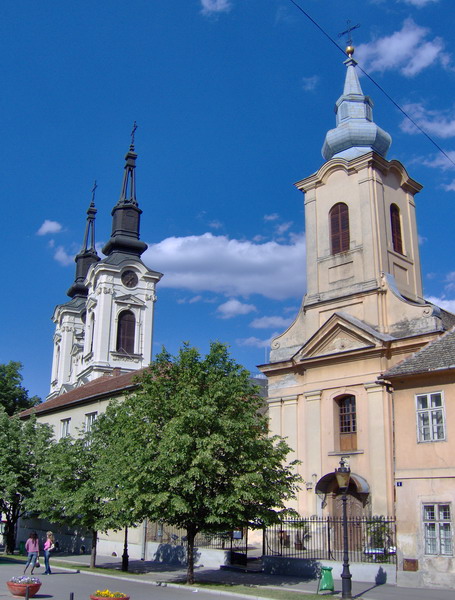


- Educational historical buildings:
- Gymnasium of Karlovci, first Serbian secondary school (gymnasium)
- Clerical High School of Saint Arsenije
- Administrative buildings:
- Sremski Karlovci City Hall
- Religious buildings
- The Patriarchal Court
- The Orthodox Cathedral of Saint Nicholas
- The Roman Catholic Church of the Holy Trinity
- Other buildings
- Fountain "Four Lions"
- The Chapel of Peace, Sremski Karlovci
- Archives of Sremski Karlovci
International relations
Twin towns – sister cities
Sremski Karlovci is twinned with:
- SVK Bardejov, Slovakia
- MKD Karpoš, North Macedonia
- BIH Prnjavor, Bosnia and Herzegovina
- MNE Tivat, Montenegro (2007)
- RUS Kyakhta, Russia (2025)
Gallery
File:Karlovačka gimnazija 15.7.2018 013.jpg|Gymnasium of Karlovci File:The Orthodox Cathedral of St. Nicholas.jpg|Sremski Karlovci Orthodox Cathedral File:RS-NS-SK-Karlóca014.JPG|Clerical High School of Saint Arsenije File:Градска скупштина у Сремским Карловцима.jpg|City assembly building File:Kuća Sabov Dejanović u Sremskim Karlovcima.jpg|Sabov-Dejanović's rococo house, 1790 File:SremskiKarlovciPlatan1.JPG|An old Platanus, monument of nature protected by the state, in front of a church File:Museum of Sremski Karlovci 01.jpg|City museum File:Muzej pčelarstva, Sremski Karlovci 09.jpg|Museum of beekeeping File:Muzej Podunavskih Švaba 8.8.2018 141.jpg|Museum of Danube Swabians File:Hotel Prezident 8.8.2018 052.jpg|A hotel in the centre File:RS-NS-SK-Karlóca001.JPG|Faculty of management File:Frontal view of Eco-center "Radulovački".jpg|Ecological center Miodrag Radulovacki File:Vidikovac Sremski Karlovci 8295 13.jpg|Monument dedicated to Duško Trifunović and viewpoint of Karlovci
Notes
References
- Milorad Grujić, Vodič kroz Novi Sad i okolinu, Novi Sad, 2004.
- Slobodan Ćurčić, Broj stanovnika Vojvodine, Novi Sad, 1996.
References
- {{Serbian municipalities 2006
- "Насеља општине Сремски Карловци". Statistical Office of Serbia.
- "Census 2022: Total population, by municipalities and cities".
- [https://www.britannica.com/topic/Synod-of-Karlovci "Synod of Karlovci"], ''[[Encyclopedia Britannica]]'' online
- [https://encyclopedia.1914-1918-online.net/article/wrangel_petr_nikolaevich_baron "Wrangel, Petr Nikolaevich, Baron"], Encyclopedia 1914-1918
- [http://www.politika.rs/scc/clanak/4102/Споменик-белом-барону Споменик белом барону] ''[[Politika]]'', 13 September 2007.
- (26 November 2019). "Sremski Karlovci obeležili 30 godina od ponovnog uspostavljanja samostalnosti".
- Vojvodine, Javna medijska ustanova JMU Radio-televizija. "Mirović: Sačuvaćemo kulturno-istorijski značaj Sremskih Karlovaca".
- "2011 Census of Population, Households and Dwellings in the Republic of Serbia". Statistical Office of the Republic of Serbia.
- "Попис становништва, домаћинстава и станова 2011. у Републици Србији". Republički zavod za statistiku.
- "ОПШТИНЕ И РЕГИОНИ У РЕПУБЛИЦИ СРБИЈИ, 2018.". [[Statistical Office of the Republic of Serbia]].
- (26 September 2016). "The people of Tiv visited the sister municipality in Vojvodina".
- "Fakultet za menadžment".
- "Visoka škola za menadžment i poslovne komunikacije".
- "Градови побратими". Sremski Karlovci.
- "Сремски Карловци се побратимили са руским Кјахтом – два града веже иста историјска личност".
This article was imported from Wikipedia and is available under the Creative Commons Attribution-ShareAlike 4.0 License. Content has been adapted to SurfDoc format. Original contributors can be found on the article history page.
Ask Mako anything about Sremski Karlovci — get instant answers, deeper analysis, and related topics.
Research with MakoFree with your Surf account
Create a free account to save articles, ask Mako questions, and organize your research.
Sign up freeThis content may have been generated or modified by AI. CloudSurf Software LLC is not responsible for the accuracy, completeness, or reliability of AI-generated content. Always verify important information from primary sources.
Report