From Surf Wiki (app.surf) — the open knowledge base
Square thread form
Screw thread profile with a square cross-section
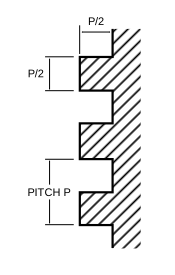
Screw thread profile with a square cross-section
The square thread form is a common screw thread profile, used in high load applications such as leadscrews and jackscrews. It gets its name from the square cross-section of the thread. It is the lowest friction and most efficient thread form, but it is difficult to fabricate.
Advantages & disadvantages
The greatest advantage of square threads is that they have a much higher intrinsic efficiency than trapezoidal threads (Acme or metric trapezoidal). Due to the lack of a thread angle there is no radial pressure, or bursting pressure, on the nut. This also increases the nut life.
The greatest disadvantage is the difficulty in machining such a thread. The single-point cutting tools or taps and dies used to cut the thread cannot have efficient rake and relief angles (because of the square form), which makes the cutting slow and difficult. Square threads also cannot carry as much load as a trapezoidal thread, because the root of the square thread is smaller. Also, there is no way to compensate for wear on the nut, so it must be replaced when worn out.
Classification
Square threads are defined as follows by ISO standards:
:Sq,60 \times 9
where Sq designates a square thread, 60 is the nominal diameter in millimeters, and 9 is the pitch in millimeters. When there is no suffix it is a single start thread. If there is a suffix then the value after the multiplication sign is the lead and the value in the parentheses is the pitch. For example:
:Sq,60 \times 18 (P9) LH
would denoted two starts, as the lead divided by the pitch is two. The "LH" denotes a left hand thread.
| Nominal diameter [mm] | Pitch [mm] |
|---|---|
| 22, 24, 26, 28 | 5 |
| 30, 32, 36 | 6 |
| 40, 44 | 7 |
| 48, 50, 52 | 8 |
| 55, 60 | 9 |
| 65, 70, 75, 80 | 10 |
| 85, 90, 95, 100 | 12 |
Mechanics
Main article: Leadscrew#Mechanics
References
Notes
Bibliography
- .
References
- Bhandari, p. 203.
- Bhandari, p. 205.
This article was imported from Wikipedia and is available under the Creative Commons Attribution-ShareAlike 4.0 License. Content has been adapted to SurfDoc format. Original contributors can be found on the article history page.
Ask Mako anything about Square thread form — get instant answers, deeper analysis, and related topics.
Research with MakoFree with your Surf account
Create a free account to save articles, ask Mako questions, and organize your research.
Sign up freeThis content may have been generated or modified by AI. CloudSurf Software LLC is not responsible for the accuracy, completeness, or reliability of AI-generated content. Always verify important information from primary sources.
Report