From Surf Wiki (app.surf) — the open knowledge base
Sprengel's deformity
Congenital abnormality involving a single higher shoulder blade

Congenital abnormality involving a single higher shoulder blade
| Field | Value |
|---|---|
| name | Sprengel's deformity |
| image | Sprengel's_deformity.png |
| caption | Sprengel's deformity, showing a higher right-sided shoulder blade |
| synonyms | Sprengel deformity, Sprengel's shoulder, Sprengel shoulder, high scapula |
| types | Muscular forms |
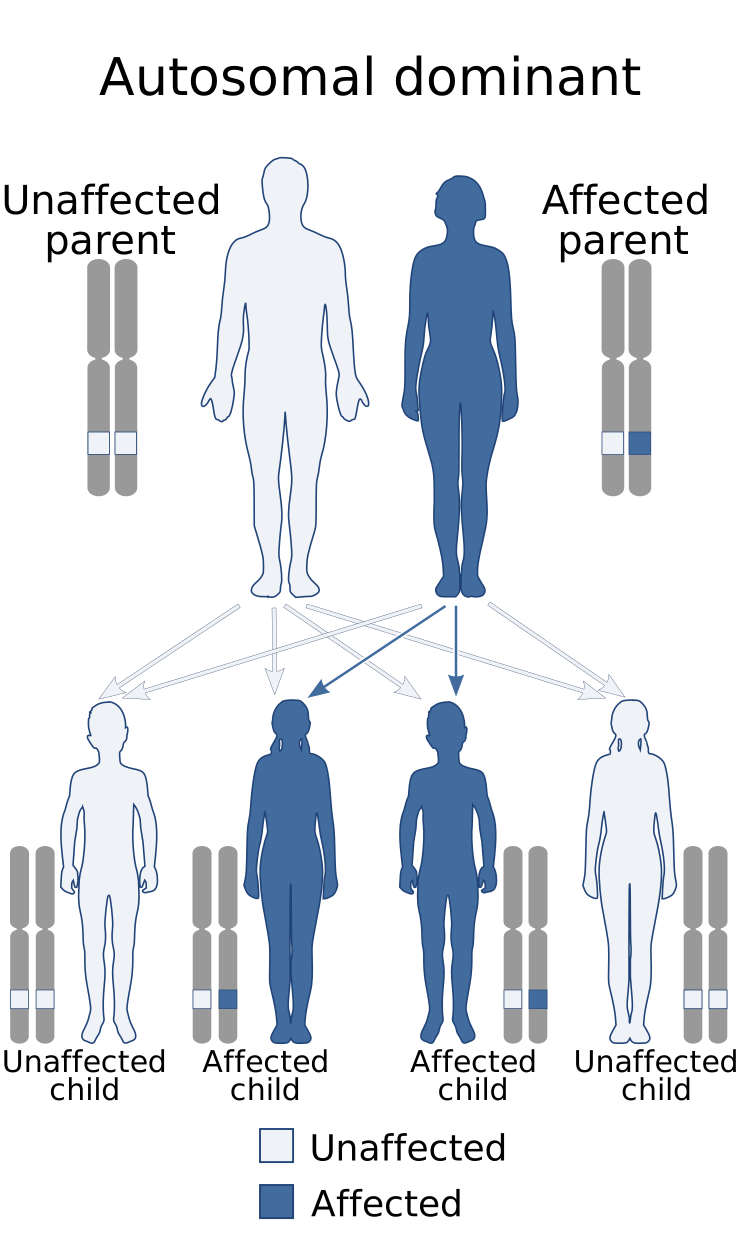
Sprengel's deformity (also known as high scapula, scapular hypoplasia, or congenital high scapula) is a rare congenital skeletal abnormality where a person has one shoulder blade that sits higher on the back than the other. The deformity is due to a failure in early fetal development where the shoulder fails to descend properly from the neck to its final position. Majority of the cases are sporadic with very few having autosomal dominant inheritance.
The deformity is associated with the following conditions:
- Klippel–Feil syndrome (most common)
- congenital scoliosis,
- hemivertebrae,
- cervical ribs,
- fused ribs,
- omovertebral connections which are fibrous, cartilaginous or bony connection between the superomedial angle of scapula with the spinous process, lamina or transverse process of cervical spine
- spina bifida,
- cleft palate.
The left shoulder is more commonly affected, but it can occur bilaterally as well.
About 75% of all observed cases are girls. Treatment includes surgery in early childhood and physical therapy. Surgical treatment in adulthood is complicated by the risk of nerve damage when removing the omovertebral bone and when stretching the muscle tissue during relocation of the shoulder.
Presentation
The scapula is small and rotated so that its inferior edge points toward the spine. Sometimes a bony connection is present between the elevated scapula and one of the cervical vertebrae, usually C5 or C6. This connection is known as an omovertebral bone.
There is a high correlation between Sprengel's deformity and Klippel–Feil syndrome.
Diagnosis
Diagnosis is clinical and can be confirmed by instrumental diagnostics like conventional radiography and CT scan. It may be indicated to perform a genetic analysis, as the deformity may occur under other conditions (see Klippel–Feil syndrome).
Eponym
It is named for German surgeon Otto Sprengel, who described it in 1891.
References
References
- "Sprengel deformity {{!}} Genetic and Rare Diseases Information Center (GARD) – an NCATS Program".
- {{WhoNamedIt. synd. 2450
- O. K. Sprengel. Die angeborene Verschiebung des Schulterblattes nach oben. Archiv für klinische Chirurgie, Berlin, 1891, 42: 545-549.
This article was imported from Wikipedia and is available under the Creative Commons Attribution-ShareAlike 4.0 License. Content has been adapted to SurfDoc format. Original contributors can be found on the article history page.
Ask Mako anything about Sprengel's deformity — get instant answers, deeper analysis, and related topics.
Research with MakoFree with your Surf account
Create a free account to save articles, ask Mako questions, and organize your research.
Sign up freeThis content may have been generated or modified by AI. CloudSurf Software LLC is not responsible for the accuracy, completeness, or reliability of AI-generated content. Always verify important information from primary sources.
Report