From Surf Wiki (app.surf) — the open knowledge base
Spotted gar
Species of fish

Species of fish
(Lepisosteus oculatus)
- ?Lepisosteus latirostris Girard, 1858
- Cylindostreus productus Cope, 1865
- Lepisosteus productus (Cope, 1865)
- Cylindrosteus agassizii Duméril, 1870
- Cylindrosteus bartonii Duméril, 1870
- Cylindrosteus zadockii Duméril, 1870
The spotted gar (Lepisosteus oculatus) is a freshwater fish native to North America that has an abundance of dark spots on its head, fins, and dart-like body. Spotted gar have an elongated mouth with many needle-like teeth to catch other fish and crustaceans. It is one of the smallest of the seven species of gar found in North America, growing 2–3 ft (0.61–0.91 m) in length and weighing 4–6 lb (1.8–2.7 kg) typically. Gars have diamond-shaped, thick, enamel (ganoid) scales. The name Lepisosteus is Greek for "bony scale".
Gars are almost never eaten in the central and northern United States. They have high levels of mercury and are considered a cancer risk.
Distribution and habitat
The spotted gar is native to North America and its current range is from southern Ontario to the west from the Devils River in Texas east to the northern coast of the Gulf of Mexico and southeast to the lower Apalachicola River in Florida. The gar population is small in the north and is being threatened in Lake Erie by the destruction of their habitat and pollution. The gar is more common in the southern waters like the Mississippi River basin from southern Minnesota to Alabama and western Florida. Historical records indicate the spotted gar resided in the Thames and Sydenham Rivers in Ontario, Canada. Also, the fish was once common in Illinois in the Green and Illinois Rivers to the swamps in Union County; though sporadic, the population has dwindled in these water systems because of the loss of specific habitat they need to live, clear pools with aquatic vegetation.
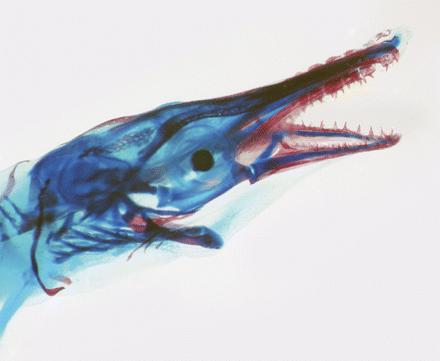
Habitats for spotted gar are clear, slow-moving, shallow waters of creeks, rivers, and lakes. It occasionally enters brackish or more salty waters. In response to the low oxygen levels created by slow-moving water, the gars have developed the ability to gulp air and send it to a primitive lung called a gas bladder.
In one study, most spotted gar were shoreline oriented, preferred submerged branches as cover, and avoided areas of exposed bank. During a flood pulse, a floodplain provides habitat for spawning and nursery habitat for gar eggs.

Ecology
The spotted gar is a voracious predator. Its sharp-toothed beak is very effective at catching fast moving prey. A diet study of the spotted gar reported the diet of a spotted gar consists of four species of fish; golden topminnow, warmouth, bluegill, and spotted sunfish, which adds to 18.1% of total food volume in the stomach, while 57.5% of the stomach content was shrimp. Other invertebrates filled the remaining 23.6% of the stomach. Gar are also known to eat insect larvae and algae.
Gar are a main predator in the aquatic food chain in lakes and rivers. In one example of a food chain herbivorous fish eat algae and are eaten by gar. Another food chain example is herbivorous invertebrates eat algae, are eaten by carnivorous fish, then the fish is eaten by the gar. Gar do not have many predators, only carnivorous fish would eat them, mainly at an early life stage. The fish would compete with other carnivorous fish such as the bowfin (Amia calva).
Movement rates were higher during the summer than during the fall and winter, and rates were greater at night than at dawn during both seasons. The temperature greatly affects their moving rates and their ability to range their home turf. When the water is warmer during the spring and summer, they travel more often than during the cold seasons. Spotted gars eat 70% of their food intake at night compared to dusk and dawn.
Abiotic factors that affect the spotted gar by humans include destruction of habitat and increased sedimentation in the water. In 2002, the Louisiana Department of Environmental Quality, Office of Water Resources, in coordination with the US Environmental Protection Agency, took fish tissue samples in the Lower Mississippi River to test for heavy metals and organic compounds. Spotted gar was found to be a cancer risk with high concentrations of heavy metals and organic compounds.
Life history
Spotted gar spawn in the spring in April, May, and June, or when the water temperature is between 21.0 and 26.0 °C (69.8 and 78.8 °F), depending on the location. Gar spawn in shallow water with abundant vegetation and cover. A female can have multiple mating partners and the female is usually larger than the male.
The female can lay up to about 20,000 eggs, but on average about 13,000 eggs are laid. They lay their eggs on leaves of aquatic plants. The eggs are green in color and have an adhesive coating to keep them attached to aquatic vegetation. They are highly toxic to prospective predators. After 10 to 14 days, the eggs hatch. At this stage, the gar are most vulnerable.
Males mature at the age of two or three, whereas females mature at three or four years old. The male's average lifespan is 8 years and the female's average lifespan is 10 years. Females have lower annual mortality rates. The maximum lifespan for a gar is around 18 years; however, Teri the spotted gar, of undetermined sex, lived at the Museum of Natural Sciences of the University of Saskatchewan for over 20 years.
Current management
Today, humans are affecting this fish species by destroying habitat and aquatic vegetation, and creating sedimentation in the waters of North America. Waste and chemical drainage into lakes and rivers causes chemical buildup and contamination of the water. Consequently, the water becomes murkier and causes predatory fish to have high mercury levels or accumulate carcinogenic compounds into their bodies. Spotted gar desire clear pools of water, and anthropogenic factors can decrease their survivability. This species is not on the U.S. Fish and Wildlife Service federally endangered species list, although in some northern states it is on special concern lists. In Canada, the fish is designated as threatened by the Committee on the Status of endangered wildlife in Canada. For Canadian waters the spotted gar is protected by the Species at Risk Act and the federal Fisheries Act. The Habitat Stewardship Program for Species at Risk works to protect the spotted gar and its habitat. Current management plans for spotted gar include: increasing water quality, minimizing or avoiding pollution, analyzing contaminated samples. The most important biological decline of the species is habitat destruction. This species should be monitored and managed by electroshocking. Electroshocking would be conducted in shallow areas of lakes and rivers where there is gar habitat. After shocking numerous places a population sample can be made and then biologists can base a management plan on the sample population of the certain water system. Population sampling could occur every few months or annually. Sampling to monitor the species could be to visually monitor. Be in a boat or on the shore and visually count the number of gar and observe their condition. Anglers could fill out surveys for how many spotted gars they have caught or for bow anglers to report how many spotted gars they shot each time. Underwater technology such as a camera could be used to look for spotted gar. Certain shallow areas could be outlawed for fishing and those areas could be sampled to compare the population to the fishing areas. Spotted gar has few predators therefore no invasive species are threatening the fish and need to be removed. When dealing with abiotic factors recommendations for spotted gar management would be to first know the factors that affect the gar and from there managers and environmentalists can set guidelines for the advantage of the species. Harbor improvements, filling, dredging and destruction of shoreline habitats negatively affect the fish and should be stopped. These actions result in habitat loss and could ultimately decrease the population after a few generations of repetitive negative activity. The water quality should have a designated quality level and biologists should check the levels often and address the issues if the level is low quality. Industrial corporations and pollution should be addressed and dumping chemicals, waste and organic compounds into the waters and environment should be monitored and stopped. Citizen who use lakes and rivers that gar are present in should be educated on their important role in the aquatic ecosystem and have a joint effort to help keep gar present for many generations to come. Research in main rivers should be conducted on gar tissue samples to test for contaminants. Spotted gar is not a popular game fishing species to anglers, but to bow fishers they are a prized species to shoot. Promoting gar fishing would help the conservation of the species. Increasing their popularity with anglers would help the fish to have a better environment because if anglers fish for them the anglers care about the habitat they flourish in and they will fight to protect it.--
References
References
- Collette, B.B.. (2019). "''Lepisosteus oculatus''".
- (2017). "Lepisosteidae".
- (11 November 2014). "Family-group names of Recent fishes". Zootaxa.
- Snedden, G. (1999). Diet and seasonal patterns of spotted gar movement and habitat use in the lower Atchafalaya River basin, Louisiana. ''Transactions of the American Fisheries Society.'' 128:144-154.
- Hunt, Burton. (1953). Food Relationships Between Florida Spotted Gar and Other Organisms in the Tamiami Canal, Dade County, Florida. ''Transactions of the American Fisheries Society''. 82:13-33.
- Watanabe, Karen. 2003. "Fish tissue quality in the lower Mississippi River and health risks from fish consumption." ''Science of the Total Environment''. 302.1-3:109-126.
- Alfaro RM, Gonzalez CA, Ferrara Am. (2008). Gar biology and culture: status and prospects. ''Aquaculture Research'' 39:748-763.
- (2022-10-31). "USask's Teri the spotted gar dies". USask College of Arts and Sciences.
- Hayer, Cari-Ann. (2008). Influence of Gravel Mining and Other Factors on Detection Probabilities of Coastal Plain Fishes in the Mobile River Basin, Alabama. ''Transactions of the American Fisheries Society'' 137: 1606–1620.
- Brim, M.S., D. Bateman, R. Jarvis. (2000). Environmental Contaminants Evaluation of St. Joseph Bay, Florida. Publication No. PCFO-EC-00-01. U.S. Fish and Wildlife Service, Panama City Field Office, Panama City, Florida. Vol 1 - Vol 2.
This article was imported from Wikipedia and is available under the Creative Commons Attribution-ShareAlike 4.0 License. Content has been adapted to SurfDoc format. Original contributors can be found on the article history page.
Ask Mako anything about Spotted gar — get instant answers, deeper analysis, and related topics.
Research with MakoFree with your Surf account
Create a free account to save articles, ask Mako questions, and organize your research.
Sign up freeThis content may have been generated or modified by AI. CloudSurf Software LLC is not responsible for the accuracy, completeness, or reliability of AI-generated content. Always verify important information from primary sources.
Report