From Surf Wiki (app.surf) — the open knowledge base
Spion Kop (stadiums)
Name for stands at sports stadiums, mostly in the UK

Name for stands at sports stadiums, mostly in the UK

Spion Kop (or the Kop for short) is a colloquial name or term for a number of single-tier terraces and stands at sports stadiums, particularly in the United Kingdom. The steep nature resembles the Spion Kop, a hill near Ladysmith, South Africa, which was the scene of the Battle of Spion Kop in January 1900 during the Second Boer War.
History

The first recorded reference to a sports terrace as "Kop" related to Woolwich Arsenal's Manor Ground in 1904, four years after the Second Boer War. A local newsman likened the silhouette of fans standing on a newly raised bank of earth to soldiers standing atop the hill at the Battle of Spion Kop. Two years later in 1906, Liverpool Echo sports editor Ernest Edwards noted of a new open-air embankment at Anfield:
The use of the name for the stand was given recognition at Anfield in 1928 when it was extended to a 27,000 capacity and a cantilever roof was added which amplified the roar of the crowd to create an intense atmosphere. Such is the reputation of the stand that it was claimed that the crowd in the Kop could suck the ball into the goal and it has become one of the most famous football stands in the world.
Liverpool's Spion Kop (capacity 27,000, although crowds of 30,000+ have been recorded) was redesigned in 1994 (completed) to comply with requirements of the Taylor Report, which made all-seater stadiums obligatory in the highest two divisions of English football. A new Spion Kop was built in its place with 12,390 seats, making it the largest single-tier stand in the country at the time. This new Kop still stands and currently houses the club's museum.
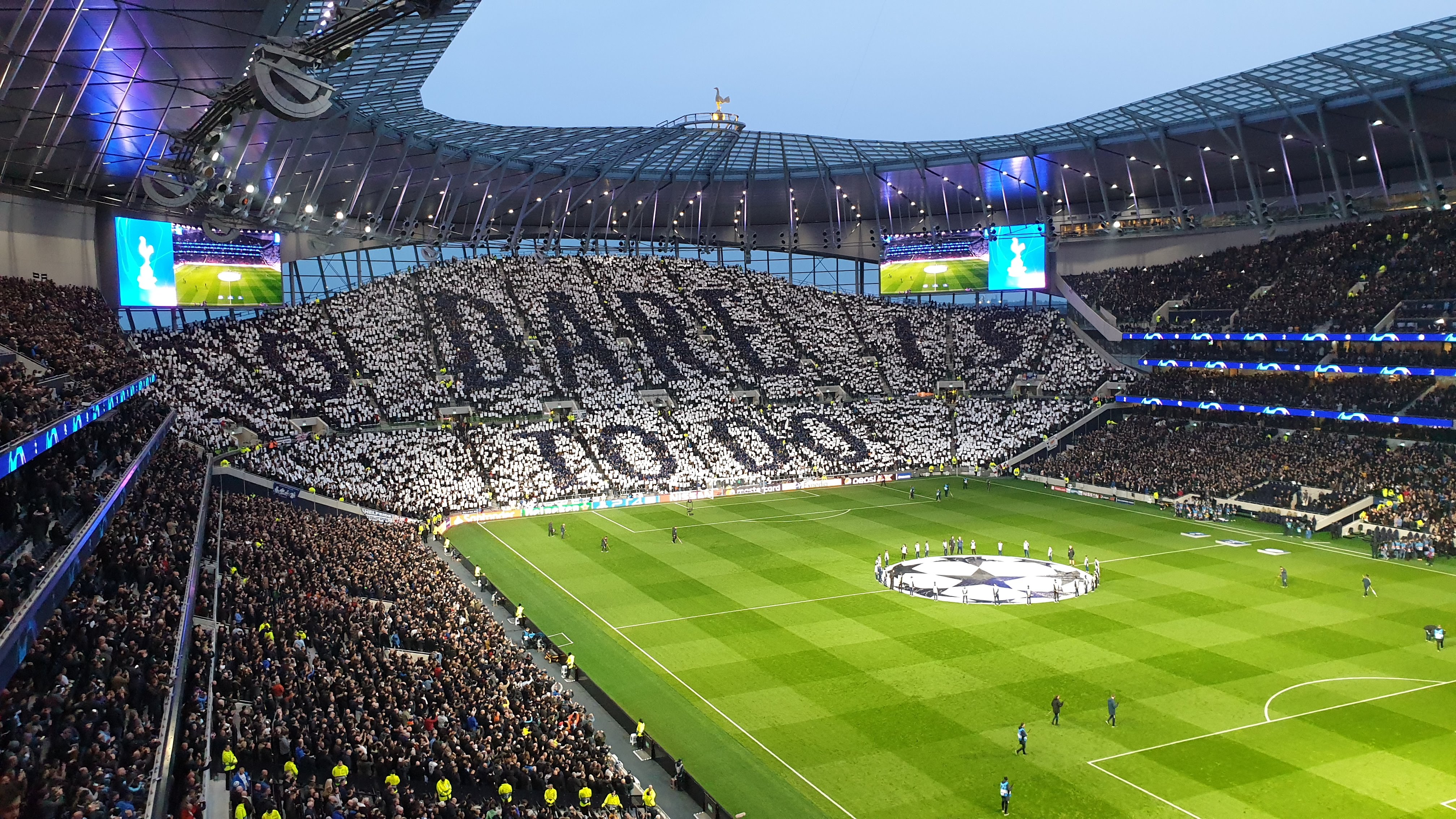
Following the opening of the new Tottenham Hotspur Stadium, Anfield's Kop ceased to be the largest single-tier stand in the country. The South Stand of the new stadium has 17,500 seats and has an incline of 34 degrees, making it one of the steepest stands in the country.
Manchester United's proposed new 100,000-capacity Old Trafford stadium will reportedly take inspiration from Tottenham's South Stand with a 'new Stretford End' to be a single-tier, steep stand which, due to the overall ground's significantly higher capacity, would likely house 25,000 supporters, indeed a stadium designed to the same proportions but with a 100,000 capacity would actually see this 'new Stretford End' holding as many as 29,000.
Villa Park's old Holte End was historically the largest of all Kop ends, closely followed by the old South Bank at Molineux, both once regularly holding crowds in excess of 30,000.
Many other English football clubs and some rugby league clubs (such as Wigan's former home Central Park) applied the same name to stands in later years.
Composition
There is much debate about what type of stand constitutes a Kop. The size and location of the stand in the stadium varies; most are located behind the goal and are occupied by its club's most vocal supporters. It is usually a single-tiered stand and was traditionally terraced. In England, safety regulations brought into effect after the 1989 Hillsborough disaster required many to be made all-seated. A Kop is not necessarily the largest stand in the stadium and does not have to have a particularly large capacity; for example, Chesterfield's former stadium, Saltergate, had a Kop with a capacity of only a few thousand.
Kops


.jpg)

| Ground | Club | Stand | ||||||||||
|---|---|---|---|---|---|---|---|---|---|---|---|---|
| Anfield | Liverpool | last=Pearce | first=James | url=http://icliverpool.icnetwork.co.uk/0500liverpoolfc/0100news/tm_objectid=17610578&method=full&siteid=50061&headline=how-kop-tuned-in-to-glory-days-name_page.html | title=How Kop tuned in to glory days | newspaper=Liverpool Echo | date=23 August 2006 | access-date=7 April 2010 | url-status=dead | archive-url=https://web.archive.org/web/20090210193006/http://icliverpool.icnetwork.co.uk/0500liverpoolfc/0100news/tm_objectid%3D17610578%26method%3Dfull%26siteid%3D50061%26headline%3Dhow-kop-tuned-in-to-glory-days-name_page.html | archive-date=10 February 2009 | df=dmy-all}} |
| Central Park (demolished 1999) | Wigan Warriors RLFC | The Kop (demolished 1999) | ||||||||||
| Baseball Ground (demolished 2003–04) | Derby | Popside Kop (The Popside) (demolished 2003–04) | ||||||||||
| Bloomfield Road | Blackpool | Mortensen Kop | ||||||||||
| Bramall Lane | Sheffield United | The Kop | ||||||||||
| County Ground | Northampton Town | Spion Kop | ||||||||||
| Deepdale | Preston North End | Bill Shankly Kop | ||||||||||
| Elland Road | Leeds United | The Kop | ||||||||||
| Molineux | Wolverhampton Wanderers | The Southbank (Sir Jack Hayward Stand) | ||||||||||
| Filbert Street (demolished 2003) | Leicester City | Spion Kop (Double Decker) (demolished 2003) | ||||||||||
| Fratton Park | Portsmouth | Spion Kop (renamed as The Milton End) | ||||||||||
| Highfield Road (demolished 2006) | Coventry City | The Spion Kop Terrace (demolished 2006) | ||||||||||
| Hillsborough Stadium | Sheffield Wednesday | Spion Kop | ||||||||||
| Home Park | Plymouth Argyle | Spion Kop (demolished 2001) | ||||||||||
| Knowsley Road (demolished 2011) | St Helens R.F.C. | The Kop (demolished 2011) | ||||||||||
| London Stadium | West Ham | Billy Bonds Stand (East Stand) | ||||||||||
| Manor Ground (demolished c.1913) | Woolwich Arsenal | Spion Kop (demolished c.1913) | ||||||||||
| Meadow Lane | Notts County | Spion Kop | ||||||||||
| Oakwell | Barnsley | Spion Kop (demolished 1998) | ||||||||||
| Prenton Park | Tranmere Rovers | Essar Kop Stand | ||||||||||
| Racecourse Ground | Wrexham | The Kop (demolished 2023, now temporary stand) | ||||||||||
| Recreation Ground (demolished 2012) | Chesterfield | Spion Kop (demolished 2011) | ||||||||||
| St Andrew's | Birmingham City | Spion Kop | ||||||||||
| Stade de la Meinau | RC Strasbourg | Ouest Kop | ||||||||||
| Tottenham Hotspur Stadium | Tottenham Hotspur | South Stand/Park Lane | ||||||||||
| Wilderspool Stadium (demolished 2014) | Warrington Wolves | Spion Kop (demolished 2014) | ||||||||||
| Valley Parade | Bradford City | The Kop End | ||||||||||
| King Power Stadium | Leicester City | South Stand/Fosse Stand (The Kop) | ||||||||||
| Windsor Park | Linfield / Northern Ireland | The Kop | ||||||||||
| Parc des Princes | Paris Saint-Germain | Kop of Boulogne | ||||||||||
| Westfalenstadion | Borussia Dortmund | The Yellow Wall |
References
Sources
- Inglis, Simon. The Football Grounds of England and Wales (Collins Willow, 1982)
- Kelly, Stephen F. The Kop, (Virgin Books, 2005)
- Pearce, James. How Kop tuned in to glory days, Liverpool Echo. 23 August 2006.
- Chapple, Mike. Spion Kop's mixture of myth and magic Liverpool Daily Post, 25 August 2006.
References
- (25 June 2010). "Showdown in Durban".
- "Football First 11: Stunning stadiums". CNN.
- Burt, Jason. (16 January 2011). "Liverpool 2 Everton 2: match report". The Daily Telegraph.
- White, Jim. (2019-03-22). "Tottenham Hotspur's new home sets benchmark for modern stadia". The Telegraph.
- Kenmare, Jack. (2024-02-15). "Sir Jim Ratcliffe's plans for a 'new Old Trafford' have emerged and they are seriously impressive". Sport Bible.
- Irwin, Colin. (2006). "Sing When You're Winning". Andre Deutsch.
- Pearce, James. (23 August 2006). "How Kop tuned in to glory days". [[Liverpool Echo]].
- Hadfield, Dave. (3 September 1999). "Rugby League: Curtain falls on house of fame". [[The Independent]].
- "derbycountyfootballhistory.co.uk".
- "Blackpool". Football Ground Guide.
- "Sheffield United". Football Ground Guide.
- "County Ground, Northampton". Football Ground Guide.
- "Preston North End". Football Ground Guide.
- (1 December 2009). "ARTISTS IMPRESSIONS – ELLAND ROAD FOR WORLD CUP". Leeds United AFC.
- "Filbert Street Leicester City". Football Ground Guide.
- (21 September 2018). "Fratton Park Portsmouth". Football Addict.
- "Highfield Road, Coventry City". Football Ground Guide.
- "The ASD Lighting Kop". Sheffield Wednesday F.C..
- "Londons Stadium History". West Ham United.
- "Notts County | Club | Meadow Lane | Meadow Lane — The Home Of Notts County FC". Nottscountyfc.premiumtv.co.uk.
- (January 2010). "Oakwell | Barnsley FC | Football Ground Guide".
- "Tranmere Rovers". [[Football Supporters Federation]].
- "Chesterfield". Football Ground Guide.
- "St Andrew's Stadium Plan". Birmingham City F.C..
- (16 June 2016). "La tribune Ouest Kop".
- "Bradford City". Football Ground Guide.
- (22 September 2009). "The Walkers Stadium". Leicester City F.C..
- (4 December 2008). "Alex Russell Stand reverts back to "Kop Stand" name". Linfield F.C..
This article was imported from Wikipedia and is available under the Creative Commons Attribution-ShareAlike 4.0 License. Content has been adapted to SurfDoc format. Original contributors can be found on the article history page.
Ask Mako anything about Spion Kop (stadiums) — get instant answers, deeper analysis, and related topics.
Research with MakoFree with your Surf account
Create a free account to save articles, ask Mako questions, and organize your research.
Sign up freeThis content may have been generated or modified by AI. CloudSurf Software LLC is not responsible for the accuracy, completeness, or reliability of AI-generated content. Always verify important information from primary sources.
Report