From Surf Wiki (app.surf) — the open knowledge base
Spinthariscope
Device for observing individual nuclear disintegrations

Device for observing individual nuclear disintegrations
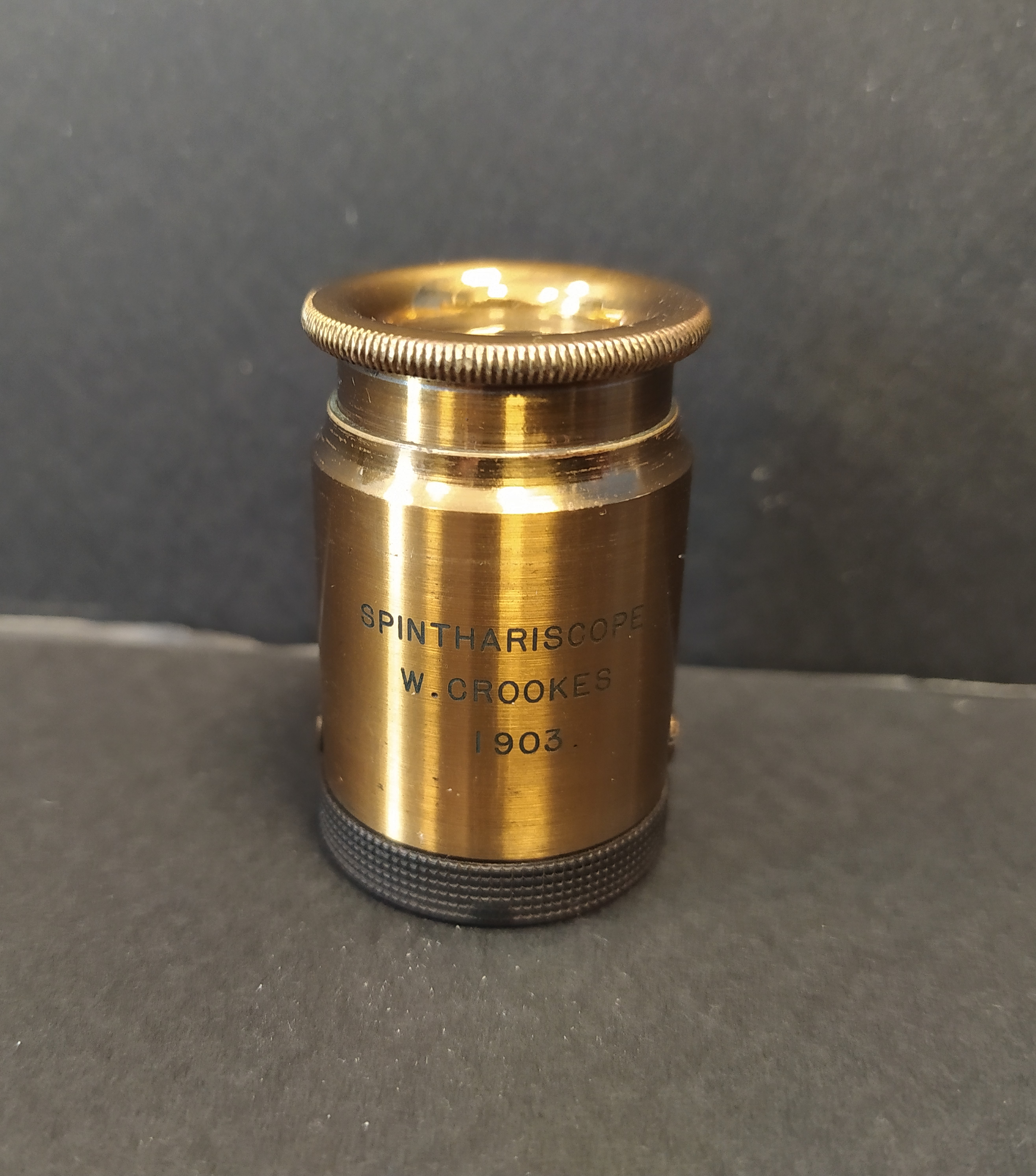
A spinthariscope () is a device for observing individual nuclear disintegrations caused by the interaction of ionizing radiation with a phosphor (see radioluminescence) or scintillator.
Invention
The spinthariscope was invented by William Crookes in 1903. While observing the apparently uniform fluorescence on a zinc sulfide screen created by the radioactive emissions (mostly alpha radiation) of a sample of radium bromide, he spilled some of the sample, and, owing to its extreme rarity and cost, he was eager to find and recover it. Upon inspecting the zinc sulfide screen under a microscope, he noticed separate flashes of light created by individual alpha particle collisions with the screen. Crookes took his discovery a step further and invented a device specifically intended to view these scintillations. It consisted of a small screen coated with zinc sulfide affixed to the end of a tube, with a tiny amount of radium salt suspended a short distance from the screen and a lens on the other end of the tube for viewing the screen. Crookes named his device from (grc) "spark".
Crookes debuted the spinthariscope at a meeting of the Royal Society, London on 15 May 1903.
Toy spinthariscopes
Spinthariscopes were quickly replaced with more accurate and quantitative devices for measuring radiation in scientific experiments, but enjoyed a modest revival in the mid 20th century as children's educational toys. In 1947, Kix cereal offered a Lone Ranger atomic bomb ring that contained a small one, in exchange for a box top and US$0.15 (). Spinthariscopes can still be bought today as instructional novelties, but they now use americium or thorium. Looking into a properly focused toy spinthariscope, one can see many flashes of light spread randomly across the screen. Almost all are circular, with a very bright pinpoint centre surrounded by a dimmer circle of emission.
In museums
The American History Museum of the Smithsonian has several spinthariscopes in its collections, and an article discussing them. However, none are currently on display.
References
References
- AXIOCOM.be. "Le spinthariscope, un petit objet à l'histoire étonnante !".
- {{cite Merriam-Webster. spinthariscope
- {{cite LPD. 3
- Crookes, William. (1903). "Certain Properties of the Emanations of Radium". Chemical News.
- Frame, Paul W.. "The Crookes Spinthariscope". Oak Ridge Associated Universities.
- Alfred Romer. (1960). "The Restless Atom: The Awakening of Nuclear Physics". Anchor Books.
- "Spinthariscopes".
- Santos, Lucy Jane. (2020). "Half Lives: The Unlikely History of Radium". Icon Books Ltd.
- Bonnier Corporation. (June 2007). "Popular Science". Bonnier Corporation.
- Reif, Rita. [https://www.nytimes.com/1995/06/11/arts/arts-artifacts-trivia-long-ago-serious-treasures-now.html "ARTS/ARTIFACTS; Trivia Long Ago, Serious Treasures Now"]. ''[[The New York Times]].'' 11 June 1995.
- Miklós, Vincze. (15 January 2014). "The Terrifying Age of Radioactive Toys for Kids".
- (5 October 2011). "Lone Ranger Atom Bomb Ring Spinthariscope (1947 - early 1950s)".
- "The Spinthariscope and the Smithsonian".
- "Collections Search Results".
This article was imported from Wikipedia and is available under the Creative Commons Attribution-ShareAlike 4.0 License. Content has been adapted to SurfDoc format. Original contributors can be found on the article history page.
Ask Mako anything about Spinthariscope — get instant answers, deeper analysis, and related topics.
Research with MakoFree with your Surf account
Create a free account to save articles, ask Mako questions, and organize your research.
Sign up freeThis content may have been generated or modified by AI. CloudSurf Software LLC is not responsible for the accuracy, completeness, or reliability of AI-generated content. Always verify important information from primary sources.
Report