From Surf Wiki (app.surf) — the open knowledge base
Spider monkey
Genus of mammals belonging to the New World monkeys
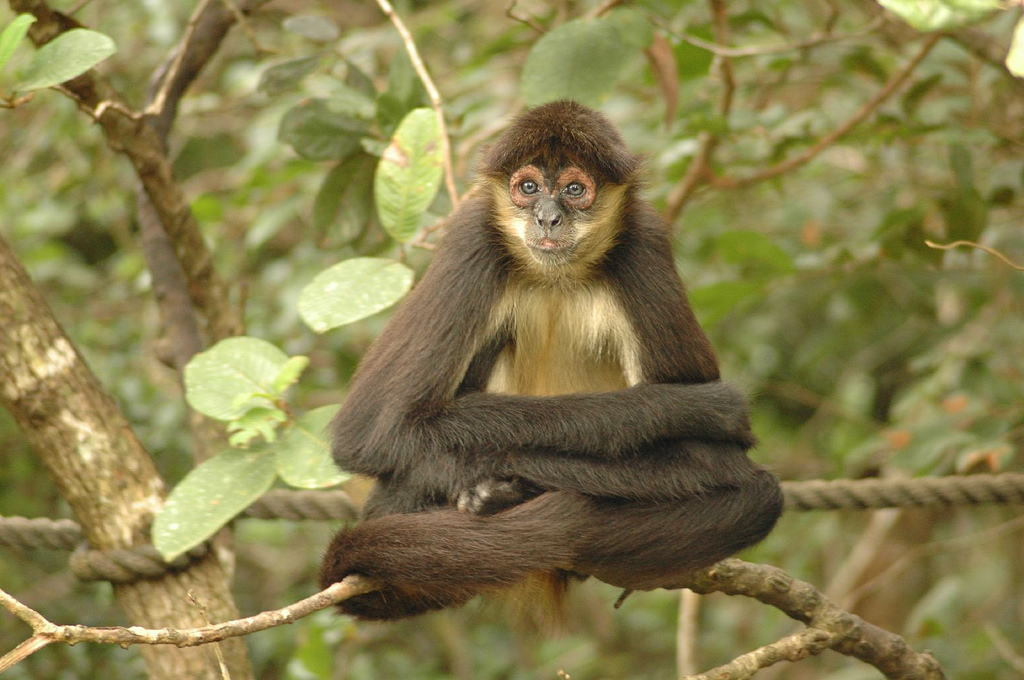
Genus of mammals belonging to the New World monkeys
Spider monkeys are New World monkeys belonging to the genus Ateles, part of the subfamily Atelinae, family Atelidae. Like other atelines, they are found in tropical forests of Central and South America, from southern Mexico to Brazil. The genus consists of seven species, all of which are under threat; the brown spider monkey is critically endangered. They are also notable for their ability to be easily bred in captivity.
Disproportionately long limbs and long prehensile tails make them one of the largest New World monkeys and give rise to their common name. Spider monkeys live in the upper layers of the rainforest and forage in the high canopy, from 25 to. They primarily eat fruits, but will also occasionally consume leaves, flowers, and insects. Due to their large size, spider monkeys require large tracts of moist evergreen forests, and prefer undisturbed primary rainforest. They are social animals and live in bands of up to 35 individuals, but will split up to forage during the day.
Recent meta-analyses on primate cognition studies indicated spider monkeys are the most intelligent New World monkeys. They can produce a wide range of sounds and will "bark" when threatened; other vocalisations include a whinny similar to a horse and prolonged screams.
They are an important food source due to their large size, so are widely hunted by local human populations; they are also threatened by habitat destruction due to logging and land clearing. Spider monkeys are susceptible to malaria and are used in laboratory studies of the disease. The population trend for spider monkeys is decreasing; the IUCN Red List lists one species as vulnerable, five species as endangered and one species as critically endangered.
Evolutionary history
Theories abound about the evolution of the atelines; one theory is they are most closely related to the woolly spider monkeys (Brachyteles), and most likely split from woolly monkeys (Lagothrix) in the South American lowland forest, to evolve their unique locomotory system. This theory is not supported by fossil evidence. Other theories include Brachyteles, Lagothrix and Ateles in an unresolved trichotomy, and two clades, one composed of Ateles and Lagothrix and the other of Alouatta and Brachyteles. More recent molecular evidence suggests the Atelinae split in the middle to late Miocene (13 Ma), separating spider monkeys from the woolly spider monkeys and the woolly monkeys.
Taxonomic classification
The genus name Ateles derives from the ancient greek word (), meaning "incomplete, imperfect", in reference to the reduced or non-existent thumbs of spider monkeys.
The genus contains seven species, and seven subspecies.
- Family Atelidae
- Subfamily Alouattinae: howler monkeys
- Subfamily Atelinae
- '*Genus *Ateles''''': spider monkeys
- Red-faced spider monkey, Ateles paniscus
- White-fronted spider monkey, Ateles belzebuth
- Peruvian spider monkey, Ateles chamek
- Brown spider monkey, Ateles hybridus
- White-cheeked spider monkey, Ateles marginatus
- Black-headed spider monkey, Ateles fusciceps
- Brown-headed spider monkey, Ateles fusciceps fusciceps
- Colombian spider monkey, Ateles fusciceps rufiventris
- Geoffroy's spider monkey, Ateles geoffroyi
- Hooded spider monkey Ateles geoffroyi grisescens
- Yucatan spider monkey, Ateles geoffroyi yucatanensis
- Mexican spider monkey, Ateles geoffroyi vellerosus
- Nicaraguan spider monkey, Ateles geoffroyi geoffroyi
- Ornate spider monkey, Ateles geoffroyi ornatus
- '*Genus *Brachyteles''''': muriquis (woolly spider monkeys)
- '*Genus *Lagothrix''''': woolly monkeys
- '*Genus *Ateles''''': spider monkeys
Anatomy and physiology

Spider monkeys are among the largest New World monkeys; black-headed spider monkeys, the largest spider monkey, have an average weight of 11 kg for males and 9.66 kg for females. Disproportionately long, spindly limbs inspired the spider monkey's common name. Their deftly prehensile tails, which may be up to 89 cm long, have very flexible, hairless tips and skin grooves similar to fingerprints. This adaptation to their strictly arboreal lifestyle serves as a fifth hand. When the monkey walks, its arms practically drag on the ground. Unlike many monkeys, they do not use their arms for balance when walking, instead relying on their tails. The hands are long, narrow, and hook-like and have reduced or nonexistent thumbs. The fingers are elongated and recurved.
Their hair is coarse, ranging in color from ruddy gold to brown and black, or white in a rare number of specimens. The hands and feet are usually black. Heads are small with hairless faces. The nostrils are very far apart, which is a distinguishing feature of spider monkeys.
Spider monkeys are highly agile, and they are said to be second only to the gibbons in this respect. They have been seen in the wild jumping from tree to tree.
Pseudo-penis Female spider monkeys have a clitoris that is especially developed; it may be referred to as a pseudo-penis because it has an interior passage, or urethra, that makes it almost identical to the penis, and retains and distributes urine droplets as the female moves around. This urine is emptied at the bases of the clitoris, and collects in skin folds on either side of a groove on the perineal. Researchers and observers of spider monkeys of South America look for a scrotum to determine the animal sex because these female spider monkeys have pendulous and erectile clitorises long enough to be mistaken for a penis; researchers may also determine the animal's sex by identifying scent-marking glands that may be present on the clitoris.
Behavior
.jpg)
Spider monkeys form loose groups, typically with 15 to 25 individuals, but sometimes up to 30 or 40. During the day, groups break up into subgroups. The size of subgroups and the degree to which they avoid each other during the day depends on food competition and the risk of predation. The average subgroup size is between 2 and 8 but can sometimes be up to 17 animals. However, the strongest social bonds are between females and their young offspring.

Spider monkeys communicate their intentions and observations using postures and stances, such as postures of sexual receptivity and of attack. When a spider monkey sees a human approaching, it barks loudly similar to a dog. When a monkey is approached, it climbs to the end of the branch it is on and shakes it vigorously to scare away the possible threat. It shakes the branches with its feet, hands, or a combination while hanging from its tail. It may also scratch its limbs or body with various parts of its hands and feet. Seated monkeys may sway and make noise. Males and occasionally adult females growl menacingly at the approach of a human. If the pursuer continues to advance, the monkeys may break off live or dead tree limbs weighing up to 4 kg and drop them towards the intruder. The monkeys also defecate and urinate toward the intruder.
Spider monkeys are diurnal and spend the night sleeping in carefully selected trees. Groups are thought to be directed by a lead female, which is responsible for planning an efficient feeding route each day. Grooming is not as important to social interaction, owing perhaps to a lack of thumbs.
Spider monkeys have been observed avoiding the upper canopy of the trees for locomotion. One researcher speculated this was because the thin branches at the tops of trees do not support the monkeys as well.Allen, William (English cardinal). "On standby for the new ark: if spider monkeys are chosen to ride out the 'demographic winter,' here is what latter-day Noahs will have to know." The Sciences 34.n5 (Sept-Oct 1994): 15(3). Expanded Academic ASAP. Gale. BENTLEY UPPER SCHOOL LIBRARY (BAISL). 6 Oct. 2009 http://find.galegroup.com/gtx/start.do?prodId=EAIM
At 107 g, the spider monkey brain is twice the size of the brain of a howler monkey of equivalent body size;{{cite book |author=Milton, Katharine
Diet

Spider monkeys eat fleshy fruits 71 to 83 percent of the time.
Spider monkeys have a unique way of getting food: a dominant female is generally responsible for leading the searches for food. During the search for food, a regular group of spider monkeys will split into groups of 3, each led by the dominant female. Each group is closely associated with its territory.
Reproduction
The female chooses a male from her group for mating. Both males and females use "anogenital sniffing" to check their mates for readiness for copulation. The gestation period ranges from 226 to 232 days. Each female bears only one offspring on average, every three to four years.
Until six to ten months of age, infants rely completely on their mothers. Males are not involved in raising the offspring.
A mother carries her infant around her belly for the first month after birth. After this, she carries it on her lower back. The infant wraps its tail around its mother's and tightly grabs her midsection. Mothers are very protective of their young and are generally attentive mothers. They have been seen grabbing their young and putting them on their backs for protection and to help them navigate from tree to tree. They help the more independent young to cross by pulling branches closer together. Mothers also groom their young.
Male spider monkeys are one of the few primates that do not have a penis bone (baculum).
Cultural depictions

Spider monkeys are found in many aspects of the Mesoamerican cultures. In the Aztec 260-day calendar, Spider Monkey (Nahua Ozomatli) serves as the name for the 11th day. In the corresponding Maya calendar, Howler Monkey (Batz) is substituted for Spider Monkey. In present-day Maya religious feasts, spider monkey impersonators serve as a kind of demonic clowns. In Classical Maya art, they are ubiquitous, often shown carrying cacao pods.
Captain Simian & the Space Monkeys features a spider monkey named Spydor who is the smallest of the crew.
References
References
- Cawthon Lang, K.A.. (April 10, 2007). "Primate factsheets: black spider monkey (''Ateles fusciceps'') taxonomy, morphology, and ecology". Wisconsin Primate Research Center (WPRC).
- (2009). "Spider monkey". [[Encyclopædia Britannica, Inc.]].
- Deaner, R.O.. (2006). "Do some taxa have better domain-general cognition than others? A meta-analysis". Evolutionary Psychology.
- Kinzey, W.G.. (1997). "New world primates: ecology, evolution, and behavior". Aldine Transaction.
- Ford, S.M.. (1986). "Comparative Primate Biology, Volume I: Systematics, Evolution and Anatomy". Alan R. Liss.
- Kay, R.F.. (1990). "The phyletic relationships of extant and fossil Pitheciinae (Platyrrhini, Anthropoidea)". [[Journal of Human Evolution]].
- Schneider, H.. (2000). "The current status of the New World monkey phylogeny". Anais da Academia Brasileira de Ciências.
- Bailly, Anatole. (1981). "Abrégé du dictionnaire grec français". Hachette.
- Bailly, Anatole. "Greek-French dictionary online".
- {{MSW3 Groves
- Youlatos, D.. (2002). "Positional behavior of black spider monkeys (''Ateles paniscus'') in French Guiana". [[International Journal of Primatology]].
- (2007). "Primates in Perspective". [[Oxford University Press]].
- Benson, Elizabeth P.. (1997). "Birds and Beasts of Ancient Latin America". University Press of Florida.
- "Swing through the trees With amazing spider monkeys".
- (10 September 2010). "Spider monkeys".
- (November 11, 2013). "Rainforest spider monkey". Animal Corner.
- (April 17, 2015). "Watch incredibly rare white monkeys ghost through a forest". National Geographic.
- "Exclusive: rare ghost monkeys filmed in Colombia".
- Gorog, A.. "''Ateles geoffroyi''". [[Animal Diversity Web]].
- Rosenberger, Alfred L.. (March 15, 2008). "Spider Monkeys: The Biology, Behavior and Ecology of the Genus ''Ateles''". [[Academia.edu]].
- Dixson, Alan F.. (2012). "Primate Sexuality: Comparative Studies of the Prosimians, Monkeys, Apes, and Humans". [[Oxford University Press]].
- Roughgarden, Joan. (2004). "Evolution's Rainbow: Diversity, Gender, and Sexuality in Nature and People". [[University of California Press]].
- "Spider monkey fact sheet". World Animal Foundation.
- "Spider monkey". [[Lamar University]].
- Weghorst, Jennifer Anne. (2007). "Behavioral Ecology and Fission-fusion Dynamics of Spider Monkeys (''Ateles geoffroyi'') in Lowland Wet Forest". [[Washington University in St. Louis.
- "Spider monkey". Planet Wild Life.
- Gottstein, Malika. (August 7, 2024). "Same-sex sexual behavior in brown-headed spider monkeys (Ateles fusciceps fusciceps) during grappling between two subadult males". Primates.
- Agnew, Corrie. "A spider monkey's life in the canopy". PawNation.
- "Spider monkey". Mac Como Zoo.
- (1990). "Association patterns of spider monkeys: the influence of ecology and sex on social organization". [[Behavioral Ecology and Sociobiology]].
- Burton, Maurice. (2002). "International Wildlife Encyclopedia". Marshall Cavendish.
- Henderson, Carrol L.. (2002). "Field Guide to the Wildlife of Costa Rica". University of Texas Press.
- (December 29, 2006). "Oldest spider monkey in the world at Fort Rickey". Fort Rickey Children's Discover Zoo.
- (8 June 2023). "She was one of the world's oldest spider monkeys. Fort Rickey zoo mourns loss of Gummy". Utica Observer dispatch.
- (2007). "Wildlife and Plants". [[Marshall Cavendish Corporation]].
- "Spider Monkey".
- Gordon, Nick. "Monkey business".
- Carpenter, C.R.. (1935). "Behavior of red spider monkeys in Panama". [[Journal of Mammalogy]].
- Campbell, Christina J.. (September 25, 2008). "Spider Monkeys: The Biology, Behavior and Ecology of the Genus ''Ateles''". Cambridge University Press.
- Harvey, Suzanne. (November 26, 2012). "How did man lose his penis bone?". University College London.
- Bingham, Ann. (2004). "South and Meso-American Mythology A to Z". [[Infobase Publishing.
- "The Maya monkey". Meso-America Foundation.
This article was imported from Wikipedia and is available under the Creative Commons Attribution-ShareAlike 4.0 License. Content has been adapted to SurfDoc format. Original contributors can be found on the article history page.
Ask Mako anything about Spider monkey — get instant answers, deeper analysis, and related topics.
Research with MakoFree with your Surf account
Create a free account to save articles, ask Mako questions, and organize your research.
Sign up freeThis content may have been generated or modified by AI. CloudSurf Software LLC is not responsible for the accuracy, completeness, or reliability of AI-generated content. Always verify important information from primary sources.
Report