From Surf Wiki (app.surf) — the open knowledge base
Sphericon
Type of rollable 3D shape
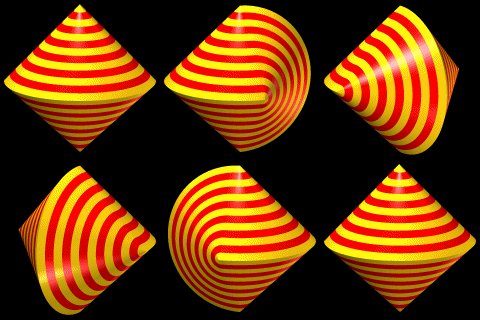
Type of rollable 3D shape


-- In solid geometry, the sphericon is a solid that has a continuous developable surface with two congruent, semi-circular edges, and four vertices that define a square. It is a member of a special family of rollers that, while being rolled on a flat surface, bring all the points of their surface to contact with the surface they are rolling on. It was discovered independently by carpenter Colin Roberts (who named it) in the UK in 1969,{{cite journal |last1=Stewart |first1=Ian |title=Mathematical Recreations: Cone with a Twist |journal=Scientific American |date=October 1999 |volume=281 |issue=4 |pages=116–117 |jstor=26058451 |url=http://www.mathias.org/steve/sphericons/sa.htm |url-status = live |archive-url = https://web.archive.org/web/20190212154635/http://www.mathias.org/steve/sphericons/sa.htm |archive-date = 2019-02-12}} by dancer and sculptor Alan Boeding of MOMIX in 1979,
Construction
The sphericon may be constructed from a bicone (a double cone) with an apex angle of 90 degrees, by splitting the bicone along a plane through both apexes, rotating one of the two halves by 90 degrees, and reattaching the two halves. Alternatively, the surface of a sphericon can be formed by cutting and gluing a paper template in the form of four circular sectors (with central angles \pi/\sqrt{2}) joined edge-to-edge.
Geometric properties
The surface area of a sphericon with radius r is given by :S = 2\sqrt{2}\pi r^2. The volume is given by :V = \frac{2}{3}\pi r^3, exactly half the volume of a sphere with the same radius.
History
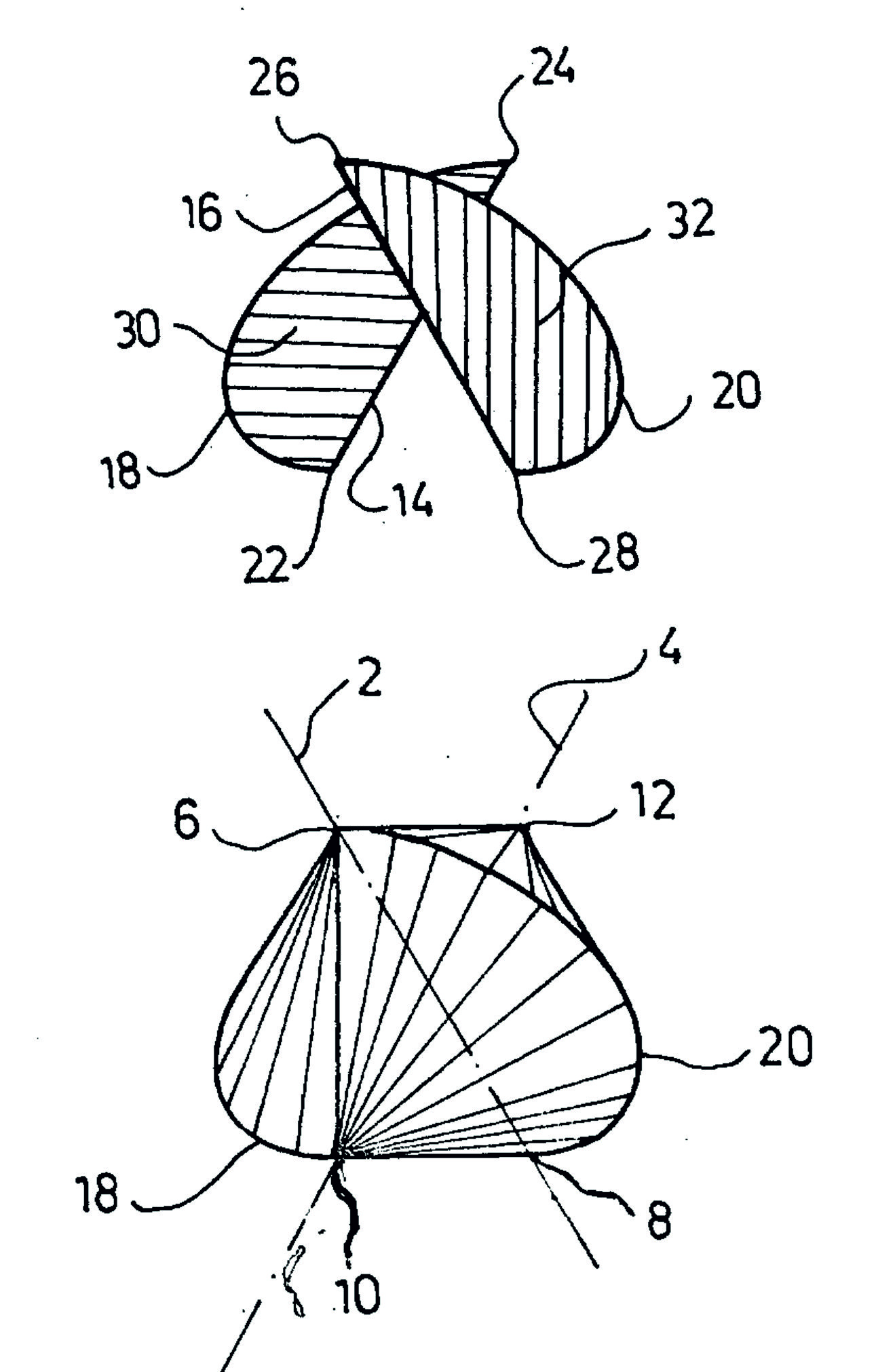
Around 1969, Colin Roberts (a carpenter from the UK) made a sphericon out of wood while attempting to carve a Möbius strip without a hole.
In 1979, David Hirsch invented a device for generating a meander motion. The device consisted of two perpendicular half discs joined at their axes of symmetry. While examining various configurations of this device, he discovered that the form created by joining the two half discs, exactly at their diameter centers, is actually a skeletal structure of a solid made of two half bicones, joined at their square cross-sections with an offset angle of 90 degrees, and that the two objects have exactly the same meander motion. Hirsch filed a patent in Israel in 1980, and a year later, a pull toy named Wiggler Duck, based on Hirsch's device, was introduced by Playskool Company.
In 1999, Colin Roberts sent Ian Stewart a package containing a letter and two sphericon models. In response, Stewart wrote an article "Cone with a Twist" in his Mathematical Recreations column of Scientific American. This sparked quite a bit of interest in the shape, and has been used by Tony Phillips to develop theories about mazes. Roberts' name for the shape, the sphericon, was taken by Hirsch as the name for his company, Sphericon Ltd.

In popular culture
In 1979, modern dancer Alan Boeding designed his "Circle Walker" sculpture from two crosswise semicircles, a skeletal version of the sphericon. He began dancing with a scaled-up version of the sculpture in 1980 as part of an MFA program in sculpture at Indiana University, and after he joined the MOMIX dance company in 1984 the piece became incorporated into the company's performances. The company's later piece "Dream Catcher" is based around a similar Boeding sculpture whose linked teardrop shapes incorporate the skeleton and rolling motion of the oloid, a similar rolling shape formed from two perpendicular circles each passing through the center of the other.
In 2008, British woodturner David Springett published the book "Woodturning Full Circle", which explains how sphericons (and other unusual solid forms, such as streptohedrons) can be made on a wood lathe.
References
References
- and by inventor David Hirsch, who patented it in Israel in 1980.David Haran Hirsch (1980): "[http://commons.wikimedia.org/wiki/File:Patent59720-specifications.pdf Patent no. 59720: A device for generating a meander motion]; [http://commons.wikimedia.org/wiki/File:Patent59720-drawings.pdf Patent drawings]; [http://commons.wikimedia.org/wiki/File:Patent59720-Application.pdf Patent application form]; [http://commons.wikimedia.org/wiki/File:Patent59720-claims.pdf Patent claims]
- Paul J. Roberts. (2010). "The Sphericon".
- [https://web.archive.org/web/20120723050439/http://www.pjroberts.com/sphericon/images/nets/4n.jpg A mesh] at www.pjroberts.com/sphericon, archived by web.archive.org
- Michele Emmer. (2005). "The Visual Mind II". MIT Press.
- ""Sphericon Ltd. - Israel-Export" (pdf)".
- Boeding, Alan. (April 27, 1988). "Circle dancing". The Christian Science Monitor.
- Green, Judith. (May 2, 1991). "hits and misses at Momix: it's not quite dance, but it's sometimes art". San Jose Mercury News.
- Anderson, Jack. (February 8, 2001). "Leaping Lizards and Odd Denizens of the Desert". The New York Times.
- Springett, David. "Woodturning Full Circle".
This article was imported from Wikipedia and is available under the Creative Commons Attribution-ShareAlike 4.0 License. Content has been adapted to SurfDoc format. Original contributors can be found on the article history page.
Ask Mako anything about Sphericon — get instant answers, deeper analysis, and related topics.
Research with MakoFree with your Surf account
Create a free account to save articles, ask Mako questions, and organize your research.
Sign up freeThis content may have been generated or modified by AI. CloudSurf Software LLC is not responsible for the accuracy, completeness, or reliability of AI-generated content. Always verify important information from primary sources.
Report