From Surf Wiki (app.surf) — the open knowledge base
Spencer repeating rifle
World's first military metallic-cartridge repeating rifle

World's first military metallic-cartridge repeating rifle
| Field | Value | |||||
|---|---|---|---|---|---|---|
| name | Spencer repeating rifle | |||||
| image | M1865_REPEATING_RIFLE.jpg | |||||
| image_size | 300 | |||||
| caption | M1865 Spencer rifle | |||||
| origin | United States | |||||
| type | Lever-action rifle | |||||
| <!-- Type selection --> | is_ranged | yes | ||||
| is_UK | ||||||
| used_by | {{ubl | United States Army | ||||
| Queen's Own Rifles of Canada<ref>{{cite web | url | https://www.americanrifleman.org/content/guns-of-the-first-fenian-raid-the-irish-invasion-of-canada/ | title=Guns of the First Fenian Raid: The Irish Invasion of Canada}} | |||
| Peru<ref>{{cite web | url | https://issuu.com/camilapesse/docs/jornada_antofagasta | title=Jornada de Historia Militar en Antofagasta. Guerra del Pacifico | work=Issuu | date=30 August 2019}} | |
| wars | {{ubl | American Civil War | ||||
| Franco-Prussian War<ref>{{cite book | last1 | Huon | first1=Jean | title=Les armes françaises en 1870-1871 | date=2007 | isbn=978-2703003090}} |
| Argentine Civil Wars<ref name | Argentina / | |||||
| Federalist Revolution<ref>{{Cite web | title | O EXÉRCITO REPUBLICANO | url=https://www.acadhistoria.com.br/livros/ExRepublicano.pdf}} | |||
| First Sino-Japanese War<ref>{{cite web | url | https://www.usni.org/magazines/proceedings/1895/october/war-east | title=The War in the East | date=13 December 1901}} | ||
| <!-- Production history --> | designer | Christopher Spencer | ||||
| design_date | 1860 | |||||
| manufacturer | Spencer Repeating Rifle Company | |||||
| Burnside Rifle Co <ref name | "riflestory" | |||||
| Falisse & Trapmann | ||||||
| unit_cost | $40 (1861) | |||||
| production_date | 1860–1874 | |||||
| number | 200,000 approx. | |||||
| variants | ||||||
| length | 47 in rifle with 30 inch barrel | |||||
| 39.25 in carbine with 22 inch barrel | ||||||
| part_length | {{ubl | 30 in | ||||
| {{convert | 22 | in | abbr | on}} | ||
| {{convert | 20 | in | abbr | on}} | ||
| crew | ||||||
| cartridge | .56-56 Rimfire | |||||
| .56-52 Rimfire | ||||||
| .56-50 Rimfire | ||||||
| .56-50 Centerfire (Brazil) | ||||||
| .56-46 Rimfire | ||||||
| caliber | .52 in | |||||
| action | Manually cocked hammer, lever action | |||||
| rate | 14-20 rounds per minute | |||||
| velocity | 931 to | |||||
| range | 500 yd | |||||
| feed | 7-round tubular magazine |
|United States Navy |Queen's Own Rifles of Canada |France |Siam |Tokugawa Shogunate |Aizu Domain |Empire of Japan |Empire of Brazil |Argentina |Chile |Bolivia |Peru |Mexico |Kingdom of Dahomey |China |Indian Wars |Fenian Raids |Boshin War |Paraguayan War |Franco-Prussian War |Occupation of Araucanía |Second French intervention in Mexico |War of the Pacific |Argentine Civil Wars |Second Franco-Dahomean War |Federalist Revolution |First Sino-Japanese War
Burnside Rifle Co Falisse & Trapmann 39.25 in carbine with 22 inch barrel |22 in |20 in .56-52 Rimfire .56-50 Rimfire .56-50 Centerfire (Brazil) .56-46 Rimfire
The Spencer repeating rifle was a 19th-century American lever-action firearm invented by Christopher Spencer. The Spencer carbine was a shorter and lighter version designed for the cavalry.
The Spencer was the world's first military metallic-cartridge repeating rifle, and over 200,000 examples were manufactured in the United States by the Spencer Repeating Rifle Co. and Burnside Rifle Co. between 1860 and 1869.
The Spencer repeating rifle was adopted by the Union Army, especially by the cavalry, during the American Civil War but did not replace the standard issue muzzle-loading rifled muskets in use at the time. Among the early users was George Armstrong Custer.
Design

The Spencer is a lever-action repeating rifle designed by Christopher Spencer in 1860. It uses a falling breechblock mounted in a carrier. Firing forces are contained by the receiver at the rear of the breechblock. Actuating the loading lever causes the breechblock to fall. Once the breechblock is clear of the receiver, the carrier "rolls" downward, ejecting a spent cartridge from the chamber and collecting a fresh round from the tubular magazine in the buttstock. Closing the lever chambers the new cartridge and the breechblock then rises vertically to close the breech. The hammer of the Spencer needs to be manually cocked after each loading cycle. The Spencer was initially produced as a carbine, chambered for the .56-56 Spencer rimfire cartridge.
The tubular magazine of the Spencer holds seven rounds. Originally this was nine rounds, but their number was reduced to reduce the mass of cartridges in the magazine and the risk of their inertia causing an accidental discharge if the weapon was dropped on its butt, or merely from recoil.{{Cite book |orig-date=1956 |access-date=2008-06-12
Unlike later cartridge designations, in the Spencer .56-56 the first number referred to the diameter of the case just ahead of the rim, while the second number is the case diameter at the mouth; the actual bullet diameter was .52 in. Cartridges were loaded with 45 gr of black powder, and were also available as .56-52, .56-50, and a wildcat .56-46, a necked down version of the original .56-56. Lugs indicates that the .50 calibre was the standard issue rifle, with a reduced diameter bullet to reduce the recoil and the risk of accidental magazine explosions. Cartridge length was limited by the action size to about 1.75 in. Later calibers used a smaller diameter, lighter bullet and larger powder charge to increase power and range over the original .56-56 cartridge, which was almost as powerful as the .58 caliber rifled musket of the time but under-powered by the standards of other early cartridges such as the .50–70 and .45-70.
Use in the military
American Civil War
When the Spencer rifle was made available for adoption right after the American Civil War broke out, the view by the Department of War Ordnance Department was that soldiers would waste ammunition by firing too rapidly with repeating rifles, and thus denied a government contract for all such weapons. (They did, however, encourage the use of breech-loading carbine, which is also single-shot like most firearms of the day but faster to reload than cap and ball muskets, but is shorter than standard rifles and thus more suited to mounted warfare)
More fundamentally, they feared that the Army's logistics train would be unable to provide enough ammunition for the soldiers in the field, as they already had grave difficulty bringing up enough ammunition to sustain armies of tens of thousands of men over distances of hundreds of miles. A weapon able to fire several times as fast would require a vastly expanded logistics train and place great strain on the already overburdened railroads and tens of thousands of more mules, wagons, and wagon train guard detachments. Its unit cost (several times that of a Springfield Model 1861 rifled musket) also stood in the way. However, shortly after the July 1863 Battle of Gettysburg, Spencer was able to gain an audience with President Abraham Lincoln, who invited him to a shooting match and demonstration of the weapon on the lawn of the White House. Lincoln was deeply impressed with the weapon, and ordered Gen. James Wolfe Ripley to adopt it for production. Ripley disobeyed the order and continued to use the old single-shooters, causing him to be replaced as head of the Ordnance Department later that year.
The Spencer repeating rifle was first adopted by the United States Navy and later by the United States Army. It was used during the American Civil War, and it became a popular weapon. The Confederates occasionally captured some of these guns and their ammunition, but, as they were unable to manufacture the cartridges because of their dire copper shortage, their utilization of the weapons was limited.
Notable early instances of use included the Battle of Hoover's Gap (where Colonel John T. Wilder's "Lightning Brigade" of mounted infantry effectively demonstrated the firepower of repeaters), and the Gettysburg campaign, where two regiments of the Michigan Brigade (under Brigadier General George Armstrong Custer) carried them at the Battle of Hanover and at East Cavalry Field.
As the war progressed, Spencers were carried by a number of Union cavalry and mounted infantry regiments and provided the Union army with a firepower advantage over their Confederate opponents. At the Battle of Nashville, 9,000 mounted infantrymen armed with the Spencer, under the command of Maj. Gen. James H. Wilson, chief of cavalry for the Military Division of the Mississippi, rode around Gen. John Bell Hood's left flank and attacked from the rear. President Lincoln's assassin John Wilkes Booth was armed with a Spencer carbine at the time he was captured and killed.
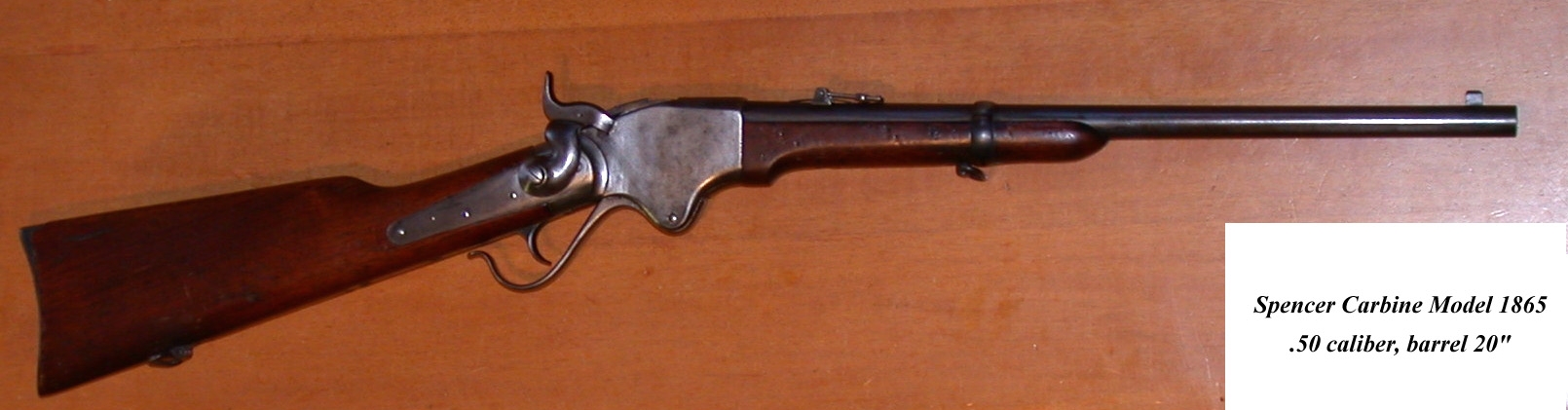

The Spencer showed itself to be very reliable under combat conditions, with a sustainable rate-of-fire in excess of 20 rounds per minute. Compared to standard muzzle-loaders, with a rate of fire of 2–3 rounds per minute, this represented a significant tactical advantage. However, effective tactics had yet to be developed to take advantage of the higher rate of fire. Similarly, the supply chain was not well prepared enough to transport the extra ammunition. Detractors also complained that the amount of smoke produced was such that it was hard to see the enemy, which was not surprising since even the smoke produced by muzzleloaders would quickly blind whole regiments, and even divisions as if they were standing in thick fog, especially on still days.
One of the advantages of the Spencer was that its ammunition was waterproof and hardy, and could stand the constant jostling of long storage on the march, such as Wilson's Raid. The story goes that every round of paper and linen Sharps ammunition carried in the supply wagons was found useless after long storage in supply wagons. Spencer ammunition had no such problem owing to the new technology of metallic cartridges.
In the late 1860s, the Spencer company was sold to the Fogerty Rifle Company and ultimately to Winchester. Many Spencer carbines were later sold as surplus to France where they were used during the Franco-Prussian War in 1870.
Even though the Spencer company went out of business in 1869, ammunition was manufactured in the United States into the 1920s. Later, many rifles and carbines were converted to centerfire, which could fire cartridges made from the centerfire .50-70 brass. The original archetype of rimfire ammunition can still be obtained on the specialty market.
Use by cavalry
Argentina purchased 500 carbines between 1865 and 1869. They were issued to the Argentine cavalry (Specially the President's Escort Squadron) and a few to the Navy; and were used against natives.
In 1867 Brigadier General James F. Rusling of the Quartermaster's Department recommended cavalry exclusively use the carbine against mounted Indian raiders, after completing a one-year tour of the new western territories.
In September 1868 Major Frederick A. Forsyth led a small force of veterans, an "elite mounted attack-and-pursuit force", and came into heavy contact with a superior number of Cheyenne warriors led by Roman Nose. The battle is known as the Battle of Beecher Island. Forsyth's band was armed with Spencer repeating carbines and 150 rounds of .56-50 Spencer cartridges per weapon. Forsyth and his men were able to hold off and turn away a vastly larger force. It is claimed that this was largely due to the "rapid firepower of the seven-shot Spencer carbines."
In the summer of 1870–1871 Chilean cavalry adopted the rifles, a change that substantially increased military disparity with the indigenous Mapuche who were at war with Chile. An example of this was Quilapán's warriors' attack on Chilean cavalry on January 25, 1871, when mounted Mapuche warriors were armed with spears and bolas. The Mapuches panicked as they did not expect a second round of shots, and casualties among them were high.
From 1873-1874, Falisse & Trapmann in Liege produced a little under 1,000 carbines for Brazil. These are found to be chambered in .56-50 Centerfire, but it is unknown if they were produced like this or converted in Brazil.
References
References
- "Guns of the First Fenian Raid: The Irish Invasion of Canada".
- Esposito, Gabriele, The Paraguayan War 1864–70: Osprey Publishing (2019)
- (30 August 2019). "Jornada de Historia Militar en Antofagasta. Guerra del Pacifico". Issuu.
- Kea, R. A. "Firearms and Warfare on the Gold and Slave Coasts from the Sixteenth to the Nineteenth Centuries." The Journal of African History, vol. 12, no. 2, 1971, pp. 185–213. JSTOR, http://www.jstor.org/stable/180879. Accessed 5 Sep. 2022
- (2007). "Les armes françaises en 1870-1871".
- Esposito, Gabriele, Armies of the War of the Pacific 1879–83: Osprey Publishing (2016)
- "O EXÉRCITO REPUBLICANO".
- (13 December 1901). "The War in the East".
- Walter, John. (2006). "The Rifle Story". Greenhill Books.
- [https://books.google.com/books?id=NJoFAAAAQAAJ&pg=PA170 Purchase of arms], House Documents, 1861, P. 168-170.
- "www.romanorifle.com".
- Walter, John. (2006). "The Rifle Story". Greenhill Books.
- "The Spencer Repeater and other breechloading rifles of the Civil War".
- Wills, C., ''[https://books.google.com/books?id=7ilZDwAAQBAJ The Illustrated Encyclopedia of Weaponry From Flint Axes to Automatic Weapons]'' (2013) Thunder Bay Press, San Dieago.
- Philip Leigh "Lee's Lost Dispatch and Other Civil War Controversies" (Yardley, Penna.: Westholme Publishing, 2015), 25-36
- (1982). "The civil war: strange & fascinating facts". Fairfax Press.
- "Spencer Carbine". Smithsonian Institution.
- Rummel III, George, ''Cavalry of the Roads to Gettysburg: Kilpatrick at Hanover and Hunterstown'', White Mane Publishing Company, 2000, {{ISBN. 1-57249-174-4.
- Steers, Edward. (12 September 2010). "The Trial: The Assassination of President Lincoln and the Trial of the Conspirators". University Press of Kentucky.
- "The Spencer Repeater". Army of the Cumberland.
- "More on Spencer's Seven Shot Repeater". Hackman-Adams.
- Pritchard, Russ A.. (1 August 2003). "Civil War Weapons and Equipment". Globe Pequot Press.
- Houze, Herb. (28 February 2011). "Winchester Repeating Arms Company". Gun Digest Books.
- Tucker, Spencer. (21 November 2012). "Almanac of American Military History". ABC-CLIO.
- Flatnes, Oyvind. (30 November 2013). "From Musket to Metallic Cartridge: A Practical History of Black Powder Firearms". Crowood Press, Limited.
- "Unidades y armas durante el sitio de Buenos Aires de 1880".
- Rusling, Brevet Brigadier General, James F.. (17 June 1868). "Letters from The Secretary or War, "AFFAIRS IN UTAH AND THE TERRITORIES"". 40th Congress 2nd Session.
- Guns of the Old West Magazine, Summer 2022 edition, article by Frank Jardim, "Savior of Beecher Island", p.10
- Bengoa, José. (2000). "Historia del pueblo mapuche: Siglos XIX y XX". [[LOM Ediciones]].
- Cayuqueo, Pedro. (2020). "Historia secreta mapuche 2". [[Catalonia (publisher).
- "Falisse & Trapmann".
- ".56-5Spencer CF".
This article was imported from Wikipedia and is available under the Creative Commons Attribution-ShareAlike 4.0 License. Content has been adapted to SurfDoc format. Original contributors can be found on the article history page.
Ask Mako anything about Spencer repeating rifle — get instant answers, deeper analysis, and related topics.
Research with MakoFree with your Surf account
Create a free account to save articles, ask Mako questions, and organize your research.
Sign up freeThis content may have been generated or modified by AI. CloudSurf Software LLC is not responsible for the accuracy, completeness, or reliability of AI-generated content. Always verify important information from primary sources.
Report