From Surf Wiki (app.surf) — the open knowledge base
Sparapet
Hereditary supreme military commander in ancient and medieval Armenia
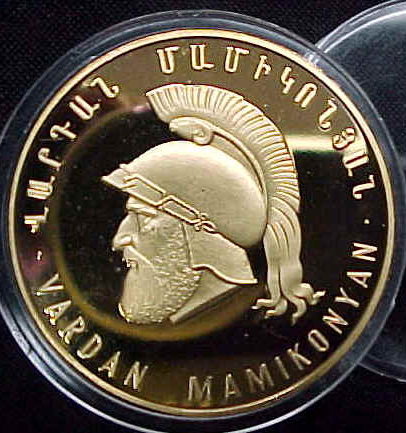
Hereditary supreme military commander in ancient and medieval Armenia
xcl () was a military title and office in ancient and medieval Armenia. Under the Arsacid dynasty of Armenia, the xcl was the supreme commander of the kingdom's armed forces. During the Arsacid period and for some time afterwards, the office was held hereditarily by the senior member of the House of Mamikonian. Later in history, the title was held by members of other noble houses, such as the Bagratuni and Pahlavuni dynasties. The title was used in the medieval Armenian Kingdom of Cilicia, where the bearer of the title was also called hy (), from the Byzantine and Western title of constable.
Etymology
The word xcl is of Iranian origin, ultimately deriving from Proto-Iranian *spādapati- (“commander of the army”), which is composed of *cwáHdaH (“army”) and *pati- (“lord”). The word was borrowed into Armenian several times from different Iranian languages, yielding the alternative forms xcl, xcl, and xcl; the most common form, xcl, was borrowed from Parthian. It is cognates with Middle Persian pal (whence modern ) and Georgian ka.
xcl has been translated into English as "grand marshal," "commander-in-chief," and "high constable."
History
The exact period in which the office of xcl emerged in Armenia is not known for certain. Historian Suren Yeremian believed it to have been instituted in the 2nd century BCE during the reign of Artaxias I, although according to another historian, it was established under the Arsacids, along with the other major hereditary state offices of Armenia.
In Arsacid Armenia, the xcl was at all times in control of the royal cavalry units called the xcl, and during times of war was the supreme commander of all military units of the Kingdom of Armenia. It is not clear to what extent the functions of the office coincided with those of the Sasanian pal. The title of xcl came with considerable prestige and power, which gave its hereditary holders, the Mamikonians, a degree of influence rivalling that of the ruling Arsacids. Historian Nicholas Adontz writes:
In the late 4th century, the Arsacid king Varazdat ordered the murder of xcl Mushegh Mamikonian and appointed a non-Mamikonian, Bat Saharuni, to the office. This was short-lived, however, as Mushegh's kinsman Manuel Mamikonian soon returned to Armenia and drove Varazdat out of the country. After the dethroning of the last Arsacid king of Armenia in 428, the Mamikonians continued to hold the title of sparapet under Sasanian rule. In the first half of the 8th century, during the period of Arab rule in Armenia, the office of *sparapet'' was usurped by the Bagratunis, the traditional rivals of the Mamikonians. Later on, the title was borne by members of the Pahlavuni family.
In the medieval Armenian Kingdom of Cilicia, the title of sparapet or gundstabl was no longer the hereditary privilege of one house. It was held by members of the Rubenid and Hethumid dynasties, as well as representatives of other noble houses.
Modern usage
The 18th century commander Mkhitar Sparapet led the Armenian efforts for independence in the Syunik province of Armenia.
The title "Sparapet of Syunik" (Սյունյաց սպարապետ) was held by the Garegin Nzhdeh, as supreme commander of the Republic of Mountainous Armenia, in 1920–21.
The title is also used for the Grand Commander of the Knights of Vartan, an Armenian-American fraternal order. The title was held by Alex Manoogian during his leadership of that organization.
Vazgen Sargsyan, Armenia's Defense Minister in 1991-92 and 1995–99, is often informally referred to as Sparapet in recognition of his leadership during the First Nagorno-Karabakh War.
References
Sources
References
- [[Anahit Perikhanian. Perikhanyan, A. G.]] (1993). ''Материалы к этимологическому словарю древнеармянского языка: часть 1'' [Materials for the Etymological Dictionary of the Old Armenian Language. Part 1] (in Russian), Yerevan: Armenian Academy of Sciences, p. 18.
- "Նժդեհ Գարեգին". [[Armenian Encyclopedia Publishing]].
- (27 April 2011). "Որ զանգը զուր չհնչի". [[Aravot]].
- "Alex Manoogyan".
- "Vazgen Sargsyan". Government of the Republic of Armenia.
- (20 March 2009). "50th Anniversary of Birth of Sparapet". [[Yerevan State University]].
- (5 March 2014). "Armenians commemorate Sparapet Vazgen Sargsyan". [[A1plus]].
This article was imported from Wikipedia and is available under the Creative Commons Attribution-ShareAlike 4.0 License. Content has been adapted to SurfDoc format. Original contributors can be found on the article history page.
Ask Mako anything about Sparapet — get instant answers, deeper analysis, and related topics.
Research with MakoFree with your Surf account
Create a free account to save articles, ask Mako questions, and organize your research.
Sign up freeThis content may have been generated or modified by AI. CloudSurf Software LLC is not responsible for the accuracy, completeness, or reliability of AI-generated content. Always verify important information from primary sources.
Report