From Surf Wiki (app.surf) — the open knowledge base
Spandau
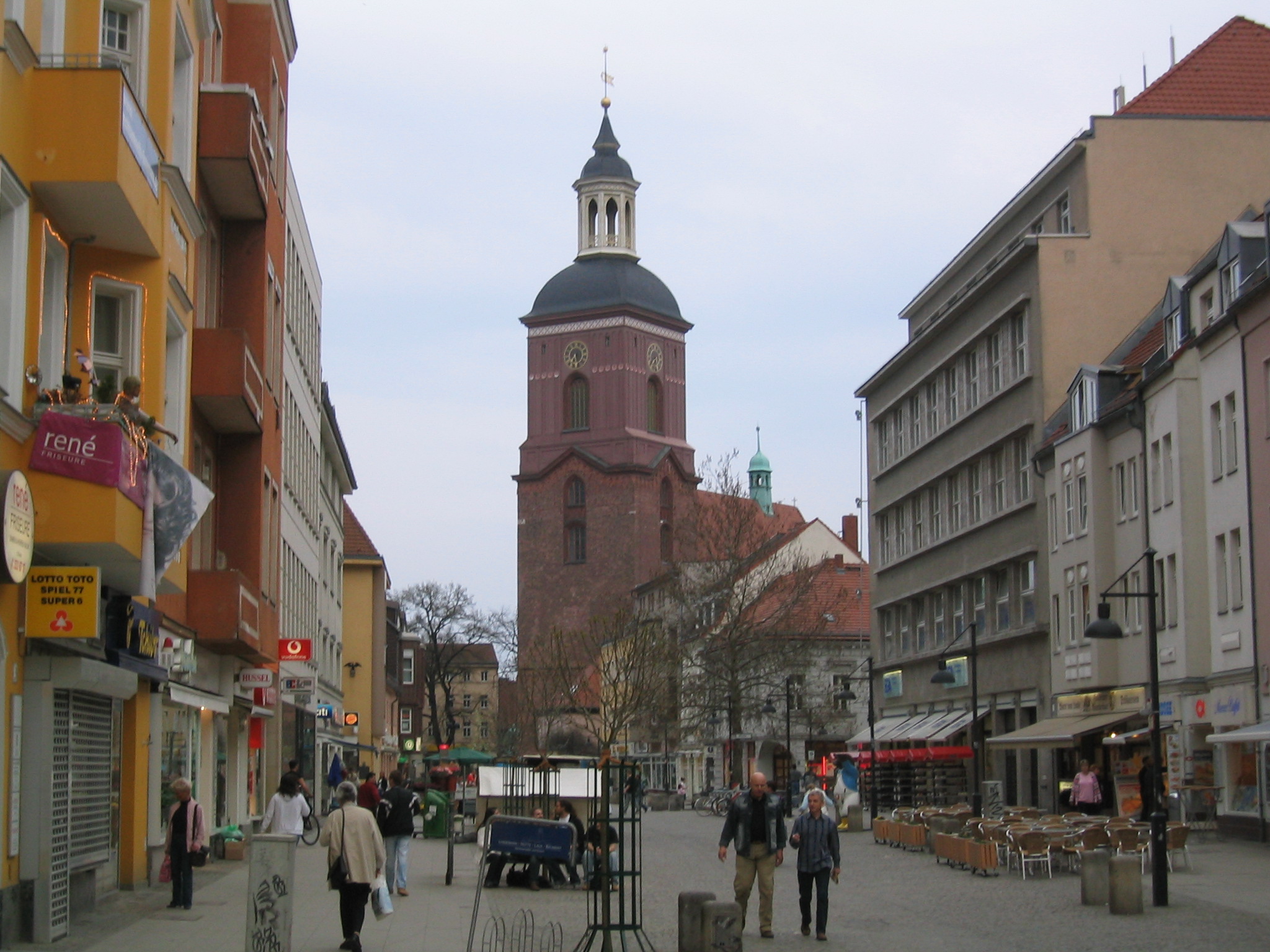
| Field | Value |
|---|---|
| name | Spandau |
| image_photo | 2013-08 View from Rathaus Spandau 03.jpg |
| image_caption | Old town of Spandau |
| type | Borough |
| City | Berlin |
| image_flag | Flagge Bezirk Spandau.svg |
| image_coa | Coat of arms of borough Spandau.svg |
| coordinates | |
| state | Berlin |
| divisions | 9 localities |
| Bürgermeistertitel | Borough Mayor |
| mayor | Frank Bewig |
| party | CDU |
| area | 91.91 |
| pop_ref | |
| population | |
| population_as_of | |
| licence | B |
| plantext | Location of Spandau in Berlin |
| image_plan | Berlin Bezirk Spandau (labeled).svg |
| website |
Spandau () is the westernmost of the 12 boroughs (Bezirke) of Berlin, situated at the confluence of the Havel and Spree rivers and extending along the western bank of the Havel. It is the smallest borough by population, but the fourth largest by land area.
Overview
Modern industries in Spandau include metalworking, and chemical and electrical factories. BMW Motorrad's Spandau factory made all BMW's motorcycles from 1969 until final assembly plants were added in Rayong, Thailand, in 2000, and Manaus, Brazil, in 2016.
Rathaus Spandau, Spandau's seat of government, was built in 1913. Other landmarks include the Renaissance-era Spandau Citadel, the 1848 St. Marien am Behnitz Catholic church designed by August Soller, and Spandau arsenal. That arsenal's Spandau machine gun inspired the slang Spandau Ballet to describe dying soldiers on barbed wire during the First World War, and later was applied to the appearance of Nazi war criminals at Spandau Prison. In 1979, the English New Romantic band Spandau Ballet again re-purposed the term for its name.
History
The history of Spandau begins in the 7th century or 8th century, when the Slav Heveller first settled in the area and later built a fortress there. It was conquered in 928 by the German King Henry I, but returned to Slavic rule after the rebellion of 983.
In 1156, the Ascanian Earl Albrecht von Ballenstedt ("Albrecht the Bear") took possession of the region. 1197 marked the first mention as Spandowe in a deed of Otto II, Margrave of Brandenburg – thus forty years earlier than the Cölln part of medieval Berlin. Spandau was given city rights in 1232.
During Ascanian rule the construction of Spandau Citadel began, which was completed between 1559 and 1594 by Joachim II of Brandenburg. In 1558 the village of Gatow became part of Spandau. In 1634, during the Thirty Years' War, Spandau was surrendered to the Swedes. In 1689, a commune of French Huguenots and Waldensians was established.
In 1806, after the Battle of Jena and Auerstedt, French troops under Napoleon took possession of the city and stayed there until 1807. In 1812, Napoleon returned, and the Citadel was besieged the following year by Prussian and Russian troops.
From 1849 the poet and revolutionary Gottfried Kinkel was an inmate of Spandau town prison, until he was freed by his friend Carl Schurz in the night of 6 November 1850.
Before World War I, Spandau Arsenal was a seat of large government cannon foundries, factories for making gunpowder and other munitions of war, making it a centre of the arms industry in the German Empire. It was also a garrison town with numerous barracks, home of the 5th Guard Infantry Brigade and the 5th Guard Foot Regiment of the German Army. In 1920, Spandau (whose name had been changed from Spandow in 1878) was incorporated into Greater Berlin as a borough.
During World War II, Spandau was the location of a subcamp of the Sachsenhausen concentration camp, mostly for Polish and Hungarian women.
After World War II, it was part of the British sector of West Berlin. Spandau Prison, which had been rebuilt in 1876, was used to house Nazi war criminals given custodial sentences at the Nuremberg Trials. After the death of Spandau Prison's last inmate, Rudolf Hess, in 1987, it was completely demolished by the Allied powers and later replaced by a shopping mall.
Gatow airfield, in the south of the district, was used by the Royal Air Force during the post-war Allied occupation, most notably during the Berlin Airlift. Since 1995 the airfield has been the Gatow Museum of Military History.
Geography
Outside Berlin, Spandau borders the districts (Kreis) of Oberhavel to the north, and Havelland to the west, and the city of Potsdam, Brandenburg, to the southwest. Within Berlin, it borders the boroughs of Steglitz-Zehlendorf to the south, Charlottenburg-Wilmersdorf to the east, and Reinickendorf to the northeast. Its land area of 91.91 km2 is the fourth-largest of the twelve boroughs.
Subdivisions

Spandau Borough is divided into nine quarters (Ortsteile):
- Spandau
- Haselhorst
- Siemensstadt
- Staaken
- Gatow
- Kladow
- Hakenfelde
- Falkenhagener Feld
- Wilhelmstadt
Demographics
As of 2010, Spandau had a population of 223,962, the smallest of the twelve boroughs of Berlin. 62,000 of those were migrants or other non-ethnic Germans, comprising 27% of Spandau's population.
| Germans without migration background/non-migrants |
|---|
| Germans with migration background or foreign citizens |
| Middle Eastern origin (Turkey, Arab League, Iran etc.) |
| (non-German) EU-European migration background (esp. Poles, Romanians etc.) |
| African background/Afro-Germans (Ghana, Nigeria, Cameroon etc.) |
| Others (East Asians, Russians, Serbs etc.) |
Politics
District council
The governing body of Spandau is the district council (Bezirksverordnetenversammlung). It has responsibility for passing laws and electing the city government, including the mayor. The most recent district council election was held on 26 September 2021, and the results were as follows:
! colspan=2| Party ! Lead candidate ! Votes ! % ! +/− ! Seats ! +/− |- | 31,250 | 27.7 | 5.5 | 17
| 3 |
|---|
| 30,714 |
| 27.2 |
| 1.5 |
| 16 |
| ±0 |
| - |
| 13,460 |
| 11.9 |
| 4.3 |
| 7 |
| 3 |
| - |
| 11,516 |
| 10.2 |
| 5.8 |
| 6 |
| 3 |
| - |
| 8,464 |
| 7.5 |
| 1.1 |
| 4 |
| 1 |
| - |
| 6,104 |
| 5.4 |
| 0.2 |
| 3 |
| ±0 |
| - |
| 5,063 |
| 4.5 |
| New |
| 2 |
| New |
| - |
| - |
| 2,235 |
| 2.0 |
| 0.4 |
| 0 |
| ±0 |
| - |
| 1,743 |
| 1.5 |
| New |
| 0 |
| New |
| - |
| | 1,222 | 1.1 | New | 0
| New |
|---|
| | 677 | 0.6 | 0.8 | 0
| ±0 |
|---|
| 296 |
| 0.3 |
| New |
| 0 |
| New |
| - |
| 138 |
| 0.1 |
| New |
| 0 |
| New |
| - |
| ! colspan=3 |
| ! 112,882 |
| ! 98.6 |
| ! |
| ! |
| ! |
| - |
| ! colspan=3 |
| ! 1,577 |
| ! 1.4 |
| ! |
| ! |
| ! |
| - |
| ! colspan=3 |
| ! 114,459 |
| ! 100.0 |
| ! |
| ! 55 |
| ! ±0 |
| - |
| ! colspan=3 |
| ! 177,874 |
| ! 64.3 |
| ! 5.0 |
| ! |
| ! |
| - |
| } |
District government
The district mayor (Bezirksbürgermeister) is elected by the Bezirksverordnetenversammlung, and positions in the district government (Bezirksamt) are apportioned based on party strength. Carola Brückner of the SPD was elected mayor on 4 November 2021. Since the 2021 municipal elections, the composition of the district government is as follows:
| Councillor | Party | Portfolio | |
|---|---|---|---|
| Carola Brückner | Social Democratic Party of Germany}} | SPD | |
| Frank Bewig | Christian Democratic Union of Germany}} | CDU | |
| Thorsten Schatz | Christian Democratic Union of Germany}} | CDU | |
| Gregor Kempert | Social Democratic Party of Germany}} | SPD | |
| Oliver Gellert | Alliance 90/The Greens}} | GRÜNE | |
| Vacant | Alternative for Germany}} | AfD | |
| Source: Berlin.de |
Sports
The Wasserfreunde Spandau 04 have traditionally been an immensely powerful water polo team. They have been the most successful ball sports team in Europe with 85 national and international titles. Hagen Stamm, longtime captain of the team, was German champion fourteen times in a row from 1979 to 1992, and winner of the German cup twelve times and won the European Cup in 1982, 1985, 1986 and 1989. He is currently the president of the association (as of 2020). The team's home games do not take place in the district, but in the Sportzentrum Schöneberg. For 2027, the team plans to move to the then newly constructed arena in Spandau.
In 1939, LSV Spandau won the title of the first German basketball championship, which was won by a clear 47:16 victory over Bad Kreuznach. After 1945, the association was dissolved.
Notable people
- Bela B. (born 1962), musician
- Hans Berndt (1913–1988), football player
- Helmut Bonnet (1910–1944), athlete
- Käthe Heinemann (1891–1975), pianist
- Robert Hoyzer (born 1979), football referee
- Käthe Itter (1907–1992), actress
- Paul Kellner (1890–1972), swimmer
- Henning Alexander von Kleist (1707–1784), Governor of Spandau citadel, died there
- Rosa Lindemann (1876–1958), communist
- Arthur Löwenstamm (1882–1965), Spandau Synagogue's first and only rabbi from 1917 to 1938
- Moriz von Lyncker (1853–1932), Prussian officer and Chief of the Military Cabinet of Kaiser Wilhelm II
- Christian Friedrich Neue (1789–1886), philologist
- Oliver Petszokat (born 1978), better known by his stage name Oli.P, singer, actor and TV presenter
- Hans von Plessen (1841–1929), Prussian Colonel-General
- Ivan Rebroff (1931–2008), singer
- Erna Sack (1898–1972), coloratura soprano, known as the German Nightingale for her high vocal range.
- Sıla Şahin (born 1985), actress
- Richard Schulze-Kossens (1914–1988), SS commander during the Nazi era
- Elke Sommer (1940-)
- Franz Hermann Troschel (1810–1882), zoologist
- Carl Albert Weber (1856–1931), botanist
- Kai Wegner (born 1972), politician of the Christian Democratic Union of Germany (CDU)
Twin towns – sister cities
Spandau is twinned with:
- ISR Ashdod, Israel (1968)
- FRA Asnières-sur-Seine, France (1959)
- TUR İznik, Turkey (1987)
- ENG Luton, United Kingdom (1959)
- GER Nauen, Germany (1988)
- GER Siegen, Germany (1952)
- GER Siegen-Wittgenstein, Germany (1952)
References
References
- {{Population Germany
- "my FB Title".
- Henry, Ian. (6 January 2015). "BMW: Global growth". Ultima Media.
- (4 April 2016). "BMW Motorrad expands production network with its own manufacturing site in Brazil. [press release]". [[BMW Group]].
- Muret, Eduard. (1885). "Geschichte der Französischen Kolonie in Brandenburg-Preußen, unter besonderer Berücksichtigung der Berliner Gemeinde. Aus Veranlassung der Zweihundertjährigen Jubelfeier am 29. Oktober 1885".
- Megargee, Geoffrey P.. (2009). "The United States Holocaust Memorial Museum Encyclopedia of Camps and Ghettos 1933–1945. Volume I". Indiana University Press, United States Holocaust Memorial Museum.
- Goda, Norman J. W.. (2006). "Tales from Spandau". [[University of Florida]].
- (31 December 2010). "Melderechtlich registrierte Einwohner im Land Berlin".
- [https://spandau04.de/wasserball-bundesliga-mannschaft Wasserball-Bundesliga-Mannschaft der Männer] spandau04.de. Accessed 17 March 2022.{{in lang. de
- (14 January 2021). "Millionen-Baustelle rückt näher – der Antrag ist da". [[Der Tagesspiegel]].
- "Städtepartnerschaften des Bezirks Spandau". Berlin.
This article was imported from Wikipedia and is available under the Creative Commons Attribution-ShareAlike 4.0 License. Content has been adapted to SurfDoc format. Original contributors can be found on the article history page.
Ask Mako anything about Spandau — get instant answers, deeper analysis, and related topics.
Research with MakoFree with your Surf account
Create a free account to save articles, ask Mako questions, and organize your research.
Sign up freeThis content may have been generated or modified by AI. CloudSurf Software LLC is not responsible for the accuracy, completeness, or reliability of AI-generated content. Always verify important information from primary sources.
Report