From Surf Wiki (app.surf) — the open knowledge base
Spam (food)
Canned cooked pork meat product

Canned cooked pork meat product
| Field | Value | |
|---|---|---|
| logo | logo SPAM.svg | |
| logo_caption | Brand logo | |
| image | Spam wall - Flickr - freezelight.jpg | |
| caption | Products on display | |
| producttype | Precooked canned meat product | |
| currentowner | Hormel Foods Corporation | |
| producedby | Hormel Foods Corporation | |
| country | United States | |
| introduced | 1937 | |
| markets | Worldwide | |
| website | ||
| module | ||
| module1 | footnotes = |
Spam (stylized in all-caps) is a brand of lunch meat (processed canned pork and ham) made by Hormel Foods Corporation, an American multinational food processing company. It was introduced in the United States in 1937 and gained popularity worldwide after its use during World War II. , Spam was sold in 41 countries, and trademarked in more than 100 countries, on 6 continents.
Spam's main ingredient is pork, with salt, water, modified potato starch (as a binder), sugar, and sodium nitrite (as a preservative). Natural gelatin is formed during cooking in its cans on the production line. It is available in different flavors, some using different meats, as well as in "lite" and lower-sodium versions. Spam is precooked, making it safe to consume straight from the can, but it is often cooked further for taste.
Concerns about Spam's nutritional attributes have been raised because it contains twice as much of the daily dietary recommendation of fat as it does of protein, and because of the health effects of salt and preservatives.
Spam has become part of popular culture, including a Monty Python sketch, which repeated the name many times, leading to its name being borrowed to describe unsolicited electronic messages, especially email. It is occasionally celebrated at festivals such as Spamarama in Austin, Texas.
History
Hormel introduced Spam on July 5, 1937. The Oxford Encyclopedia of Food and Drink in America states that the product was intended to increase the sale of pork shoulder, a cut which did not sell well. Ken Daigneau, the brother of a company executive, won a $100 prize that year in a competition to name the new item. Hormel states that the meaning of the name "is known by only a small circle of former Hormel Foods executives", but a popular belief is that the name is a contraction of "spiced ham". It has also been speculated to be an acronym for "shoulder of pork and ham".
The difficulty of delivering fresh meat to the front during World War II saw Spam become a ubiquitous part of the U.S. soldier's diet. It became variously referred to as "ham that didn't pass its physical", "meatloaf without basic training", and "Special army meat". Over 150 e6lb of Spam were received by the military before the war's end. However, several troops grew tired of the product. They expressed their frustrations in written letters to Jay Hormel, the president of the company, about the presence of Spam at every meal. Despite this disparagement, throughout the war, countries ravaged by the conflict and faced with strict food rations came to appreciate Spam.
During World War II and the occupations that followed, Spam was introduced into Guam, Hawaii, Okinawa, the Philippines, and other islands in the Pacific. Immediately absorbed into native diets, it has become a unique part of the history and effects of U.S. influence in the Pacific islands. As a consequence of World War II rationing and the Lend-Lease Act, Spam was sold in the United Kingdom. British Prime Minister Margaret Thatcher later referred to it as a "wartime delicacy". In addition to increasing production for the U.K., Hormel expanded Spam output as part of Allied aid to the Soviet Union. In his memoir Khrushchev Remembers, Nikita Khrushchev declared: "Without Spam, we wouldn't have been able to feed our army."

The billionth can of Spam was sold in 1959, and the eight billionth can was sold in 2012.

International usage
United States and territories
thumb|right|225px|Baked Spam Domestically, Spam's chief advantages were affordability, accessibility, and extended shelf life. Statistics from the 1990s say that 3.8 cans of Spam were consumed every second in the United States, totaling nearly 122 million cans annually. It became part of the diet of almost 30% of American households, perceived differently in various regions of the country. It is also sometimes associated with economic hardship because of its relatively low cost.
After World War II, Spam changed roles in the U.S. from being the main protein source to being a side dish or ingredient used in items like sandwiches and eggs.
Spam that is sold in North America, South America, and Australia is produced in Austin, Minnesota (also known as "Spam Town USA"), and in Dubuque, Iowa. Austin, Minnesota also had a restaurant with a menu devoted exclusively to Spam called "Johnny's SPAMarama Menu".
Hawaii

Residents of the state of Hawaii have the highest per capita consumption in the United States, bringing in sales of 7 million cans of Spam per year. Its perception there is very different from that on the mainland. Hawaiians sometimes call it "Portagee Steak".
A local dish in Hawaii is Spam musubi, in which cooked Spam is placed on top of rice and wrapped in a band of nori, a form of onigiri or riceball. Varieties of Spam are found in Hawaii and Saipan that are unavailable in other markets, including Honey Spam, and Hot and Spicy Spam.
Hawaiian Burger King restaurants began serving Spam in 2007 to compete with the local McDonald's chains (which also serve Spam). In Hawaii, Spam is so popular that it is sometimes referred to as "The Hawaiian Steak". There is even an annual Spam-themed festival on the island of Oahu each spring, known as the "Waikiki Spam Jam". Local chefs and restaurants compete to create new Spam-themed dishes, which are then sold in a massive street fair on Kalakaua Avenue in Waikiki.
In 2017, Hawaii was plagued by a rash of thefts of Spam. Spam had long been a target of thieves in Hawaii, but the magnitude of the thefts ramped up, with incidents in which multiple cases of Spam were stolen at once. Local retailers believe organized crime was involved. This came alongside increases in thefts of some other retail goods, such as corned beef and liquor. The president of the retail merchants of Hawaii attributed the rise in retail thefts to a recent change in criminal law, which raised the threshold at which a theft would lead to felony charges by approximately $400.
Guam and the Northern Marianas
In Guam, the average per capita consumption is 16 tins (cans) per year. It is also found on McDonald's menus there. The Spam Games also occur in Guam, where locals sample and honor the best original, homemade Spam recipes.
In the Northern Mariana Islands, lawyers from Hormel have threatened to sue the local press for publishing articles alleging ill effects of high Spam consumption on the health of the local population.
Puerto Rico
Sandwich de Mezcla is a party staple in Puerto Rico containing Spam, Velveeta, and pimientos (made into a spread) between two slices of sandwich bread.
Europe
United Kingdom
After World War II, Newforge Foods, part of the Fitch Lovell group, was awarded the license to produce the product in the U.K. at its Belle Vale factory, Liverpool, where it stayed until production switched to the Danish Crown Group (owners of the Tulip Food Company) in 1998.
The United Kingdom has adapted Spam into various recipes, for example, sliced, battered and deep-fried into Spam fritters.
Asia
Israel
Loof, a canned corned beef product often featured in Israeli Defense Forces rations, was sometimes known as "kosher Spam", because it contains no pork.
Philippines

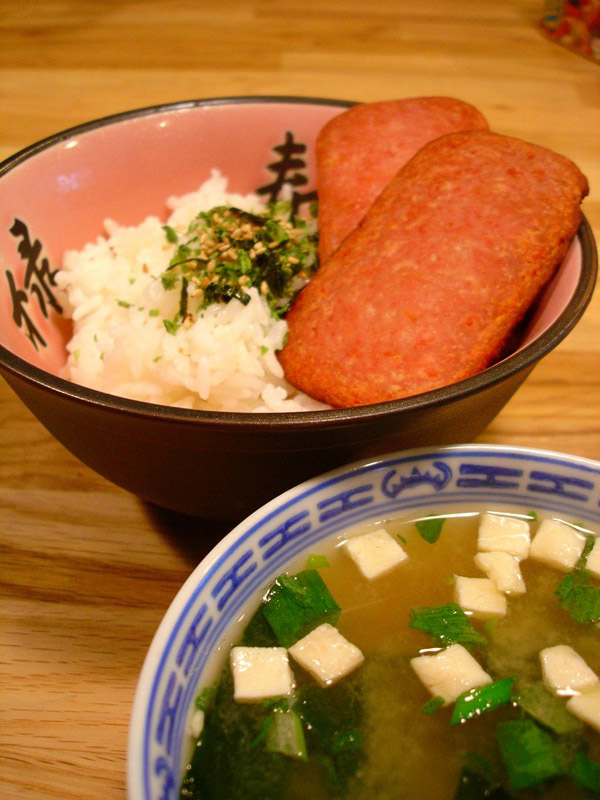
In the Philippines, Spam (currently distributed by the Purefoods-Hormel Company Inc.) is a popular food item seen as a cultural symbol. Spam reached the islands similarly as it did other former US colonies such as Hawaii and Guam: as a result of World War II rationing. Spam is commonly eaten with rice (usually garlic fried rice) and a sunny-side-up egg for breakfast. It is prepared and used in a variety of ways, including being fried, caramelized, served with condiments, or in sandwiches. It has also been featured in numerous Filipino fusion cuisine dishes, including Spam burgers, Spam spaghetti, and Spam nuggets.
The popularity of Spam in the Philippines transcends economic class, and the canned product is even given during holidays. There are at least ten different varieties of Spam currently available in the country, and an estimated 1.25 million kilos of the meat is sold every year in the Philippines. Its popularity among Filipinos has led to the creation of a version with sugar and annatto—Tocino-flavor Spam, made for the overseas Filipino market in the US and Canada. During the rescue efforts after Typhoon Ondoy (Ketsana) in 2009, Hormel Foods donated over 30,000 pounds of Spam to the Philippine National Red Cross.
China
In mainland China, Hormel decided to adopt a different strategy to market Spam (), promoting it as a foreign, premium food product and changing the Spam formula to be meatier to accommodate local Chinese tastes. Spam-like canned pork products are also produced by other food companies in China as "luncheon meat" ().
Hong Kong
After World War II, meat was scarce and expensive in Hong Kong, so Spam was an accessible, affordable alternative. The luncheon meat has been incorporated into dishes such as macaroni with fried egg and Spam in chicken soup, egg and Spam sandwiches, and instant ramen. Nowadays, Spam remains a staple in Hong Kong’s low to middle-income families.
South Korea
Spam was exported to Korea post-World War II, whose population was on the brink of starvation. Spam returned to South Korea and was widely consumed during the Korean War. US soldiers deployed to South Korea used Spam as a means of trading for items, services, or information around their bases. Spam and other meats were smuggled out of US military installations for the local population. Its popularity led to the creation of the Spam kimbap (rice and vegetable filled seaweed roll) in Korean cuisine. Because of a scarcity of fish and other traditional kimbap products such as kimchi or fermented cabbage, Spam was added to a rice roll with kimchi and cucumber and wrapped in seaweed. Spam is also an original ingredient in budae jjigae (부대찌개; ), a spicy stew with different types of preserved meat or kimchi.
In South Korea, Spam (licensed from Hormel by CJ CheilJedang) is popular with a majority of the population. , South Korea produced and consumed more Spam than any other country except the United States. It is considered something of a luxury dish and is a common gift for Korean New Year combined with cooking oil and seasoning.
Japan
In Okinawa, Japan, the product is added into onigiri alongside eggs and used as a staple ingredient in the traditional Okinawan dish chanpurū, and a Spam burger is sold by local fast food chain Jef. For the 70th anniversary of Spam in 2007, cans with special designs were sold in Japan due to its popularity, primarily in Okinawa. Following the March 2011 earthquake, Spam sales in Japan declined, and Hormel shifted its focus to China, although Hormel did pledge to donate $100,000 along with cans of Spam for relief efforts.
In the summer of 2011, Burger King introduced its own version of a burger made of Spam, called 'BK Shot' Spam Burgers. These small burgers are filled with slices of the canned meat and were an attempt by Burger King to capitalize on Spam's popularity in Japan. In early 2014, Burger King also introduced the Spam and Cheese burger as a breakfast menu item.
In popular culture
thumb|250px|Comparison of Spam with similar products: Spam (L), [[Treet]] (C), and [[List of Walmart brands#Great Value|Walmart Great Value]] Luncheon Meat (R) From 1940 to 1941, Spam sponsored George Burns and Gracie Allen on their radio program.
During World War II, Spam was not only eaten but was also incorporated into many other aspects of the war (grease for guns, cans for scrap metal, etc.); it was so prominent that Uncle Sam was nicknamed "Uncle Spam". Other terms influenced by the product's name include the European invasion fleet or the "Spam Fleet". Furthermore, the United Service Organizations (USO) toured the "Spam Circuit". In 1943, comedian Suzette Tarri appeared as the harassed waitress character "Mrs Spam" in the British film Somewhere in Civvies.
In the United States in the aftermath of World War II, a troupe of former servicewomen was assembled by Hormel Foods to promote Spam from coast to coast. The group was known as the Hormel Girls and associated the food with patriotism. In 1948, two years after its formation, the troupe had grown to 60 women, with 16 forming an orchestra. The show became a radio program where the main selling point was Spam. The Hormel Girls were disbanded in 1953.
Spam has long had a somewhat dubious reputation in the United States and (to a lesser degree) in the United Kingdom as a poverty food. The image of Spam as a low-cost meat product gave rise to the Scottish colloquial term "Spam valley" to describe certain affluent housing areas where residents have an outward appearance of wealth but, in private, may be living at poverty levels.
Monty Python sketch and email spam
Main article: Spam (Monty Python sketch)
Spam was featured in an iconic 1970 Monty Python sketch titled "Spam", the concluding sketch of episode 12 of series 2 of Monty Python's Flying Circus. Set in a greasy-spoon café, every dish on the menu contains Spam, such as "egg and Spam", "egg bacon and Spam", and "Spam egg sausage and Spam", but many dishes contain mostly Spam, such as "Spam egg Spam Spam bacon and Spam". A modified audio version of the sketch appeared on Monty Python's 1972 LP Another Monty Python Record, and was also released as a 7" single.
The sketch concluded with a chorus of Vikings boisterously singing a song – "Lovely Spam, Wonderful Spam", which, by the 1990s, led to "Spam" being adopted as a term for unsolicited electronic messages, especially spam email, because in the song, the repeated singing of the word "Spam" drowns out all other communication.
Because Spam was mentioned in a song in Monty Python and the Holy Grail, "We dine well here in Camelot/We eat ham and jam and Spam a lot", the title of the musical version of the film became Spamalot.
Continued cultural presence
Spam is the subject of the "Weird Al" Yankovic song "Spam", which is a parody of the R.E.M. song "Stand".{{cite web| title=WEIRD AL YANKOVIC – SPAM LYRICS|url=http://www.songlyrics.com/weird-al-yankovic/spam-lyrics/|access-date=August 3, 2014|archive-date=April 2, 2015|archive-url=https://web.archive.org/web/20150402090659/http://www.songlyrics.com/weird-al-yankovic/spam-lyrics/| url-status=live
In 2017 the SPAM® brand team launched the boy band ALL4SPAM in the Philippines as part of a new advertisement campaign in the region.
Spam is referred to in Island of the Sequined Love Nun by Christopher Moore, where SPAM is explained as Shaped Pork Approximating Man, which was used to explain its popularity amongst Pacific island cannibals. In Top Gear: Polar Special, James May took a can of Spam to the magnetic North Pole and Jeremy Clarkson destroyed it with a shotgun.
Introduced in 2008's Fallout 3 and seen in later entries to the franchise, a common foodstuff item called "Cram", a can of processed meat that serves as a parody of Spam, is used as a health regenerative item. The Pumpkin Spice Spam, introduced in September 2019, has gained the attention of the media and the public.
Spam celebrations

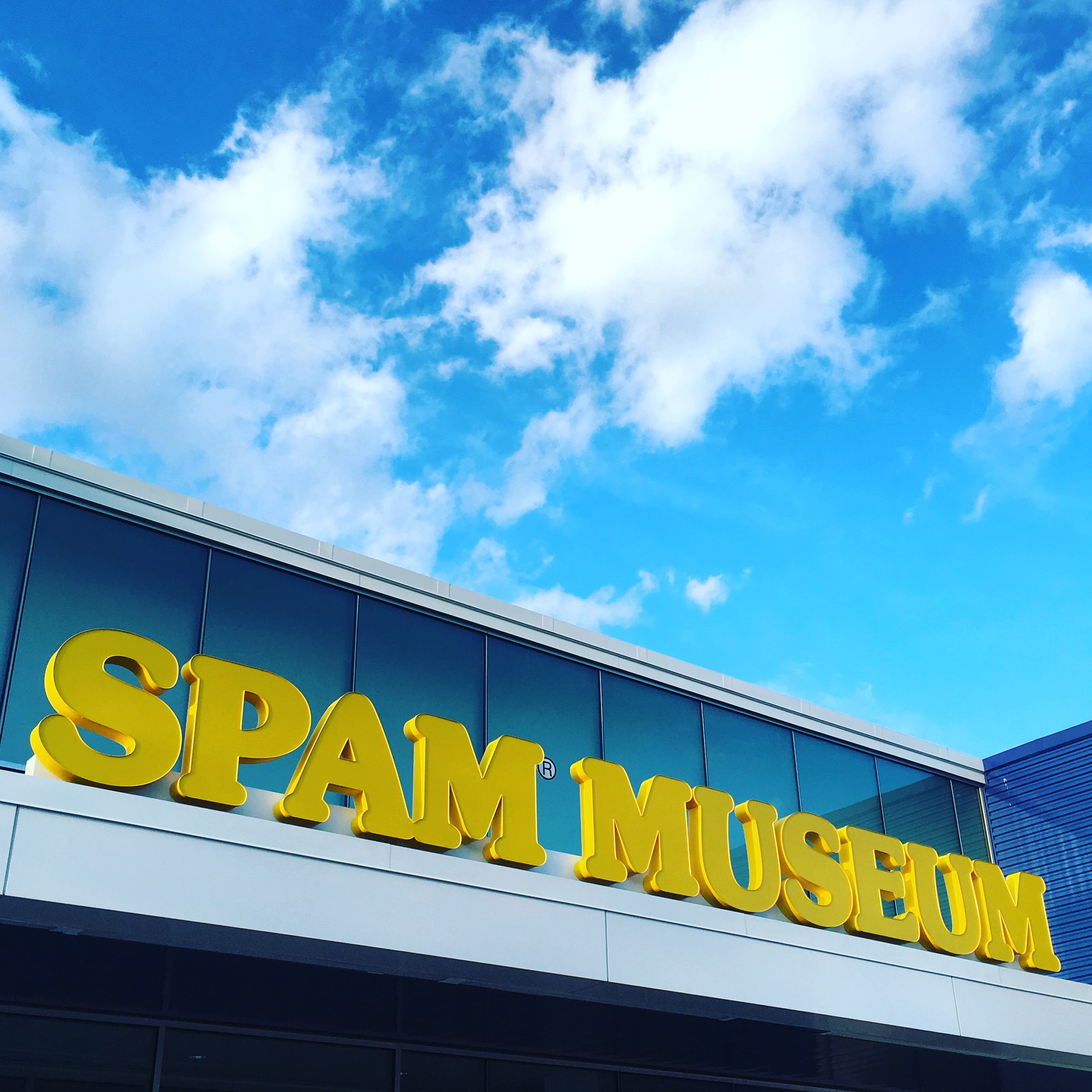
Spam is celebrated in Austin, Minnesota, home to the Spam Museum. The museum tells the history of the Hormel company, the origin of Spam, and its place in world culture.
Austin is also the location of the final judging in the national Spam recipe competition. Competing recipes are collected from winning submissions at the top 40 state fairs in the nation. The Spamettes are a quartet from Austin that only sing about Spam in parodies of popular songs. They first performed at the first Spam Jam in 1990 and continue to perform at various events.
Hawaii holds an annual Spam Jam in Waikiki during the last week of April. The small town of Shady Cove, Oregon, is home to the annual Spam Parade and Festival, with the city allocating US$1,500 for it.
Spamarama was a yearly festival from 1978 to 2007 in Austin, Texas, which had a peak attendance of 14,000. The themed events included a Spam cook-off (to contrast with Texas chili cook-offs) and the Spamalymplics, including a "Spam toss" and a Spamburger (a 12-ounce portion on a bun) eating contest. The event returned in 2019.
On August 8, 2021, L&L Hawaiian Barbecue established "National SPAM Musubi Day" to celebrate the iconic snack from Hawaii. The celebration also happened on August 8, 2022, and has since become an annual celebration.
Nutritional data


The ingredients of Spam vary according to variety and market; those of variety "Spam Classic" are pork with ham, salt, water, modified potato starch, sugar, and sodium nitrite. Sodium nitrite is a common preservative used in highly processed meat products. Excessive consumption has been linked to many health issues.
| Substance | Quantity per 100g serving |
|---|---|
| Energy | 1,300 kJ (310 calories or kilocalories) |
| Protein | 13g (26% daily value or DV) |
| Total fat | 27g (41% DV) |
| of which: saturated fat | 10g (49% DV) |
| Carbohydrates | 3g (1% DV) |
| Sodium | 1369 mg (57% DV) |
| Cholesterol | 70 mg (23% DV) |
| Vitamins and minerals (% DV) | 1% vitamin C, 1% calcium, 5% iron, 3% magnesium, 9% potassium, 12% zinc, and 5% copper |
| Net weight per package: 340 grams (12 oz.) |

Varieties
The official Spam website lists numerous different flavors of Spam products. Some varieties are permanent, but some others are limited time only. In addition to the variety of flavors, Spam is sold in tins smaller than the standard twelve-ounce (340 g) size. Spam Singles are also available, which are single sandwich-sized slices of Spam Classic, Lite, Hot & Spicy, and with Real Hormel Bacon, sealed in retort pouches.
References
References
- (2010). "Spam – Postwar Popularity". Hormel Foods.
- [https://www.livescience.com/32813-hormel-spam-no-mystery-meat.html How Do They Make Spam?] {{Webarchive. link. (February 19, 2022 . Live SCeine (2010-09-16). Retrieved 2022-01-28.)
- (2002). "Food Technology". Heinemann.
- "SPAM® Lite | SPAM® Varieties".
- "SPAM® Less Sodium | SPAM® Varieties".
- Grabianowski, Erb. (October 3, 2007). "How Spam (The Food) Works".
- (1937-07-23). "Hormel Announces Spam".
- Waxman, Olivia B.. (July 5, 2017). "Spam Turns 80: History and Origins of Canned Meat". [[Time (magazine).
- "SPAM Brand FAQ". Hormel Foods.
- DeJesus, Erin. (2014-07-09). "A Brief History of Spam, an American Meat Icon".
- Zimmerman, Dwight. (July 8, 2021). "A War Won With Spam (and a Few Other Things)".
- DeJesus, Erin. (2014-07-09). "A Brief History of Spam, an American Meat Icon".
- Heydt, Bruce. (June 2006). "Spam Again". 310 Publishing LLC.
- (July 4, 2007). "Spam: More than Junk Mail or Junk Meat".
- (July 24, 1994). "About Spam". The New York Times.
- Atkins, Annette. (2007). "Creating Minnesota: A History From the Inside Out". Minnesota Historical Society.
- (2012). "The Oxford Encyclopaedia of Food and Drink in America". [[Oxford University Press]].
- Waxman, Olivia B.. (July 5, 2017). "Spam Is Turning 80. Here's How the Canned Meat Took Over the World".
- Jackson, Sharyn. (July 5, 2017). "For Spam's 80th anniversary, ten outrageous retro recipes by the Minnesota meat maker". startribune.com.
- Smith, Andrew. (May 1, 2007). "The Oxford Companion to American Food and Drink". Oxford University Press.
- (January 1997). "Data Stream". [[Imagine Media]].
- Kim, Sojin; Livengood, Mark (1995). [http://digest.champlain.edu/archivepdf/DIGESTvol15.pdf "Ramen Noodles and Spam: Popular Foods, Significant Tastes"] {{webarchive. link. (October 6, 2014 , pp. 2–11. Retrieved September 18, 2014.)
- Martin, Andrew. (November 15, 2008). "Spam Turns Serious and Hormel Turns Out More". [[The New York Times]].
- DeJesus, Erin. (2014-07-09). "A Brief History of Spam, an American Meat Icon".
- Wyman, Carolyn. "Spam: A Biography". Harvest Books, 1999
- (November 14, 2008). "Spam Turns Serious and Hormel Turns Out More". [[The New York Times]].
- "SPAM® Frequently Asked Questions | SPAM® Brand".
- Lovegren, Sylvia. (2005). "Fashionable food: seven decades of food fads". University of Chicago Press.
- Corum, Ann Kondo. (1987). "Hawaii's Spam Cookbook". Bess Press.
- "Spam – Hawaiian Spam Musubi". Whatscookingamerica.net.
- Song, Jaymes. (June 11, 2007). "Burger giants wage Spam war". The Star.
- (2007-06-11). "Burger King to Serve Spam in Hawaii". Yahoo! News.
- Huppert, Boyd. (May 17, 2007). "Land of 10,000 Stories – Spam in Paradise". KARE11 News.
- (April 7, 2003). "The Spam That Isn't Via E-Mail". The New York Times.
- "Welcome - Waikiki Spam Jam".
- (October 22, 2017). "Hawaii's Spate Of Spam Heists". [[NPR]].
- "Why is Spam Brand a Household Name?".
- (July 21, 2006). "Organic smoke (and mirrors)". Saipan Tribune.
- (July 14, 2006). "A junkie waiting to happen". Saipan Tribune.
- (August 12, 2013). "Receta: Sandwichitos para fiestas".
- The story of Fitch Lovell Ambrose Keevil Phillimore Press 1972 {{ISBN. 978-0-85033-074-8
- "Tulip Food Company". english.tulip.dk.
- "Spam Fritters".
- (November 24, 2011). "As IDF bids adieu to Loof, a history of kosher Spam". J.
- (December 16, 2016). "Stay Warm With Filipino Brunch & A Cookie Competition This Weekend". Gothamist.
- (September 18, 2017). "Why Spam and Rice Is a Filipino Food Classic". Culture Trip.
- (December 12, 2017). "Why Filipinos Love Spam So Much". NextShark.
- (September 29, 2016). "What Is SPAM And Why Are Filipinos Obsessed With It?". RemitBlog.
- (June 24, 2014). "SPAM: A story of love and hate". Rappler.
- Matejowsky, Ty. (March 1, 2007). "SPAM and Fast-food "Glocalization" in the Philippines". Food, Culture and Society.
- "SPAM® Tocino | SPAM® Varieties".
- (October 8, 2009). "Hormel Foods Announces Donation to Philippines". Web wire.
- (2017-12-22). "一朝种草,三年拔。SPAM世棒又...双...叒回来了!!!". Sohu.
- Boyle, Matthew. (August 4, 2011). "Spam's Long March in China". Bloomberg BusinessWeek.
- "Why is Spam served in Hong Kong diners on top of macaroni noodles?". HK Magazine.
- DeJesus, Erin. (July 9, 2014). "A Brief History of Spam, an American Meat Icon".
- (2019). "An Exploratory Research for Reduction of Sodium of Korean HMR Product -Analysis on Labeling of Guk, Tang, Jjigae HMR Products in Korea-". The Journal of the Korea Contents Association.
- (September 5, 2014). "In Korea, It's Spam Time of Year". Wall Street Journal.
- Williamson, Lucy. (September 19, 2013). "Why is Spam a luxury food in South Korea?".
- (March 2019). "국내 HMR제품의 나트륨 저감화를 위한 탐색적 분석 :국내 국, 탕, 찌개류 HMR제품의 라벨 분석을 중심으로". 한국콘텐츠학회논문지.
- (2007). "Korea in the middle: Korean studies and area studies : essays in honour of Boudewijn Walraven". CNWS Publications.
- "스팸 (SPAM)". [[CJ CheilJedang]].
- (2006). "Survey on Korean Food Preference of College Students in Seoul - Focused on Side Dishes -". Journal of Nutrition and Health.
- (2005). "A Survey on the Seasonal Menu and Consumer Acceptance Test of Free Meals for the Elderly Facility in Sungnam Region". Journal of the Korean Society of Food Culture.
- Lewis, George H.. (March 5, 2004). "From Minnesota Fat to Seoul Food: Spam in America and the Pacific Rim". The Journal of Popular Culture.
- (January 26, 2014). "In South Korea, Spam Is the Stuff Gifts Are Made Of". The New York Times.
- Sieg, Linda. (March 12, 2008). "Okinawa cuisine: tofu, Spam and root beer". Reuters.
- (March 17, 2011). "Hormel Foods Pledges to Relief Efforts in Japan". Reuters.
- Kim, Clara. (2011-06-15). "Hey Ladies: Burger King Japan Has Spam Burgers, Just For You". [[Time (magazine).
- Bleier, Evan. (May 1, 2014). "Burger King introduces Spam and cheese burger in Japan, for breakfast". United Press International.
- Brown, Ray Broadus. (2001). "The Guide to United States Popular Culture". University of Wisconsin Press.
- (March 29, 2011). "Cuisine and Culture: A History of Food and People". John Wiley & Sons.
- [https://www2.bfi.org.uk/films-tv-people/4ce2b76ec175c Somewhere in Civvies (1943)] "Somewhere in Civvies", ''BFI''] {{Webarchive. link. (October 26, 2020 . Retrieved 21 October 2020)
- Danelle D. Keck, Jill M. Sullivan. (2007). "The Hormel Girls, ''American Music, Vol. 25, No. 3 (Fall, 2007), pp. 282–311''". University of Illinois Press.
- (2001). "Human geography of the UK: an introduction". Routledge.
- "Spam". Monty Python.
- "Merriam Webster Dictionary".
- "We dine well here in Camelot/We eat ham and jam and Spam a lot." [https://www.lyrics.com/lyric/35708677/Monty+Python/Knights+of+the+Round+Table+%28Camelot+Song%29 Knights of the Round Table (Camelot Song)] {{Webarchive. link. (October 31, 2021 . Retrieved October 30, 2021.)
- (May 2007). "The Oxford Companion to American Food and Drink". Oxford University Press.
- (2017-07-12). "SPAM® Brand Launches Campaign in the Philippines".
- (December 29, 2008). "The magical, mystical world of SPAM - AOL Finance". Aol.com.
- Bomey, Nathan. "Pumpkin spice version of Spam?! Hormel Foods introduces limited-edition Spam".
- (July 7, 2008). "Singing Spam's praises".
- Hormel Foods. (2010). "Spam Jam Waikiki 2010". Hormel Foods Corporation.
- Pitto, Christy. (December 7, 2010). "Shady Cove issues- riparian, event insurance and liability". Upper Rogue Independent.
- Currie-Buckner, Alexandra. (July 4, 2019). "Festival Founder Resurrects Spamarama After 12-Year Hiatus". Austin Chronicle.
- (2 September 2021). "First National Spam Musubi Day sold over 24,000 musubis".
- (8 August 2022). "It's National SPAM Musubi Day! Here's how to get one for free".
- (1998). "Preliminary Study on the Establishment of Proper Portion Using Consumed Size and Food Preference of Frequently Served Meals in the Elementary School Lunch Program in Inchon - 2. A Study on the Consumption Size of Frequently Served Meals in the Eleme". Journal of the Korean Dietetic Association.
- "Spam Classic?". Hormel Foods.
- "How Bad Is Sodium Nitrate for You?".
- "Nutritional Facts and Analysis for Spam". Nutritiondata.com.
- Gordon, Jeremy. (2018-03-28). "15 Flavors of Spam and Counting".
- "SPAM Products".
This article was imported from Wikipedia and is available under the Creative Commons Attribution-ShareAlike 4.0 License. Content has been adapted to SurfDoc format. Original contributors can be found on the article history page.
Ask Mako anything about Spam (food) — get instant answers, deeper analysis, and related topics.
Research with MakoFree with your Surf account
Create a free account to save articles, ask Mako questions, and organize your research.
Sign up freeThis content may have been generated or modified by AI. CloudSurf Software LLC is not responsible for the accuracy, completeness, or reliability of AI-generated content. Always verify important information from primary sources.
Report