From Surf Wiki (app.surf) — the open knowledge base
Southern tick-associated rash illness
| Field | Value |
|---|---|
| name | Southern tick-associated rash illness |
| synonyms | Masters' disease |
| image | Amblyomma americanum tick.jpg |
| caption | Lone star ticks can be carriers of southern tick-associated rash illness. |
| field | infectious disease |
Southern tick-associated rash illness (STARI) is a tick-borne disease resembling a mild form of Lyme disease, which occurs in southeastern and south-central United States. It is spread by bites from the lone star tick Amblyomma americanum. The actual cause is still unknown.
Signs and symptoms
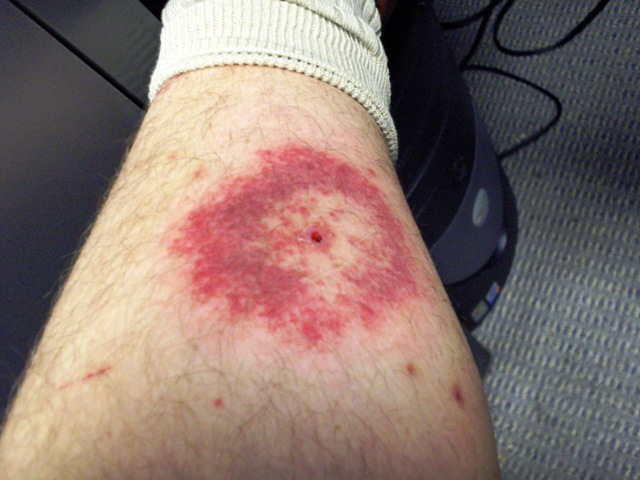
Diagnosis is based on a circular "bull's-eye" rash at the site of infection called erythema chronicum migrans, which is very similar to that seen in Lyme disease. However, the symptoms of STARI are mild and resemble influenza, with fatigue, muscle pains, and headache. Fever is sometimes seen, but is not characteristic.
Geography
As of 2018, most cases were from Southeastern Missouri, a few were from South Carolina, North Carolina, Georgia, and one case each in Mississippi and Long Island, New York.
Cause
The illness, first described in 1997, is a tick-borne disease carried by the lone star tick Amblyomma americanum. The tick had first been proposed as a possible vector of disease in 1984, and the illnesses associated with the tick was called "Lyme-like disease", but it was not recognized to be distinct from Lyme disease until the late 1990s.
In 2004, the disease was suggested to be caused by the related bacterium Borrelia lonestari, which is a spirochete first isolated in culture in 2004. However, the conclusion has been controversial since the spirochete has not been detected in many cases of the syndrome, which has led some authors to argue that the illness is not caused by a bacterial pathogen. Several studies have failed to detect Borrelia burgdorferi, which is the causative agent of Lyme disease, in patients from the southern United States.
It has been suggested that tick salivary toxins may play a role, as the toxins are similar to spiders, scorpions, and homologous to those found in snakes.
Treatment
Infections are treated with antibiotics, particularly doxycycline, and the acute symptoms appear to respond to these drugs.
Prognosis
No serious long-term effects are known for this disease, but preliminary evidence suggests, if such symptoms do occur, they are less severe than those associated with Lyme disease.
References
References
- Kirkland KB. (1997). "Erythema migrans-like rash illness at a camp in North Carolina: a new tick-borne disease?". Arch. Intern. Med..
- Schulze TL. (May 1984). "Amblyomma americanum: a potential vector of Lyme disease in New Jersey". Science.
- (July 1995). "Lyme and/or Lyme-like disease in Missouri". Missouri Medicine.
- (August 1998). "Physician-diagnosed erythema migrans and erythema migrans-like rashes following Lone Star tick bites". Arch Dermatol.
- (June 2008). "STARI, or Masters disease: Lone Star tick-vectored Lyme-like illness". Infect. Dis. Clin. North Am..
- (June 2001). "Borrelia lonestari infection after a bite by an Amblyomma americanum tick". J. Infect. Dis..
- Varela AS. (March 2004). "First Culture Isolation of Borrelia lonestari, Putative Agent of Southern Tick-Associated Rash Illness". J. Clin. Microbiol..
- Wormser GP. (February 2005). "Microbiologic Evaluation of Patients from Missouri with Erythema Migrans". Clin. Infect. Dis..
- Dennis DT.. (2006). "Reply to Masters. "Lyme-Like Illness Currently Deserves Lyme-Like Treatment"". Clinical Infectious Diseases.
- (October 2006). "Serologic Evaluation of Patients from Missouri with Erythema Migrans-Like Skin Lesions with the C6 Lyme Test". Clin. Vaccine Immunol..
- (December 2018). "Report of Non-Lyme, Erythema Migrans Rashes from New Jersey with a Review of Possible Role of Tick Salivary Toxins". Vector Borne and Zoonotic Diseases (Larchmont, N.Y.).
- (June 2008). "Southern Tick-Associated Rash Illness: Erythema Migrans Is Not Always Lyme Disease". South. Med. J..
This article was imported from Wikipedia and is available under the Creative Commons Attribution-ShareAlike 4.0 License. Content has been adapted to SurfDoc format. Original contributors can be found on the article history page.
Ask Mako anything about Southern tick-associated rash illness — get instant answers, deeper analysis, and related topics.
Research with MakoFree with your Surf account
Create a free account to save articles, ask Mako questions, and organize your research.
Sign up freeThis content may have been generated or modified by AI. CloudSurf Software LLC is not responsible for the accuracy, completeness, or reliability of AI-generated content. Always verify important information from primary sources.
Report