From Surf Wiki (app.surf) — the open knowledge base
Southampton Central railway station
Railway station in Hampshire, England
Railway station in Hampshire, England
| Field | Value | |||
|---|---|---|---|---|
| name | Southampton Central | |||
| symbol_location | gb | |||
| symbol | rail | |||
| image | Southampton Central Station.jpg | |||
| borough | Southampton, City of Southampton, England | |||
| grid_name | Grid reference | |||
| grid_position | ||||
| coordinates | ||||
| manager | South Western Railway | |||
| platforms | 5 (4 in passenger use) | |||
| code | SOU | |||
| classification | DfT category B | |||
| original | London and South Western Railway | |||
| pregroup | London and South Western Railway | |||
| postgroup | Southern Railway | |||
| years | 1 November 1895 | |||
| events | Opened as Southampton West | |||
| years1 | 1934–1935 | |||
| events1 | Enlarged | |||
| years2 | 7 July 1935 | |||
| events2 | Renamed Southampton Central | |||
| years3 | 10 July 1967 | |||
| events3 | Renamed Southampton | |||
| years4 | 29 May 1994 | |||
| events4 | Renamed Southampton Central | |||
| mpassengers | ||||
| {{Rail pass box | pass_year | 2018/19 | passengers= 6.665 million | interchange= 1.619 million}} |
| {{Rail pass box | pass_year | 2019/20 | passengers= 6.352 million | interchange= 1.481 million}}-- |
| {{Rail pass box | pass_year | 2020/21 | passengers= 1.448 million | interchange= 0.273 million}} |
| {{Rail pass box | pass_year | 2021/22 | passengers= 4.294 million | interchange= 0.875 million}} |
| {{Rail pass box | pass_year | 2022/23 | passengers= 5.496 million | interchange= 1.208 million}} |
| {{Rail pass box | pass_year | 2023/24 | passengers= 5.795 million | interchange= 0.842 million}} |
| {{Rail pass box | pass_year | 2024/25 | passengers= 6.173 million | interchange= 0.975 million}} |
| footnotes | Passenger statistics from the Office of Rail and Road |
-- Southampton Central (originally Southampton West and later known simply as Southampton) is a main line railway station serving the city of Southampton in Hampshire, southern England. It is on the South West Main Line and also serves the Wessex Main Line and the West Coastway Line. The station is approached from the London direction by passing through Southampton Tunnel and is 79 mi measured from .Railways in the United Kingdom historically are measured in miles and chains. There are 80 chains to one mile. It is the busiest station in Hampshire.
The station is managed by South Western Railway who operate the majority of services, including frequent trains between here and London Waterloo, Weymouth and Portsmouth & Southsea. Other operators are CrossCountry (providing services between here and Bournemouth, Birmingham New Street and Manchester Piccadilly), Great Western Railway (between here and Portsmouth Harbour, Bristol Temple Meads and Cardiff Central) and Southern (linking Southampton with Havant, Chichester, Worthing and Brighton).
History
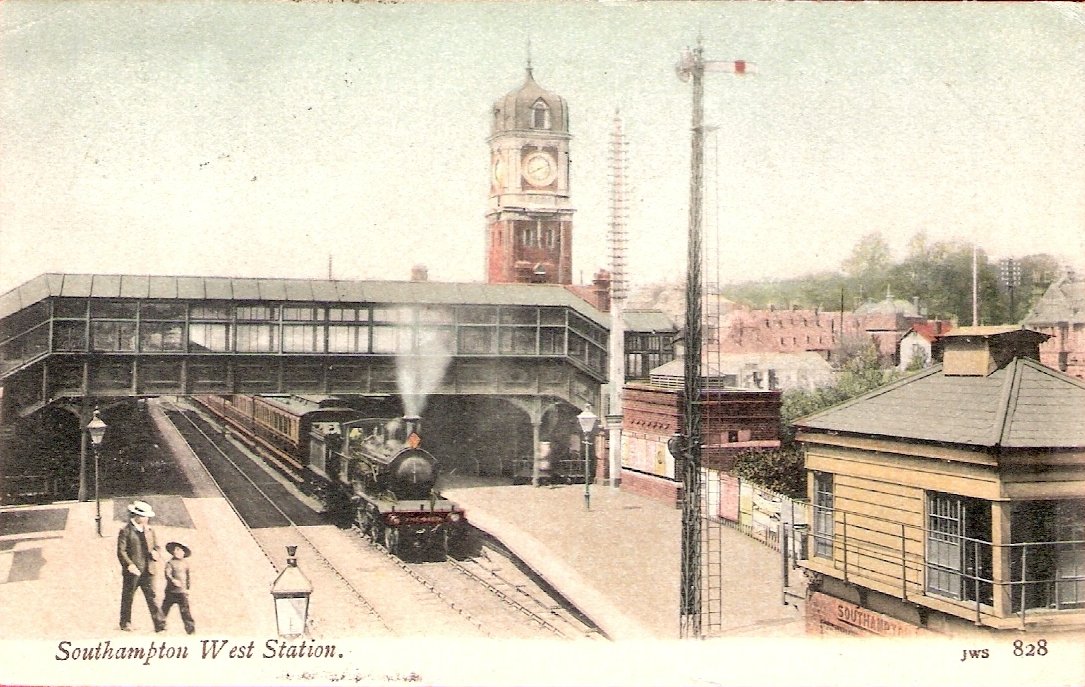
Southampton Central station was opened as Southampton West in 1895, to replace the smaller nearby West End station; this was originally named Blechynden when it opened in 1847. The station was on the seafront, specifically the stretch of water known as West Bay, with the water reaching right up to the southern edge of the platforms at high tide. A series of land reclamation projects to expand the docks, largely funded by the London and South Western Railway, culminated in the building of the vast New Docks (now Western Docks) between 1927 and 1934, which led to all of West Bay being reclaimed and the station becoming landlocked. The new land and the demand for new lines allowed the station to be enlarged and redeveloped in 1934–1935 (from two platforms to four) and it became Southampton Central. The new station buildings were largely constructed from concrete in the art deco style.
An air raid on 23 November 1940 damaged the buildings alongside platform one. The station was hit by two German parachute mines on 22 July 1941, which destroyed the ticket hall on platform four and damaged the island platform.
In preparation for the closure of Southern Terminus station, near to the docks in 1966, alterations were made to the station's parcel handling facilities to allow it to handle increased volume. At this point, it was renamed Southampton,
A partnership between Network Rail, South West Trains and Southampton City Council saw a £3million investment in the refurbishment of the station entrances and improved passenger facilities which was completed in 2012.
Former services
In December 2007, a number of changes were made to South West Trains, First Great Western and Southern services. The Waterloo to Southampton Central stopping service was extended to , replacing in part the former to stopping service. The former Poole train was extended to .
The to shuttle and the Salisbury to Southampton Central portion of the First Great Western to Southampton Central service were replaced by a South West Trains to Romsey via Southampton Central and Chandlers Ford service, which calls at Romsey twice on its journey. Southern introduced a new service from Southampton Central to , and the service to London Victoria then operated via rather than via . This service was later withdrawn by Southern in 2024, although a single northbound service in the morning peak was retained.
In December 2008, CrossCountry launched its new timetable with most trains operating between Bournemouth and , with one service originating at and one service on Saturdays terminating at . During a short period in the summer, there was also a single service on Saturdays to . , an hourly CrossCountry train runs from to , via , calling at Southampton Central. There were also around six trains per day in each direction on the to route, via , which occasionally extended to Southampton Central, but no longer operates.
Platform layout
All the platforms are split into two sections, A at the east and B at the west, allowing two services to occupy a platform at the same time, or to allow for trains dividing into two portions or attaching to make one train. This dual use occurs throughout the day on platforms 2 and 3, and in peak hours on platforms 1 and 4.
Platforms 1 and 4 are side platforms facing the fast lines. These platforms accommodate CrossCountry's service between Manchester Piccadilly and Bournemouth; Great Western Railway's service between Cardiff Central and Portsmouth Harbour; and fast services between London Waterloo and Weymouth operated by South Western Railway.
Platforms 2 and 3 are on an island, facing the slow lines. Services typically serving these platforms include South Western Railway's local services between Romsey and Salisbury, and between here and Portsmouth & Southsea. Southern services between here and Brighton also serve these platforms.
There is also an ex-Red Star Parcels bay on the Bournemouth end of platform 4. Previously numbered as platform 5, stopping services between here and Brockenhurst used this platform, but the platform can no longer be used for passenger services due to the lack of a proper starting signal. It is now used for the stabling of spare units. Up and down goods loops are located a short distance to the west of the station. These allow terminating trains to clear the platforms for through services if required, and also to allow passenger services to pass freight or empty coaching stock trains.
Services

Southampton Central is served by four train operating companies, with the following typical off-peak service patterns in trains per hour (tph):
South Western Railway
- 2 tph to London Waterloo (fast), taking approximately 80 minutes
- 1 tph to
- 1 tph to Weymouth and , dividing at Bournemouth
- 1 tph to (stopping)
- 1 tph to (stopping)
- 1 tph to (stopping)
- 1 tph to via
- 1 tph to via and Romsey.
Southern
- 2 tph to via .
Great Western Railway
- 1 tph to via
- 1 tph to .
CrossCountry
- 1tph to Bournemouth
- 1tph to
Romsey can be reached by trains departing in both directions: by South Western Railway via in the up direction, and by South Western Railway and Great Western Railway via in the down.
Connections
As well as services to the wider area, there are bus services connecting the station to:
- the city centre
- the Isle of Wight Red Funnel and Blue Funnel ferries
- the National Oceanography Centre
- Southampton Airport
- the University of Southampton's Highfield Campus
References
Notes
Citations
References
- Butt, R.V.J. (1995). ''The Directory of Railway Stations'', Patrick Stephens Ltd, Sparkford, {{ISBN. 1-85260-508-1, p. 214.
- "Office of Rail & Road".
- Moody, Bert. (1997). "Southampton's Railways". Atlantic Publishers.
- Moody, Bert. (1997). "Southampton's Railways". Atlantic Publishers.
- Moody, Bert. (1997). "Southampton's Railways". Atlantic Publishers.
- Moody, Bert. (1997). "Southampton's Railways". Atlantic Publishers.
- "Planning Southampton City Centre City Centre Action Plan, Part C". Southampton City Council.
- "Timetable changes for December – South West Trains".
- ""First Great Western – Draft December 07 to May 08 Timetable"".
- "CrossCountry December 2008 timetable".
- "CrossCountry December 2023 timetable".
- "South Western Railway timetable Southampton Central-London Waterloo".
- Network Rail Sectional Appendix Wessex, Network Rail 2018
- (2 June 2024). "Timetables". South Western Railway.
- (2 June 2024). "Timetables". Southern Railway.
- (2 June 2024). "Train Times". Great Western Railway.
- (2 June 2024). "Train Timetables". CrossCountry.
This article was imported from Wikipedia and is available under the Creative Commons Attribution-ShareAlike 4.0 License. Content has been adapted to SurfDoc format. Original contributors can be found on the article history page.
Ask Mako anything about Southampton Central railway station — get instant answers, deeper analysis, and related topics.
Research with MakoFree with your Surf account
Create a free account to save articles, ask Mako questions, and organize your research.
Sign up freeThis content may have been generated or modified by AI. CloudSurf Software LLC is not responsible for the accuracy, completeness, or reliability of AI-generated content. Always verify important information from primary sources.
Report