From Surf Wiki (app.surf) — the open knowledge base
South West Trains
Former Stagecoach-owned English train operator

Former Stagecoach-owned English train operator
| Field | Value | ||
|---|---|---|---|
| name | South West Trains | ||
| image | SWT 444001 Clapham Junction.jpg | ||
| caption | Class 444 Desiro at in 2011 | ||
| logo | SouthWestTrainsLogo.svg | ||
| regions | |||
| secregions | |||
| fleet | |||
| franchise | South West | ||
| 4 February 1996 – 3 February 2007 | |||
| South Western | |||
| 4 February 2007 – 20 August 2017 | |||
| stations | 213 | ||
| stationsop | 185 (including Island Line) | ||
| parent_company | Stagecoach | ||
| abbr | SW | ||
| map | [[File:South West Trains route map 2010.svg | 300px | Route map]] |
| successor | South Western Railway | predecessor=Network SouthEast | |
| Island Line (Island Line franchise) |
the former Stagecoach-owned operator of the South Western railway franchise
4 February 1996 – 3 February 2007 South Western 4 February 2007 – 20 August 2017 Island Line (Island Line franchise) Stagecoach South Western Trains Limited, trading as South West Trains (SWT), was an English train operating company owned by Stagecoach, which operated the South Western franchise between February 1996 and August 2017.
SWT operated the majority of commuter services from its Central London terminus at London Waterloo to South West London and was the key operator for outer suburban and regional services in the counties of Surrey, Hampshire and Dorset. It also provided regional services in Devon, Somerset, Berkshire, Wiltshire and on the Isle of Wight through its Island Line subsidiary. Unlike the majority of franchises, SWT operated without subsidies, being a profitable concern due to the high number of commuters that regularly used its services.
The area of operation was the former South Western division of Network SouthEast, and was also roughly that of the pre-1923 London & South Western Railway (excluding everything west of Exeter). As part of the privatisation of British Rail, SWT was taken over by Stagecoach. In 2004, the franchise was retained by Stagecoach when re-tendered. In 2007, the franchise was merged with the Island Line franchise to form a newly extended South Western franchise, which was won by Stagecoach. When next tendered, the franchise was awarded to South Western Railway which took over the franchise on 20 August 2017.
History
Origins
As a consequence of the privatisation of British Rail during the mid 1990s, railway operations were segmented into various franchises, one of which being the South Western franchise. These franchises were awarded to various privately owned companies following an evaluation of competitive bids. During 1995, it was announced that the Director of Passenger Rail Franchising had awarded the South West Trains franchise to the Scottish transport group Stagecoach. Operations commenced on 4 February 1996, with South West Trains' first train, the 05:10 Twickenham to London Waterloo; it was the first privatised scheduled train to operate for 48 years.
In April 2001, the Strategic Rail Authority awarded Stagecoach a new franchise for the region, its bid having been judged to be superior to those from its rivals, FirstGroup / NedRailways and Sea Containers. The 2001 franchises awarded were (as promulgated) to run for twenty years; however, only one year later, the Strategic Rail Authority decided to reduce the duration of franchises, thus South West Trains was awarded a three-year franchise starting on 1 February 2004. Shortly following this award, SWT placed a substantial order for new rolling stock for the network, it was described as being the largest such order in British history.
During the early days of its franchise, SWT gained notoriety for enacting severe cuts to its services, which were typically attributed to the shortage of drivers; the company sought to remedy this by seeking to hire additional drivers. SWT also implemented significant improvements upon the network, including replacing much of the inherited British Rail-era rolling stock, along with the refurbishment of most stations, which included increasing their accessibility to disabled passengers. There was also an emphasis on the improving the customer experience, such as better access to service information. During the early 2000s, improvements included the introduction of new rail services and the reopening of Chandler's Ford station in Hampshire.
Changes
From May 2004, a smoking ban on all SWT services was introduced; this move, which came partly in response to a fire caused by a cigarette left next to an under-seat heater during the previous year that raised safety concerns, also pre-empting the public smoking ban that was introduced two years later. Additional staff were deployed onboard trains to help enforce the change. At the time, most other commuter services had already banned smoking, and the measure was claimed by the Evening Standard to be popular with the majority of the travelling public.
On 12 December 2004, the company completely recast its timetable, the first occasion that such an exercise had been performed in the South West region since 1967. This was reportedly motivated by ambitions to bring service provision into line with changing demand and to take into account the different characteristics of modern rolling stock. Within a year, the new timetable had delivered an increase in reliability and punctuality across the network, measured as a 12% improvement in the operator's Public Performance Measure. Further major changes to the timetable followed in subsequent years, including the restoration of services between Yeovil and Yeovil Pen Mill that had been withdrawn under the Beeching cuts.
During December 2005, the Department for Transport (DfT) announced that Arriva, FirstGroup, MTR/Sea Containers, National Express and Stagecoach had been shortlisted to tender for the new South Western franchise, which combined the South West Trains and Island Line Trains franchises; National Express later withdrew. In September 2006, the DfT awarded the franchise to Stagecoach, the new franchise starting on 4 February 2007, for a period of ten years.
Throughout the operation of the franchise, passenger numbers grew year on year, along with rapid spikes in numbers occurring in some years. While many franchises required government funding to sustain their services, SWT operated without any subsidies and was a profitable venture. This outcome was largely on account of the high proportion of commuters that made frequent use of its services. One of the franchise's major ongoing concerns was the overcrowding that occurred on some services, particularly around rush hour, thus SWT's management paid considerable attention to increasing capacity when feasible.
Major measures performed by SWT to expand the network's capacity included improvement works at London Waterloo station and the procurement of new rolling stock. Christian Roth, SWT's engineering director, claimed in 2015 that the firm was in the process of delivering similar capacity improvements to the Thameslink programme at a tenth of the cost and a quarter of the time. While some rival companies chose to pursue driver-only operated trains, eliminating the necessity of a guard, SWT senior manager Brian Souter promised to keep a guard on every service; one consequence of this agreement was strong relations between the company and the trade unions.
Further measures were also proposed by SWT; Tim Shoveller, the company's managing director, periodically spoke out on his desire to eventually introduce double-decker trains to serve its busiest commuter routes. While typically viewed as an effective means of increasing capacity, such ambitions were complicated by multiple factors, the principal of which that there were no double-deck trains in operation that were believed to be suitable for SWT's needs, thus likely necessitating the development of an original design. Procuring a small fleet of bespoke rolling stock would certainly incur a steep price rise over conventional rolling stock, while handling the increased dwell times typically necessary when operating double-deck trains would also adversely impact the timetable; finally, no such rolling stock could be operated until the completion of track lowering across substantial portions of the network, particularly around bridges and tunnels, for sufficient headroom to be achieved.
Between 2012 and 2015, Stagecoach partnered with the British railway infrastructure owner Network Rail to jointly operate London Waterloo via a single management team that operated both tracks and trains in and around the station from a on-site joint control room. At the time, the partnership was hailed as an advancement for rail operations, However, the arrangement was dissolved in 2015 without any official explanation, although anonymous insiders claimed the cause to be Network Rail's reluctance to devolve power over its centralised infrastructure to individual routes, while Stagecoach desired local decisions to be made in partnership.
Demise
In March 2013, the Secretary of State for Transport announced the DfT was in talks with Stagecoach to extend the franchise until April 2019. At one point, it seemed certain that the franchise would be renewed, information to that effect having been included on the Government's published Rail Franchise Schedule in October 2014. However, in July 2015, Stagecoach confirmed that talks had failed and the franchise would be relet. This outcome was viewed by several industry commentators as being unexpected and inconvenient in its timing; the periodical Rail speculated that Stagecoach's rejection had been largely due to government officials feeling that the state was not receiving a sufficiently large share of the profits being generated.
Stagecoach and a FirstGroup / MTR Corporation joint venture were shortlisted on 4 February 2016 to bid for the new franchise. On 27 March 2017, the franchise was awarded to South Western Railway, in spite of concerns that it would result in a single company holding a monopoly on services between London and the West of England, Dorset and Somerset, due to FirstGroup also operating the Greater Western franchise in those regions.
Services
South West Trains was the key operator for western Surrey, Hampshire and Dorset, and also served Berkshire, Wiltshire, Somerset and Devon. In Greater London, it operated all National Rail services (other than London Overground) in the Royal Borough of Kingston upon Thames and the London Boroughs of Richmond-upon-Thames and Hounslow, and also served the London Boroughs of Merton, Wandsworth and Lambeth.
Most SWT services ran on electrified lines using the 750 V DC third-rail system. A diesel fleet was used for services on the West of England line to Salisbury, Exeter and Bristol, using the unelectrified track beyond Worting Junction just west of Basingstoke, and for Salisbury to Southampton via Romsey services which also served Eastleigh. By 2015, SWT was reportedly operating roughly 1,600 train services each day and managing in excess of 200 stations.
From Waterloo, SWT's London terminus, long-distance trains ran to southern England, including the major coastal population centres of Portsmouth, Southampton, Bournemouth, Poole and Weymouth. There were also trains to Reading, Exeter and Bristol, but these were not the principal fast services from London to those cities, which are operated from by Great Western Railway. The majority of its passengers were on suburban commuter lines in inner and south-west London, Surrey, east Berkshire, and north-east Hampshire.
After privatisation in 1996, the network changed considerably, no longer serving West Croydon, Sutton, 'Coastway' stations between Chichester and Brighton, or the Reading to Basingstoke line. Services to Bristol (introduced in 2004 to replace withdrawn Arriva Trains Wales services), Mottisfont and Dunbridge and Dean were introduced after the start of the franchise. Its longstanding services beyond Exeter to Paignton, Plymouth and Penzance, which ran in competition with First Great Western and its predecessors, ceased in December 2009 so as to release stock for the hourly Waterloo to Exeter service.
As with most rail companies, non-folding bicycles were banned from peak-time trains to and from London. However, these restrictions applied only to cyclists boarding or alighting in the area bounded by Hook, Alton, Guildford, Reading and Dorking. The aim was to maximise available passenger space on the most crowded trains.
South West Trains had Quiet Zones, similar to the Quiet Coaches on trains operated by certain other Train Operating Companies. Quiet Zones were available on most outer-suburban services and on some express services and are indicated by notices in the windows and signs on the doors. Passengers in these zones were requested not to use mobile phones to take calls or play music out loud.
Routes
South West Trains operated suburban and long-distance trains. Main destinations included: London Waterloo, Clapham Junction, , Richmond, Twickenham, Hounslow, Ascot, Staines, Reading, Windsor & Eton Riverside, Kingston, Raynes Park, Motspur Park, New Malden, Chessington South, Surbiton, Leatherhead, Weybridge, Dorking, Effingham Junction, Woking, Guildford, Aldershot, Alton, Farnborough Main, Fleet, Basingstoke, Haslemere, Andover, Winchester, Eastleigh, Southampton Central, Romsey, Salisbury, Fareham, Portsmouth & Southsea, Brockenhurst, Portsmouth Harbour, Bournemouth, Westbury, Bristol Temple Meads, Weymouth, Yeovil Junction and Exeter St Davids.
Main lines


The seven main lines operated by SWT were:
- The South West Main Line (SWML) to Southampton Central, Bournemouth and Weymouth. 2 trains an hour through to Weymouth (1 fast and 1 semi-fast) and 1 train an hour to Poole (stopping) Mondays-Saturdays, with Sunday Bournemouth services extended to Poole.
- The Portsmouth Direct line via Guildford and Haslemere: leaves the main line at Woking. 4 trains per hour to Guildford, then 1 semi-fast service and 1 stopping service to Haslemere. The semi-fast service continued as a stopping service to Portsmouth. The fast services ran approximately half-hourly Mondays-Saturdays, 2 trains per hour (1 fast, 1 stopping from Guildford) on Sundays.
- The West of England Main Line to Salisbury, Yeovil Junction and : leaves the main line at Basingstoke.
- Wessex Main Line (part): Salisbury to Bristol Temple Meads. This service originated from London Waterloo and divides at Salisbury.
- Heart of Wessex Line (part): Yeovil Junction to Yeovil Pen Mill / Frome. This service originates from London Waterloo and divides at Yeovil Junction.
- London Waterloo to Portsmouth Harbour via Basingstoke and Eastleigh. Hourly service off-peak Mondays-Saturdays, merges with the Poole train on Sundays.
- London Waterloo to Reading via Staines-upon-Thames, Ascot and .
Suburban services
Suburban services diverged from the above routes. Taken in order westwards from Waterloo, travelling down the SWML, they are:
- Waterloo–Reading line: from Clapham Junction
- The Hounslow Loop line from Barnes to Whitton or Feltham
- The Windsor branch from Staines-upon-Thames
- The Chertsey loop line from Virginia Water to Weybridge
- The Ascot to Guildford line via Aldershot
- The Mole Valley Line, from Raynes Park to Dorking via Epsom
- The Chessington branch from Motspur Park
- The branch to Guildford from Leatherhead
- The Kingston loop line, from New Malden (Main Line) to Twickenham (Reading Line)
- The Shepperton branch from Teddington; normally, these services run via New Malden, some peak services run via Twickenham
- The New Guildford line, to Guildford via Cobham from Surbiton (travellers from Guildford to London can also travel via the main line through Woking)
- The Hampton Court branch, also from Surbiton
- The Alton branch, from Brookwood also serves the Mid Hants Railway, a heritage line
Other services
- Southampton local lines: Salisbury to Romsey via Southampton Central and Chandler's Ford (previously this service ran to Totton)
- Lymington branch line (Brockenhurst to Lymington Pier)
- Island Line, Isle of Wight, Ryde Pier Head to Shanklin
- Southampton Central to Portsmouth & Southsea
Ticketing
Travelcards
London Travelcards were available and widely used for journeys into Greater London beyond any of the South West Trains stations. They were valid on London Buses, Tramlink, Docklands Light Railway, London Underground and national rail services within the London travelcard area. All tickets and (London) Travelcards were available on weekly, monthly and annual bases (such tickets are traditionally known as season tickets), a pre-requisite for which is a passport-sized photograph for a booking hall to issue a nationally valid railcard. All ticket pricing structures are regulated by the Office of Rail & Road.
Daily tickets fell into four categories: Peak 'Anytime', Off Peak, Super Off Peak and Advance (pre-booked, long distance). These were broken down into whether the user requires a Single, Return (valid for one calendar month) or a Day Return.
Smartcards
Oyster pay-as-you-go could be used on services within Greater London. Oyster cards holding season tickets were accepted within the London Travelcard area, in the same way as normal paper Travelcards and season tickets.
In November 2010, the DfT announced that passengers would be able to top up Oyster cards at all stations operated by South West Trains in the London Travelcard area from May 2011. SWT was the last rail company franchise to offer this facility (except at Wimbledon and Richmond stations) for passengers using suburban rail services within the London Travelcard area.
The smartcard scheme for tickets on the national rail system was extended in early 2010 to cover the lines from Weymouth to Basingstoke and from Staines to Wokingham, and on the Isle of Wight, in addition to the current trial area between Staines and Windsor. It was also announced that SWT proposed to reduce operating hours at 24 of its ticket offices.
Penalty fares
South West Trains issued penalty fares for passengers travelling by train without a valid ticket. However, the company had planned to install at least one self-service ticket machine at each of its served stations in the bid to stop fare evasion. In 2009, ticket gates were installed at Waterloo to improve revenue protection.
Megatrain
Main article: Megatrain
Stagecoach, SWT's parent company, sold seats on some off-peak services under the Megatrain brand from Mondays to Saturdays. This used a similar low-cost model to its Megabus service. Megatrain tickets were available on certain services expected to be lightly loaded. Tickets were generally between London Waterloo and other principal stations, and ticket-holders are assigned to a specific train.
Performance
Latest performance figures released by Network Rail for period 5 (2014/15) were 88.2% (Public Performance Measure – PPM) and 88.9% (Moving Annual Average – MAA) for the 12 months up to 16 August 2014.
Rolling stock
Electric
Desiro fleet
The introduction of Desiro rolling stock built by Siemens was to replace the old , , and slam-door trains, which were life-expired and did not meet modern health and safety requirements; a franchise commitment was to replace all slam-door stock by the end of 2005. The Desiro trains have on-board information systems and full air-conditioning. Their faster acceleration is counterbalanced by the need to dwell longer at each station, since they have fewer doors.
The Desiro stock comes in two variants – units which have four 20 m cars and are mainly used on suburban and outer-suburban services, and units which have five 23 m cars as well as intercity-style door layouts and are used on longer-distance services to and .
British Rail EMUs (Class 455)
South West Trains operated a fleet of metro-style commuter trains on services from London Waterloo to Shepperton, Hampton Court, Woking, Guildford, Dorking and Chessington, as well as services on the Kingston and Hounslow loops and occasionally on Windsor line services. These were built for British Rail.
A full refurbishment programme started in 2004 on the fleet of 91 four-car units, and was completed in March 2008. Modifications included a new 2+2 seating layout with high-back seats, CCTV, cycle storage, wheelchair space, doors that open further to allow for faster alighting, and additional passenger information systems. Almost all of the trains were then withdrawn in early 2026.
British Rail EMUs (Class 456)
All 24 two-car EMUs were transferred from Southern to SWT, with the first units entering SWT service on 23 March 2014. These early 1990s-built units are compatible with the existing Class 455 fleet and are coupled with these to form ten-car trains, increasing capacity on some local services in and out of Waterloo.
Coradia Juniper fleet (Class 458/0 – 458/5)
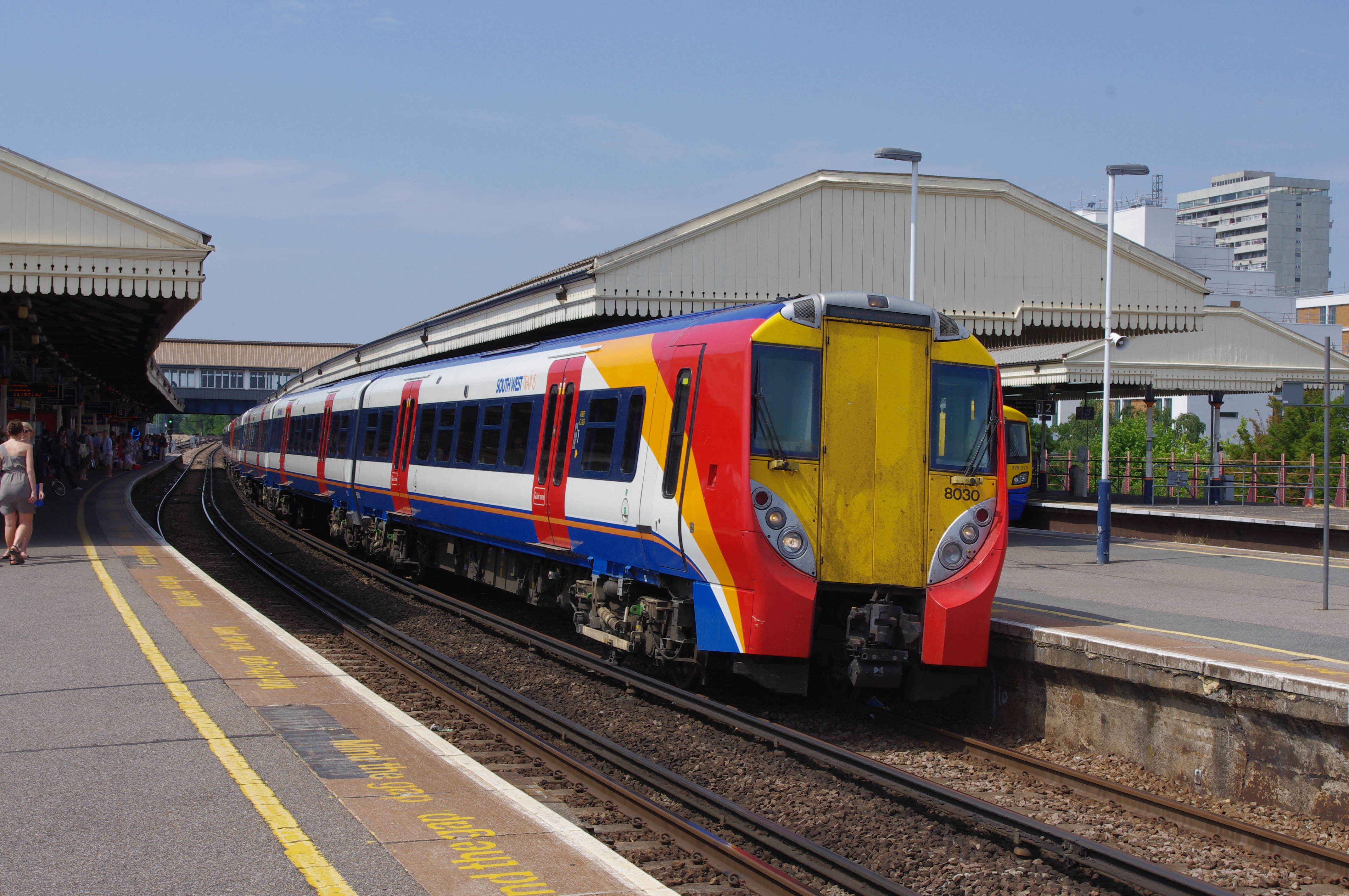

Thirty of these four-car units were ordered by South West Trains in 1998, to create extra capacity and to replace some of the ageing Class 411 (4-CEP) trains, which at the time were on short-term lease. Deliveries of these trains began in 1998.
The class suffered major technical problems, so in the end, none of the older trains were withdrawn from service at that time. It was six more years, in 2004, before the full fleet was in service. In 2003 and 2004, reliability was so poor that, although they were only six years old, South West Trains decided that the units should be replaced by 2005 with the newer Desiro units. Only a handful of units were required each day to help maintain services from Waterloo to Reading, and these had been expected to cease after 31 July 2006, when the lease with the rolling stock company expired. An application by SWT to extend this by six months was refused, as the class did not meet all the requirements of disability legislation.
However, later it was decided that, on or before the start of the new franchise in February 2007, the class would be reinstated and take over all operations on the Waterloo to Reading line, indirectly covering the loss of the Class 442. They have been fitted with new, larger destination screens that comply with the disability legislation, but the trains still fall foul in some other areas, such as the height of the door-open buttons.
All 30 Class 458 trains were split up and the 120 vehicles reconfigured into 36 five-car sets, incorporating 60 extra vehicles from the mechanically similar formerly used on Gatwick Express services. The five-car sets are now designated Class 458/5 and since 2014 have been coupled together to form ten-car trains.
The first two of the five-car sets were delivered in October 2013, and underwent testing ahead of the introduction of the first ten-car train into service in December 2013. Passenger service started in March 2014, with the work concluding in 2016, thereby rendering the Class 458/0 extinct.
Diesel

South West Trains had 11 two-car units and 30 three-car units (22 Class 159/0 and eight Class 159/1).
The Class 159/1 units were converted at Wabtec, Doncaster from Class 158s, received from First TransPennine Express in exchange for s. Eleven further two-car Class 158 units were received from First TransPennine Express, which were also refurbished at Wabtec.
The Class 159 has on occasion been used for railtours.
Locomotives
Although South West Trains did not operate locomotive-hauled services, until 2009 it maintained three locomotives for recovery duties. Locomotive 73109 had been in service with SWT since the start of the franchise; the other two, 73201 and 73235, were acquired from Gatwick Express in 2005. 73235 was the only one of the three locomotives to be owned by South West Trains at the end of the Franchise.
Fleet at end of franchise
| Class | Image | Type | Top speed | Carriages | Number | Routes operated | Built | mph | km/h | |
|---|---|---|---|---|---|---|---|---|---|---|
| Class 73 | [[File:73201 at Woking.jpg | 130px]] | Electro-diesel locomotive | 90 | 145 | N/A | 1 | Thunderbird Locomotive | 1966 | |
| Class 158 Express Sprinter | [[File:South West Trains class 158.jpg | 130x130px]] | ||||||||
| [[File:South West Trains' class 158 DMU 158880 at Cardiff Central (32886440142).jpg | 130px]] | DMU | 2 | 11 | London Waterloo – Salisbury / Exeter St Davids (Occasionally) / Bristol Temple Meads | |||||
| Exeter St Davids – Honiton / Axminster (Weekday service) | ||||||||||
| Romsey – Salisbury via Southampton Central | ||||||||||
| Brockenhurst – Lymington Pier (Weekday services) | ||||||||||
| [[File:Class 158 South West Trains Diagram.png | 320px]] | |||||||||
| Class 159 South Western Turbo | [[File:Westbury - SWT 159107+159018 diverted Exeter train.JPG | 130x130px]] | ||||||||
| [[File:SWT 159 New 2.jpg | 130x130px]] | DMU | 90 | 145 | 3 | 30 | West of England / Heart of Wessex / Wessex Main Lines: | |||
| London Waterloo – Salisbury / Bristol Temple Meads / Exeter St Davids / Yeovil Pen Mill / Frome | ||||||||||
| Portsmouth Harbour – Basingstoke (Morning Service) | ||||||||||
| Portsmouth Harbour – Southampton Central (Occasionally) | ||||||||||
| [[File:Class 159 South West Trains Diagram.PNG | 480px]] | |||||||||
| Class 444 Desiro | [[File:444029 at Woking.jpg | 130px]] | EMU | 100 | 160 | 5 | 45 | Main Line Routes: | ||
| London Waterloo – Poole / Weymouth | 20032004 | |||||||||
| [[File:Class 444 South West Trains Diagram.PNG | 800px]] | |||||||||
| Class 450 Desiro | [[File:Reading - SWR 450115+450554 (SWT livery).jpg | 130x130px]] | EMU | 100 | 160 | 4 | 127 | Main Line Routes: London Waterloo – Portsmouth Harbour (Shared with Class 444s weekdays and Sundays)/ Alton / Basingstoke / Poole (Occasionally) / Reading | ||
| Southampton Central – Portsmouth & Southsea | ||||||||||
| Brockenhurst – Lymington Pier (Weekend services) | 20022006 | |||||||||
| [[File:Class 450 South West Trains Diagram.PNG | 640px]] | |||||||||
| Class 455 | [[File:Reading SWT - 455721-455863.JPG | 130x130px]] | ||||||||
| [[File:Guildford railway station MMB 24 455853.jpg | 130px]] | |||||||||
| [[File:455904 D London Waterloo.JPG | 130px]] | EMU | 75 | 120 | 4 | 91 | Inner Suburban Routes: | |||
| London Waterloo – Shepperton / Hampton Court / Woking / London Waterloo via Hounslow /London Waterloo via Strawberry Hill / Dorking / Guildford via Oxshott or Epsom / Chessington South / Windsor & Eton Riverside | ||||||||||
| [[File:Class 455 South West Trains Diagram.PNG | 640px]] | |||||||||
| Class 456 | [[File:SWR 456 014 at Guildford.jpg | 130x130px]] | EMU | 75 | 120 | 2 | 24 | Used on suburban services in conjunction with services operated by Class 455 units to make 8 & 10 coach trains. | 19901991 | |
| [[File:Class 456 South West Trains Diagram.png | 320px]] | |||||||||
| Class 458/5 Coradia Juniper | [[File:458 526 leaving Waterloo.jpg | 130x130px]] | EMU | 75 | 120 | 5 | 36 | Outer Suburban Services: | ||
| [[File:Class 4585 South West Trains Diagram.png | 800px]] | |||||||||
| Class 707 Desiro City | [[File:Reading - SWT 707004+707006 on test (GWR 166220).JPG | 130px]] | EMU | 100 | 160 | 5 | 2 | London Waterloo – Windsor & Eton Riverside via Staines upon Thames | 20162017 | |
| [[File:Class 707 South West Trains Diagram.png | 800px]] |
Isle of Wight Fleet
| Class | Image | Type | Top speed | Carriages | Number | Routes operated | Built | mph | km/h | |
|---|---|---|---|---|---|---|---|---|---|---|
| Class 483 | [[File:483004 Smallbrook Junction.JPG | 130px]] | EMU | 45 | 72.5 | 2 | 6 | Ryde Pier Head – Shanklin |
Past fleet
Former units operated by South West Trains include:
| Class | File | Type | Number | Withdrawn | |||
|---|---|---|---|---|---|---|---|
| Class 170 Turbostar | [[File:Stdenys 170392.jpg | 100px]] | DMU | 9 | July 2007 | ||
| Class 411 (4Cep) | [[File:CEP (Corridor Electro-Pneumatic) in a Quarry - geograph.org.uk - 639863.jpg | 100px]] | EMU | 29 | May 2005 | ||
| Class 412 (4Bep) | [[File:2325 departing London Waterloo.jpg | 100px]] | 7 | ||||
| Class 421 (4Cig) | [[File:1313 at London Waterloo.JPG | 100px]] | 34 | ||||
| Class 423 (4Vep) | [[File:3414 and 3419 at London Waterloo.JPG | 100px]] | 66 | ||||
| Class 442 Wessex Electrics | [[File:2407 at Moreton, Dorset.JPG | 100px]] | 24 | February 2007 | |||
| [[File:Class 442 041.png | left | frameless | 800px]] | ||||
| [[File:960012.jpg | 100px]] | DMU | 1 | March 2009 | |||
| Class 458/0 Coradia Juniper | [[File:Clapham Junction railway station MMB 24 458004 458XXX.jpg | 100px]] | EMU | 30 | 20132015 | ||
| [[File:Class 458 in swt livery.png | left | frameless | 640px]] |
Wessex Electrics fleet
These units were initially dedicated to the Weymouth line but, in the 1990s, began to be operated on the London to Portsmouth direct line also. In preparation for the Class 444 and Class 450 "Desiro" units taking over from the slam-door fleet, the Wessex Electrics were withdrawn from Portsmouth line services and were again wholly dedicated to the Weymouth line.
South West Trains announced that it would be withdrawing these units, and they last ran on 3 February 2007. This move coincided with SWT reinstating all Class 458s for the Waterloo–Reading line. As a result, the Class 444 inherited the Waterloo–Weymouth route and the Class 450 took over some Portsmouth Harbour services, while the Class 442 units went into storage at Eastleigh. From 2008 to 2017, Southern leased these trains for its Gatwick Express service and operated them on services from London Victoria to Gatwick Airport and Brighton. Eighteen Class 442 units were supposed to return to the franchise when the changeover to South Western Railway occurred, but the fleet was withdrawn in 2021 and will now be replaced by modified class 458s.
Turbostar fleet
In 2000, South West Trains acquired eight 2-car Class 170/3 units to supplement its existing Class 159 fleet. They were used on London to Salisbury services as well as a new Southampton local service, and on Reading to Basingstoke services. They were sometimes pressed into use on Waterloo-Exeter services but, as they were not fitted with end gangways for catering or selective door opening for the short platforms at some stations, this was not a regular route.
From late 2006 to mid-2007, the Class 170 units were gradually transferred to First TransPennine Express in exchange for a larger number of Class 158 units, to expand and standardise the fleet. One unit, 170392, originally built to Southern specifications but taken over by SWT soon after its construction, went to Southern and was converted to a Class 171.
Preserved trains

Of the Classes 411, 412, 421 and 423 slam-door trains, several complete former SWT units have been preserved.
- Class 411 411198 at Chinnor and Princes Risborough Railway
- Class 412 412311 and 422315 at Eden Valley Railway
- Class 412 412325 at East Kent Railway
- Class 421 421399 at Dartmoor Railway
- Class 421 421497 at Mid-Norfolk Railway
- Class 421 421498 at Epping Ongar Railway
- Class 423 423417 at Bluebell Railway, currently at Strawberry Hill. In contrast, just two former Southern units have been preserved – one Class 421 and one Class 423. No complete units from South Eastern Trains have been preserved.
Class 121/Class 960 55028 is preserved on the Swanage Railway.
Liveries
File:Guildford railway station MMB 24 455853.jpg|The red livery symbolised short-distance journeys, such as the Hounslow Loop Line File:Portsmouth and Southsea railway station MMB 02 450097.jpg|The blue symbolised medium distance services, such as the Southampton Central to Portsmouth & Southsea. File:Exeter St Davids - SWT 158883-159006 arrived from Waterloo.JPG|The white symbolised long-distance services, such as London Waterloo to Exeter St Davids.
Depots
Wimbledon
Main article: Wimbledon Traincare depot
Wimbledon Traincare depot is located between Wimbledon and Earlsfield stations, on the main line to Waterloo, next to the Wimbledon railway viaduct.
Bournemouth
Main article: Bournemouth Train & Rolling Stock Maintenance Depot
Bournemouth depot is southwest of Bournemouth station, occupying the approach to the former Bournemouth West station. Until their withdrawal in February 2007, the depot was home to the Class 442 (5Wes) Wessex Electrics. The branch turns off at Branksome station where trains can be seen stopping at platform 2 and reversing into the depot.
Clapham
Clapham Junction depot provides stabling for the Desiro fleet.
Northam
Main article: Northam Carriage Servicing Depot
Northam depot was built by Siemens in 2002 as the home depot for the Desiro fleet as part of a 20-year maintenance contract. It is located south of St Denys station and is near Southampton Football Club's St Mary's Stadium.
Effingham
Main article: Effingham Junction Carriage Holding Sidings
Located next to Effingham Junction station, the depot is used for the berthing of MPVs (Multipurpose Vehicles). It has two pitted roads and a fuel point.
Salisbury
Main article: Salisbury TMD
Salisbury depot provides servicing for South West Trains' diesel fleet.
Fratton
Main article: Fratton Traincare Depot
Fratton Traincare depot is in central Portsea Island, alongside Fratton station. It has a carriage washer and is the fuelling point for the 158s and 159s. The depot has a train shed with two pitted roads for maintenance of rolling stock. Class 444 and 450 units berth overnight. Stabling sidings and bay platforms at Portsmouth & Southsea station are co-ordinated from the depot.
Farnham
Farnham depot, in Weydon Lane, was opened by the Southern Railway at the time of the electrification of the Portsmouth and lines in 1937. It was refurbished for the introduction of modern units when slam-door trains were replaced circa 2005. At the same time, disused quarry and ballast dump sidings behind the carriage shed were removed and a number of outdoor sidings were laid for overnight storage and servicing of units.
References
As part of British Rail South Western franchise Island Line franchise South West franchise
References
- "STAGECOACH SOUTH WESTERN TRAINS LIMITED". [[HM Government]].
- [http://www.londonstockexchange.com/exchange/news/market-news/market-news-detail/FGP/13171647.html FirstGroup and MTR welcome South Western rail franchise award] {{Webarchive. link. (26 June 2018 London Stock Exchange 27 March 2017)
- (3 January 1996). "Bus firm Stagecoach is first franchisee".
- [http://data.companieshouse.gov.uk/doc/company/02938995 Companies House extract company no 2938995]. South Western Trains Limited.
- (31 January 1996). "First privatised train in 50 years will be a bus". [[The Independent]].
- (2 April 2001). "Stagecoach Group Welcomes South West Trains Decision". Stagecoach Holdings.
- (13 November 2002). "SRA cuts SWT's new franchise plan from 20 years to just three".
- (June 2001). "SWT retains franchise – and places Britain's biggest-ever train order".
- (14 May 1997). "South West Trains to hire drivers after £90m order". The Independent.
- (11 June 2003). "First trains call at Chandler's Ford station".
- (22 May 2004). "Smoking ban on trains extended". BBC News.
- (1 December 2003). "Smoking 'safety scare' sparks SWT ban". [[Evening Standard]].
- (27 February 2020). "Creating the Right Time Railway". Modern Railways.
- (20 December 2005). "Stagecoach Group shortlisted for South Western rail franchise". Stagecoach Group.
- (4 April 2006). "South Western stakeholder briefing". Department for Transport.
- (22 September 2006). "Stagecoach wins railway franchise". BBC News.
- Davidson, Ros. (22 September 2006). "Stagecoach Wins South West Trains Contract". The Guardian.
- (23 December 2011). "London commuters to benefit from longer peak time trains". South West Trains.
- (26 March 2013). "Rail franchising: Railway plan puts new focus on passengers". Department for Transport.
- (5 August 2020). "End of the line for South West Trains?". Rail.
- (7 July 2015). "South West Trains franchise 'out to competition'". BBC News.
- (4 February 2016). "Two companies shortlisted to compete for the next South Western rail franchise". Department for Transport.
- (27 March 2017). "First MTR South Western Trains Limited wins South Western franchise". Department for Transport.
- [http://www.firstgroupplc.com/about-firstgroup/uk-rail/improving-south-western-railway.aspx Improving South Western Railway] FirstGroup plc, 27 March 2017
- [https://www.gov.uk/cma-cases/firstgroup-and-mtr-south-western-rail-franchise-merger-inquiry FirstGroup and MTR / SouthWestern rail franchise merger inquiry] Competition & Markets Authority
- (18 August 2017). "Rail fares set to be capped between London and Exeter". The Telegraph.
- (2 July 2008). "SWT Exeter – Paignton / Plymouth will stop in December 2009".
- "Cycle policy". South West Trains.
- (21 November 2015). "Single and Return Tickets". South West Trains.
- "Passengers to benefit from roll-out of Oyster pay as you go to South West Trains services". South West Trains.
- (12 November 2010). "Top up expansion makes journeys easier for rail users". Department for Transport.
- "South West Trains proposes new ticket office opening hours". South West Trains.
- (March 2009). "Waterloo ticket gates longest in Europe".
- "Rail performance results period 7". Network Rail.
- "Our trains". South West Trains.
- (28 March 2008). "South West Trains' last class 455 returns from refurbishment". Rail Technology Magazine.
- "CLASS 456 ENTERS SERVICE".
- (16 May 2012). "Cascaded 456s to give SWT commuters more seats".
- (12 January 2004). "Train firm to replace new fleet". BBC News.
- Clinnick, Richard. (25 January 2012). "Class 460 driving vehicles made redundant".
- Walmsley, Ian. "Junipers United: Darth Vader goes suburban".
- (11 January 2012). "£42m for longer Waterloo trains".
- (23 December 2011). "London commuters to benefit from longer peak time trains". South West Trains.
- (23 October 2013). "South West Trains prepares to introduce longer trains". Railway Gazette.
- "Improving Your Railway – Longer Trains". South West Trains.
- "UK Railtours". UK Railtours.
- "Rail UK Diesel/Electric Locomotive Information".
- (4 April 2007). "More trains arriving on busy rail routes (Note 5)". [[Department for Transport]].
- [http://www.railwaygazette.com/news/news/europe/single-view/view/first-mtr-joint-venture-wins-south-western-franchise.html First MTR joint venture wins South Western franchise] ''Railway Gazette International'' 27 March 2017
- (February 2007). "Extra 170 for Southern".
- (September 2007). "DMU digest".
- (21 July 2016). "55028 Class Class 121 Driving Motor Brake Second". Preserved Railcar.
- [http://www.railwaygazette.com/news/single-view/view/desiro-uk-demands-a-pit-stop-approach.html "Desiro UK demands a pit stop approach]". ''Railway Gazette''. 1 March 2002.
- (25 June 1937). "Civil Engineering".
This article was imported from Wikipedia and is available under the Creative Commons Attribution-ShareAlike 4.0 License. Content has been adapted to SurfDoc format. Original contributors can be found on the article history page.
Ask Mako anything about South West Trains — get instant answers, deeper analysis, and related topics.
Research with MakoFree with your Surf account
Create a free account to save articles, ask Mako questions, and organize your research.
Sign up freeThis content may have been generated or modified by AI. CloudSurf Software LLC is not responsible for the accuracy, completeness, or reliability of AI-generated content. Always verify important information from primary sources.
Report