From Surf Wiki (app.surf) — the open knowledge base
South Canara
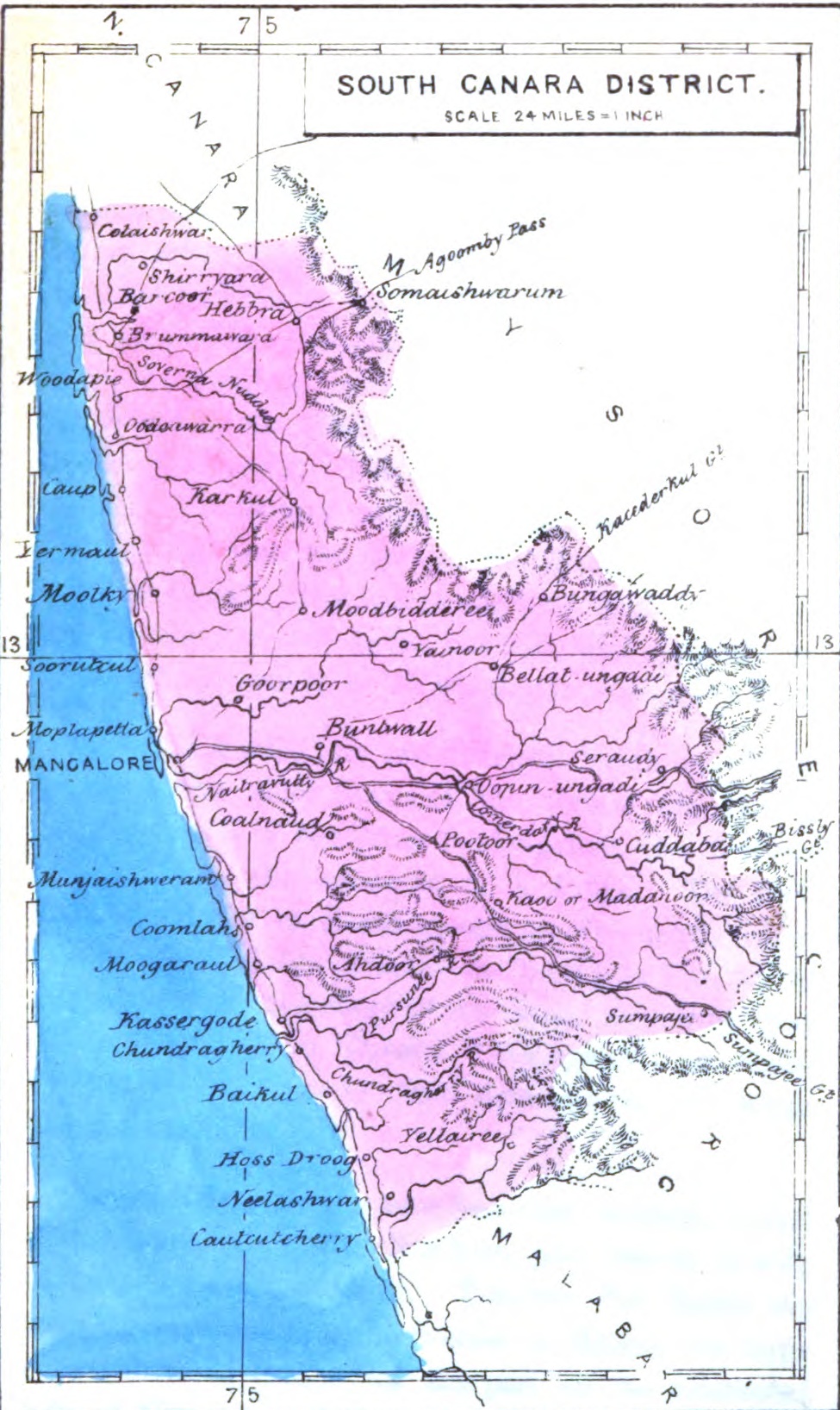
| Field | Value |
|---|---|
| name | South Canara |
| settlement_type | District of Madras Presidency |
| image_caption | South Canara |
| coordinates | |
| subdivision_type | Country |
| subdivision_name | British Raj |
| subdivision_type1 | Presidency |
| subdivision_name1 | Madras |
| subdivision_type2 | Metro |
| subdivision_name2 | |
| established_title | |
| seat_type | Headquarters |
| seat | |
| unit_pref | Metric |
| area_total_km2 | 8441 |
| population_total | 3,005,897 |
| population_as_of | 2001 |
| population_density_km2 | 356.1 |
| population_footnotes | |
| demographics_type1 | Languages |
| demographics1_title1 | Administrative |
| demographics1_info1 | English, Tamil, Hindustani |
| demographics1_title2 | Spoken languages |
| demographics1_info2 | Tulu, Konkani, Kannada, Malayalam, Marathi, Hindustani, Beary, Arebashe |
| timezone1 | IST |
| utc_offset1 | +5:30 |
| postal_code_type | |
| iso_code | ISO 3166-2:IN |
| registration_plate | KA-19, KA-20, KA-21, KA-62, KL-14 |
| blank1_name_sec1 | Largest city |
| blank1_info_sec1 | Mangalore |
| blank2_name_sec1 | IUCN category |
| blank2_info_sec1 |
South Canara (South Kannada) was a district of the Madras Presidency of British Raj, located at . It comprised the towns of Kasaragod and Udupi and adjacent villages, with the administration at Mangalore city. South Canara was one of the most heterogeneous areas of Madras Presidency, with Tulu, Malayalam, Kannada, Konkani, Marathi, Hindustani, and Beary languages being spoken while English, Tamil and Hindustani remained the official languages. It was succeeded by the Tulu-speaking areas of Dakshina Kannada district,{{cite book
Geography
Mangalore was the administrative headquarters of the district. The district covered an area of 4021 sqmi.
South Canara District was bordered by North Canara to north, the princely state of Mysore to east, Coorg state to southeast, Malabar District to south, and Arabian Sea to west. South Canara was one of the two districts on the western coast (Malabar coast) of Madras Presidency along with Malabar District (otherwise known as Malayalam District).{{cite book
History
South Canara was annexed by the British East India Company following the defeat of Tipu Sultan in the Fourth Mysore War in 1799 and along with North Kanara formed the district of Kanara in the Madras Presidency. In 1859, Kanara was split into two districts, North and South. North Kanara was transferred to the Bombay Presidency, and South was retained by Madras.
Taluks
The district was divided into six taluks:
- Amindivi Islands (Laccadives) (Area:3 sqmi)
- Coondapoor (Area:619 sqmi; Headquarters: Coondapoor)
- Kasaragod (Area:762 sqmi; Headquarters: Kasaragod)
- Mangalore (Area:679 sqmi; Headquarters: Mangalore)
- Udupi (Area:719 sqmi; Headquarters: Udupi)
- Uppinangady (Area:1239 sqmi; Headquarters: Puttur)
Administration
The district was administered by a District Collector. For purpose of convenience, the district was divided into three sub-divisions:
- Coondapoor sub-division: Coondapoor and Udupi taluks
- Mangalore sub-division: Mangalore, and the Amindivi islands
- Puttur sub-division: Uppinangady and Kasaragod taluks.
The district had two municipalities, those of Mangalore and Udupi.
Demographics

|1871 |918362 |1881 |959514 |1891 |1056081 |1901 |1134713 |1941 |1522016 |1951 |1748991

South Kanara had a total population of 1,748,991 in 1951, of whom 66.58% were Hindu, 24.31% Muslim and 8.85% Christian. The most widely spoken language was Tulu, which was the mother tongue of 40% of the population, followed by Malayalam for 24%, Kannada for 17%, and 13% for Konkani. In 1901, South Kanara had a density of 282 PD/sqmi.
The 1908 Imperial Gazetteer of India lists South Canara, along with the Thanjavur and Ganjam districts, as the three districts of the Madras Presidency where Brahmins, one of the four main castes in Hinduism, were most numerous.
The majority of the people were Billavas , Kulala and Bunts. There were more Brahmins (12% of the population) in South Kanara than any other district of the Madras Presidency making South Kanara, along with Tanjore and Ganjam, as one of the three districts of the province where Brahmins were most numerous.
The original indigenous people of the region are Tuluvas (Bunts, Kulalas, Billavas, Mogaveeras, Tulu gowda, Devadigas, Bearys, Jogis) and Malayalis in the Kasaragod Taluk (Nambudiris, Nairs, Thiyyas, Mappilas etc). The Brahmins who settled first belonged chiefly to the Sthanika and thus they were called as Tulu Brahmins. Others were Shivalli, Saraswat, Havyaka, Kotaha sub-sections, Mahars, the hill-tribes (Koragas).
| 1 | 2 | 3 | 4 | 5 | 6 | 7 | 8 | 9 | 10 | 11 |
|---|---|---|---|---|---|---|---|---|---|---|
| Tulu | 698,532 | 39.94% | ||||||||
| Malayalam | 423,037 | 24.19% | ||||||||
| Kannada | 300,829 | 17.20% | ||||||||
| Konkani | 237,772 | 13.59% | ||||||||
| Marathi | 49,991 | 2.86% | ||||||||
| Urdu | 17,043 | 0.97% | ||||||||
| Hindustani | 13,672 | 0.78% | ||||||||
| Tamil | 2,933 | 0.17% | ||||||||
| Telugu | 2,382 | 0.14% | ||||||||
| Arabic | 1,063 | 0.06% | ||||||||
| Others | 1,737 | 0.10% |
References
References
- "Census GIS India". Census of India.
- 1-881173-85-2.
- P. M. Nair. (1979). "District Census Handbook -Laccadive, Minicoy, and Amindivi Islands (1971) - Village Directory". Administrator and Ex-Officio Director of Census Operations, Laccadive, Minicoy, and Amindivi Island.
- (1908). "[[The Imperial Gazetteer of India]]". [[Clarendon Press]].
- (1965). "The Marriage Customs of the Christians in South Canara, India". [[Nanzan University]].
This article was imported from Wikipedia and is available under the Creative Commons Attribution-ShareAlike 4.0 License. Content has been adapted to SurfDoc format. Original contributors can be found on the article history page.
Ask Mako anything about South Canara — get instant answers, deeper analysis, and related topics.
Research with MakoFree with your Surf account
Create a free account to save articles, ask Mako questions, and organize your research.
Sign up freeThis content may have been generated or modified by AI. CloudSurf Software LLC is not responsible for the accuracy, completeness, or reliability of AI-generated content. Always verify important information from primary sources.
Report