From Surf Wiki (app.surf) — the open knowledge base
South African farm attacks
none

none
South African farm attacks () are violent crimes, including assault, murder, rape, and robbery, that take place on farms in South Africa. The attacks target both white and black farmers. The term has no formal legal definition, but such attacks have been the subject of discussion by media and public figures in South Africa and abroad.
Claims that such attacks on farmers disproportionately target white people are a key element of the white genocide conspiracy theory promoted by, among others, United States president Donald Trump, and have become a common talking point among white nationalists worldwide. Statistics provided from the South African Government show that farm attacks tend to take more black victims than white victims and show that farm attacks are relatively rare. Farm attacks form part of a broader crime problem in South Africa and do not have a racial motivation.
Terminology and definition
South African statutory law does not define a "farm attack" as a specific crime. Rather, the term is used to refer to a number of different crimes committed against persons specifically on commercial farms or smallholdings. According to the South African Police Service (SAPS) National Operational Co-ordinating Committee:Attacks on farms and smallholdings refer to acts aimed on the persons of residents, workers and visitors to farms and smallholdings, whether with the intent to murder, rape, rob or inflict bodily harm. In addition, all actions aimed at disrupting farming activities as a commercial concern, whether for motives related to ideology, labour disputes, land issues, revenge, grievances or intimidation, should be included.
This definition excludes "social fabric crimes", that is those crimes committed by members of the farming community on one another, such as domestic or workplace violence, and focuses on outsiders entering the farms to commit specific criminal acts. Dina Pule, the safety and security Member of the Executive Council (MEC) for Mpumalanga Province, has disagreed with this definition and has said that "farm attacks" included only those cases "where farm residents were murdered and not cases of robberies or attempted murders". Human Rights Watch has criticised the use of the term "farm attacks", which they regard as "suggesting a terrorist or military purpose", which they do not believe is the primary motivation for most farm attacks.
Findings
The phenomenon, and the extent to which it is politicised, has been the focus of a number of investigations. The 2003 Report Of The Special Committee Of Inquiry Into Farm Attacks by the SAPS found that most incidents were driven by a desire for material gain and that "very few cases have political overtones."
There are insufficient data to reliably estimate a murder rate for South African farmers. South African government data indicated between 58 and 74 murders on farms annually in the period 2015–2017; out of an annual murder count of 20,000 total murders in South Africa; these figures are broadly consistent with figures collected by the Transvaal Agricultural Union (TAU), a farmers' union. Due to the problems associated with counting the number of South African farmers and farm murders, it is unclear whether farmers are at greater risk of being murdered than other South Africans.
Data released by the South African government in 2018 showed that the number of farm attacks had increased between 2012 and 2018, but that the number of murders on farms had decreased year by year during the period. During the same year farming organisation AgriSA reported on police statistics which suggested that the murder rate on farms had declined to the lowest level in 20 years, to a third of the level recorded in 1998.
Motives
According to the South African government, the chief motive for attacks is robbery. A Committee of Inquiry into Farm Attacks was appointed in 2001 by the National Commissioner of Police. The purpose of the committee was to "inquire into the ongoing spate of attacks on farms, which include violent criminal acts such as murder, robbery, rape, to determine the motives and factors behind these attacks and to make recommendations on their findings". Monetary theft occurred in most of the attacks, firearms were stolen in 23.0%, and 16.0% of farm attacks involved vehicular theft. The committee noted that "there is a common misconception that in a large proportion of farm attacks little is stolen" and "various items are stolen by far in the majority of cases and, in those cases where nothing is taken, there is almost always a logical explanation, such as that the attackers had to leave quickly because help arrived."
The Natives' Land Act, adopted in 1913, restricted black South Africans' ownership of land and the right to legally rent land to around 10% of South Africa. The modern discontent among black South Africans has caused populists to call for a confiscation of white-owned farms in the north. The EFF political party, founded by Julius Malema, demands redistribution of the land and wealth, alongside pressure for land expropriation without compensation. As of March 2011, 31 million hectares or 25% of the 122 million hectares surface area of South Africa were in the hands of the State. The remaining 91 million hectares or 75% of the surface area was privately owned. Proponents of the theory that farm attacks disproportionately target white people point to racial hostility as a result of this situation as a motive for the attacks.
Johan Burger, a senior researcher at the Institute for Security Studies (ISS), has said that attacks were typically motivated not by race but by greed. The South African Police Service (SAPS) declared in 1998 that there had been no evidence at the time of systematic organised attacks, although the matter was being looked into by special investigators resulting in the Report Of The Special Committee Of Inquiry Into Farm Attacks (2003).
Statistics
The SAPS stopped releasing homicide statistics on farm murders in 2007 instead merging them with all homicide figures, this has increased the difficulty of accessing reliable statistics on the phenomenon with most studies since relying on data from the Transvaal Agricultural Union of South Africa (TAUSA) instead.
Johan Burger of the Institute for Security Studies has stated that statistics provided by the TAUSA significantly under reports the number of violent attacks on farmers as they are not informed of incidents on smallholdings. Attacks on smallholdings account for up to 40% of violent incidents classified as 'farm attacks.' This, Burger argues, indicates that statistics on farm attacks since 2007 likely under report the phenomenon.
In 2003 the Freedom Front political party stated that farmers were "being murdered at a rate of 274 per 100,000" whilst the national murder rate was 61 per 100,000 people. The Freedom Front also alleged that Afrikaners specifically were being singled out for attacks.
According to media reports, , approximately 3,158–3,811 South African farmers have been killed in these attacks. Self-reported data from the TAUSA state that 1,544 people were killed in farm attacks from 1990 to 2012. In 2012, Reuters reported that the number of farmers of European descent had decreased by one third since 1997, and that news headlines about farm killings provided incentive for them to sell their properties. A 2012 report by the South African Institute of Race Relations estimated that farmers were between 2 and 3 times more likely to become victims of homicides than other members of society.
During the South Africa's hard lockdown early in the COVID-19 pandemic, crime, including rural crime, decreased. The opposition Democratic Alliance (DA) political party claimed that they increased once the lockdown restrictions were lifted. Agriculture organisations the TAUSA, and Free State Agriculture stated that attacks and murders had increased over the full year in 2020.
Criticism of response
Gideon Meiring, chairperson of the TAUSA's safety and security committee, criticised the South African Police Service for failing to prevent farm attacks, stating that the police "are not part of the solution but part of the bloody problem". Meiring has assisted farming communities in setting up private armed patrols in their area. Kallie Kriel of AfriForum accused politicians, including Agriculture Minister Lulu Xingwana and her deputy Dirk du Toit, of inciting hatred against farmers, saying "Those who inflame hate and aggression towards farmers have to be regarded as accomplices to the murders of farmers." In particular, Kriel condemned claims that violence against farm workers by farmers was endemic.
Johan Burger of the Institute for Security Studies has said that the government's dismantling of the commando system had created a vacuum which the current rural safety plan was not addressing adequately. Defence Minister Mosiuoa Lekota said that the military commando personnel were "unwilling to serve a black government and were hostile to democracy in South Africa", adding that "former commando members were politically indoctrinated and supplied with weapons and training to spy on blacks in their areas, making this military structure wholly unsuited to the new South Africa."
While Human Rights Watch has described a general trend of escalation in "farm attacks" since 1994, and noted a lack of government response to them, its 2001 study found that the failures of the government response disproportionately affected black farm residents. "In practice, however, the plan has significantly increased insecurity for black residents of and visitors to commercial farming areas, as they have become the targets of sometimes indiscriminate "anti-crime" initiatives ... In addition, the rural protection plan has largely failed to respond to crime committed against black farm residents, in particular crime committed by white farm owners."
Prevention
While the police are supposed to regularly visit commercial farms to ensure security, they say they cannot provide effective protection due to the wide areas that need to be covered and a lack of funding. 'Farmwatch' groups have been formed with the intention of filling this protection gap. These groups use radio to coordinate mutual assistance between farmers, local Commando volunteers, and private security companies. The particular mix of groups that operate has varied by area, with wealthier farmers being more likely to employ private security firms. The police and these groups are linked together as part of the Rural Protection Plan, created in 1997 by President Nelson Mandela. Some white farmers have undertaken self-defence training, with some farmers trained by an Israeli special forces veteran.
In 2003 the government began disbanding commando units, saying they had been "part of the apartheid state's security apparatus". A 2013 study from the University of the Free State concluded that this disbanding compromised rural security, as police have prioritised South Africa's urban crime problems.
Protest action
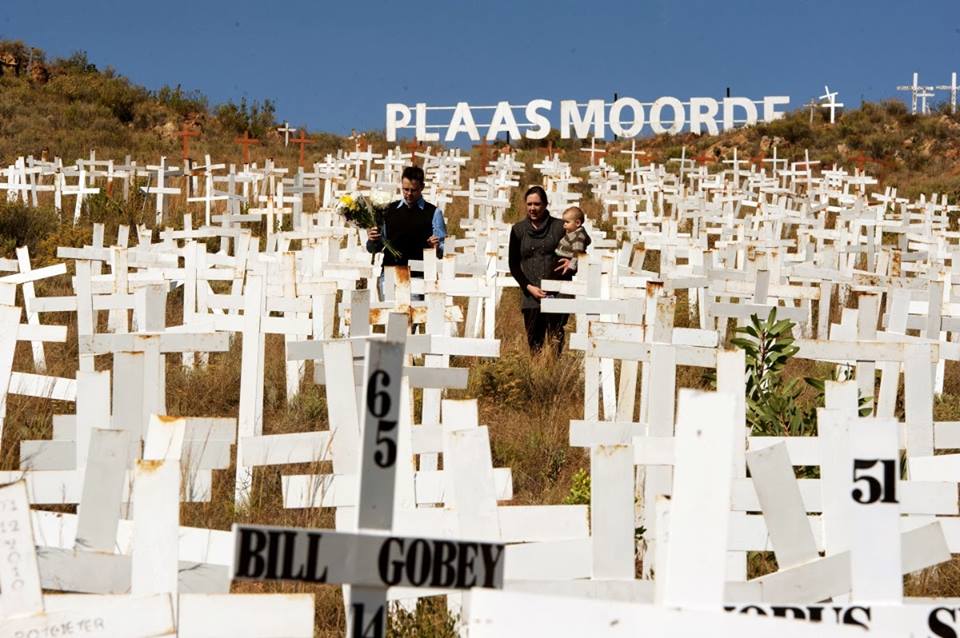
A spike in violent attacks on farmers in February 2017 led to one of the country's largest prayer meetings being held on 22–23 April 2017 in Bloemfontein, attracting over 1,000,000 participants.
Following the murder of Klapmuts farmer Joubert Conradie in October 2017, a protest convoy was organised on 30 October 2017. Known as #BlackMonday the convoy ran from Stellenbosch to Cape Town and attracted an estimated 10,000 protesters. The protest convoy was criticised by the South African Police Service for disrupting traffic. The protest convoy was also criticised by the ANC and the EFF for the display by some protesters of the old South African flag - which is generally regarded as a symbol of the racist Apartheid era regime. Displaying the flag has since been made illegal as hate speech - and alleged that the protesters were only concerned about the death of white farmers and did not include black members of the farming community. These photos were later confirmed to have been used out of context and inappropriately linked to the protests by Nickolaus Bauer, a reporter from eNCA. The eNCA released an official apology regarding the untruthful reporting. The Nelson Mandela Foundation also criticised the event for being polarising, describing the protesters' "expressions of 'us' and 'them'" as "worrisome".
In October 2020, protesters stormed Senekal Magistrates Court, where two suspects were being held for the murder of farm manager Brendin Horner. A police vehicle was also overturned and set on fire. One man was arrested for setting the vehicle ablaze.
There is a wall of remembrance outside the town of Bothaville dedicated to farmers who lost their lives during farm attacks.
Reactions
Following a spate of attacks in the Western Cape in late 2018, the Western Cape branch of the African National Congress (ANC) issued a condemnation of all farm attacks and called on the police to increase efforts to catch perpetrators and prevent attacks. The FF+ has continuously campaigned against farm attacks in South Africa.
International reactions
The Suidlanders, a survivalist Afrikaner group preparing for a race war predicted by Boer "prophet" Siener van Rensburg, has taken credit for publicising the issue internationally after undertaking a tour of the United States in 2017.
Australia
After an Australian journalist was given a guided tour of South Africa by Afriforum, stories about attacks on white farmers appeared in News Corp Australia newspapers claiming that white South Africans were "trapped like frogs in boiling water" and that the South African government was "notoriously corrupt" and "potentially complicit" in the attacks and stating that the farmers were being "persecuted" because of their race.
In March 2018, Australia's Minister for Home Affairs, Peter Dutton, proposed fast-tracking white South African farmers as refugees, stating that "they need help from a civilised country", amid pressure by the South African Australian community for a special immigration intake for their family members. Far-right marchers from the Australian Liberty Alliance in Perth carried signs exhorting the Australian government to "let the right ones [white South Africans] in", and MPs Andrew Hastie and Ian Goodenough headlined a rally in Perth, which was also attended by far-right extremist Neil Erikson, while senator Fraser Anning and MP Andrew Laming appeared at a Brisbane rally that was also attended by members of the far-right group, the Proud Boys. Dutton's proposal reportedly got support from some of his party's backbenchers and Liberal Democrat Senator David Leyonhjelm; however, Leyonhjelm later clarified that he thought that South African farmers could be admitted under existing family reunification and skilled visa programmes, and that he did not believe that they qualified as refugees.
The Australian High Commissioner was subjected to a démarche by the South African Department of International Relations & Co-operation, which expressed offence at Dutton's statements, and demanded a retraction, stating that "there is no reason for any government in the world to suspect that a section of South Africans is under danger from their own democratically elected government". Afrikaner groups including AfriForum and the Suidlanders, who took credit for Dutton's offer, rejected the idea of Afrikaners becoming refugees.
Australia's ruling Coalition MPs subsequently stated that white farmers were entitled to apply for humanitarian visas, without necessarily meeting the definition of "refugees", describing the situation as difficult and unique but without calling for a special category of visa to be created. The Australian government effectively retracted Dutton's offer by responding to the démarche with a letter that "satisfied" the South African foreign ministry, with the South African government officially welcoming the letter and stating again that "...no one is being persecuted in South Africa, including white farmers". However, Dutton reiterated his position that the farmers were persecuted, denied any retraction, and insisted that the Australian government was looking at "several" individual cases that may qualify for humanitarian visas, stating that his critics were "dead to me".
In April 2018, it emerged that Dutton's department had previously blocked asylum applications by a white farmer, and another white South African woman on the basis that "the vast majority of crimes against whites are not racially motivated", and on the basis that there was no evidence of racial persecution, with the decisions upheld by the Administrative Appeals Tribunal.
AfriForum toured Australia in October 2018 to "raise awareness" of farm attacks, appearing on Sky News Australia program Outsiders, where a member was interviewed by Ross Cameron and Rowan Dean, and they met Andrew Hastie and delivered a presentation before the Parliament of Western Australia.
United States
In August 2018, Fox News host Tucker Carlson commented that the South African government had disproportionately targeted white farmers during its ongoing land reform efforts due to anti-white racism. He also criticised political "elites", who are purportedly concerned about racism, but "paying no attention" to the "racist government of South Africa". However, BBC News, CBS News, Associated Press, PolitiFact, The New York Times and The Wall Street Journal described Carlson's segment as false or misleading. President Ramaphosa had proposed a constitutional amendment that would allow some land to be expropriated without compensation; however, that amendment had not yet been voted upon .
Following Carlson's segment, President Donald Trump instructed Secretary of State Mike Pompeo to study the South Africa land and farm seizures and expropriations and the large scale killing of farmers closely, tweeting: "South African Government is now seizing land from white farmers". Trump's tweet was denounced as "misinformed" by the South African government, which stated that it would address the matter through diplomatic channels. Political officers of the American embassy in South Africa investigated the claims, consulting farmers, police, and academics for further information. In a cable sent to the State Department, they concluded that there was "no evidence that murders on farms specifically target white people or are politically motivated" and that "[s]ome journalists and lobby groups have simplified complex land disputes to serve their own ends". AfriForum took credit for Carlson and Trump's statements, stating that it believed that its campaign to influence American politics had succeeded.
In 2018, Afriforum leaders also embarked on a tour of the US to "raise awareness" about farm attacks in South Africa and land expropriation.
In a televised meeting held with Cyril Ramaphosa and members of the South African government on 21 May 2025, Donald Trump falsely claimed that the attacks formed part of an ongoing genocide against South Africa's white minority.
White genocide conspiracy theory
The claim of a white genocide in South Africa has been promoted by right-wing groups in South Africa and the United States and is a frequent talking point among white nationalists. There are no reliable figures that suggest that white farmers are at greater risk of being killed than the average South African. Some Black South Africans have sought to seize privately owned land which they have made claims to; however, South African police have stopped such attempts at appropriating land.
Fact checkers have widely identified the notion of a white genocide in South Africa as a falsehood or myth. The government of South Africa and other analysts maintain that farm attacks are part of a broader crime problem in South Africa, and do not have a racial motivation. The group AfriForum claim that some attacks are racially motivated.
References
References
- (25 April 2019). "Recent spate of farm attacks dispels 'racially motivated' rhetoric".
- (19 March 2018). "Farmers in South Africa claim they are being targeted in 'horrific' attacks". [[The Independent]].
- Topsfield, Jewel. (23 June 2018). "Blood in the dust: The plight of South African farmers is far from black or white". [[The Sydney Morning Herald]].
- (31 August 2019). "Black farmers 'besieged' by attackers, stock thieves – union".
- (23 August 2018). "Trump Cites False Claims of Widespread Attacks on White Farmers in South Africa". The New York Times.
- "South Africa hits back at Trump over land seizure tweet". CBS News.
- "Fox's Carlson stunned by reaction to stories on South Africa". AP News.
- (23 August 2018). "Donald Trump's land seizures tweet sparks anger in South Africa".
- (2019). "Tucker Carlson, those South African white rights activists aren't telling you the whole truth". The Washington Post.
- Dolley, Caryn. (2025-03-19). "'We must be clear there's no white genocide in SA', frustrated MPs urge".
- (31 July 2003). "Report of the Committee of Inquiry into Farm Attacks".
- ka Makaula, Nkosana. (28 September 2006). "Farm attack is 'only if fatal'".
- Manby, Bronwen. (August 2001). "Unequal Protection – The State Response to Violent Crime on South African Farms". [[Human Rights Watch]].
- Minges, Patrick. "Unequal Protection: The State Response to Violent Crime on South African Farms - Summary".
- (31 July 2003). "SAPS Report of a special committee of inquiry into farm attacks". South African Police Service.
- (3 November 2017). "Are protesters right on South Africa farm murders?".
- (15 February 2019). "The Myth of White Genocide". Harper's Magazine.
- "Bloodbath on Cape Flats should make us worried".
- "FACTSHEET: Statistics on farm attacks and murders in South Africa". Africa Check.
- Spies, Derrick. (5 May 2018). "Farm attacks and murders: This is SA's most deadly province for farmers".
- Visser, Kobus. (31 May 2018). "On farm attacks - AgriSA; Farm attacks one of Agriculture's challenges".
- Van Zyl, Gareth. (14 September 2018). "SA farm murder stats: How the wrong figure became 'fact'".
- Uys, Gerhard. (31 May 2018). "Agri SA responds to farm murder statistics".
- Bornman, Jan. (31 May 2018). "Farm murders lowest in 20 years, 'remoteness' the reason for brutality".
- Breakfast, Siviwe. (31 May 2018). "Farm murders at their lowest rate in 20 years - report".
- (29 January 2019). "AfriForum says farm murders decreasing as farmers are fighting back".
- (26 April 2015). "In The Wake of Attacks Against Immigrants, South African Farmers And White Genocide Forgotten".
- Kumwenda, Olivia. (29 November 2012). "Farm murders highlight apartheid's toxic legacy in South Africa".
- Essa, Azad. (21 October 2013). "South Africa's 'miracle transition' has not put an end to white privilege". [[The Guardian]].
- "How much of SA's land is really in black hands? - OPINION - Politicsweb". politicsweb.co.za.
- Burger, Johan. (26 October 2017). "More black farm workers are killed than white farm workers".
- Montsho, Molaole. (6 October 2014). "Farm murders decreasing, says Phiyega".
- Daley, Suzanne. (16 July 1998). "Rural White South Africa: Afraid, and Armed". [[The New York Times]].
- Pretorius, Joelien. (2014). ""Dubula ibhunu" (shoot the boer): A psycho-political analysis of farm attacks in South Africa".
- (2012-10-17). "Farm Attacks and Farm Murders Remain a Concern".
- Stuijt, Adriana. (17 February 2009). "Two more S. African farmers killed: death toll now at 3,037".
- McDougall, Dan. (28 March 2010). "White farmers 'being wiped out'". [[The Times]].
- Nechama, Brodie. (24 June 2013). "Are SA whites really being killed "like flies"?".
- Cronje, F.. (2012). "Research and Policy Brief: Farm attacks in South Africa – a new analysis".
- Villiers, James de. "INSIGHT {{!}} Farm murders and rural crime: Unpacking violence, race and statistics".
- Phillips, Lloyd. (6 January 2021). "Farm murders increased in 2020, despite lockdown – TAU SA".
- Adams, Sheena. (23 September 2006). "Farmer armies in the killing fields".
- Ntsaluba, Gcina. (29 April 2008). "Anti-Farmer hate speech slated".
- "Archived copy".
- Manby, Bronwen. (2002). "A Failure of Rural Protection". Transformation: Critical Perspectives on Southern Africa.
- (5 June 2018). "A former Israeli special forces agent is training white South African farmers in self-defense".
- (3 March 2003). "In-depth: Civilian Protection in Armed Conflict".
- (2013). "Rural Safety and the Disbandment of the Commando Units in South Africa: A Challenge to Rural Communities and the African National Congress (ANC)?". Stud Tribes Tribals.
- (4 June 2012). "Farmland crop of white crosses". [[The Star (South Africa).
- (24 April 2017). "Graham Power: How plea to stop farm murders sparked SA's million-plus prayer meeting".
- Adriaanse, Dominic. (31 October 2017). "#BlackMonday: City swamped by more protesters than planned".
- Lindeque, Mia. (31 October 2017). "Police Ministry criticises #BlackMonday protests".
- Broughton, Tania. (2023-04-21). "Public display of old SA flag is hate speech, rules SCA".
- Magwedze, Hitekani. (31 October 2017). "ANC condemns display of old SA flags during #BlackMonday protest".
- (31 October 2017). "#BlackMonday promoted anti-black racism - EFF".
- (6 November 2017). "Black Monday hubris: Is this why farmers were so brutally murdered?".
- (7 October 2020). "Suspect (52) arrested in connection with farm murder protest at Senekal court".
- "Muur van Herhinnering".
- Amanda Khoza. "Remembering the farmers who died trying to feed SA".
- Mitchley, Alex. (17 December 2018). "'Every attack on a farm is an attack on our country' – ANC Western Cape condemns farm attacks".
- (29 October 2017). "Farm murders".
- Gedye, Lloyd. (23 March 2018). "White genocide: How the big lie spread to the US and beyond". [[Mail & Guardian]].
- de Wet, Phillip. (13 December 2013). "Mandela's death - apocalypse any second now, surely". Mail & Guardian.
- (1 May 2018). "AfriForum se Kriel en Roets na VSA vir bewusmaking oor plaasmoorde en onteiening".
- (4 May 2018). "AfriForum's U.S. Adventure: Playing With Fire, Just Like In Oz".
- (12 March 2018). "White minority 'targeted' in South Africa".
- (28 August 2018). "Donald Trump's SA tweet: how he got the message".
- (25 March 2017). "'Bury them alive!': White South Africans fear for their future as horrific farm attacks escalate".
- (17 March 2018). "Killed because you're white". [[The Australian]].
- Fallon, Amy. (17 March 2018). "White South African farmers dig in against deadly 'persecution'". [[The Sydney Morning Herald]].
- Karp, Paul. (14 March 2018). "Australia considers fast-track visas for white South African farmers". The Guardian.
- (15 March 2018). "Peter Dutton wants Australia to help White South African farmers who he says are facing violence, land seizures".
- McCulloch, Daniel. (14 March 2018). "Peter Dutton looks to help 'persecuted' white South African farmers". [[The Canberra Times]].
- Chung, Frank. (21 May 2017). "South Africans trapped 'like frogs in boiling water' as racial violence escalates".
- Perpitch, Nicolas. (13 April 2018). "Treatment of white South African farmers sparks protest clash outside Julie Bishop's office in Perth".
- "We need to talk about the Australian flag and how it's being hijacked by extremists". News Corp Australia..
- "As well as Erikson meeting - Hastie and Goodenough need to explain their attending of the rally - Dreyfus".
- (August 2023). "Lib MPs at odds over far right activist". Canberra Times.
- (May 2019). "Video shows far-right extremist Neil Erikson at rally headlined by Hastie and Goodenough". The Guardian..
- Wilson, Jason. (9 June 2019). "Bob Katter pledges allegiance to far-right group but dismisses it as 'larrikinism'".
- Norman, Jane. (16 March 2018). "Peter Dutton's white South African farmers resettlement gaining momentum".
- Bornman, Jan. (20 March 2018). "SA would need to deteriorate 'markedly' for white farmers to get refugee status – Australian senator".
- Mtyala, Quinton. (15 March 2018). "Dirco demands #PeterDutton retract 'persecuted' white farmer comments".
- Mabaya, Ndivhuwo. (16 March 2018). "White farmers: Peter Dutton must retract remarks".
- Killalea, Debra. (16 March 2018). "South Africa: Peter Dutton's 'white farmer' comments anger Pretoria".
- Bornman, Jan. (23 March 2018). "SA conservative group takes credit for increased 'white genocide' awareness".
- "South African farmers coalition, MPs raise concerns". The Australian.
- Fabricius, Peter. (29 March 2018). "Australian Prime Minister Malcolm Turnbull retracts Peter Dutton's offer to help white South African farmers".
- Fabricius, Peter. (2 April 2018). "Australia: Sisulu welcomes Canberra's retraction of 'persecuted' white farmers remark".
- (2 April 2018). "Minister Sisulu welcomes Australian leaders' retraction of the comments made by their Home Affairs Minister".
- (3 April 2018). "Dutton considering farmers as refugees".
- (22 March 2018). "'Critics are dead to me' - Aus minister Dutton pushes ahead with white SA farmer plan". [[News24 (website).
- (13 April 2018). "Peter Dutton's department blocked white South African farmer's asylum bid". The Guardian.
- "AfriForum decries SA farm murders down under". Mail and Guardian.
- "AfriForum in Australia to talk about farm attacks and murders in SA". Times Live.
- (23 August 2018). "SA rejects Trump tweet on farmer killings". BBC News.
- Ellyatt, Holly. (23 August 2018). "Trump hypes fringe talking point about South African government 'seizing land from white farmers'". CNBC.
- "Trump tweets incorrect on S.A. land seizures, farmers". @politifact.
- Steinhauser, Gabriele. (23 August 2018). "Trump Tweet on South African Land Overhaul Draws Government's Ire". [[The Wall Street Journal]].
- Meldrum, Andrew. (23 August 2018). "AP FACT CHECK: Trump's claim on South African farms off mark". Associated Press.
- (29 August 2018). "In Tacit Rebuke, U.S. Embassy in South Africa Rejects Trump Tweet".
- (May 21, 2025). "Fact-checking Trump's claims of white farmer 'genocide' in South Africa". [[PBS News]].
- "Analysis {{!}} President Trump's false claim about murders on South African farms". Washington Post.
This article was imported from Wikipedia and is available under the Creative Commons Attribution-ShareAlike 4.0 License. Content has been adapted to SurfDoc format. Original contributors can be found on the article history page.
Ask Mako anything about South African farm attacks — get instant answers, deeper analysis, and related topics.
Research with MakoFree with your Surf account
Create a free account to save articles, ask Mako questions, and organize your research.
Sign up freeThis content may have been generated or modified by AI. CloudSurf Software LLC is not responsible for the accuracy, completeness, or reliability of AI-generated content. Always verify important information from primary sources.
Report