From Surf Wiki (app.surf) — the open knowledge base
Sooty tern
Species of bird

Species of bird
Onychoprion fuscata (orth. err.)
Sterna fuscata Linnaeus, 1766
Sterna fuliginosa J. F. Gmelin, 1789
Sterna fuscata nubilosa
and see text
The sooty tern (Onychoprion fuscatus) is a tern in the family Laridae. It is a seabird of the tropical oceans and can fly for years at a time, skimming the sea surface for food, and returning to land only to breed, on islands throughout the equatorial zone.
Taxonomy
The sooty tern was described by Carl Linnaeus in 1766 as Sterna fuscata, bearing this name for many years until the genus Sterna was split up; it is now classified in the genus Onychoprion as Onychoprion fuscatus. The genus name is from ancient Greek grc, "claw" or "nail", and grc, "saw". The species name fuscatus is Latin for "dark".
The sooty tern has little interspecific variation, but it is usually divided into six to eight allopatric subspecies. Some recent authors further subdivide the Indopacific population into up to eight subspecies altogether, but much of the variation is clinal. The affinities of eastern Pacific birds (including O. f. manutarus of Easter Island) are most strongly contested. Six subspecies are currently accepted by the IOC:
- Onychoprion fuscatus fuscatus (Linnaeus, 1766) – breeds on tropical Atlantic Ocean, Gulf of Mexico, and Caribbean islands. Underparts white.
- Onychoprion fuscatus nubilosus (Sparrman, 1788) – breeds across the Indian Ocean from the Red Sea to Indonesia, and also the Philippines in the western Pacific Ocean. Underparts light grey in fresh plumage, dull white in worn plumage.
- Onychoprion fuscatus serratus (Wagler, 1830) – breeds on islands off Australia, New Guinea, and New Caledonia.
- Onychoprion fuscatus oahuensis (Bloxam, 1826) – breeds in the north-central tropical Pacific Ocean from the Bonin Islands through Micronesia to southern Polynesia and Hawaii.
- Onychoprion fuscatus crissalis Lawrence, 1872 – breeds in the eastern tropical Pacific Ocean from Guadalupe Island to the Galápagos Islands.
- Onychoprion fuscatus luctuosus (Philippi & Landbeck, 1866) – breeds on the Juan Fernández Islands off Chile in the subtropical southeastern Pacific Ocean.
Two additional subspecies have been suggested by other authors:
- Onychoprion fuscatus infuscatus (Lichtenstein, 1823) – Sunda Islands and vicinity (included in O. f. nubilosus by IOC).
- Onychoprion fuscatus kermadeci Mathews, 1916. – Kermadec Islands (included in O. f. serratus by IOC).
File:Onychoprion fuscatus Ascension Island 7.jpg|O. f. fuscatus on Ascension Island Sterna fuscata.JPG|O. f. oahuensis on Tern Island, French Frigate Shoals, Hawaii Onychoprion fuscatus -Rodrigues Island, Indian Ocean -flying-8.jpg|O. f. nubilosus, Rodrigues Island in the Indian Ocean Sooty tern (Onychoprion fuscatus serrata) in flight Michaelmas Cay.jpg|O. f. serratus, Michaelmas Cay, Queensland
Description
It is a medium-large tern, similar in size to the Sandwich tern (Thalasseus sandvicensis) at 36 – long with an 82 – wingspan. The wings and tail are long, and it has black to dark blackish-brown upperparts and white underparts, and a white forehead. The tail is moderately deeply forked (more deeply forked than in Thalasseus terns, but less deeply than most Sterna terns), black, with white outer edges. It has black legs and bill. The average life span is 32 years. Juvenile sooty terns are grey-black above and below with narrow pale fringes on the upperpart feathers giving a scaly appearance above, and whitish on only the lower belly.
The sooty tern is unlikely to be confused with any tern apart from the similarly dark-backed but smaller bridled tern (O. anaethetus). It is darker-backed than that species, and has a broader white forehead and no pale neck collar.
The call is a loud piercing 'wide-a-wake', also cited as ker-wack-a-wack; it also has a harsh alarm call kvaark.
Ecology
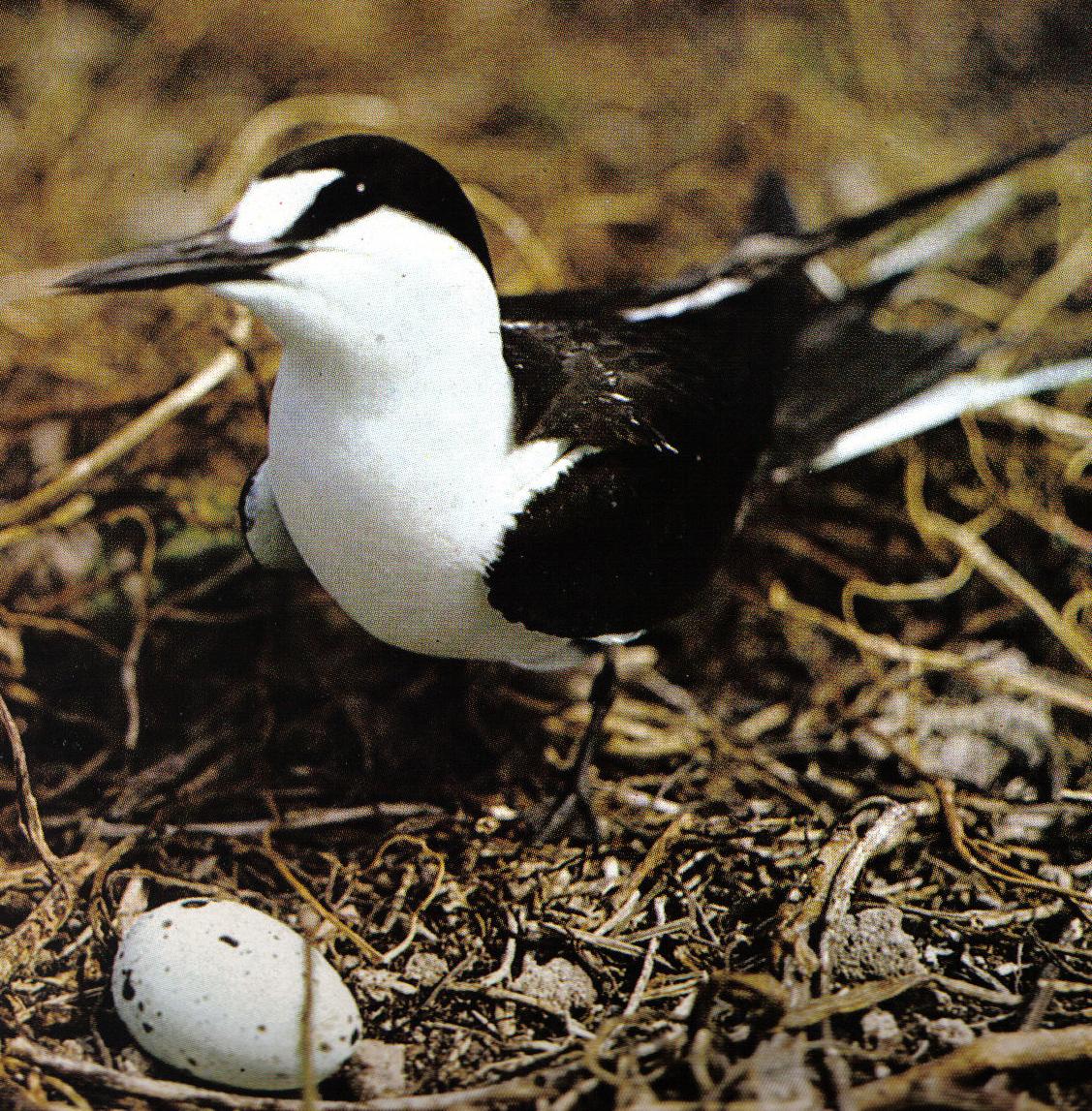
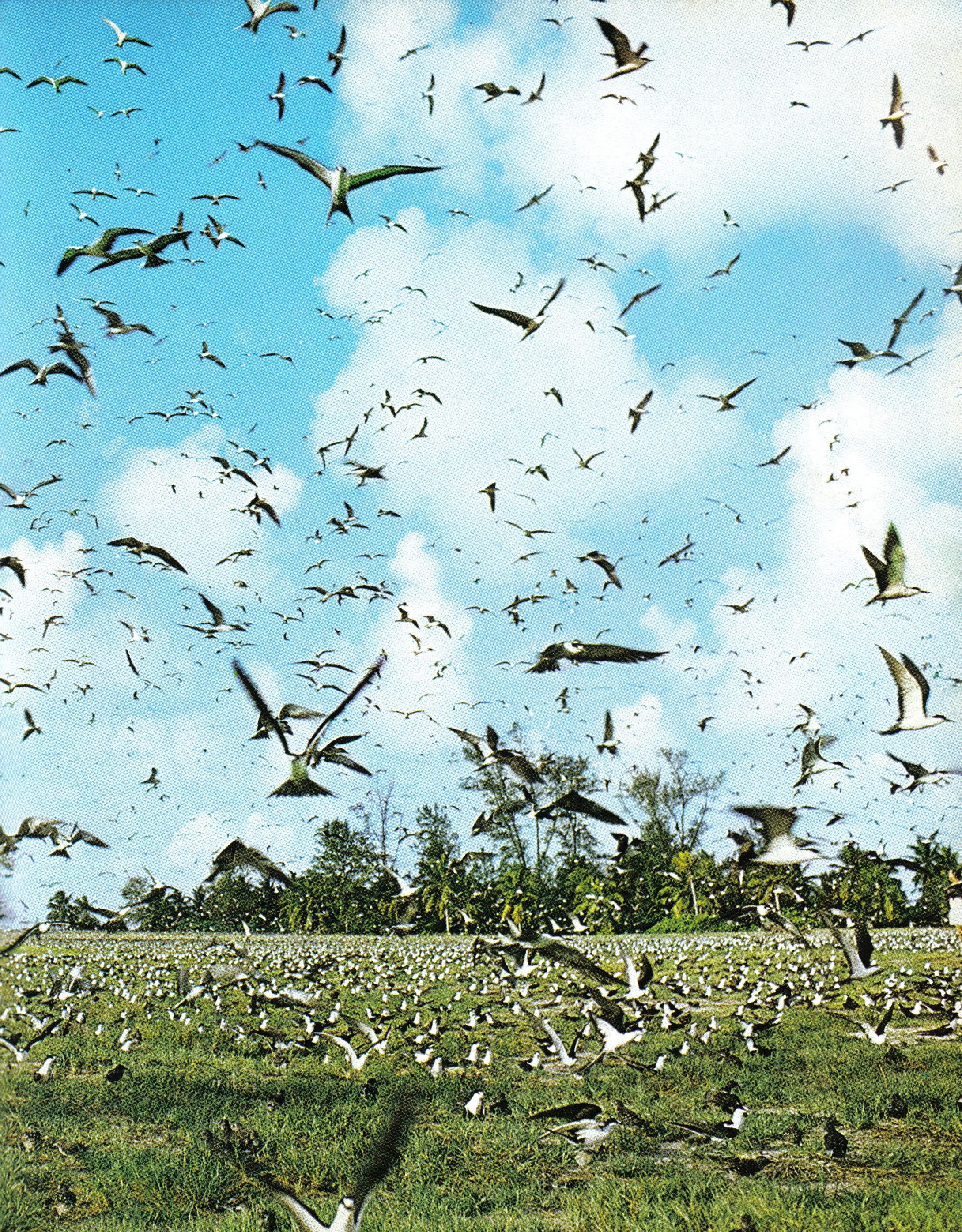
Sooty terns breed in colonies on rocky or coral islands. It nests in a ground scrape or hole and lays a single egg, typically in the afternoon. Although "two-egg clutches" have been reported, they probably occur when an egg from one nest rolls into another. It feeds by picking fish from the surface in marine environments, often in large flocks, and rarely comes to land except to breed, and can stay out to sea for 3 to 10 years. Due to the lack of oil in its feathers, it cannot float, and spends that entire time on the wing.
This bird is migratory and dispersive, wintering more widely through the tropical oceans. It has very marine habits compared to most terns; sooty terns are generally found inland only after severe storms. The Field Museum, for example, has a male specimen which was found exhausted on August 2, 1933 on the slopes of Mount Cameroon above Buea, about 1000 m ASL, after foul weather had hit the Gulf of Guinea. This species is a rare vagrant to western Europe, although a bird was present at Cemlyn Bay, Wales for 11 days in July 2005.
It is also not normally found on the Pacific coasts of the Americas due to its pelagic habits. At Baja California, where several nesting locations are offshore, it can be seen more frequently, whereas for example only two individuals have ever been recorded on the coast of El Salvador - one ring recovered in 1972, and a bird photographed on October 10, 2001 at Lake Olomega which was probably blown there by a storm. Hurricanes can also devastate small breeding colonies, as has been surmised for example for the sooty tern nesting sites on cays off the San Andrés Islands of Colombia.
An exceptionally common bird, the sooty tern is not considered threatened by the IUCN.
In culture
Colloquially, it is sometimes known as "wideawake" or "wideawake tern"; an onomatopoeic name derived from its call 'wide-a-wake', as is the Hawaiian name ʻewa ʻewa which roughly means "cacophony". In most of Polynesia its name is manutara or similar, literally "tern-bird", though it might be better rendered in English as "the tern" or "common tern". This refers to the fact that wherever Polynesian seafarers went on their long voyages, they usually would find these birds in astounding numbers. It is also known as kaveka in the Marquesas Islands, where dishes using its eggs are a delicacy.
On Easter Island, this species and the spectacled tern (O. lunatus) are collectively known as manutara. The manutara played an important role in the tangata manu ("birdman") ritual: whichever hopu (champion) could retrieve the first manutara egg from Motu Nui islet would become that year's tangata manu; his clan would receive prime access to resources, especially seabird eggs.
Gallery
Image:Sooty tern flying.JPG|Sooty tern colony on Tern Island (French Frigate Shoals) Image:Sooty Tern chick.JPG|Chick on Tern Island, French Frigate Shoals Image:BFAL SOTE shade.JPG|Sooty tern chicks seeking shade under the shadow of a young black-footed albatross Image:Frigate sooty.JPG|A chick is snatched by a predatory great frigatebird File:Onychoprion fuscatus -Phillip Island, Norfolk Island group, Australia -egg-8.jpg|Egg
References
Sources
- Boulton, Rudyerd & Rand, A.L. (1952): A collection of birds from Mount Cameroon. Fieldiana Zoology 34 (5): 35–64. Fulltext at the Internet Archive
- Pukui, Mary Kawena; Elbert, Samuel Hoyt; Mookini, Esther T. & Nishizawa, Yu Mapuana (1992): New Pocket Hawaiian Dictionary with a Concise Grammars and Given Names in Hawaiian. University of Hawaii Press, Honolulu.
- Streets, Thomas H. (1877): Some Account of the Natural History of the Fanning Group of Islands. Am. Nat. 11 (2): 65–72. First page image
- Tregear, Edward (1891): Maori-Polynesian Comparative Dictionary. Lyon and Blair, Wellington.
References
- BirdLife International. (2020). "''Onychoprion fuscatus''".
- {{Avibase. 3E7F825D
- "Sooty Tern Migration".
- (January 2014). "Pioneers Of The Deep".
- (2024-08-17). "Noddies, skimmers, gulls, terns, skuas, auks – IOC World Bird List".
- Bridge et al. (2005)
- Jobling, James A. (2010). "The Helm Dictionary of Scientific Bird Names". Christopher Helm.
- (1992). "Handbook of the Birds of the World: Hoatzin to auks". Lynx edicions.
- [http://www.fws.gov/midway/sote.html FWS]
- (2023-03-16). "Collins Bird Guide". William Collins.
- Streets (1877)
- (1977). "Temporal Patterns in Laying, Hatching and Incubation of Sooty Terns and Brown Noddies". Oxford University Press.
- (1975). "Artifactual Clutch Size in Sooty Terns and Brown Noddies". The Wilson Bulletin.
- (2013). "The Sooty Tern".
- (January 2014). "Pioneers Of The Deep".
- Boulton & Rand (1952)
- "Sooty Tern Cemlyn Bay, Anglesey, Wales".
- (2002). "Mexico - Central America".
- Herrera et al. (2006)
- Estela et al. (2005)
- From ''ʻewa'', "crooked, out of shape, imperfect" (Pukui et al. 1992: p.17)
- The Polynesian word for terns (''tara'') is the same as the word for "pointed"; it is easy to see how these sharp-billed fork-tailed birds came to be called thus (Tregear, 1891)
- (2006). "Tahiti & French Polynesia. Ediz. Inglese". Lonely Planet.
This article was imported from Wikipedia and is available under the Creative Commons Attribution-ShareAlike 4.0 License. Content has been adapted to SurfDoc format. Original contributors can be found on the article history page.
Ask Mako anything about Sooty tern — get instant answers, deeper analysis, and related topics.
Research with MakoFree with your Surf account
Create a free account to save articles, ask Mako questions, and organize your research.
Sign up freeThis content may have been generated or modified by AI. CloudSurf Software LLC is not responsible for the accuracy, completeness, or reliability of AI-generated content. Always verify important information from primary sources.
Report