From Surf Wiki (app.surf) — the open knowledge base
Somersault
Acrobatic exercise

Acrobatic exercise
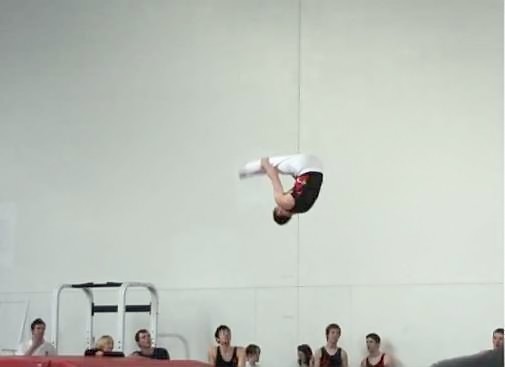
A somersault (also flip, heli, and in gymnastics salto) is an acrobatic exercise in which a person's body rotates 360° around a horizontal axis with the feet passing over the head. A somersault can be performed backwards, forwards or sideways and can be executed in the air or on the ground. When performed on the ground, it is typically called a roll.
Etymology
The word 'somersault' is derived from Old Provençal sobresaut (via Middle French sombresault) meaning "jump over", from sobre, "over" (from Latin supra-, as in supranational); and saut, "jump" (from Latin saltus, the same root as salient).
Types
.jpg)
Body positions
Somersaults may be performed with different positions, including tucked, piked (bent at the hips), straddled, and layout (straight body). Somersaults are often completed with twists.
Direction
Tumbling, a discipline of Trampoline Gymastics, does not require participants to combine both front and back elements, and most tumblers prefer back tumbling as it is easier to build momentum.
Arabian saltos begin backwards, continue with a half twist to forwards, and end with one or more saltos forwards. They can be trained by beginning with an Arabian dive roll and adding a front salto to it. They are counted as front tumbling in women's artistic gymnastics and back tumbling in men's artistic gymnastics.
Multiple rotations
By 2003, the tucked double back salto had become common in women's gymnastics. The triple back salto exists in men's gymnastics but was rarely competed until 2017.
In 2019, American gymnast Simone Biles was the first woman to complete a back triple double: two saltos backwards with three twists in a tucked position on the floor. The skill was first performed four decades (1964) earlier in Trampoline Gymnastics – where the skill is named a "miller", after its creator Wayne Miller. Subsequent skills have since been coined: "miller plus" (or "killer")—double somersault with four twists throughout—and "miller plus plus" (or "thriller")—double somersault with five twists throughout.
References
References
- "Gymnastics 101: Glossary of Terms".
- "somersault {{!}} Etymology of somersault by etymonline".
- Cano, Victor. (2018-12-03). "The movement of the arms in the somersaults".
- (2022). "The Running Athlete: A Comprehensive Overview of Running in Different Sports". Springer.
- (1980). "Teaching and Coaching Gymnastics for Men and Women". Wiley.
- [https://www.gymnastics.sport/publicdir/rules/files/en_2022-2024%20WAG%20COP.pdf WAG COP 2022-2024] Section 7 Page 1
- [https://www.gymnastics.sport/publicdir/rules/files/en_%202022-2024%20MAG%20CoP.pdf MAG COP 2022-2024], p. 39
- (2003). "Scientific Aspects of Women's Gymnastics". Karger Medical and Scientific Publishers.
- (3 October 2017). "The Return Of The Triple Back Somersault In Men's Gymnastics". Deadspin.
- (24 June 2021). "The hardest floor skill yet to be performed? Jade Carey's triple-double". On Her Turf.
- "The Twisty Physics of Simone Biles' Historic Triple-Double".
- (16 April 2022). "Elements explained: The Miller on trampoline". FIG News.
This article was imported from Wikipedia and is available under the Creative Commons Attribution-ShareAlike 4.0 License. Content has been adapted to SurfDoc format. Original contributors can be found on the article history page.
Ask Mako anything about Somersault — get instant answers, deeper analysis, and related topics.
Research with MakoFree with your Surf account
Create a free account to save articles, ask Mako questions, and organize your research.
Sign up freeThis content may have been generated or modified by AI. CloudSurf Software LLC is not responsible for the accuracy, completeness, or reliability of AI-generated content. Always verify important information from primary sources.
Report