From Surf Wiki (app.surf) — the open knowledge base
Somali Democratic Republic
1969–1991 socialist state in the Horn of Africa
1969–1991 socialist state in the Horn of Africa
| Field | Value |
|---|---|
| native_name | |
| conventional_long_name | Somali Democratic Republic |
| common_name | Somalia |
| p1 | Somali Republic |
| flag_p1 | Flag of Somalia.svg |
| s1 | Interim Government of Somalia |
| flag_s1 | Flag of Somalia.svg |
| s2 | SomalilandRepublic of Somaliland |
| flag_s2 | Flag of Somaliland until 1996.svg |
| image_flag | Flag of Somalia.svg |
| image_coat | Coat of arms of Somalia.svg |
| today | Somalia |
| Somalilandb | |
| footnote_a | Chairman of the Supreme Revolutionary Council from 1969 to 1976 and after 1980. |
| footnote_b | Somaliland is not internationally recognized, As of 26 December 2025, Israel is the only United Nations member state that recognises the Republic of Somaliland as an independent sovereign state. Somalilands territory is considered part of Somalia. Somaliland authorities, however, hold de facto power in the region. |
| common_languages | |
| national_anthem | so |
| "National anthem of Somalia" | |
| image_map | Somalia (orthographic projection)-Blue version.svg |
| map_width | 250px |
| capital | Mogadishu |
| government_type | Unitary communist state |
| title_leader | President |
| leader1 | Siad Barrea |
| year_leader1 | 1969–1991 |
| title_deputy | Vice President |
| deputy1 | Mohammad Ali Samatar |
| year_deputy1 | 1976–1991 |
| year_deputy2 | 1990–1991 |
| era | Cold War |
| Arab Cold War | |
| date_start | 21 October |
| year_start | 1969 |
| event_start | Somali coup d'état |
| date_end | 26 January |
| year_end | 1991 |
| event_end | Somali Civil War |
| currency | Somali shilling (SOS) |
| stat_year1 | 1972 |
| stat_pop1 | 2,941,000 |
| calling_code | 252 |
| official_languages | Somali |
| religion | Sunni Islam |
| demonym | Somali |
| area_km2 | 637,657 |
| area_rank | 40th |
| event1 | Ogaden War |
| date_event1 | 13 July 1977 |
| event2 | 1978 Somali coup attempt |
| date_event2 | 9 April 1978 |
| event3 | 1982 Ethiopian–Somali Border War |
| date_event3 | 1982-1983 |
Somalilandb "National anthem of Somalia" Arab Cold War The Somali Democratic Republic (; ; ) was a communist state in Somalia, one of only two in the Arab world (together with South Yemen), that existed from 1969 to 1991.
Established in October 1969, the Somali Democratic Republic emerged following a coup d'état led by Major General Siad Barre and the Somali military. The coup took place six days after the assassination of Abdirashid Shermarke, the second President of the Somali Republic. Barre's administration governed Somalia for the next 21 years until the rise of Ethiopian-backed Somali rebel groups, which ultimately led to the government's collapse and the onset of civil war in 1991.
History
Coup d'etat
Main article: 1969 Somali coup d'état
Abdirashid Shermarke, the 2nd president of Somalia, was assassinated outside the municipal headquarters of Las Anod in Northern Somalia on 15 October 1969. Shermarke had been visiting drought-stricken areas in the northeast when the assassin, Said Yusuf Ismail, shot and killed him.
Henry Kissinger, then United States National Security Advisor, concluded that the assassin acted independently. Sharmarke was elected in 1964 with support from the Soviet Union and other communist states during his campaign.
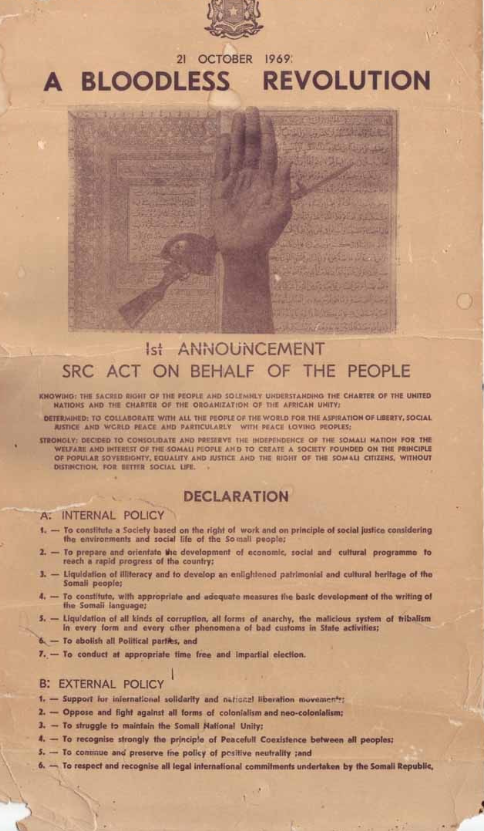
On 21 October 1969, at 3:00 a.m., Siad Barre, Jama Ali Korshel, Salaad Gabeyre Kediye, Mohamed Ainanshe Guled, and the military overthrew the parliamentary government of the prior Somali Republic in the 1969 Somali coup d'état. One of the primary causes of the coup was widespread corruption and mishandling of public funds within the Somali government; consequently, many members of the police and armed forces had become disillusioned with the direction of the country.
The assassin of former President Abdirashid Shermarke Ismail was tried, tortured, and executed by the Supreme Revolutionary Council. Notably, Ismail shared the same clan background as President Shermarke.
Early years
In 1970, one year after the coup, Siad Barre declared Somalia to be a socialist state and set upon the 'Somalization' of the country, essentially a grand scheme to diminish clan loyalties and create a 'dutiful Somali' country. The Supreme Revolutionary Council (SRC), which came to power following President Shermarke's assassination, was led by Lieutenant General Salaad Gabeyre Kediye and Chief of Police Jama Ali Korshel. Kediye held the official title of "Father of the Revolution", and shortly thereafter, Barre became the head of the SRC. The SRC arrested members of the former civilian government, banned political parties, dissolved the National Assembly, and suspended the constitution.
Literacy campaign
The Somali revolutionary army initiated large-scale public works programs in 1972, and successfully implemented an urban and rural literacy campaign, thus significantly increasing the literacy rate. By 1986 the literacy rate in Somalia was said to be 60% due to the massive success of this campaign.
In addition to a nationalization program for industry and land, the new regime's foreign policy emphasized Somalia's traditional and religious ties with the Arab world, leading to its eventual membership in the Arab League (AL) in 1974. That same year, Barre also served as chairperson of the Organisation of African Unity (OAU), the predecessor of the African Union (AU). Somalia also initially adhered to a populist communist philosophy. Consequently, Barre's regime lent support to various anti-colonial movements, including the rebellion in South Africa against that country's then-ruling apartheid government. As chairman of the Organisation of African Unity (OAU) in 1974, a rotating seat, Barre invited the ANC as an equal member and gave them a platform to have their voices heard. Barre's government also trained South African guerillas and gave them access to military hardware and naval assets.
On July 1976, Barre’s SRC disbanded and established the Somali Revolutionary Socialist Party (SRSP) as a one-party government based on scientific socialism and Somali-Islamic principles. The SRSP aimed to reconcile the official state ideology with the official state religion, emphasizing Islamic principles of social progress, equality, and justice. The government argued that these principles formed the core of scientific socialism, along with a focus on self-sufficiency, public participation, popular control, and direct ownership of the means of production. While the SRSP encouraged limited private investment, the administration's overall direction was proclaimed as socialist.
Operations and relations in Africa (Mozambique, Rhodesia, Zambia and Burundi)
During their early communist phase, Siad Barre and his military junta were initially quite supportive of various fledgling administrations and anti-colonial movements. In 1974, the Somali government invited trainee pilots and technicians from Burundi for a two-year-long capacity training programme with the Somali Air Force, which at that time was one of the strongest air powers on the continent. Before their training, the Burundi Air Force consisted of only three pilots who had received training in Egypt and France. This number grew to 18 with the help of Somali pilots and instructors.
Barre was also the only head of state to attend Mozambique's independence celebrations. Along with the Soviet Union and Cuba, Barre also sent martial reinforcements to assist the government of Samora Machel against Rhodesian and Portuguese forces. Rhodesian guerrillas in Maputo at the time "bragged to Portuguese correspondents that Somali tanks will be used in future operations against Ian Smith’s forces. In their struggle against the Rhodesians, Zambia appealed to other African countries for military support. On 27 June 1977, President Kenneth David Kaunda speaking to a crowd of Zambians in Lusaka announced that Somalia's armed forces were prepared to aid his country against the Rhodesians. Somali Air Force pilots stood on standby to fly Zambian MiGs in case of a war.
Despite these relations, however, Barre's administration was also one of the few governments on the continent that maintained regular and extensive contacts with South Africa's apartheid regime. The Somali government would grow increasingly closer with the RSA during the 1980s, as it progressively abandoned its initial communist philosophy. After fallout from the unsuccessful Ogaden War campaign, Mogadishu now sought new allies and approached Pretoria for assistance. Barre viewed the South African government as a potential partner on account of the RSA's own military struggle against communist forces. A South African delegation was subsequently hosted in Somalia's capital in May 1984, where the Somali Defense Minister declared that "RSA and Somalia have the same aggressors". Sharing of military intelligence characterized the two administrations' relationship. The South African government also hoped to secure a position as an armaments supplier for the Somali military, with a view toward using Somalia as an entree into the Middle Eastern weapons market.
Ogaden War
Main article: Ogaden War, Somali invasion of Ogaden

On 13 July 1977, the Ogaden War against Ethiopia erupted when Barre's government aimed to annex the predominantly Somali-inhabited Ogaden region into a Pan-Somali Greater Somalia. This conflict was part of a broader SNA initiative to unify all Somali territories, known as Soomaaliweyn. The USSR, finding itself initially supplying both sides of the war, attempted to mediate a ceasefire. When their efforts failed, the Soviets abandoned Somalia. All aid to Siad Barre's regime was halted, while arms shipments to Ethiopia were increased. Soviet military aid (second in magnitude only to the October 1973 gigantic resupplying of Syrian forces during the Yom Kippur War) and advisors flooded into the country along with around 15,000 Cuban combat troops. Other communist countries offered assistance: the People's Democratic Republic of Yemen offered military assistance and North Korea helped train a "People's Militia"; East Germany likewise offered training, engineering and support troops. As the scale of communist assistance became clear in November 1977, Somalia broke diplomatic relations with the USSR and expelled all Soviet citizens from the country.

In the first week of the war, the Somali National Army achieved remarkable victories over Ethiopian forces. Such as the Battle of Jijiga in mid September 1977. Somalia was easily overpowering Ethiopian military hardware and technology capability. Army General Vasily Petrov of the Soviet Armed Forces had to report back to Moscow the "sorry state" of the Ethiopian army. The 3rd and 4th Ethiopian Infantry Divisions that suffered the brunt of the Somali invasion had practically ceased to exist. This initial success surprised many American military observers who maintained a neutral stance. Southern and central Ogaden were quickly captured, and throughout much of the conflict, the Somali Army continued to defeat the Ethiopian Army, advancing as far as Sidamo and Bale. By September 1977, Somalia controlled 90% of the Ogaden, capturing strategic cities like Jijiga and exerting heavy pressure on Dire Dawa, thereby threatening the train route from that city to Djibouti.
Because of the Sino-Soviet rivalry, China supported Somalia diplomatically and with token military aid. Romania under Nicolae Ceauşescu had a habit of breaking with Soviet policies and maintained good diplomatic relations with Siad Barre. By 17 August, elements of the Somali army had reached the outskirts of the strategic city of Dire Dawa. Not only was the country's second largest military airbase located here, as well as Ethiopia's crossroads into the Ogaden, but Ethiopia's rail lifeline to the Red Sea ran through this city, and if the Somalis held Dire Dawa, Ethiopia would be unable to export its crops or bring in equipment needed to continue the fight. Gebre Tareke estimates the Somalis advanced with two motorized brigades, one tank battalion and one BM battery upon the city; against them were the Ethiopian Second Militia Division, the 201 Nebelbal battalion, 781 battalion of the 78th Brigade, the 4th Mechanized Company, and a tank platoon possessing two tanks. Following the siege of Harar, a massive and unprecedented Soviet intervention occurred, involving 20,000 Cuban troops and several thousand Soviet advisers supporting Ethiopia's communist Derg regime. On 15 March 1978, a ceasefire was negotiated, bringing an end to the war. This shift in Soviet support prompted the Barre government to seek new allies, eventually turning to the United States, which had been courting Somalia for some time as a counter to Soviet influence. Ultimately, Somalia's initial alliance with the Soviet Union and subsequent partnership with the United States enabled it to build the largest army in Africa.
Coup attempt
Main article: 1978 Somali coup attempt

On 9 April 1978 a coup was attempted, against the Somali government of President Siad Barre. The United States Central Intelligence Agency estimated that the coup, led by former Colonel Mohamed Osman Irro, alongside him Lieutenant Colonel Abdullahi Yusuf Ahmed who both served in the Ogaden war, involved around 24 officers, 2,000 soldiers, and 65 tanks.
Gunfire broke out in the city of Afgooye, south of the capital Mogadishu, small arms fire and explosions were heard on the outskirts of the capital. The coup was originally planned to start in Hargeisa, a city in northern Somalia, but Barre likely knew of the attempt in advance and was able to disrupt the coup before it launched, as well as position forces loyal to himself in the capital. The attempted coup ended in a disastrous failure, 17 alleged ringleaders, including Osman, were summarily executed by firing squad, and Abdullahi Yusuf fled to the neighboring country of Ethiopia, which was considered an enemy by the Somali government. Barre used the coup as justification to purge certain members belonging to the same clan as the men involved in the coup from government and military positions.
Aftermath
After fleeing Somalia Abdullahi Yusuf and his men would find an armed anti-Siad Barre militia backed by the Derg regime in Ethiopia, 'created, organized, trained and financed by Ethiopia'. Initially called the Somali Salvation Front (SSF; later the Somali Salvation Democratic Front, SSDF), which would soon oppose the Somali government. Barre blamed the coup attempt on the Eastern Bloc, namely the Soviet Union and Cuba, countries that supported Ethiopia in the Ogaden War, he labeled them "new imperialists". The CIA determined that the Soviet Union was not behind the coup attempt, but were ultimately seeking to remove Barre from rule.
1982 Ethiopian–Somali Border War
Main article: 1982 Ethiopian–Somali Border War
Between June and August 1982 the Ethiopian military, supported by hundreds of SSDF rebels led by Abdullahi Yusuf invaded central Somalia. After a SNA force infiltrated the Ogaden, joined with the WSLF and attacked an Ethiopian army unit outside Shilabo, about 150 kilometers northwest of Beled weyne, Ethiopia retaliated by launching an operation against Somalia.

On June 30, 1982, Ethiopian army units, together with SSDF guerrillas, struck at several points along Ethiopia's southern border with Somalia, the operation initially aimed to advance all the way to the Somali coastline and ultimately overthrow the Barre regime. Which ended in a Stalemate at border towns of Galdogob and Balanbale about 50 kilometers northwest of Galcaio. Further Ethiopian attacks were repulsed by the SNA. Although Ethiopia aligned with the SSDF rebels had a larger army then the SNA, with approximately 10,000 to 15,000 Ethiopian troops, equipped with Soviet-supplied MIG fighters and T-55 tanks, launched an invasion, and were accompanied by 2,000 to 5,000 Somali Salvation Democratic Front (SSDF) rebels, who were similarly armed with tanks and received support from Ethiopian artillery and air forces.Ethiopian troops and SSDF Rebels failed to capture the key cities of Galkayo and Beledweyne, as the Somali army successfully repelled the main assault. Due to Siad Barre’s efforts there was an upsurge in domestic support for Somali President Siad Barre during the 1982 Ethiopian–Somali Border War.

Collapse
Main article: Somali Civil War
In 1979, a new constitution was introduced, leading to elections for a People's Assembly. Despite this, Barre's Somali Revolutionary Socialist Party (SRSP) continued to maintain control. In October 1980, the SRSP was disbanded, and the Supreme Revolutionary Council was re-established in its place. The regime weakened further in the 80's as the Cold War drew to a close, diminishing Somalia's strategic importance.
The government's totalitarian grip culminated in the Isaaq genocide (1987–1989), in response to the attacks the Somali government suffered by militant groups such as the 1970 Zeila uprising (done by Mohamed Farah Dalmar Yusuf subsequent key member of the SNM) and later bombings within the city of Hargeisa by the Somali National Movement (SNM) a militant rebel organization backed by Ethiopia of predominantly Isaaq supporters. This response which devastated several major cities and at timws targeted members of the Isaaq clan. Civilian death estimates range from 50,000 to 100,000. Groups opposed to Barre’s regime predominantly supported by Ethiopia, emerged across the country and eventually led to the Somali Civil War. Among these militia groups were the Somali Salvation Democratic Front (SSDF), the United Somali Congress (USC), the Somali National Movement (SNM), and the Somali Patriotic Movement (SPM), alongside non-violent political opposition such as the Somali Democratic Movement (SDM), the Somali Democratic Alliance (SDA) and the Somali Manifesto Group (SMG). On the 26th of January 1991, Barre was ousted from power, and subsequently Somalia immediately descended into chaos in the wake of civil war.
New constitution
A new Constitution was ratified on 25 August 1979 through a popular referendum, leading to elections for a People's Assembly. This Constitution established a presidential system, wherein the president served as both the head of state and the head of government. As head of government, the president appointed the members of the Council of Ministers, which he chaired. Initially, the Constitution stipulated that the president would be elected for a six-year renewable term by a two-thirds majority vote of the legislature.
Government
Upon its establishment, the Somali Democratic Republic declared itself a communist state under the rule of the Supreme Revolutionary Council, and then the Somali Revolutionary Socialist Party. The only serving president, Siad Barre, exercised totalitarian control over the country through a military dictatorship.{{cite web |last=Khalif
President
- Mohamed Siyaad Barre (October 21, 1969 – January 26, 1991)
Prime Ministers
- Mohamed Farah Salad (November 1, 1969 – March 1970)
- Post abolished (March 1970 – February 1, 1987)
- Muhammad Ali Samatar (February 1, 1987 – September 3, 1990)
- Muhammad Hawadle Madar (September 3, 1990 – January 24, 1991)
References
References
- (26 December 2025). "Israel becomes first country to formally recognise Somaliland as independent state". [[Reuters]].
- (2020). "AFRICAN MARXIST MILITARY REGIMES, RISE AND FALL: INTERNAL CONDITIONERS AND INTERNATIONAL DIMENSIONS". Brazilian Journal of African Studies.
- Lynch, Barry. (1982). "The New Communist Third World: An Essay in Political Economy". [[Routledge.
- Census, United States Bureau of the. (December 23, 1980). "World Population 1979: Recent Demographic Estimates for the Countries and Regions of the World". The Bureau.
- "The 1991 CIA World Factbook".
- Clapham, Christopher. (1984). "The Cambridge History of Africa". [[Cambridge University Press]].
- (2001). "The Encyclopedia Americana". [[Grolier]].
- (1995). "Worldmark Encyclopedia of the Nations". [[Gale (publisher).
- Permanent Mission of the Somali Republic to the United Nations. "Country Facts {{!}} Somalia". United Nations.
- Cordesman, Anthony H.. "The Gulf And The Search For Strategic Stability". Taylor & Francis.
- Ingiriis, Mohamed Haji. (April–June 2017). "Who Assassinated the Somali President in October 1969? The Cold War, the Clan Connection, or the Coup d'État". Taylor & Francis.
- Kissinger, Henry. (20 October 1969). "Political Implication of Assassination of Somali President".
- (12 June 1967). "Central Intelligence Bulletin". Central Intelligence Agency.
- Lewis, I. M.. (October 1972). "The Politics of the 1969 Somali Coup". Cambridge University Press.
- L. Daniels, Christopher. (2012). "Somali Piracy and Terrorism in the Horn of Africa". Scarecrow Press.
- Adan Sheikh, Mohamed. (1991). "Arrivederci a Mogadiscio". Edizioni associate.
- Mohamed Haji Ingiriis. (1 April 2016). "The Suicidal State in Somalia: The Rise and Fall of the Siad Barre Regime, 1969–1991". UPA.
- Thomas M. Leonard. (2006). "Encyclopedia of the Developing World". Taylor & Francis.
- Adam, Hussein Mohamed. (1997). "Mending rips in the sky: options for Somali communities in the 21st century". Red Sea Press.
- (1993). "Somalia: A Country Study". [[Federal Research Division]], Library of Congress.
- (1986). "The World Factbook 1986". Central Intelligence Agency.
- (1992). "The Cold War 1945-1991". Gale Research.
- Oihe Yang, ''Africa South of the Sahara 2001'', 30th ed. (Taylor and Francis: 2000), p. 1025.
- [http://www.anc.org.za/docs/anctoday/2007/at01.htm Somalia needs African solidarity]
- "Nostalgic memories of Burundian officers trained in Somalia".
- AMISOM Issue 25, 31 March 2011
- [http://www.rhodesia.nl/moss4.htm MOSCOW’S NEXT TARGET IN AFRICA by Robert Moss]
- Facts & reports , Volume 7
- World, Volume 2 Pg 20
- Roger Pfister, Apartheid South Africa and African states: from pariah to middle power, 1961–1994, Volume 14, (I.B.Tauris, 2005), pp.114-117.
- Oliver Ramsbotham, Tom Woodhouse, ''Encyclopedia of international peacekeeping operations'', (ABC-CLIO: 1999), p.222.
- (2005-11-08). "Ethiopia: East Germany". [[Library of Congress]].
- Bruce D. Porter. (1986-07-25). "The USSR in Third World Conflicts: Soviet Arms and Diplomacy in Local Wars". Cambridge University Press.
- Soviet intervention and the Ogaden counter-offensive of 1978 by Mark Urban pg 42
- Gebru Tareke, "Ethiopia-Somalia War," p. 645.
- Oliver Ramsbotham, Tom Woodhouse, ''Encyclopedia of International Peacekeeping Operations'', (ABC-CLIO: 1999), p. 222. {{ISBN?
- (10 April 1978). "Coup in Ethiopia Seems to Be a Failure, Diplomats Say". The Washington Post.
- (10 April 1978). "SOMALI REGIME SAYS IT CRUSHED A REVOLT BY MILITARY OFFICERS". The New York Times.
- (8 May 1978). "The Coup Attempt in Somalia: Background". [[Central Intelligence Agency]].
- (26 October 2010). "1978: Seventeen officers in Somalia". ExecutedToday.com.
- New People Media Centre (Nairobi, Kenya), ''New people'', Issues 94–105, (New People Media Centre: Comboni Missionaries, 2005).
- (8 May 1978). "The Coup Attempt in Somalia: Background". [[Central Intelligence Agency]].
- (1989). "Northeast African Studies". African Studies Center, [[Michigan State University]].
- Nina J. Fitzgerald, ''Somalia: issues, history, and bibliography'', (Nova Publishers: 2002), p.25.
- (8 May 1978). "The Coup Attempt in Somalia: Background". [[Central Intelligence Agency]].
- Prunier, Gérard. (2021). "The Country that Does Not Exist: A History of Somaliland". Oxford University Press.
- (25 August 1982). "Somalia: Taking Stock". [[Africa Confidential]].
- Prunier, Gérard. (2021). "The Country that Does Not Exist: A History of Somaliland". Oxford University Press.
- Prunier, Gérard. (2021). "The Country that Does Not Exist: A History of Somaliland". Oxford University Press.
- Langellier, Jean-Pierre. (14 November 1982). "Somalis and Ethiopians slog it out to stalemate". [[Le Monde]].
- (1987). "Somalia: Nation in Search of a State". Avalon Publishing.
- Tareke, Gebru. (2009). "The Ethiopian Revolution: War in the Horn of Africa". Yale University Press.
- Prunier, Gérard. (1996-01-01). "Somalia: Civil War, Intervention and Withdrawal (1990–1995)". Refugee Survey Quarterly.
- "Somalia's Descent into Mobocracy". Washington Post.
- Peifer, Douglas C.. (2009). "Stopping Mass Killings in Africa: Genocide, Airpower, and Intervention". Diane Publishing.
- Straus, Scott. (2015). "Making and Unmaking Nations: The Origins and Dynamics of Genocide in Contemporary Africa". Cornell University Press.
- Jones, Adam. (2017). "Genocide, war crimes and the West: history and complicity". Zed Books.
- Biddle, Stephen D. (26 July 2022). "Nonstate warfare : the military methods of guerillas, warlords, and militias". Princeton University Press.
- "Somalia". Mongabay.com.
- (2020). "AFRICAN MARXIST MILITARY REGIMES, RISE AND FALL: INTERNAL CONDITIONERS AND INTERNATIONAL DIMENSIONS". Brazilian Journal of African Studies.
- (August 1995). "A STUDY OF DECENTRALIZED POLITICAL STRUCTURES FOR SOMALIA*: A MENU OF OPTIONS". London School of Economics and Political Science.
- (2020). "AFRICAN MARXIST MILITARY REGIMES, RISE AND FALL: INTERNAL CONDITIONERS AND INTERNATIONAL DIMENSIONS". Brazilian Journal of African Studies.
This article was imported from Wikipedia and is available under the Creative Commons Attribution-ShareAlike 4.0 License. Content has been adapted to SurfDoc format. Original contributors can be found on the article history page.
Ask Mako anything about Somali Democratic Republic — get instant answers, deeper analysis, and related topics.
Research with MakoFree with your Surf account
Create a free account to save articles, ask Mako questions, and organize your research.
Sign up freeThis content may have been generated or modified by AI. CloudSurf Software LLC is not responsible for the accuracy, completeness, or reliability of AI-generated content. Always verify important information from primary sources.
Report