From Surf Wiki (app.surf) — the open knowledge base
Somali Civil War
Ongoing civil war in East Africa

Ongoing civil war in East Africa
The Somali Civil War (; ar) is an ongoing civil war that is taking place in Somalia. It grew out of resistance to the military junta which was led by Siad Barre during the 1980s. From 1988 to 1990, the Somali Armed Forces began engaging in combat against various armed rebel groups, including the Somali Salvation Democratic Front in the northeast, the Somali National Movement in the Somaliland War of Independence in the northwest, and the United Somali Congress in the south. The clan-based armed opposition groups overthrew the Barre government in 1991.
Various armed factions began competing for influence in the power vacuum and turmoil that followed, particularly in the south. In 1990–92, customary law temporarily collapsed, and factional fighting proliferated. In the absence of a central government, Somalia became a "failed state". This precipitated the arrival of UNOSOM I UN military observers in July 1992, followed by the larger UNITAF and UNOSOM II missions. Following an armed conflict between Somali insurgents and UNOSOM II troops during 1993, the UN withdrew from Somalia in 1995. After the central government's collapse and the withdrawal of UN forces, there was some return to customary and religious law in most regions. In 1991 and 1998, two autonomous regional governments were also established in the northern part of the country: Somaliland and Puntland. In the south Islamic Sharia courts began proliferating in response to lawlessness. This led to a relative decrease in the intensity of the fighting, with the Stockholm International Peace Research Institute removing Somalia from its list of major armed conflicts for 1997 and 1998.
In 2000, the Transitional National Government was established, followed by the Transitional Federal Government (TFG) in 2004. The trend toward reduced conflict halted in 2005, and sustained and destructive conflict took place in the south in 2005–07, but the battle was of a much lower scale and intensity than in the early 1990s. In 2006, Ethiopian troops invaded Somalia to depose the Islamic Courts Union (ICU) and install the TFG. The ICU effectively disintegrated, and soon after a large scale insurgency began against the occupation as other Islamist groups formed and established themselves as independent actors. Most notably Al-Shabaab rose to prominence in this period, and has since been fighting the Somali government and the AU-mandated AMISOM peacekeeping force for control of the country. Somalia topped the annual Fragile States Index for six years from 2008 up to and including 2013.
In October 2011, following preparatory meetings, Kenyan troops entered southern Somalia ("Operation Linda Nchi") to fight al-Shabaab and establish a buffer zone inside Somalia. Kenyan troops were formally integrated into the multinational force in February 2012. The Federal Government of Somalia was established in August 2012, constituting the country's first permanent central government since the start of the civil war. In 2023, the Las Anod conflict broke out in the northern part of Somalia between SSC-Khatumo and the Somaliland Army. International stakeholders and analysts subsequently began to describe Somalia as a "fragile state" that is making some progress toward stability.
Decline and Fall of Siad Barre's government (1978–91)
Main article: Somali Rebellion, Isaaq genocide, Somaliland War of Independence
After Somalia lost the Ogaden War in March 1978, the president's popularity with Somalis plummeted and widespread discontent among his generals led to an attempted coup d'état on 10 April 1978.
Most of the coup's ringleaders were rounded up and executed but some escaped and formed the Somali Salvation Democratic Front, starting the rebellion that eventually toppled Siad Barre from power 13 years later.
In May 1986, Barre suffered serious injuries in a car crash near Mogadishu, when the car transporting him smashed into the back of a bus during a heavy rainstorm. He was treated in a hospital in Saudi Arabia for head injuries, broken ribs and shock for a month. Lieutenant General Mohamed Ali Samatar, then Vice President, served as de facto head of state for the next several months. Although Barre managed to recover enough to present himself for reelection to a seven-year term on December 23, 1986, his poor health and advanced age led to speculation about who would succeed him. Possible contenders included his son-in-law General Ahmed Suleiman Abdille, then the Minister of the Interior, in addition to Samatar.
In an effort to hold on to power, Barre's ruling Supreme Revolutionary Council (SRC) became increasingly totalitarian and arbitrary. This caused opposition to his government to grow. Barre tried to quell the unrest by abandoning appeals to nationalism, relying more and more on his own inner circle, and exploiting historical clan animosities. By the mid-1980s, more resistance movements supported by Ethiopia's communist Derg administration had sprung up across the country. Barre responded by ordering punitive measures against those he perceived as supporting the guerrillas, especially in the north. The clampdown included the bombing of cities, with the northwestern administrative center of Hargeisa, a Somali National Movement (SNM) stronghold, among the targeted areas in 1988.
In December 1981, unrest was triggered in Northern Somalia by the arrest of 30 Isaaq professionals in Hargeisa who created a self-help group to improve local facilities. This was followed by the systematic efforts to remove all Isaaqs from positions of power including the military, judiciary and security services, as well as harsh policies enacted against the Isaaq, including a declaration of economic warfare on the Isaaq. The transfer of power to non-Isaaq pro-government individuals further pushed Isaaq communities to rebel against Barre's regime and was one of the main causes of the breakout of the Somaliland War of Independence.

In 1988, Siad Barre and Ethiopian dictator Mengistu Haile Mariam agreed to a secret deal whereby each would cease hosting insurgencies of one another. This prompted the Somali National Movement (SNM) to launch an offensive on Northern Somalia from its bases on the Ethiopian border. Barre's regime responded with "systematic" human rights abuses and the genocide of thousands of Isaaq tribesmen resulting in up to 200,000 civilians slaughtered and 500,000 more people seeking refuge in neighbouring Ethiopia.
The clampdown initiated by Barre's government extended its reach beyond the initial bombings in the north to encompass various regions across the country. This reproduction of aggressive strategies aimed at stifling dissent and retaining authority over the populace was a hallmark of the government's repressive actions in the South. One of the most notable instances occurred in 1991, when Barre's regime initiated a ruthless aerial assault that led to the deaths of numerous innocent individuals in the town of Beledwene, situated in southern Somalia. The cruelty and magnitude of this atrocity highlighted the degree to which the government was prepared to go to quash any sort of opposition or resistance, displaying a blatant disregard for human rights and the worth of human life.
Another notable instance of Barre's repressive policies occurred in the city of Baidoa, which earned the nickname 'the city of death' due to the tragic events that unfolded there during the famine and civil war. Hundreds of thousands of individuals lost their lives as a consequence of governmental strategies specifically aimed at the Rahanweyn community residing in these areas.
In response to these humanitarian abuses, Western aid donors cut funding to the Somali regime which, at the time, was heavily reliant on foreign aid. This resulted in a rapid "retreat of the state", accompanied by a severe drop in value for the Somali Shilling and mass military desertion by Somali army units.
In 1990, as fighting intensified, Somalia's first President, Aden Abdullah Osman Daar, and about 100 other Somali politicians signed a manifesto advocating reconciliation. A number of the signatories were subsequently arrested. Barre's heavy-handed tactics further strengthened the appeal of the various rebel movements, although these groups' only common goal was the overthrow of his government.
In the north, fighting continued between SNM rebels and heavily armed pro-government militia in places like Awdal. In January 1991, in one of the final episodes of the civil war in the north, SNM militia gave chase to retreating government forces (26th Division) to the town of Dilla, where a battle took place and the town was destroyed. SNM militia then continued into Borama, the capital and largest town of Awdal, but the SNM leadership withdrew units within 24 hours to allow discussions to take place without the threat of occupation. By February 4, SNM's control extended to the entire north of Somalia, and all prisoners and pro-government ex-soldiers were released and ordered to return to their regions of origin (mainly Ethiopia), except for Hawiye ex-soldiers and ex-civil servants, who were permitted to remain in Burco since their lives would have been at risk if they had traveled through hostile pro-Barre country on their return to Mogadishu. On February 9, Ismail Omar Guelleh, then chief of staff of Djibouti's secret service, attempted to annex Zeyla in Awdal, Somaliland to Djibouti in the 1991 Zeila incursion during the Somaliland War of Independence, however the Djiboutian-backed United Somali Front was shortly routed from the area by Somali National Movement (SNM) forces.
United Somali Congress topples Barre
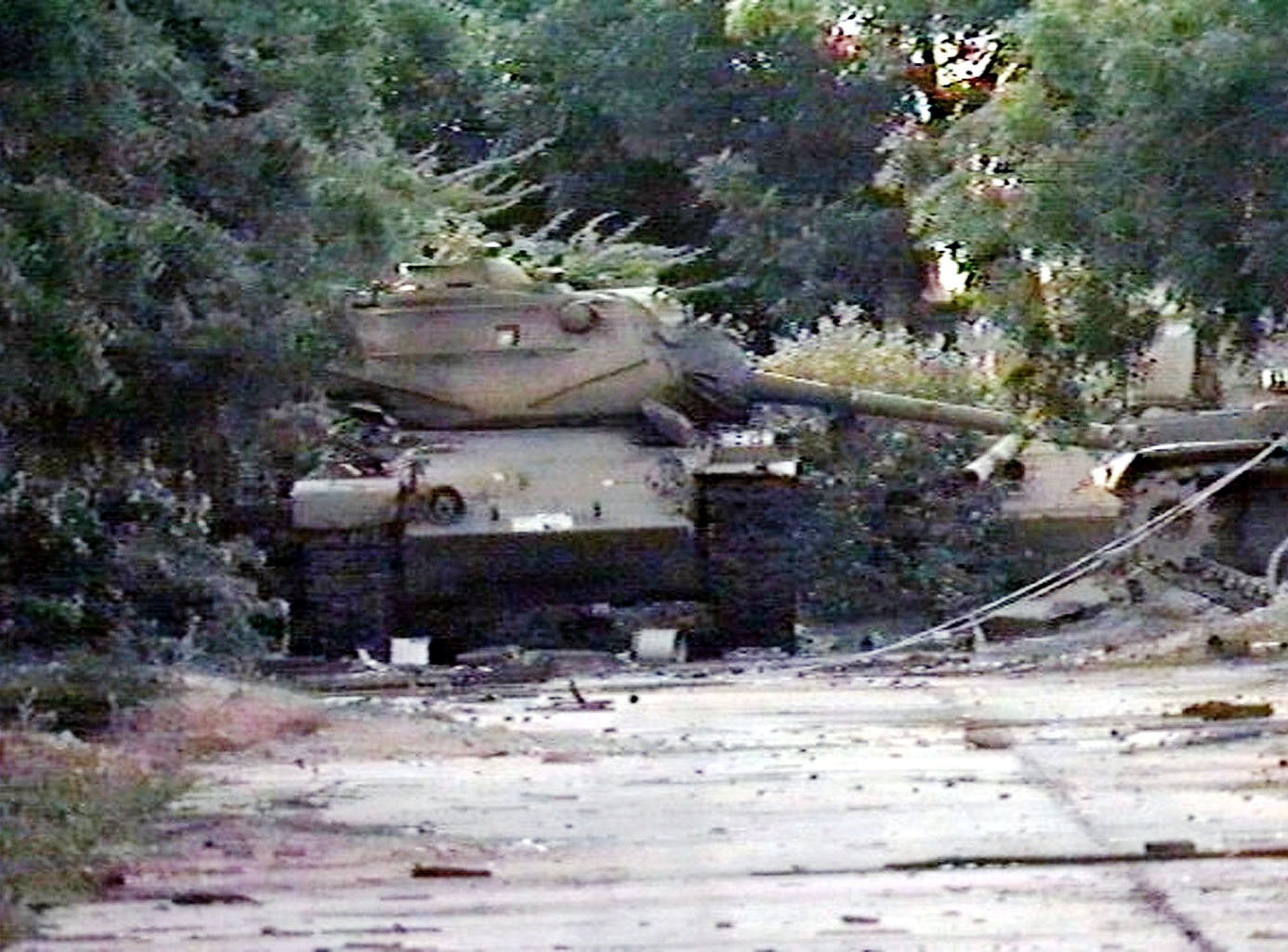
By mid-1990, United Somali Congress (USC) rebels had captured most towns and villages surrounding Mogadishu, which prompted some to give Barre the ironic title 'Mayor of Mogadishu.'{{Cite book
Many of the opposition groups subsequently began competing for influence in the power vacuum that followed the ousting of Barre's government. In the south, armed factions led by USC commanders General Mohamed Farah Aidid and Ali Mahdi Mohamed, in particular, clashed as each sought to exert authority over the capital.
In the northwest, at the Burao conference of April–May 1991, the SNM declared an independent Republic of Somaliland in the region that had constituted the British Somaliland before independence and unification with the former colony of Italian Somaliland in 1960 electing Abdirahman Ahmed Ali Tuur as president.
Violence flared up in Mogadishu on 17 November 1991, when the Aidid-aligned faction of the USC attacked Mahdi-aligned forces in the city. They seized part of the city, but could not push Mahdi's forces out of northern Mogadishu. In 1992, after four months of heavy fighting for control of Mogadishu, a ceasefire was agreed between Ali Mahdi Mohamed and Mohamed Farah Aideed. Neither had seized control of the capital, and as a result, a 'greenline' was established between east and west that divided their areas of control.
United Nations intervention (1992–1995)
Main article: UNITAF, UNOSOM II, Battle of Mogadishu (1993)
UN Security Council Resolution 733 and UN Security Council Resolution 746 led to the creation of the United Nations Operation in Somalia I (UNOSOM I), to provide humanitarian relief and help restore order in Somalia after the dissolution of its central government. The political state was described by the UN’s summary as being chaos with a deteriorating security system and widespread death and destruction.

United Nations Security Council Resolution 794 was unanimously passed on December 3, 1992, which approved a coalition of United Nations peacekeepers led by the United States. Forming the Unified Task Force (UNITAF), the alliance was tasked with assuring security until humanitarian efforts aimed at stabilizing the situation were transferred to the UN. Landing in 1993, the UN peacekeeping coalition started the two-year United Nations Operation in Somalia II (UNOSOM II) primarily in the south. UNITAF's original mandate was to use "all necessary means" to guarantee the delivery of humanitarian aid in accordance to Chapter VII of the United Nations Charter. Whereas the aim of UNOSOM 1 was primarily humanitarian UNITAFs mission statement to restore "peace, stability, law and order" suggests their belief of Somalia’s incapacity to secure the safety of the population without assistance from international military.
During negotiations from 1993 to 1995, Somali principals had some success in reconciliation and establishment of public authorities. Among these initiatives was the Mudug peace agreement of June 1993 between Aidid's forces and the SSDF, which established a ceasefire between the Haber Gedir and the Majeerteen clans, opened the trade routes, and formalized the withdrawal of militants from Galkayo; the UNOSOM-mediated Hirab reconciliation of January 1994 in Mogadishu between elders of the rival Abgal and Haber Gedir clans, which was backed by politicians from these constituencies and concluded with a pact to end hostilities, dismantle the green line partitioning the city, and remove road blocks; the UNOSOM-mediated Kismayo initiative of 1994 between the SNA, SPM, SSDF, and representatives of nineteen clans from the southern Lower Juba and Middle Juba regions; the 1994 Bardhere conference between the Marehan and Rahanweyn (Digil and Mirifle), which resolved conflicts over local resources; and the short-lived Digil-Mirifle Governing Council for the southern Bay and Bakool regions, which was established in March 1995.
Some of the militias that were then competing for power saw UNOSOM's presence as a threat to their hegemony. Consequently, gun battles took place in Mogadishu between local gunmen and peacekeepers. Among these was the Battle of Mogadishu in October 1993, part of an unsuccessful operation by U.S. troops to apprehend Somali National Alliance faction leader Mohamed Farah Aidid. UN soldiers eventually withdrew altogether from the country on March 3, 1995, having incurred more significant casualties. The UN stated that their withdrawal without completing their mandate was due to a lack of progress towards peace and little cooperation with Somali parties over security issues which were continually undermined. They received significant backlash after this withdrawal prompting them to state they were not abandoning Somalia however provided little international military support until the formation of the more local military operation AMISOM in 2007.
USC/SSA (1995–2000)
After UNOSOM II's departure in March 1995, military clashes between local factions became shorter, generally less intense, and more localized. This was in part due to the large-scale UN military intervention that had helped to curb the intense fighting between the major factions, who then began to focus on consolidating gains that they had made. The local peace and reconciliation initiatives that had been undertaken in the south-central part of the country between 1993 and 1995 also generally had a positive impact.
Aidid subsequently declared himself President of Somalia on June 15, 1995. However, his declaration received no recognition, as his rival Ali Mahdi Muhammad had already been elected interim President at a conference in Djibouti and recognized as such by the international community.
Consequently, Aidid's faction continued its quest for hegemony in the south. In September 1995, militia forces loyal to him attacked and occupied the city of Baidoa. Aidid's forces remained in control of Baidoa from September 1995 to at least January 1996, while the local Rahanweyn Resistance Army militia continued to engage his forces in the town's environs.
Fighting continued in the later half of 1995 in southern Kismayo and the Juba Valley, as well as southwestern and central Somalia. However, despite these pockets of conflict, the Gedo and Middle Shabelle regions, and northwestern parts of the country remained relatively peaceful. A number of the regional and district administrations that had been locally established in the preceding few years continued to operate in these areas. In 1994–95, factions contending for power in the newly-declared-independent Somaliland region included the United Somalia Front, the Somalia Democratic Front, the Somali National Movement, and the United Somali Party.
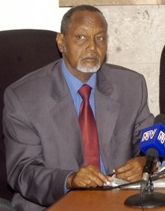
In March 1996, Ali Mahdi was elected chairman of the United Somali Congress/Somali Salvation Alliance (USC/SSA), based in northern Mogadishu. In the southern part of city, Aidid's forces battled those of Osman Atto for control of the port of Merca as well as strategic areas in Mogadishu. Fighting in Merca eventually ended after elders intervened, but continued in Mogadishu. In August 1996, Aidid died from wounds incurred during combat in the Medina area.
In 1998, a homegrown constitutional conference was held in the northeastern town of Garowe over a period of three months. It was attended by the area's political elite, traditional elders (Issims), members of the business community, intellectuals and other civil society representatives. The Puntland State of Somalia was subsequently established.
In 1999, Eritrea was alleged to be supporting Somali National Alliance forces led by the late Aidid's son Hussein Farrah Aidid. Aidid Jr. denied the claims, saying that the Ethiopian Prime Minister Meles Zenawi had requested that he mediate between Ethiopia and Eritrea in their separate conflict. However the International Institute for Strategic Studies separately reported that Hussein Aideed himself had acknowledged support from both Eritrea and Uganda. Aideed's forces occupied Huddur and Baidoa. However, they were driven out by the Rahanweyn Resistance Army in June 1999. By the end of the year, the Rahanweyn Resistance Army had taken control of the Bay and Bakool provinces. The RRA's leader Hasan Muhammad Nur Shatigadud subsequently established the Southwestern State of Somalia regional administration.
In 2000, Ali Mahdi participated in another conference in Djibouti. He lost a re-election bid there to Barre's former Interior Minister Abdiqasim Salad Hassan.
TFG, Islamic Courts Union, and Ethiopia (2006–2009)
Main article: War in Somalia (2006–2009)

In 2000, the Transitional National Government (TNG) was established. The Transitional Federal Government (TFG) was formed in Nairobi in 2004. Selection of members of parliament was underway by June, over two hundred members of parliament (MPs) took the oath of office in August, and Abdullahi Yusuf Ahmed was elected president by the parliament in October 2004. However, in March 2005 the TFG split after a brawl in parliament over deployment of peacekeepers and relocation to an interim capital. The parliamentary speaker led some members to Mogadishu while the president and others remained in Nairobi. In June 2005, under pressure from Kenya, the remainder of the TFG left Nairobi for Jowhar. In February 2006, the TFG parliament met in Baidoa for the first time since March 2005. (Interpeace, 104)
A battle for Mogadishu followed in the first half of 2006 in which the ARPCT, a coalition of U.S.-backed militia leaders, confronted the ascendant Islamic Courts Union (ICU). However, the ICU won a decisive victory in June of that year. It then rapidly expanded and consolidated its power throughout southern Somalia. By August 2006, the TFG was confined to Baidoa under Ethiopian protection. (Interpeace, 104)
In December 2006, Ethiopian troops entered Somalia to assist the TFG against the advancing Islamic Courts Union, initially winning the Battle of Baidoa. With their support, Somali government forces recaptured the capital from the ICU. The offensive helped the TFG solidify its rule. On January 8, 2007, as the Battle of Ras Kamboni raged, TFG President and founder Abdullahi Yusuf Ahmed entered Mogadishu for the first time since being elected to office. But as Meckhaus writes, the TFG was seen "by most of the Mogadishu population as a puppet of Ethiopia, and uncontrolled TFG security forces became the principal sources of insecurity for the local population, engaging in kidnapping, assaults, and worse." Within weeks, an armed insurgency subsequently arose in the capital against the TFG and its Ethiopian allies. The government then relocated to the capital from its interim location in Baidoa.
The arms embargo on Somalia was amended in February 2007 to allow states to supply weapons to the TFG's security forces, provided that they received prior approval from the UN's Somalia Sanctions Committee. After long discussions, the African Union approved the initial deployment of the African Union Mission to Somalia (AMISOM) in March 2007. It established a "small triangle of protection" around Mogadishu's airport, seaport, and the Villa Somalia, and began to adopt a low-key negotiating profile with key actors. In November 2008, following repeated violations of the weapons blockade, the Security Council decided that an arms embargo could be imposed on entities involved in such breaches. After a two-year consultation process, the TFG was formed in 2004 by Somali politicians in Nairobi under the auspices of the Intergovernmental Authority on Development (IGAD). The process also led to the establishment of the Transitional Federal Institutions (TFIs), and concluded in October 2004 with the election of Abdullahi Yusuf Ahmed as president. The TFG thereafter became Somalia's internationally recognized government.
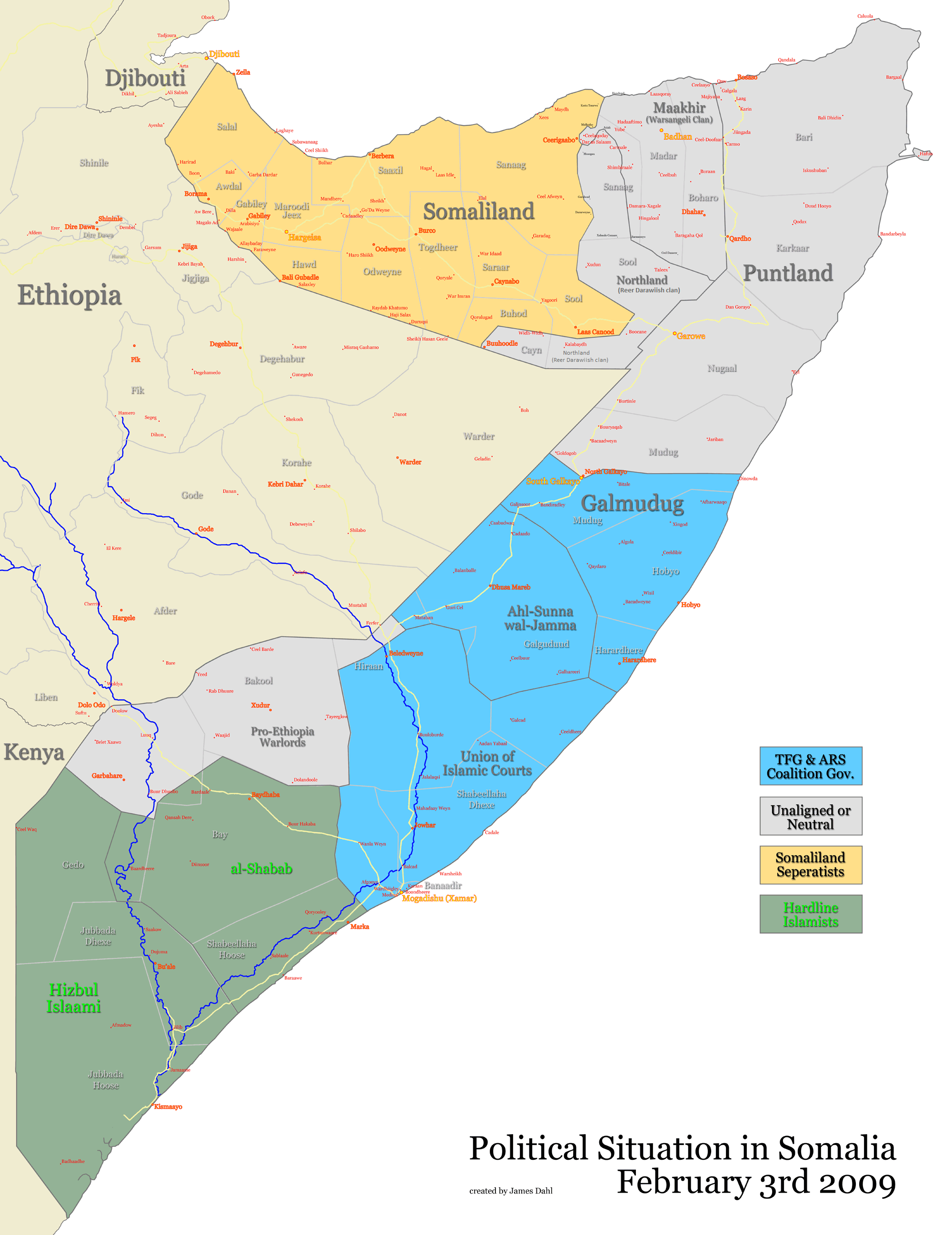
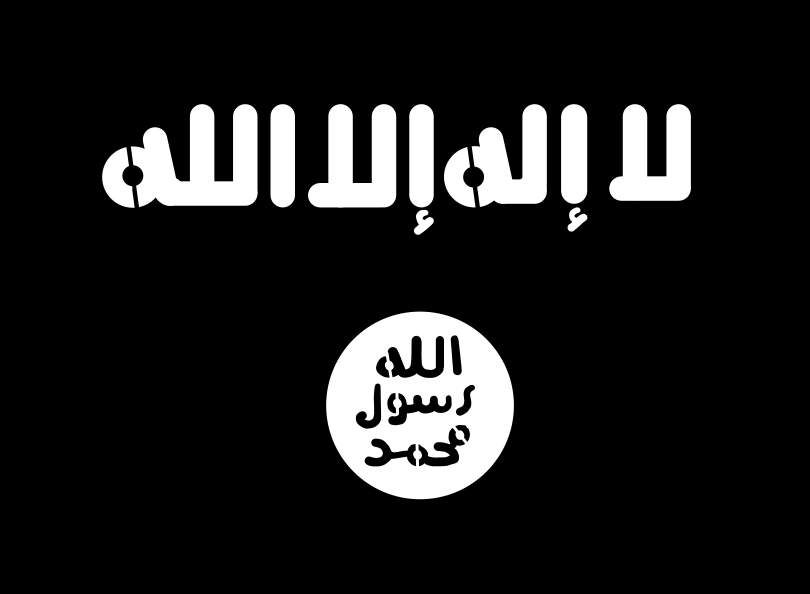
Following their defeat, the Islamic Courts Union splintered into several different factions. Some of the more radical elements, including Al-Shabaab, regrouped to continue their insurgency against the TFG and oppose the Ethiopian military's presence in Somalia. Throughout 2007 and 2008, Al-Shabaab scored military victories, seizing control of key towns and ports in both central and southern Somalia. At the end of 2008, the group had captured Baidoa but not Mogadishu. On May 1, 2008, the U.S. made an airstrike on Dhusamareb, and followed on 3 May with another airstrike on the border town of Dobley. According to the International Crisis Group, Ethiopia's leaders were surprised by the insurgency's persistence and strength and frustrated at the TFG's chronic internal problems. By January 2009, Al-Shabaab and other militias had forced the Ethiopian troops to retreat, leaving behind an understaffed African Union peacekeeping force.
Due to a lack of funding and human resources, an arms embargo that made it difficult to re-establish a national security force, and general indifference on the part of the international community, President Yusuf found himself obliged to deploy thousands of troops from Puntland to Mogadishu to sustain the battle against insurgent elements in the southern part of the country. Financial support for this effort was provided by the autonomous region's government. This left little revenue for Puntland's own security forces and civil service employees, leaving the territory vulnerable to piracy and terrorist attacks.
On December 29, 2008, Abdullahi Yusuf Ahmed announced before a united parliament in Baidoa his resignation as President of Somalia. In his speech, which was broadcast on national radio, Yusuf expressed regret at failing to end the country's seventeen-year conflict as his government had mandated to do. He also blamed the international community for its failure to support the government, and said that the speaker of parliament would succeed him in office per the charter of the Transitional Federal Government.
Coalition government (2009)
Between May 31 and June 9, 2008, representatives of Somalia's federal government and the Alliance for the Re-liberation of Somalia (ARS) participated in peace talks in Djibouti brokered by Ahmedou Ould-Abdallah, the Special Representative of the Secretary General for Somalia. The conference ended with a signed agreement calling for the withdrawal of Ethiopian troops in exchange for the cessation of armed confrontation. Parliament was subsequently expanded to 550 seats to accommodate ARS members, which then elected Sheikh Sharif Sheikh Ahmed, the former ARS chairman, to office. President Sharif shortly afterwards appointed Omar Abdirashid Ali Sharmarke, the son of slain former President Abdirashid Ali Sharmarke, as the nation's new Prime Minister.
With the help of AMISOM, the coalition government also began a counteroffensive in February 2009 to assume full control of the southern half of the country. To solidify its rule, the TFG formed an alliance with the Islamic Courts Union, other members of the Alliance for the Re-liberation of Somalia, and Ahlu Sunna Waljama'a, a moderate Sufi militia. Furthermore, Al-Shabaab and Hizbul Islam, the two main Islamist groups in opposition, began to fight amongst themselves in mid-2009.
As a truce, in March 2009, Somalia's coalition government announced that it would re-implement shari'a as the nation's official judicial system. However, conflict continued in the southern and central parts of the country. Within months, the coalition government had gone from holding about 70% of south-central Somalia's conflict zones, territory which it had inherited from the previous Yusuf administration, to losing control of over 80% of the disputed territory to the Islamist insurgents.
Since 2009
Main article: Somali Civil War (2009–present)
In November 2010, a new technocratic government was elected to office, which enacted numerous reforms. Among these, in its first 50 days in office, the new administration completed its first monthly payment of stipends to government soldiers. This government subsequently began to push back Al-Shabaab over the following years.
On August 6, 2011, Al-Shabaab was forced to withdraw from most of Mogadishu. Al-Shabaab did still retain a foothold in the northern outskirts of the capital, but by January 2012, the combined efforts of Somali government and AMISOM forces had expelled them from the city completely. An ideological rift within Al-Shabaab's leadership also emerged after the 2011 drought and the assassination of top officials in the organization. With the majority of Mogadishu secure, the Somali Armed Forces and Kenya Defence Forces next launched Operation Linda Nchi, a joint advance against Al-Shabaab, in October 2011. This operation had reportedly been planned for nearly two years, during which time Kenyan officials sought U.S. support for the mission. After the successful conclusion of Operation Linda Nchi in May 2012, Kenyan troops were formally integrated into AMISOM in June. After Operation Linda Nchi, the port city of Kismayo was the last major stronghold that remained in Al-Shabaab's control. A Kenyan-led AMISOM force, backed by the Raskamboni movement, then launched an offensive against Kismayo on September 28, 2012. After a three-day battle, Somali government forces were able to gain control of the city. The month of September 2012 also saw the establishment of the Federal Government of Somalia.
In January 2013, AMISOM's mandate was extended for another year following the adoption of UNSC Resolution 2093. The Security Council also unanimously voted to suspend Somalia's arms embargo on light weapons for one year and welcomed the Federal Government's development of a new national security strategy, urging the central authorities to accelerate the plan's implementation, further define the Somali national security forces' composition, and identify capability gaps to assist their international partners in better addressing them. While many urban areas had been seized, Al-Shabaab still controlled many rural areas, where a number of their operatives disappeared into local communities in order to more effectively exploit any mistakes by the central authorities.
In October 2013, the U.S. Africa Command began establishing the Mogadishu Coordinating Cell, which became fully operational in late December. The unit was formed at the request of the Somali government and AMISOM, who had approached U.S. Department of Defense Secretary Chuck Hagel in September about the possibility. It consists of a team of fewer than five advisers, including planners and communicators between the Somali authorities and AMISOM. The cell is intended to provide consultative and planning support to the allied forces to enhance their capacity and promote peace and security throughout the country and region. In November 2013, a senior Ethiopian government official announced that Ethiopia's troops deployed in Somalia would soon join AMISOM, having already forwarded a request to do so. At the time, an estimated 8,000 Ethiopian soldiers were stationed in the country. The Somali Foreign Ministry welcomed the decision, asserting that the move would galvanize AMISOM's campaign against Al-Shabaab.
Following the adoption of UN Security Council Resolution 2124, which authorized the deployment of 4,000 additional troops to augment AMISOM's 22,126 strong force, Ethiopian troops formally joined the mission in January 2014. They are mandated to work alongside the Somali National Army, with responsibility for the allied forces' operations in the southern Gedo, Bakool and Bay regions. The Ethiopian troops represent AMISOM's sixth contingent after the Djibouti, Burundi, Sierra Leone, Kenya and Uganda units.
In January 2014, at an African Union Summit in Addis Ababa, President Hassan Sheikh Mohamud requested an extension of the UN Security Council's weapons purchasing mandate for Somalia after its March expiration, saying that the Somali defence forces required better military equipment and arms to more effectively combat militants. The following month, the UN Somalia and Eritrea Monitoring Group reported that systematic abuses by Somali government officials had allowed weapons to be diverted away from Somalia's security forces into the hands of faction leaders and Al-Shabaab militants. The panel had observed various problems with the management of weapons and ammunition stockpiles, including difficulties by monitors in accessing local weapons stockpiles and obtaining information about the arms. The monitors also suggested that one key adviser to the president was involved in planning arms deliveries to Al-Shabaab and that shipments of weapons from Djibouti and Uganda could not be accounted for. Somali Chief of Army Dahir Adan Elmi made a pro forma denial of the allegations. He also said that a UN monitoring team had twice visited the government's weapons and ammunition storage facilities in Mogadishu, where it was shown the arms stockpiles for inspection and had expressed satisfaction. Elmi said that the government had twice purchased weapons since the arms embargo on Somalia was partially lifted. He also asserted that Al-Shabaab already had an adequate supply of weapons and mainly utilized explosive devices and sophisticated bombs.

In February 2014, a delegation led by Prime Minister of Somalia Abdiweli Sheikh Ahmed met in Addis Ababa with Ethiopian Prime Minister Hailemariam Desalegn to discuss strengthening relations between the countries. Ahmed commended Ethiopia's role in the ongoing peace and stabilization process in Somalia as well as its opposition to Al-Shabaab, and welcomed the Ethiopian military's decision to join AMISOM. Desalegn in turn pledged his administration's continued support for Somalia's peace and stabilization efforts, as well as its preparedness to assist in initiatives aiming to build up Somali security forces through experience-sharing and training. The meeting concluded with a tripartite Memorandum of Understanding agreeing to promote partnership and cooperation, including a cooperative agreement to develop the police force.
On 5 March 2014, the UN Security Council unanimously voted to extend the partial easing of the arms embargo on Somalia to 25 October. The resolution permitted the Somali government to purchase light weapons, with the stipulation that all member states must take steps to prevent the direct or indirect supply, transfer or sale of arms and military equipment to individuals or entities outside of the Somali security forces. The Somali government was also required to routinely report on the structural status of the military, as well as provide information on the extant infrastructure and protocols designed to ensure the military equipment's safe delivery, storage and maintenance.
In early March 2014, AMISOM, supported by Somali militias, launched another operation to remove Al-Shabaab from its remaining areas of control in southern Somalia. According to Prime Minister Abdiweli Sheikh Ahmed, the government subsequently launched stabilization efforts in the newly liberated areas, which included Rab Dhuure, Hudur, Wajid and Burdhubo. The Ministry of Defense provided ongoing reassurance and security to local residents, and supplied logistical and security support. Additionally, the Ministry of Interior was prepared to support and put into place programs to assist local administration and security. A Deputy Minister and several religious scholars were dispatched to all four towns to coordinate and supervise the federal government's stabilization initiatives. By March 26, the allied forces had liberated ten towns, including Qoryoley and El Buur. UN Special Representative for Somalia Nicholas Kay described the military advance as the most significant and geographically extensive offensive since AU troops began operations in 2007.
In August 2014, the Somali government-led Operation Indian Ocean was launched, aiming to reduce insurgent-held areas along the coastline. On 1 September 2014, a U.S. drone strike carried out as part of the broader mission killed Al-Shabaab leader Muktar Abu Zubeyr. U.S. authorities hailed the raid as a major symbolic and operational loss for Al-Shabaab, and the Somali government offered a 45-day amnesty to all moderate members of the militant group.
On 15 December 2018 there were demonstrations in the city of Baidoa by supporters of Mukhtar Rowbow, a presidential candidate who had been arrested two days earlier by government forces and transferred to Mogadishu. Rowbow was a senior member of al-Shabaab. AMISOM announced that its forces did not assist in Rowbow's arrest and his transfer to Mogadishu.
From the beginning of 2020, humanitarian researchers and local medical personnel became increasingly concerned that the COVID-19 pandemic could be catastrophic for Somalis, because of the damage the civil war has wrought on Somalia's health care, and weak provision since the 1980s. On 25 November 2020, it was reported that a CIA officer had been killed in Somalia. The death came as the US administration under Donald Trump was making plans to withdraw more than 600 troops from Somalia.
President Donald Trump ordered the Department of Defense to remove the majority of the 700 U.S. troops in Somalia (many from Special Operations Command Africa) in December 2020. He changed the mission of American troops to assist the Somali Armed Forces in its fight against al-Shabaab.
When President Mohamed Abdullahi Mohamed's term expired in February 2021, dates had not been set for the election of a successor, and fighting subsequently broke out in Mogadishu. This fighting continued until May 2021, when the government and opposition agreed to hold elections within 60 days; after further negotiation, the presidential election was scheduled for October 10, and was actually held on 15 May 2022, with Hassan Sheikh Mohamud being declared the new president in a peaceful transition of power.
In March 2022, the 14-year long AMISOM mission came to an end. It was replaced by a Somali-led operation, the African Union Transition Mission in Somalia (ATMIS), and later by the African Union Support and Stabilization Mission in Somalia (AUSSOM)
In 2023, fighting broke out between the Khatumo State and Somaliland leading to the 2023 Las Anod conflict.
On May 14, 2025, in a post on social medias, Donald Trump claimed that he would "support the Somali People, who should not allow the Houthis to embed.", claiming that this initiative was "to end terrorism, and bring prosperity to their Country”.
Casualties
According to Necrometrics, around 500,000 people are estimated to have been killed in Somalia since the start of the civil war in 1991. The Armed Conflict Location & Event Dataset estimates that 3,300 people were killed during the conflict in 2012, with the number of fatalities dropping slightly in 2013 to 3,150. The United Nations Assistance Mission in Somalia reported at least 596 civilian casualties by August 2020. However, officials have struggled to maintain an accurate count due to flooding and COVID-19 deaths in the area.
Notes
References
References
- link. (February 22, 2014)
- Legum, Colin. (1989). "Africa Contemporary Record: Annual Survey and Documents, Volume 20". Africa Research Limited.
- Bongartz, Maria. (1991). "The civil war in Somalia: its genesis and dynamics". Nordiska Afrikainstitutet.
- Central Intelligence Agency. (2011). "Somalia". Central Intelligence Agency.
- Central Intelligence Agency. (2011). "Somalia – Government – Judicial branch". Central Intelligence Agency.
- Ken Menkhaus, "Local Security Systems in Somali East Africa," ''Fragile States and Insecure People'', 2007, 73.
- Fergusson, James. (13 January 2013). "Identifying Causes of State failure: The Case of Somalia". Universität Konstanz Politik- und Verwaltungswissenschaften.
- Central Intelligence Agency. (2003). "Somalia – Government – Judicial branch". Central Intelligence Agency.
- (2002). "The causes of war and the consequences of peacekeeping in Africa". Portsmouth, NH : Heinemann.
- Bakonyi, Jutta. (17 Apr 2013). "Authority and administration beyond the state: local governance in southern Somalia, 1995–2006". Journal of Eastern African Studies.
- In 2007, Menkhaus wrote that 'armed conflict in Somalia has generally subsided since the early 1990s. Armed clashes continue to break out, but are nowhere near the scale and intensity of the fighting that destroyed Hargeisa in 1988–89 or Mogadishu in 1991–92.' Menkhaus, FSIP, 2007, 75.
- Menkhaus 2007, op. cit., 76.
- Mueller, Jason C.. (2018-01-02). "The Evolution of Political Violence: The Case of Somalia's Al-Shabaab". Terrorism and Political Violence.
- Messner, J.J.. (24 June 2014). "Failed States Index 2014: Somalia Displaced as Most-Fragile State". The Fund for Peace.
- (16 October 2011). "Kenya launches offensive in Somalia".
- United Nations Security Council, Report of the Monitoring Group on Somalia and Eritrea pursuant to Security Council Resolution 2002 (2011), S/2012/544, p. 226
- "Kenya – KDF". AMIS.
- "Communiqué on Secretary-General's Mini-Summit on Somalia". United Nations.
- Hoehne, Markus V.. (June 2023). "The Conflict over Lasanod: Longterm and Immediate Factors, and Prospects for Settlement". Raad Peace Research Institute, University of Leipzig.
- Balthasar, Dominik. (19 November 2014). "New Approaches Are Needed for State-Building in Somalia". Fair Observer.
- Messner, J. J.. (24 June 2013). "Failed States Index 2013: What Were You Expecting?". The Fund for Peace.
- "The European Union announces more than €124 million to increase security in Somalia". European Commissioner.
- (January 29, 2015). "Somalia's Year of Delivery". Goobjoog.
- World of Information (Firm), ''Africa Review'', (World of Information: 1987), p. 213.
- Arthur S. Banks, Thomas C. Muller, William Overstreet, ''Political Handbook of the World 2008'', (CQ Press: 2008), p. 1198.
- National Academy of Sciences (U.S.). Committee on Human Rights, Institute of Medicine (U.S.). Committee on Health and Human Rights, ''Scientists and human rights in Somalia: report of a delegation'', (National Academies: 1988), p. 9.
- "Somalia — Government". Library of Congress.
- Nannini, Vance J.. (January 1994). "Decisions in Operations Other Than War: The United States Intervention in Somalia".
- Kapteijns, Lidwien. (18 December 2012). "Clan Cleansing in Somalia: The Ruinous Legacy of 1991". University of Pennsylvania Press.
- Balthasar, Dominik. (2017-07-26). "State-making at Gunpoint: The Role of Violent Conflict in Somaliland's March to Statehood". Civil Wars.
- Metz, Helen Chapin. (1993). "Somalia : a country study". Federal Research Division, Library of Congress, Federal Research Division., Thomas Leiper Kane Collection (Library of Congress. Hebraic Section).
- Menkhaus, Ken. (April 2011). "Somalia and the Horn of Africa". World Bank.
- Rawson, David. (1993). "The Somali State and Foreign Aid...United States Department of State". United States Department of State.
- (1 November 1992). "Somalia: Information on the capture of the town of Belet Uen by the United Somali Congress (USC) at the end of 1990 or early 1991 and on persecution of Darod in Belet Uen by USC soldiers". Canada: Immigration and Refugee Board of Canada.
- (1 January 1990). "Human Rights Watch World Report 1989". Human Rights Watch.
- Yuusuf, Muuse. (29 December 2022). "The Genesis of the Civil War in Somalia: The Impact of Foreign Military Intervention on the Conflict.". Bloomsbury Academic.
- Bloomfield, Steve. (June 11, 2007). "Aden Abdulle Osman — First President of Somalia". The Independent.
- (1991). "Horn of Africa Bulletin, Volumes 3–4". Life & Peace Institute.
- Renders, Marleen. (2012-01-20). "Consider Somaliland: State-Building with Traditional Leaders and Institutions". BRILL.
- Walls, Michael. (2011). "State formation in Somaliland: Bringing deliberation to institutionalism". University College London.
- Walls, Michael. (2009-07-01). "The Emergence of a Somali State: Building Peace from Civil War in Somaliland". African Affairs.
- Drysdale, John Gordon Stewart. (1991). "Somaliland 1991: Report and Reference". Global-Stats.
- Gurdon, Charles. (1996). "The Horn of Africa". Bulletin of the School of Oriental and African Studies.
- Nina J. Fitzgerald, ''Somalia: issues, history, and bibliography'', (Nova Publishers: 2002), p. 19.
- Ciisa-Salwe, Cabdisalaam M.. (1996). "The collapse of the Somali state: the impact of the colonial legacy". HAAN Publishing.
- Silanyo, Ahmed M.. "A Proposal to the Somali National Movement: On a Framework for a Transitional Government in Somalia". Wardheernews.
- Library Information and Research Service, ''The Middle East: Abstracts and index'', Volume 2, (Library Information and Research Service: 1999), p. 327.
- Interpeace, '[http://www.interpeace.org/publications/somali-region/60-a-history-of-mediation-in-somalia-since-1988-english/file The search for peace: A history of mediation in Somalia since 1988],' Interpeace, May 2009, 13–14. {{webarchive. link. (February 22, 2014)
- Clancy, Tom. (2005). "Battle Ready:Study in Command Commander Series". Penguin.
- (1992-03-26). "Somalia: No Mercy in Mogadishu". [[Human Rights Watch]].
- Mohamed Ahmed Jama, “Securing Mogadishu: Neighbourhood Watches,” in Whose Peace is it anyway? Connecting Somali and International Peacemaking Approaches, Accord 21, Conciliation Resources, 2010, 66.
- "United Nations Operation in Somalia I (UNOSOM I)". United Nations.
- [[Ken Rutherford (scientist). Ken Rutherford]], [https://www.amazon.com/dp/1565492609 ''Humanitarianism Under Fire: The US and UN Intervention in Somalia,'' Kumarian Press, July 2008] {{Webarchive. link. (March 10, 2020 {{ISBN). 1-56549-260-9
- "United Nations Operation In Somalia I – (Unosom I)". United Nations.
- For further details on UNOSOM-sponsored local-level community-based reconciliation conferences, see Menkhaus, 'International Peacebuilding and the Dynamics of Local and National Reconciliation in Somalia,' International Peacekeeping, Vol. 3, No. 1, Spring 1996, 52.
- See also Report of the Secretary-General on Somalia, S/1995/231 (March 28, 1995).
- "United Nations Operation in Somalia II". United Nations.
- (January 19, 1996). "Report of the Secretary-General on the Situation in Somalia (S/1996/42)".
- (March 16, 2012). "Djibouti Conference".
- Associated Press. (September 19, 1995). "Aidid troops kill Somalis, capture city". The Register-Guard.
- S/1996/42, 26, 27, 28, 29
- [[Air Command and Staff College]], [https://web.archive.org/web/19990417194537/http://www.au.af.mil/au/database/projects/ay1995/acsc/95-002/chap4/somff.htm Combatant Commands Informational Series: Central Command: Somalia: Fielded Forces], drawing on the [[International Institute for Strategic Studies]], ''Military Balance 1994–95.''
- Report of the Secretary-General on the Situation in Somalia, S/1997/135, February 17, 1997, paragraphs 6,7, and 9. For later occurrences 1997 to 2000, see S/1997/715, S/1999/882, and S/2000/1211 (December 19, 2000).
- (October 2025). "Somalia: Puntland's Experience in Peace-building and State-building}}{{Dead link".
- "Somalia: IRIN interview with Hussein Aideed, 5/4/99". IRIN.
- Strategic Survey 1999–2000, 264.
- Society, Security, Sovereignty and the State in Somalia: From Statelessness to Statelessness? – Page 222
- "August 2000 – Somalia". Rulers.
- Interpeace, 'The search for peace: A history of mediation in Somalia since 1988,' Interpeace, May 2009, 59–60
- Interpeace, May 2009, 60–61.
- (2007-08-14). "Ethiopian Invasion of Somalia". Globalpolicy.org.
- (29 December 2008). "Profile: Somali's newly resigned President Abdullahi Yusuf Ahmed". News.xinhuanet.com.
- Ken Menkhaus, 'Somalia: What went wrong?' The ''[[RUSI Journal]]'', Vol. 154, No. 4, August 2009, 8. Menkhaus says in addition: '[f]or details, see [https://www.hrw.org/reports/2007/08/12/shell-shocked Human Rights Watch, 'Shell-shocked: Civilians under siege in Mogadishu,'] {{Webarchive. link. (September 17, 2014 August 13, 2007, and HRW, 'So Much to Fear: War Crimes and the Devastation of Somalia,' December 2008.')
- Interpeace, May 2009, 61.
- "Background and Political Developments". AMISOM.
- Wezeman, Pieter D.. "Arms flows and conflict in Somalia". SIPRI.
- (8 August 2006). "Hardline Islamist Militia Group Shabbab Emerges in Somalia". Jamestown Foundation.
- International Crisis Group, Somalia: To Move Beyond the Failed State, Africa Report N°147 – December 23, 2008, 25.
- "USCIRF Annual Report 2009 – The Commission's Watch List: Somalia". USCIRF.
- (December 25, 2008). "Somalia: Guide to Puntland Election 2009". Garoweonline.com.
- "Opening Annual General Assembly Debate, Secretary-General Urges Member States to Press in Tackling Poverty, Terrorism, Human Rights Abuses, Conflicts". Unis.unvienna.org.
- [https://news.bbc.co.uk/1/hi/world/africa/7802622.stm "Somalia's president quits office"], BBC News, December 29, 2008.
- [https://www.ft.com/content/a790e984-d590-11dd-a9cc-000077b07658 "Somali President Yusuf resigns"] {{Webarchive. link. (December 31, 2008 , Reuters (FT.com), December 29, 2008.)
- Kamaal says. (May 22, 2010). "UN boss urges support for Somalia ahead of Istanbul summit". Horseedmedia.net.
- (October 21, 2009). "Islamists break Somali port truce". BBC News.
- link. (September 22, 2012 – ''[[Arab News]]'')
- Online, Garowe. (January 12, 2011). "Somalia President, Parliament Speaker dispute over TFG term". Garoweonline.com.
- "Security Council Meeting on Somalia". Somaliweyn.org.
- "Al-Shabaab Evicted from Mogadishu". Somalia Report.
- Chothia, Farouk. (August 9, 2011). "Could Somali famine deal a fatal blow to al-Shabab?". BBC.
- (October 16, 2011). "Kenya launches offensive in Somalia". National Post.
- "Joint Communique – Operation Linda Nchi". Kenya High Commission, Tanzania.
- "Somalia government supports Kenyan forces' mission". Standardmedia.co.ke.
- Azikiwe, Abayomi. (January 4, 2012). "Leaked cables confirm U.S. role in Somalia war". Pan-African News Wire.
- (2015). "Kenya at war: Al-Shabaab and its enemies in Eastern Africa". African Affairs.
- (June 19, 2012 }}{{dead link). "Kenya: Defense Minister appointed as acting Internal Security Minister". Garowe Online.
- Chonghaile, Clar Ni. (September 28, 2012). "Kenyan troops launch beach assault on Somali city of Kismayo". [[The Guardian]].
- Williams, Paul D. ''Fighting for Peace in Somalia: A History and Analysis of the African Union Mission (AMISOM), 2007–2017,'' Oxford University Press, 2018.
- "United Nations Security Council Resolution 2093".
- Hammond, Laura. (2013). "Somalia rising: things are starting to change for the world's longest failed state". Journal of Eastern African Studies.
- (10 January 2014). "U.S. military advisers deployed to Somalia to help African forces". Reuters.
- Martinez, Luis. (January 10, 2014). "U.S. Military Advisers Deployed to Somalia: First Time Since Blackhawk Down". ABC News.
- Tekle, Tesfa-Alem. (November 12, 2013). "Somalia: Ethiopia Decides to Join Amisom Force in Somalia". Sudan Tribune.
- Ali, Hassan. (November 12, 2013). "Somali government welcomes Ethiopia AMISOM integration". Dalsan Radio.
- (February 14, 2014). "Comment on Ethiopian troops formally join AMISOM peacekeepers in Somalia". Foreign Affairs.
- (January 22, 2014). "Ethiopian Forces formally integrated into AMISOM". AMISOM.
- (31 January 2014). "Mohamud wants UN to extend weapons purchasing mandate". Sabahi.
- (February 14, 2014). "Somalia diverting arms to al-Shabab, UN report claims". BBC News.
- (15 February 2014). "Somali Government official denies U.N arms diversion allegations". Horseed Media.
- (15 February 2014). "Federal government of Somalia denies the report issued by UN monitoring group". Goobjoog.
- (17 February 2014). "Somalia: Military chief says UN Monitoring Group wants Al Shabab to become an endless project". Raxanreeb.
- "Ethiopia: The Prime Minister of Somalia On a Visit to Ethiopia". Government of Ethiopia.
- (6 March 2014). "UN Security Council Extends Arms Embargo lift on Somalia to eight months". Horseed Media.
- Charbonneau, Louis. (6 March 2014). "U.N. extends partial easing of Somalia arms embargo to October". Reuters.
- (11 March 2014). "Somalia: Federal Govt, AMISOM troops clash with Al Shabaab". Garowe Online.
- (12 March 2014). "Somalia: PM hosts meeting with International Community diplomats on stabilisation efforts". Raxanreeb.
- (22 March 2014). "Somalia: The capture of Qoryooley is critical for the operations to liberate Barawe, Amisom head says". Raxanreeb.
- (26 March 2014). "Somalia: Elbur town falls for Somali Army and Amisom". Raxanreeb.
- (22 March 2014). "Somalia, AU troops close in on key Shebab base". AFP.
- (5 September 2014). "Somalia: President says Godane is dead, now is the chance for the members of al-Shabaab to embrace peace".
- (5 September 2014). "Pentagon Confirms Death of Somalia Terror Leader".
- (December 15, 2018). "US Says Airstrike in Somalia Killed 8 Militants".
- (1 April 2020). "COVID-19: A Looming humanitarian disaster for Somali East Africa". Danish Institute for International Studies.
- Sciutto, Jim. (November 25, 2020). "CIA officer killed in combat in Somalia".
- "Trump orders most US troops out of Somalia".
- AfricaNews. (2021-05-27). "Somalia to hold elections within 60 days-Gov't says".
- "Somalia to hold indirect presidential election October 10".
- (5 May 2022). "Somalia to hold presidential election on May 15". [[Arab News]].
- "Somalia elects new president after long overdue elections".
- (2020-06-30). "AU starts second phase of discussion over new mission in Somalia".
- "US won't let 'terrorists' hide in Somalia, says President Trump".
- "Conflict Trends (No. 23) Real-time Analysis of African Political Violence, February 2014". ACLED.
- Human Rights Watch. (2020-12-23). "Somalia: Events of 2020". English.
This article was imported from Wikipedia and is available under the Creative Commons Attribution-ShareAlike 4.0 License. Content has been adapted to SurfDoc format. Original contributors can be found on the article history page.
Ask Mako anything about Somali Civil War — get instant answers, deeper analysis, and related topics.
Research with MakoFree with your Surf account
Create a free account to save articles, ask Mako questions, and organize your research.
Sign up freeThis content may have been generated or modified by AI. CloudSurf Software LLC is not responsible for the accuracy, completeness, or reliability of AI-generated content. Always verify important information from primary sources.
Report