From Surf Wiki (app.surf) — the open knowledge base
Solomon R. Guggenheim Museum
Art museum in Manhattan, New York

Art museum in Manhattan, New York
| Field | Value |
|---|---|
| name | Solomon R. Guggenheim Museum |
| logo | Guggenheim Museum Logo.svg |
| logo_upright | 1.25 |
| image | Solomon R. Guggenheim Museum (48059131351).jpg |
| image_upright | 1.25 |
| caption | View from Fifth Avenue |
| coordinates | |
| mapframe-zoom | 12 |
| established | 1939 |
| location | 1071 Fifth Avenue at 89th Street |
| Manhattan, New York City | |
| type | Art museum |
| visitors | 861,000 (2023) |
| director | Mariët Westermann |
| publictransit | Subway: at 86th Street |
| Bus: | |
| website | |
| embedded | {{Infobox historic site |
| embed | yes |
| built | 19561959 |
| architect | Frank Lloyd Wright |
| architecture | Modern |
| designation1 | WHS |
| designation1_partof | The 20th-Century Architecture of Frank Lloyd Wright |
| designation1_date | 2019 (43rd session) |
| designation1_criteria | (ii) |
| designation1_number | 1496-008 |
| designation1_free1name | Region |
| designation1_free1value | North America |
| designation2 | NRHP |
| designation2_date | |
| designation2_number | 05000443 |
| designation3 | NHL |
| designation3_date | |
| designation4 | NYSRHP |
| designation4_date | |
| designation4_number | 06101.008546 |
| designation5 | New York City |
| designation5_date | |
| designation5_number | 1774 (exterior), 1775 (interior) |
| mapframe-zoom = 12 Manhattan, New York City Bus:
The Solomon R. Guggenheim Museum, often referred to as The Guggenheim, is an art museum at 1071 Fifth Avenue between 88th and 89th Streets on the Upper East Side of Manhattan in New York City. It hosts a permanent collection of Impressionist, Post-Impressionist, early Modern and contemporary art and also features special exhibitions throughout the year. It was established by the Solomon R. Guggenheim Foundation in 1939 as the Museum of Non-Objective Painting, under the guidance of its first director, Hilla von Rebay. The museum adopted its current name in 1952, three years after the death of its founder Solomon R. Guggenheim. It continues to be operated and owned by the Solomon R. Guggenheim Foundation.
The museum's building, a landmark work of 20th-century architecture designed by Frank Lloyd Wright, drew controversy for the unusual shape of its display spaces and took 15 years to design and build; it was completed in 1959. It consists of a six-story, bowl-shaped main gallery to the south, a four-story "monitor" to the north, and a ten-story annex to the northeast. A six-story helical ramp extends along the main gallery's perimeter, under a central ceiling skylight. The Thannhauser Collection is housed within the top three stories of the monitor, and there are additional galleries in the annex and a learning center in the basement. The museum building's design was controversial when it was completed but was widely praised afterward. The building underwent extensive renovations from 1990 to 1992, when the annex was built, and it was renovated again from 2005 to 2008.
The museum's collection has grown over the decades and is founded upon several important private collections, including those of Guggenheim, Karl Nierendorf, Katherine Sophie Dreier, Justin Thannhauser, Rebay, Giuseppe Panza, Robert Mapplethorpe and the Bohen Foundation. The collection, which includes around 8,000 works , is shared with sister museums in Bilbao and Venice. In 2023, nearly 861,000 people visited the museum.
History
Early years and Hilla Rebay
Solomon R. Guggenheim, a member of a wealthy mining family, began collecting works of the old masters in the 1890s. who introduced him to European avant-garde art, in particular abstract art that she felt had a spiritual and utopian aspect (non-objective art). Guggenheim and Rebay initially considered building a museum at Rockefeller Center in Manhattan.
The foundation's first venue, the Museum of Non-Objective Painting, opened at 24 East 54th Street in midtown Manhattan in 1939, under Rebay's direction. He wanted to display the collection at the 1939 New York World's Fair in Queens, but Rebay advocated for a more permanent location in Manhattan. and Rebay wanted to establish it before Guggenheim died.
Design process
In 1943, Rebay and Guggenheim wrote a letter to Frank Lloyd Wright asking him to design a structure to house and display the collection. Rebay thought the 76-year-old Wright was dead, but Guggenheim's wife Irene Rothschild Guggenheim knew better and suggested that Rebay contact him. Wright accepted the opportunity to experiment with his "organic" style in an urban setting, saying that he had never seen a museum that was "properly designed". He was hired to design the building in June 1943. He was to receive a 10 percent commission on the project, which was expected to cost at least $1 million. the cost eventually doubled from the initial estimate.
Rebay envisioned a space that would facilitate a new way of seeing modern art. She wrote Wright that "each of these great masterpieces should be organized into space, and only you ... would test the possibilities to do so. ... I want a temple of spirit, a monument!" Critic Paul Goldberger later wrote that Wright's modernist building was a catalyst for change, making it "socially and culturally acceptable for an architect to design a highly expressive, intensely personal museum. In this sense almost every museum of our time is a child of the Guggenheim." The Guggenheim is the only museum Wright designed; its urban location required him to design it in a vertical rather than horizontal form, far different from his earlier, rural works.

From 1943 to early 1944, Wright produced four differing designs. One had a hexagonal shape and level floors for the galleries, though all the others had circular schemes and used a ramp continuing around the building.{{Efn|Wright had experimented with a ramp design as early as 1924, when he had drawn plans for a visitor center at Sugarloaf Mountain in Maryland, which was never built. His original concept was called an inverted "ziggurat", because it resembled the steep steps on the ziggurats built in ancient Mesopotamia.
Site selection and announcement of plans
Wright expected that the museum would be in lower Manhattan. Instead, in March 1944, Rebay and Guggenheim acquired a site on Manhattan's Upper East Side, at the corner of 89th Street and the Museum Mile section of Fifth Avenue, overlooking Central Park. They considered numerous locations in Manhattan, as well as the Riverdale section of the Bronx, overlooking the Hudson River. Guggenheim felt that the Fifth Avenue site's proximity to Central Park was important, as the park afforded relief from the noise, congestion and concrete of the city. Wright's preliminary sketches fit the site nearly perfectly, although the site was about 25 ft narrower than what Wright anticipated. Guggenheim approved Wright's sketches in mid-1944.
Wright's designs were announced in July 1945, The structure's main feature was a main gallery with a helical ramp, surrounding a lightwell with a skylight. Guests would board an elevator to reach the top; a second, steeper ramp would serve as an emergency exit. in addition to storage space, a library and a cafe. Preliminary plans also included apartments for Guggenheim and Rebay, but these plans were scrapped. Wright built a model of the museum at Taliesin, his home in Wisconsin, and displayed it at the Plaza Hotel that September.
Difficulties
The building's construction was delayed, first because of material shortages caused by World War II, Rebay and Wright disagreed over several aspects of the design, such as the means by which the paintings were to be mounted, although they both wanted the design to "reflect the unity of art and architecture". Wright continued to modify his plans during the late 1940s, largely because of concerns over the building's lighting, and created another model of the museum in 1947. The collection was greatly expanded in 1948 through the purchase of art dealer Karl Nierendorf's estate of some 730 works.
Progress remained stalled through the late 1940s, and William Muschenheim renovated an existing townhouse on the site, at 1071 Fifth Avenue, for the museum's use. Guggenheim's health was in decline, but he refused Wright's offer to downsize the planned building so it could be completed during Guggenheim's lifetime. Under Rebay's leadership, the museum had become what Aline B. Saarinen described as an "esoteric, occult place in which a mystic language was spoken". Some of the museum's staff and trustees wished to oust Rebay and cancel Wright's design.
To accommodate the growing collection, in August 1951 the Guggenheim Foundation acquired an apartment building at 1 East 88th Street to remodel for museum use. It now owned a continuous frontage on Fifth Avenue from 88th to 89th Street. This prompted Wright to redesign the new building yet again, proposing a multi-story annex with apartments behind the museum. Rebay, who disagreed with this policy, resigned as director of the museum in March 1952. Nevertheless, she left a portion of her personal collection to the foundation in her will. Shortly after Rebay resigned, Wright filed plans for the building, which was now projected to cost $2 million. It was renamed the Solomon R. Guggenheim Museum in 1952.
Sweeney era
James Johnson Sweeney was appointed the museum's director in October 1952. He expanded the foundation's collecting criteria, rejecting Rebay's dismissal of "objective" painting and sculpture, and started exhibiting some of the works placed in storage under Rebay's leadership. In 1953, the museum hosted a retrospective of Wright's work, "Sixty Years of Living Architecture", in a temporary pavilion Wright had designed.
Construction and opening
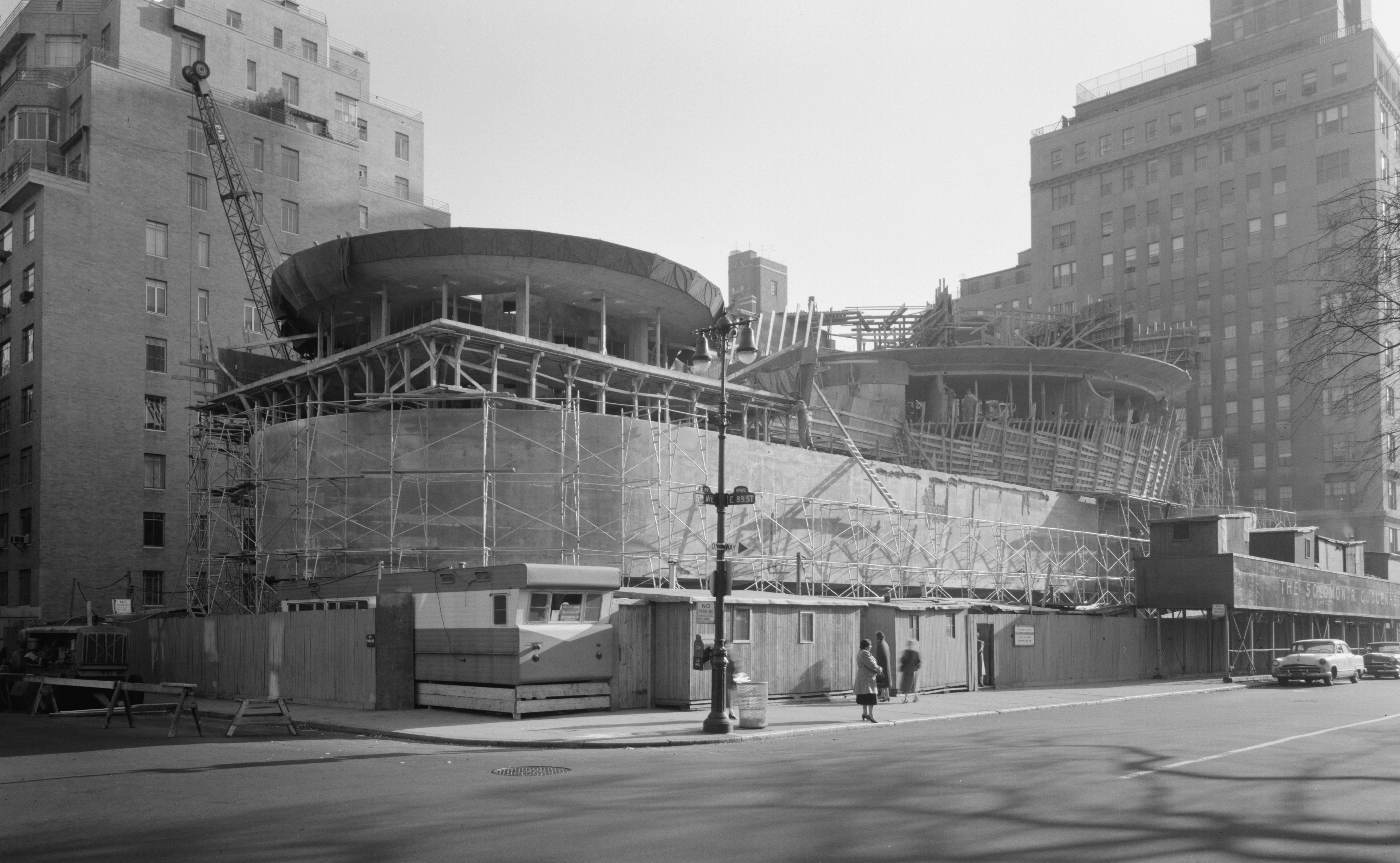
Sweeney and Wright had a strained relationship, as they disagreed over basic elements of the museum's plan. Sweeney, who believed its architecture should be subservient to the art, forced Wright to redesign it to accommodate more offices and storage facilities. The building's lighting was a significant point of contention between them. The New York City Department of Buildings (DOB) also rejected Wright's application for a construction permit in 1953 because the design did not meet building codes. Wright tasked Holden with ensuring that the design met codes and published revised drawings in 1954 and 1956. Museum staff nevertheless complained that Wright's design did not provide enough storage or laboratory space. To save money, he modified the design again in 1955, though these savings were canceled out by increasing construction costs.
Four general contractors submitted bids in late 1954, The museum rented the Oliver Gould Jennings House at 7 East 72nd Street and relocated there before construction began. The DOB issued a construction permit on May 23, and work on the museum began on August 14. Wright opened an office in New York City to oversee the construction, which he felt required his personal attention, and appointed his son-in-law William Wesley Peters to supervise the day-to-day work. In practice, neither Wright nor Peters visited the site frequently, so Holden's William Short ended up managing the project.
Sweeney wanted the new museum to allow "building up a collection which offers up a standard of judgment". He wanted to change the color scheme, level out the sloping walls and remove the clerestory windows, which led to prolonged disputes with Wright. By early 1958, Harry F. Guggenheim had to handle all communications between Sweeney and Wright, who would not speak to each other. The building topped out in May 1958, and the scaffolding on the facade was removed by that August. Meanwhile, Wright published drawings of the design in several architectural magazines, as he feared the design would be compromised after his death. Against his request, Sweeney painted the walls white and hung paintings from metal bars instead of placing them directly on the walls.
The building soft-opened for members of the media on October 20, 1959. drawing 600 visitors per hour. Its design was generally able to accommodate the retrospectives and temporary exhibits that it hosted over the years.
Messer era
Sweeney resigned as the museum's director in July 1960, citing philosophical differences with the board of trustees, and H. H. Arnason took over as temporary director. He launched "the first survey of Abstract Expressionism in a New York museum" during his brief time as director. Thomas M. Messer, director of the Boston Institute of Contemporary Art, succeeded Sweeney as director in January 1961; he worked under Sweeney, who continued to run the foundation. Messer stayed for 27 years, the longest tenure of any director of a major New York art institution. Under his leadership, the museum's collection expanded significantly. The collection pivoted toward more contemporary artists, including those from Europe and Latin America, Messer was not considered "an especially controversial director", though he also did not adhere to "the blockbuster school of exhibiting".
1960s

When Messer joined the Guggenheim, the museum's ability to present artworks was still doubted because of the tilted and curved walls. Almost immediately after becoming director, in 1962, he put on a large exhibition that combined the Guggenheim's paintings with sculptures on loan from the Hirshhorn collection. Though the combination proved generally to work well in the Guggenheim, Messer recalled that, at the time, "I was scared. I half felt that this would be my last exhibition." He had staged a smaller sculpture exhibition the previous year, where he learned how to compensate for the space's unusual geometry by constructing special plinths at a particular angle, but this was impossible for one piece, an Alexander Calder mobile whose wire inevitably hung at a true plumb vertical.
After Messer acquired a private collection from art dealer Justin Thannhauser in 1963, the Guggenheim hired Peters to renovate the monitor's second floor. The foundation auctioned off artwork from the 15th and 16th centuries, which was incompatible with the museum's modern-art collection. Rebay, who died in 1967, bequeathed over 600 artworks to the Guggenheim, although the museum did not receive the collection until 1971. To raise money for further acquisitions, such as the works in Rebay's collections, the Guggenheim also sold off some modern artwork, including several Kandinsky works.
To accommodate the expanding collection, in 1963, the Guggenheim announced plans for a four-story annex, which the New York City Board of Standards and Appeals approved the next year. William Wesley Peters of Taliesin Associated Architects, the successor firm to Wright's practice, designed the addition. The annex was downsized to two stories in 1966 due to complaints from local residents, and was completed in 1968.
1970s and 1980s
In 1971, with increasing costs and decreasing endowment income, the Guggenheim recorded a large deficit for the first time in its history. Additionally, although Wright had included space for a cafe at the southern end of the museum building, the space was instead used by the conservation and framing departments. but had difficulty agreeing on the plans, which were revised that November. As part of the project, designed by Donald E. Freed, the museum closed its driveway and added a dining area and bookstore there. Facing a growing deficit and a shortage of exhibit space, the Guggenheim announced in 1977 that it would raise $20 million over the following five years. Museum officials also planned to expand the annex on 89th Street.
Messer became director of the Guggenheim Foundation in 1980 and continued to serve as the museum director, promoting two curators to directorial positions. The Guggenheim renovated the Thannhauser wing in the early 1980s. Following these changes, John Russell of The New York Times wrote that the Thannhauser Collection "may now be said to be the equivalent of the Frick in the domain of modern art." "Works & Process", a series of performances at the Guggenheim, commenced in 1984.
In 1982, Gwathmey Siegel & Associates Architects drew up designs for an 11-story annex on 88th Street behind the existing museum building. would have been cantilevered over the existing building. The design was downsized to 10 stories in early 1987 due to opposition from local residents. At the time, the building could only exhibit 150 pieces, about 3 percent of the museum's 5000-work collection. In anticipation of the annex's construction and a wider-ranging renovation of the older building, Gwathmey Siegel also renovated the Thannhauser wing's second floor and the top level of the main gallery's ramp in 1987. The Board of Standards and Appeals approved the 89th Street annex that October, despite continuing opposition. Messer retired the next month, on the 50th anniversary of the collection's founding. The New York City Board of Estimate approved plans for the Guggenheim's annex in 1988, and the New York Supreme Court upheld the Board of Estimate's decision.
Krens era
Thomas Krens, former director of the Williams College Museum of Art, took over as the director of both the museum and the foundation in January 1988. Over his nearly two-decade tenure, he led a rapid expansion of the museum's collections, and the museum mounted some of its most popular exhibitions, including "Africa: The Art of a Continent" in 1996; "China: 5,000 Years" in 1998; "Brazil: Body & Soul" in 2001; and "The Aztec Empire" in 2004. Unusual exhibitions included "The Art of the Motorcycle", an industrial design installation of motorcycles.
Guggenheim Museum SoHoThe Guggenheim Museum SoHo, designed by Arata Isozaki, opened in June 1992 at the corner of Broadway and Prince Street in SoHo, Manhattan. The SoHo building's exhibits included Marc Chagall and the Jewish Theater, Paul Klee at the Guggenheim Museum, Robert Rauschenberg: A Retrospective and Andy Warhol: The Last Supper. and closed in 2002.
1990s

Shortly after becoming director, Krens decided to spend $24 million renovating the Guggenheim. Work commenced in late 1989. The museum initially remained open, but later closed for 18 months. The monitor wing was restored, the 88th Street wing was converted from a conservation laboratory to a restaurant, and additional exhibition space was created at the top of the main gallery. The 89th Street annex was built as part of this project, and the basement was extended under Fifth Avenue. The windows were replaced and the clerestory windows along the ramp were unsealed and restored to their original design. The building's exhibition space roughly doubled, allowing the museum to show 6 percent of its collection.
The renovation was completed on June 27, 1992. The museum's offices were moved to the annex, the basement and the former Guggenheim Museum SoHo, and storage space and conservation activities were moved to other buildings. The new annex allowed the museum to show more works from its permanent collection, as well as temporary exhibitions. The foundation acquired 200 photographs from Robert Mapplethorpe in 1992 and renamed the annex's fourth-floor gallery after him in 1993.
To finance the renovation and new acquisitions, the foundation sold works by Kandinsky, Chagall and Modigliani, raising $47 million. This move was controversial, drawing considerable criticism for trading masters for "trendy" latecomers. In The New York Times, critic Michael Kimmelman wrote that the sales "stretched the accepted rules of deaccessioning further than many American institutions have been willing to do." Krens defended the action as consistent with the museum's principles by expanding its international collection and building its "postwar collection to the strength of our pre-war holdings", and noted that museums regularly conduct such sales.
Krens was also criticized for his businesslike style and perceived populism and commercialization. One writer commented, "Krens has been both praised and vilified for turning what was once a small New York institution into a worldwide brand, creating the first truly multinational arts institution. ... Krens transformed the Guggenheim into one of the best-known brand names in the arts." The museum cut back its operating hours in 1994, causing a 25 percent decline in annual attendance, even as the city's other art museums saw increased attendance.
Samuel J. LeFrak announced in December 1993 that he would donate $10 million, the largest cash donation in the museum's history, with the Fifth Avenue building to be renamed for him and his wife. The next month, Ronald O. Perelman announced that he would also donate $10 million. The New York City Landmarks Preservation Commission (LPC), which had designated the building as a landmark, repeatedly refused to allow officials to place a sign with LeFrak's name outside the building. Consequently, LeFrak rescinded $8 million of his donation. for the restoration of the museum's auditorium, which was renamed the Peter B. Lewis Theater after the project was completed the next year. Lewis donated an additional $50 million in 1998, and several other trustees, including Perelman, increased their donations.
2000s

The museum opened an arts center in the basement in 2001; originally named for the Sackler family, it was renamed the Gail May Engelberg Center for Arts Education in 2022. It remained in place for six years after the retrospective ended.
By 2004, museum officials were raising $25 million for another restoration of the building and hired Swanke Hayden Connell Architects to survey it. By then, the structure had developed numerous leaks. After architects and engineers determined that the building was structurally sound, renovations began in September 2005 to repair cracks and modernize systems and exterior details. The restoration mainly consisted of exterior and infrastructure upgrades, preserving as many historical details as possible while allowing museum operations to continue. On September 22, 2008, the Guggenheim celebrated the project's completion with the premiere of artist Jenny Holzer's tribute For the Guggenheim. The renovation cost $29 million and was funded by the Solomon R. Guggenheim Foundation's board of trustees, the city's Department of Cultural Affairs, the New York state government and MAPEI Corporation.
Meanwhile, during the early 2000s, Krens was involved in a long-running dispute with Lewis, who was also chairman of the foundation's board of directors. When admission declined by 60 percent following the September 11 attacks in 2001, the museum faced budgetary deficits, as one-quarter of its revenue came from ticket sales. Lewis donated $12 million to the museum in 2002 under the condition that Krens tighten the budget. Despite having given $77 million, more than any other donor in the Guggenheim's history, Lewis did not have as much influence over the board's decisions as did top donors at the city's other art museums. Lewis resigned from the board of directors in 2005, expressing opposition to Krens's plans for additional museums around the world.
Longtime curator Lisa Dennison was hired as the museum's new director in 2005, working under Krens, who continued to direct the foundation. By 2006, the museum faced a $35 million deficit, even as Dennison rejected the idea of funding exhibits through corporate sponsorships. Dennison resigned in July 2007 to work at auction house Sotheby's. Tensions between Krens and the board continued, and Krens stepped down as foundation director in February 2008.
Armstrong era

Richard Armstrong, former director of the Carnegie Museum of Art, became the director of the museum and the foundation in November 2008. The New York Times said the Guggenheim Foundation had selected him because his "calmer, steadier presence" contrasted with the "nearly 20 often tumultuous years of Mr. Krens's maverick vision". In addition to its permanent collections, which continued to grow under his direction, The museum hosted exhibitions such as America (2016), one of the smallest ever hosted there.
About 140 maintenance workers and art installers joined a labor union in 2019, the first time the museum's employees had unionized. That year, Chaédria LaBouvier became the first black woman curator to create a solo exhibition and first black person to write a text published by the museum. Within a month of these criticisms, the museum hired its first full-time black curator, Ashley James. An investigation by a law firm hired by the museum found "no evidence that Ms. LaBouvier was subject to adverse treatment on the basis of her race". The museum's Artistic Director and Chief Curator, Nancy Spector, left the institution in 2020 after 34 years. The Guggenheim approved a plan for increasing racial diversity in August 2020, and it hired a "chief culture and inclusion officer" in 2021.
During the COVID-19 pandemic, the Guggenheim temporarily closed in March 2020. It reopened that October, recording a monthly net loss of $1.4 million while closed. It fired numerous staff members during the pandemic. In 2022, the Guggenheim began hosting a poet-in-residence program, the first such program at a visual-art museum. Armstrong announced in mid-2022 that he planned to resign in 2023, and he left the museum at the end of 2023.
Westermann era
In June 2024, Mariët Westermann became the Guggenheim's first female director. She had been the vice chancellor of New York University Abu Dhabi since 2019 and was its provost when it was formed in 2007 and was responsible for, among other things, its first climate action plan. Following unsuccessful attempts to steady the museum's finances by expanding the endowment, increasing ticket prices and reducing the number of exhibits, Westermann terminated about 7% of the museum's staff in early 2025.
Architecture
Wright's design for the Guggenheim Museum incorporated geometric motifs, such as squares, circles, rectangles, triangles and lozenges. The massing contains two spiraling structures, the six-story main gallery to the south and the smaller "monitor" to the north, which are connected by a "bridge" on the second story. The ten-story rectangular annex, to the northeast, appears behind the spiraling structures as viewed from Central Park.
The building embodies Wright's attempts "to render the inherent plasticity of organic forms in architecture". Wright's design included details inspired by nature, Forms echo one another throughout: oval-shaped columns, for example, reiterate the geometry of the fountain. Circularity is the leitmotif, from the main gallery to the inlays in the museum's terrazzo floors.
Exterior
Wright originally wanted to construct a marble facade, but builder George N. Cohen constructed the facade of gunite, a type of sprayed concrete, as a cost-cutting measure. Wright's and Cohen's names appear on a tile placed along the building's exterior; this is likely the only time when Wright and a builder shared credit for a building's construction. Wright had also proposed a red-colored exterior, which was never realized. known as a "cocoon". The engineers involved in the original construction thought that the "cocoon" would not crack, so the facade was built without expansion joints; they were wrong: the facade cracked in subsequent years. During subsequent renovations, conservators found that the facade was originally painted brownish yellow, which was covered with numerous coats of white or off-white paint over the years.
The sidewalk in front of the museum acts as a forecourt, with metal circles inset into its surface, similar in design to the floor inside the museum. Next to the sidewalk are curving parapets that surround planting beds, some of which are below ground level. The planting beds originally contained shrubs, sycamore trees and other vegetation.
Original building
The museum's main entrance is at the center of the Fifth Avenue facade. Above the main entrance is a "bridge" connecting the main gallery and monitor building, which is supported by several lozenge-shaped piers. To the south of the main entrance is a curved wall, which forms the base of the main gallery. There is a ramp adjacent to this wall, which leads to the basement auditorium.
At the southeast corner of the museum, on 88th Street, is a rectangular structure, which contains no openings except for five circular portals at ground level. The structure contains the museum's cafe, which was part of Wright's original plans but was not developed until 1992. The second floor of the rectangular structure contains the High Gallery. Immediately to the east, on 88th Street, is an aluminum service gate with circular designs.
The bridge, which carries the Guggenheim's second story, projects at the museum's southwest corner. The museum's name stretches along the bottom edge of the bridge's Fifth Avenue facade. The main gallery rises above the southern part of the bridge; it consists of a "bowl"-shaped massing, with several concrete "bands" separated by recessed aluminum skylights. From the street, the building looks like a white ribbon curled into a cylindrical stack, wider at the top than the bottom, displaying nearly all curved surfaces. Its appearance is in sharp contrast to the typically rectangular Manhattan buildings that surround it, a fact relished by Wright, who claimed that his museum would make the nearby Metropolitan Museum of Art "look like a Protestant barn". At the top of the "bowl" is a parapet, which surrounds three smaller skylights, as well as the large twelve-sided dome atop the main gallery.
The northern part of the bridge contains a four-story wing, originally known as the monitor. Although the monitor's interior is cylindrical, its exterior contains different materials and shapes on each story. while the upper two stories are cantilevered outward from the monitor's core.
Annex
A ten-story tower at the museum's northeastern corner, with offices, artist's studios and apartments, included in Wright's 1951 plan for the museum, was a rectangular structure, aligned on a north–south axis; it would have contained porches at each story on the northern and southern elevations. Instead William Wesley Peters designed a shorter wing on the site in 1968, with two double-height floors. This wing was made of concrete, with relief carvings of squares and octagons on its facade, and housed the museum's library, storage space and the Thannhauser Gallery. Its steel framework could accommodate the weight of six additional stories if it were expanded.
Gwathmey Siegel & Associates designed a 10-story annex that was built during the 1990s renovation. The annex, measuring 32 ft wide and 135 ft tall, uses the 1968 wing's steel framework. During the renovation, Gwathmey Siegel removed the 1968 concrete facade and replaced it with a limestone grid. They analyzed Wright's original sketches when they designed the tower.
Interior
The core part of Guggenheim's interior consists of the monitor section to the north, the larger main gallery to the south and a lecture hall beneath the main gallery. To the east of the main entrance is the bookstore, in the area that was originally part of the museum's driveway. To the south of the main entrance is a small circular vestibule, which contains a floor with metal arcs and a low plaster ceiling with recessed lighting. South of the main rotunda is a cafe, added during the 1990s renovation.
The triangular service core, at the northeast corner of the main gallery, contains an elevator and a staircase. The staircase wraps around the elevator, which is housed within a semicircular shaft; the core also contains restrooms and mechanical areas. The museum's interior is generally painted white, and parts of the interior are repainted nearly every day.
Main gallery

Wright designed the main gallery (also described as a rotunda) as an open-air atrium, surrounded by a helical ramp. Wright's design differed from the conventional approach to museum layout, in which visitors pass through a series of interconnected rooms and retrace their steps when exiting. Under Wright's plan, guests rode an elevator to the top of the building and descended the ramp, viewing the main gallery itself as a work of art. The open rotunda allows guests to observe works on different levels simultaneously and interact with guests on other levels. Structurally, the ramp acts like an enormous arch, preventing the columns in the main gallery from collapsing inward.
The main gallery has a beige terrazzo floor with inlaid metal circles. The ramp, made of reinforced concrete, ascends at a 5 percent slope with a total length of 1416 ft. from 25 ft on the lowest level to 32 ft at the top. measuring 36 in high.
The walls and ceilings are made of plaster. The walls are tilted at a 97-degree angle, and the ceilings measure 9.5 ft tall. Later in the design, Wright added a dozen concrete ribs along the walls of the main gallery, which both provide structural reinforcement and divide the ramp into sections. The ramp passes through 70 sections in total. There is limited space for sculptures within each bay,
The ramp was originally illuminated by clerestory windows along the perimeter of each level, is around 95 ft high and is the same width as the atrium. These spokes divide the skylight into twelve sections.
Monitor section
The museum's "monitor" houses the Thannhauser Collection. Its galleries surround an atrium that is circular except for a stair hall at one end of the space. Like the main gallery, the monitor contains a triangular service core, although its core is placed at the center of the structure. The monitor was originally supposed to include apartments for Rebay and Guggenheim, but this area became offices and storage space. In 1965, the second floor of the monitor was renovated to display some of the museum's growing permanent collection. Part of the fourth floor was similarly converted in 1980. With the restoration of the museum in the early 1990s, the second through fourth floors were converted entirely to exhibition space and renamed the Thannhauser Building.
Gail May Engelberg Center for Arts Education
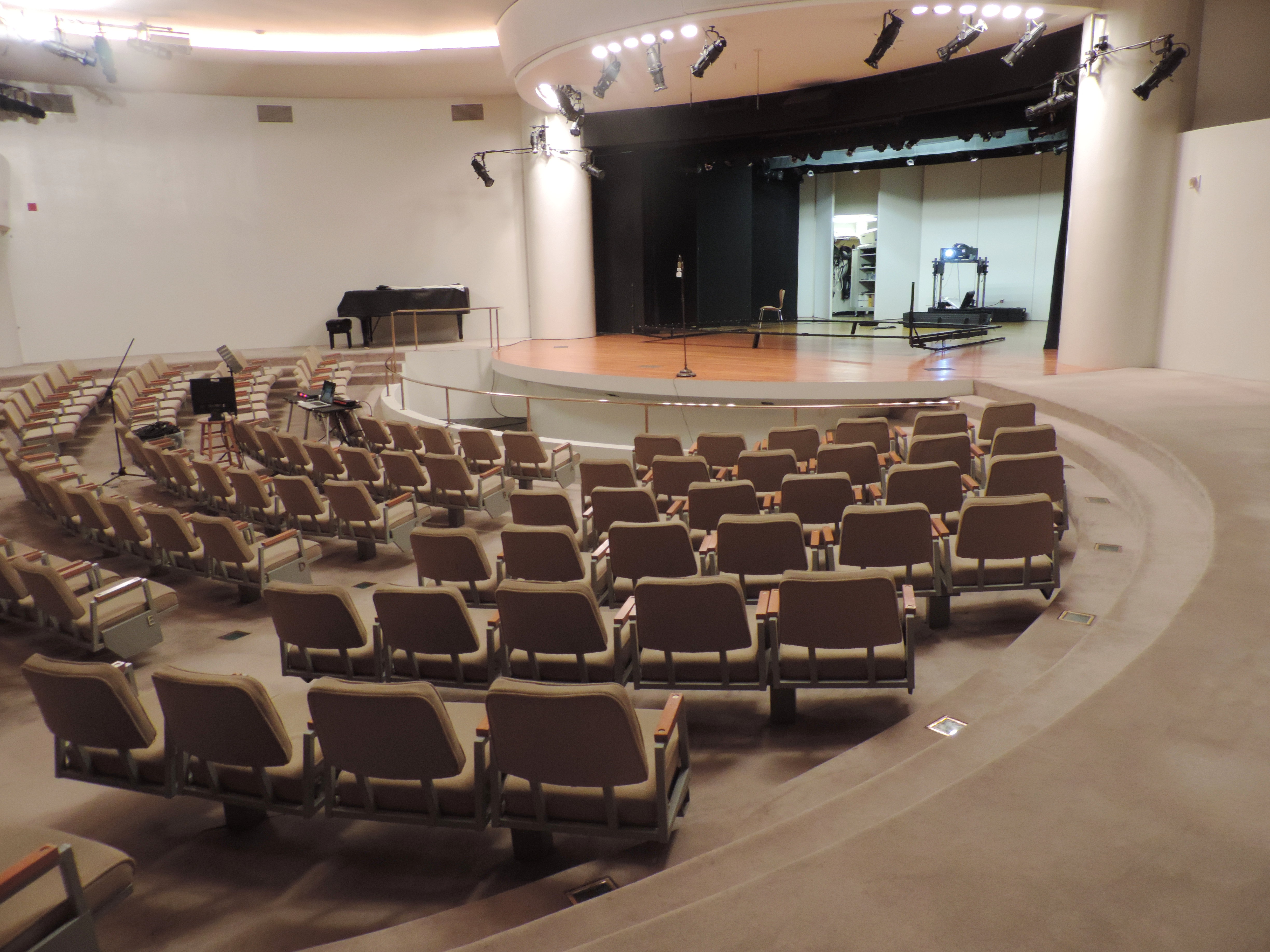
The Gail May Engelberg Center for Arts Education, completed in 2001, covers 8200 sqft on the lower level of the museum, below the main gallery. The facility provides classes and lectures about the visual and performing arts and opportunities to interact with the museum's collections and special exhibitions through its labs, exhibition spaces, conference rooms and 266-seat Peter B. Lewis Theater. the center was renamed in 2022 for museum trustee Gail May Engelberg, who along with her husband Alfred Engelberg had donated $15 million to the museum.
The basement space looks out onto a sloped driveway outside the southwest corner of the museum. When the theater was built, it could be accessed directly from the triangular service core, as well as via the driveway outside the museum.
Annex galleries
The 89th Street annex contains 10290 ft2 of additional exhibition space. There are four exhibition galleries with flat walls that are "more appropriate for the display of art". A steel-and-glass lobby connects the annex to the monitor's ground level, and ramps and passageways connect with the monitor's three upper stories. The annex is linked to the main gallery's stair tower at the fourth, fifth and seventh stories. It also connects to rooftop terraces above the monitor and main gallery.
Landmark designations
The New York City Landmarks Preservation Commission (LPC) designated the museum building and its interior as New York City landmarks on August 14, 1990, two years after opponents of the annex's construction had asked the commission to consider such a designation. At the time, the Guggenheim was one of the youngest buildings to have city landmark status, having been completed 31 years earlier. the Guggenheim Museum was included in the expanded district.
The museum was added to the National Register of Historic Places (NRHP) on May 19, 2005, UNESCO added eight properties, including the Guggenheim, to the World Heritage List in July 2019 under the title "The 20th-Century Architecture of Frank Lloyd Wright".
Collection
The Guggenheim has about 8,000 works in its collection . The museum building has a relatively small capacity; according to The Wall Street Journal, following the 1992 renovation, the Guggenheim could show "upward of 6%" of its then 5,000-piece collection. Other pieces are kept in the museum's storeroom. In contrast to other visual-art museums, the Guggenheim does not divide its collection into departments. The permanent collection is typically displayed in the side galleries and annexes, while the main gallery is used for special exhibitions.
The Guggenheim shares its collection with the Peggy Guggenheim Collection in Venice, Italy, and Guggenheim Museum Bilbao, Spain. It has also loaned objects to Guggenheim Abu Dhabi for a preview exhibit. After Peggy Guggenheim's death in 1979, the Guggenheim Foundation began to operate the Venice museum, and Guggenheim New York began to exhibit abstract expressionist, cubist and surrealist art from both the Venice and New York museums together.
Personal collections
The Guggenheim Museum has acquired private collections throughout its history, including those of Guggenheim, Karl Nierendorf, Katherine Sophie Dreier, Thannhauser, Rebay, Giuseppe Panza, Mapplethorpe and the Bohen Foundation. Its earliest works include modernists such as Rudolf Bauer, Rebay, Kandinsky, Piet Mondrian, Marc Chagall, Robert Delaunay, Fernand Léger, Amedeo Modigliani and Pablo Picasso. Parts of the original collection have been sold over the years. In 2007, 620 of the original works were designated part of the Solomon R. Guggenheim Founding Collection, with works by over 60 artists, including more than 150 by Kandinsky. The founding collection contains several pieces by Albert Gleizes, including Brooklyn Bridge, Composition for "Jazz" and Portrait of an Army Doctor. Pieces such as Chagall's Green Violinist, Franz Marc's Yellow Cow, Jean Metzinger's Woman with a Fan, and Picasso's The Accordionist are also part of the founding collection.
In 1948, the Museum of Non-Objective Art acquired Nierendorf's 730 objects, notably German expressionist paintings. comprising a broad spectrum of expressionist and surrealist works, including paintings by Paul Klee, Oskar Kokoschka and Joan Miró. In 1953, the Guggenheim acquired 28 pieces from Dreier's collection, including works by Alexander Archipenko, Constantin Brâncuși, Alexander Calder, Marcel Duchamp, Juan Gris, El Lissitzky, Mondrian and Kurt Schwitters.
The Thannhauser Collection, acquired in 1963, initially consisted of 73 works, largely in the Impressionist, Post-Impressionist and French modern styles, including pieces by Paul Gauguin, Édouard Manet, Camille Pissarro, Vincent van Gogh and 32 works by Picasso. Justin Thannhauser's widow Hilde donated additional pieces to the Thannhauser Collection in 1981 and 1991, including Manet's Portrait of Countess Albazzi.
Rebay also bequeathed a portion of her personal collection to the foundation, including works by Kandinsky, Klee, Calder, Gleizes, Mondrian and Schwitters. The Guggenheim received the pieces in 1971, four years after her death, because of a prolonged lawsuit. In 1990 the museum acquired the collection of Giovanna and Giuseppe Panza. This includes examples of minimalist sculptures by Carl Andre, Dan Flavin and Donald Judd; minimalist paintings by Robert Mangold, Brice Marden and Robert Ryman; and an array of postminimal, conceptual and perceptual art by Robert Morris, Richard Serra, James Turrell, Lawrence Weiner and others, notably American examples of the 1960s and 1970s. When the Panza Collection was acquired, some of the pieces had not been sculpted, existing only as sketches.
In 1992, the Robert Mapplethorpe Foundation gave 200 of Mapplethorpe's best photographs to the foundation, marking the museum's first major acquisition of 20th-century photography. The works spanned his entire output, from his early collages, Polaroids, portraits of celebrities, self-portraits, male and female nudes, flowers and statues; it also featured mixed-media constructions and included his well-known 1998 Self-Portrait. The acquisition initiated the foundation's photography exhibition program. including Pierre Huyghe and Sophie Calle.
Other notable works
Under Sweeney's tenure, in the 1950s, the Guggenheim acquired Brâncuși's Adam and Eve (1921) and works by other modernist sculptors such as Joseph Csaky, Jean Arp, Calder, Alberto Giacometti and David Smith. Sweeney reached beyond the 20th century to acquire Paul Cézanne's Man with Crossed Arms () The museum also acquired works by such artists as Aristide Maillol, Jean Messagier, Fritz Hundertwasser and Eduardo Paolozzi, several Giacometti drawings and sculptures, a cubist drawing by Picasso and some Henri-Georges Adam engravings. In the 1960s, among Messer's acquisitions were Francis Bacon's triptych Three Studies for a Crucifixion and David Smith's sculpture Cubi XXVII. and pieces by Brâncuși, Calder, Giacometti, Klee, Léger, Joan Miró, Egon Schiele and František Kupka.
Originally, the Guggenheim Museum's collection did not include any figurative art because of the museum's focus on "non-objective painting", but it later expanded to include a range of figurative pieces, such as a portrait of art critic Felix Feneon by Édouard Vuillard, Three Studies for a Crucifixion and Miró's painting The Tilled Field. Others include Picasso's Le Moulin de la Galette, Mandolin and Guitar, Woman With Yellow Hair and Woman Ironing; Julian Schnabel's The Student of Prague; Roy Lichtenstein's Grrrrrrrrrrr!! and Kandinsky's Study for Composition II and Blue Mountain.
Other figurative works include:
- Renoir Nature morte: fleurs - Woman with Parakeet
- van Gogh Head of a Girl - Landscape with Snow
Non-figurative:
- Delaunay Windows Open Simultaneously 1st Part, 3rd Motif
- Rothko Untitled (Black on Grey) --
Selected works in the collection
File:Pissarro L'Hermitage à Pontoise,1867.jpg|Camille Pissarro L*'Hermitage à Pontoise*,1867 File:Renoir woman with a parrot 1871.jpg|Pierre-Auguste Renoir Woman with a Parrot, 1871 File:Manet-Frau-vor-dem-Spiegel.jpg|Édouard Manet Before the Mirror, 93 x 71.6 cm, 1876 File:Still Life- Flask, Glass and Jug by Paul Cézanne, c. 1877.JPG|Paul Cézanne Still Life: Flask, Glass, and Jug, 1877 File:Georges Seurat 008.jpg|Georges Seurat Peasant with Hoe, 1882 File:Van Gogh - Landschaft im Schnee.jpg|Vincent van Gogh Landscape with Snow, 1888 File:Van Gogh - Berglandschaft in Saint-Rémy.jpeg|Vincent van Gogh Mountains at Saint-Rémy, 72.8 x 92 cm, 1889 File:Paul Cézanne, c.1899, Homme aux bras croisés (Man With Crossed Arms), oil on canvas, 92 x 72.7 cm, Solomon R. Guggenheim Museum.jpg|Paul Cézanne, , Homme aux bras croisés (Man with Crossed Arms), oil on canvas, 92 × 72.7 cm File:Paul Gauguin - Dans la vanillère, homme et cheval (1891).jpg|Paul Gauguin In the Vanilla Grove, Man and Horse, 73 x 92 cm, 1891 File:Dancers in Green and Yellow by Edgar Degas, c. 1903.jpg|Edgar Degas Dancers in Green and Yellow, 98.8 x 71.5 cm 1903 File:Claude Monet. The Palazzo Ducale, Seen from San Giorgio Maggiore (Le Palais Ducal vu de Saint-Georges Majeur), 1908 (48813686101).jpg|Claude Monet The Palazzo Ducale, Seen from San Giorgio Maggiore, 1908 File:Henri Rousseau - The Football Players.jpg|Henri Rousseau The Football Players, 100.3 x 81.1 cm 1908 File:Georges Braque, 1909 (September), Violin and Palette (Violon et palette, Dans l'atelier), oil on canvas, 91.7 x 42.8 cm, Solomon R. Guggenheim Museum.jpg|Georges Braque, 1909, Violin and Palette (Violon et palette, Dans l'atelier), oil on canvas, 91.7 × 42.8 cm File:Wassily Kandinsky, 1910, Landscape with Factory Chimney, oil on canvas, 66.2 x 82 cm, Solomon R. Guggenheim Museum.jpg|Wassily Kandinsky, 1910, Landscape with Factory Chimney, oil on canvas, 66.2 × 82 cm File:Pablo Picasso, 1911, The Poet (Le poète), Céret, oil on linen, 131.2 × 89.5 cm, The Solomon R. Guggenheim Foundation, Peggy Guggenheim Collection, Venice.jpg|Pablo Picasso The Poet, oil on linen, 131.2 × 89.5 cm 1911 File:Marcel Duchamp, 1911-12, Nude (Study), Sad Young Man on a Train (Nu -esquisse-, jeune homme triste dans un train), Peggy Guggenheim Collection, Venice.jpg|Marcel Duchamp Nude (Study), Sad Young Man in a Train, 1911-12 Oil on canvas panel 100 x 73 cm File:Franz Marc-The Yellow Cow-1911.jpg|Franz Marc, 1911, The Yellow Cow, oil on canvas, 140.5 × 189.2 cm File:Kandinsky - Sancta Francisca, 1911.jpg|Wassily Kandinsky Sancta Francisca, 1911 File:Robert Delaunay - Eiffel Tower - 1911 - Solomon R. Guggenheim Museum.jpg|Robert Delaunay Eiffel Tower, 1911 File:Juan Gris, 1911, Maisons à Paris (Houses in Paris), oil on canvas, 52.4 x 34.2 cm, Guggenheim Museum.jpg|Juan Gris, 1911, Maisons à Paris (Houses in Paris), 1911, oil on canvas, 52.4 × 34.2 cm File:Fernand Léger, 1911-1912, Les Fumeurs (The Smokers), oil on canvas, 129.2 x 96.5 cm, Solomon R. Guggenheim Museum, New York..jpg|Fernand Léger, 1911–12, Les Fumeurs (The Smokers), oil on canvas, 129.2 × 96.5 cm File:Jean Metzinger, 1912, Femme à l'Éventail (Woman with a Fan), oil on canvas, 90.7 x 64.2 cm, Solomon R. Guggenheim Museum.jpg|Jean Metzinger, 1912, Femme à l'Éventail (Woman with a Fan), oil on canvas, 90.7 × 64.2 cm File:Morning in the Village after Snowstorm (Malevich, 1912).jpg|Kazimir Malevich Morning in the Village after Snowstorm, 1912 File:Marc Chagall, 1913, Paris par la fenêtre (Paris Through the Window), oil on canvas, 136 x 141.9 cm, Solomon R. Guggenheim Museum, New York.jpg|Marc Chagall, 1913, Paris par la fenêtre (Paris Through the Window), oil on canvas, 136 × 141.9 cm File:Kirchner - Frauenkopf, Gerda.jpg|Ernst Ludwig Kirchner Gerda, Half-Length Portrait, 99.1 x 75.3 cm**.** 1914 File:Albert Gleizes, 1915, Brooklyn Bridge, oil and gouache on canvas, 102 x 102 cm, Solomon R. Guggenheim Museum, New York.jpg|Albert Gleizes, 1915, Brooklyn Bridge (Pont de Brooklyn), oil and gouache on canvas, 102 × 102 cm cm File:Piet mondrian, composizione, 1916 (guggenheim nyc) 01.jpg|Piet Mondrian Composition, 1916 File:Modigliani nude sdraiato.jpg|Amedeo Modigliani, 1917, Nude (Nu), oil on canvas, 73 × 116.7 cm File:Amedeo Modigliani 025.jpg|Amedeo Modigliani Le Sweater jaune, 1918 File:Doesburg.jpg|Theo van Doesburg, 1918, Composition XI, oil on canvas, 57 × 101 cm File:Paul Klee, 1922, Red Balloon, oil on chalk-primed gauze, mounted on board, 31.7 x 31.1 cm, Solomon R. Guggenheim Museum.jpg|Paul Klee, 1922, Red Balloon (Roter Ballon), oil on chalk-primed gauze, mounted on board, 31.7 × 31.1 cm File:Vassily Kandinsky, 1923 - Composition 8, huile sur toile, 140 cm x 201 cm, Musée Guggenheim, New York.jpg|Wassily Kandinsky, 1923, Composition 8, oil on canvas, 140 x 201 cm File:The Tilled Field.jpg|Joan Miró The Tilled Field, 1924 File:'Composition' by Piet Mondrian, 1929, Solomon R. Guggenheim Museum.JPG|Piet Mondrian Composition, 1929 File:Woman with Yellow Hair.jpg|Pablo Picasso Woman with Yellow Hair 1931, 100.2 x 81.1 cm File:Paris Society .jpg|Max Beckmann Paris Society, 1931 File:Dining-room-on-the-garden.jpg!HalfHD.jpg|Pierre Bonnard Dinning Room on the Garden, 1935 File:RothkoBlackGray.jpg|Mark Rothko Untitled (Black on Gray) 1969 Acrylic on canvas, 203.3 x 175.5 cm
Restitution claims
In 2007, the heirs of Berlin banker Paul von Mendelssohn-Bartholdy requested the restitution of the Picasso painting "Le Moulin de la Galette" (1900), which they claimed he had sold under duress by the Nazis. The museum and the heirs settled the lawsuit in 2009. The presiding judge, Jed Rakoff, criticized the secrecy of the accord. In 2018, the museum returned the Ernst Ludwig Kirchner painting Artillerymen (1915) to the heirs of Alfred Flechtheim, who had owned the painting before it fell into the hands of a Nazi collector in 1938.
In 2023, the heirs of Karl and Rosie Adler sued the Guggenheim to claim the restitution of a Picasso painting, Woman Ironing (La repasseuse) (1904), which the Adlers sold to Justin Thannhauser in 1938, allegedly for a fraction of its value, to escape the Holocaust. They alleged that Thannhauser knowingly purchased the painting, and art from other Jews on the run, profiting unfairly from their distress. The museum says they contacted the Adler family before acquiring the painting as a part of Thannhauser's bequest of his art collection in 1976, and at that time Karl Adler did not object.
The Guggenheim lists 289 artworks on the Nazi Era Provenance Internet Portal (NEPIP) but does not publish provenance for its collection.
Governance and staff
The Solomon R. Guggenheim Foundation operates and owns the Solomon R. Guggenheim Museum. The foundation's art and museum committee is responsible for proposing acquisitions and deaccessions from the foundation's collection, while the foundation's board of trustees determines whether to enact the art and museum committee's proposals. J. Tomilson Hill has served as the board's chair since 2021, while Marcy Withington has been the foundation's chief financial officer since 2018. The museum employed 315 full-time and part-time staff members .
Reception and commentary
Contemporary views
Even before the building opened, the design polarized architecture critics and was controversial among the public. Some critics believed the building would overshadow the museum's artworks. Emily Genauer of the New York Herald Tribune said the building had been likened to "a giant corkscrew, a washing machine and a marshmallow", while Solomon's niece Peggy Guggenheim believed it resembled "a huge garage". Members of the public felt that the building contrasted with the character of Fifth Avenue. Phyllis Mark of the New Leader commented that the walls and ceilings would "disorient the viewer" and noted that the museum could only display five percent of its collection in the new building.
Art critics reviewed the structure especially harshly. John Canaday of The New York Times wrote that the design would be worthy of merit if it were "stripped of its pictures", while Hilton Kramer of Arts Magazine opined that the structure was "what is probably [Wright's] most useless edifice". Architectural critic Lewis Mumford summed up the opprobrium:
Wright has allotted the paintings and sculptures on view only as much space as would not infringe upon his abstract composition. ... [He] created a shell whose form has no relation to its function and offered no possibility of future departure from his rigid preconceptions. [The ramp] has, for a museum, a low ceiling – nine feet eight inches [295 cm] so only a picture well within the vertical boundaries thus created can be shown. The wall ... slanted outward, following the outward slant of the exterior wall, and paintings were not supposed to be hung vertically or shown in their true plane but were to be tilted back against it. ... Nor [can a visitor] escape the light shining in his eyes from the narrow slots in the wall.
During his lifetime, Wright dismissed criticism of the structure, saying: "For the first time, art will be seen through an open window and, of all places, in New York". He also felt that his design complemented Central Park, particularly with the shrubbery around the new building, which formed "a little park with a building in it". Wright believed that the building would be well suited to avant-garde art, "which purported to represent space and form in a new, fully integrated manner".
The building also received critical acclaim. In a 1958 survey of the "Seven Wonders of American Architecture", five hundred architects ranked the Guggenheim as the 18th-best structure of more than 100 selected buildings. When the building opened, modernist architects such as Philip Johnson and Edward Durell Stone praised Wright's design, and Genauer regarded it as "the most beautiful building in America". A writer for the New York Daily Mirror said the Guggenheim "should be put in a museum to show how mad the twentieth century is." Directors of other major New York City museums also praised the building, though some of them were skeptical of whether the structure could function well as a museum.
Impact and retrospective commentary
In later years, the building became widely praised. Marcus Whiffen and Frederick Koeper wrote: "The dynamic interior of the Guggenheim is, for some, too competitive for the display of art, but no one disputes that it is one of the memorable spaces in all of architecture." Paul Goldberger said in 2009: "I think the legacy of this building is in the message that architecture does not have to lie down and play dead in front of art." According to Herbert Muschamp, the Guggenheim was "one of New York's most distinguished landmarks", as well as Wright's best-known design. The American Institute of Architects gave a Twenty-five Year Award to the Guggenheim in 1986, describing the museum's building as "an architectural landmark and a monument to Wright's unique vision".
Several writers described the Guggenheim as representing Wright's tendency toward organic architecture. According to William J. R. Curtis, the building was "the apotheosis of Wright's organic philosophy". Peter Blake commented that the Guggenheim was Wright's "only completed work of uncompromising plasticity and continuity", a claim with which Wright's biographer Robert C. Twombly agreed. Critics came to regard the Guggenheim as the best work of Wright's later career, as well as a culmination of the helical shapes that Wright had used in his designs since 1925. Spiro Kostof called the museum "a gift of pure architecture", and Edgar Kaufmann Jr. said the building was "one of the irrefutably grand achievements of modern architecture".
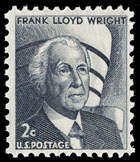
The museum building inspired other architects' designs. The building was also depicted in a two-cent postage stamp issued in Wright's honor in 1966. The American Institute of Architects' 2007 survey List of America's Favorite Architecture ranked the Guggenheim Museum among the top 150 buildings in the United States.
Attendance
When the building opened, it was popular with the general public. A 1960 Gallup poll found that 38 percent of visitors came for the building itself, while an additional 43 percent wanted to see both the building and the art. The Guggenheim did not keep precise attendance records until 1992. Before its 1990s renovation, it had an estimated 600,000 annual visitors. This increased to between 900,000 and 1 million by the early 2000s. It had 960,000 annual visitors before the September 11 attacks, but attendance decreased after the attacks; it recovered several years later. In 2013, nearly 1.2 million people visited the museum, and its James Turrell exhibition was the most popular in New York City in daily attendance. Due to the COVID-19 pandemic, the Guggenheim had only 154,000 visitors in 2020, an 88 percent decrease from the preceding year. , the museum had 861,000 visitors, compared with 1.2 million in 2019 (before the COVID-19 pandemic).
According to museum officials, surveys over the years have indicated that most visitors came because of the building's architecture rather than its artwork. In 2001, The New York Times reported that nearly 70 percent were tourists and that half were foreigners. In 2010, the Times reported that 55–65 percent of visitors were from the New York metropolitan area. According to a 2018 study, 73 percent of the museum's visitors were white and 8 percent were black.
In 2009, a Frank Lloyd Wright retrospective attracted 372,000 visitors in three months, becoming the museum's single most popular exhibit. This record was broken the next year by a Kandinsky exhibit. which attracted over 600,000 visitors in six months.
References
Notes
Citations
Sources
- , S.400
References
- {{NRISref. 2009a
- (November 7, 2014). "Cultural Resource Information System (CRIS)". [[New York State Office of Parks, Recreation and Historic Preservation]].
- (August 14, 1990). "The Solomon R. Guggenheim Museum". [[New York City Landmarks Preservation Commission]].
- (August 14, 1990). "The Solomon R. Guggenheim Museum: Interior". [[New York City Landmarks Preservation Commission]].
- Angeleti, Gabriella. (March 26, 2024). "US museums blame falling visitor numbers for staff redundancies".
- In 1926, he met artist [[Hilla von Rebay]],[http://www.artdaily.com/index.asp?int_sec=11&int_new=31711&int_modo=2 "Exhibition of Works Reflecting the Evolution of the Guggenheim's Collection Opens in Bilbao"], artdaily.org, 2009. Retrieved April 18, 2012.
- {{harvnb. Stern. Mellins. Fishman. 1995
- Guggenheim completely changed his collecting strategy, turning to the work of [[Wassily Kandinsky]], among others. He began to display his collection to the public at his apartment in the [[Plaza Hotel]] in New York City.[http://pastexhibitions.guggenheim.org/hilla_rebay/biographies_2.html "Biography: Solomon R. Guggenheim"], Art of Tomorrow: Hilla Rebay and Solomon R. Guggenheim, Solomon R. Guggenheim Foundation. Retrieved March 8, 2012.
- {{harvnb. Loebl. 2002
- Krens. 1993
- {{harvnb. Pfeiffer. 1995
- {{harvnb. Stern. Mellins. Fishman. 1995
- {{harvnb. Landmarks Preservation Commission Interior. 1990
- Stern. Mellins. Fishman. 1995
- {{harvnb. Stern. Mellins. Fishman. 1995
- "Guggenheim Architecture".
- {{harvnb. Stern. Mellins. Fishman. 1995
- (April 4, 1952). "Art Museum Plan 5th Ave. Filed; Cylindrical Building Designed by Frank Lloyd Wright to Cost $2,000,000". The New York Times.
- ''The Guggenheim: Frank Lloyd Wright and the Making of the Modern Museum'', pp. 217–18, New York: Guggenheim Museum Publications, 2009
- (October 22, 2014). "55 Years Ago Tuesday: Guggenheim Museum Officially Opens".
- Dal Co, Francesco. (2017). "The Guggenheim: Frank Lloyd Wright's Iconoclastic Masterpiece". Yale University Press.
- {{harvnb. McCarter. 1997
- (1981). "Arquitectura de los siglos XIX y XX". Ediciones Cátedra.
- Pfeiffer. 1995
- (July 23, 2015). "The Vatican Museums and the Guggenheim: Two Ingenious Spirals of Art". La Voce di New York.
- (1993). "High Renaissance art in St. Peter's and the Vatican: an interpretative guide". University of Chicago Press.
- (February 28, 2013). "Compares the Oculi at the Vatican and the Guggenheim Museum". Architectural Digest.
- {{harvnb. McCarter. 1997
- {{harvnb. National Park Service. 2005
- {{harvnb. Storrer. 2002
- {{harvnb. Pfeiffer. 1995
- (July 10, 1945). "Museum Building to Rise as Spiral; New Guggenheim Structure Designed by F.L. Wright Is Called First of Kind". The New York Times.
- (July 10, 1945). "Wright Designs Bizarre 5th Av. Art Museum: His First Building in City, on Novel Lines, to House Guggenheim Collection". New York Herald Tribune.
- {{harvnb. Landmarks Preservation Commission Interior. 1990
- Stern. Mellins. Fishman. 1995
- {{harvnb. Pfeiffer. 1995
- (September 21, 1945). "Frank Lloyd Wright Shows Plan Of a Fifth Avenue Art Museum". New York Herald Tribune.
- (September 21, 1945). "Model is Unveiled of New Museum Here; Spiral-shaped Art Center Proposed for the City". The New York Times.
- (November 5, 1946). "Wright Details How Museum Will Blend Arts: Construction on Circular Building of Non-Objective Painting Starts in Spring". New York Herald Tribune.
- {{harvnb. National Park Service. 2005
- {{harvnb. Pfeiffer. 1995
- {{harvnb. Stern. Mellins. Fishman. 1995
- National Park Service. 2005
- After Guggenheim died in 1949, members of the [[Guggenheim family]] on the foundation's board of directors had personal and philosophical differences with Rebay.[http://pastexhibitions.guggenheim.org/hilla_rebay/biographies_1.html "Biography: Hilla Rebay"], Art of Tomorrow: Hilla Rebay and Solomon R. Guggenheim, Solomon R. Guggenheim Foundation. Retrieved March 8, 2012.
- Saarinen, Aline B.. (May 30, 1954). "Lively Gallery for Living Art; Manhattan's Guggenheim is off to an exuberant new start as a showcase for pioneers who 'open up a different corner of vision'". The New York Times.
- {{harvnb. National Park Service. 2005
- (August 5, 1951). "Non-Objective Art Museum Plans to Grow: Remodeling of Apartment Building Will Allow More Paintings To Be Shown". New York Herald Tribune.
- (August 13, 1951). "Guggenheim Fund Buys Exhibit Site". Newsday.
- {{harvnb. Pfeiffer. 1995
- (August 5, 1951). "Museum Changing Exhibition Policy; Guggenheim Foundation Will Show Old Masters as Well as Non-Objective Works". The New York Times.
- (March 30, 1952). "Miss Rebay Quits as Head Of Non-Objective Museum". New York Herald Tribune.
- Louchheim, Aline B.. (March 30, 1952). "Museum Will File Plans for Building; Changes Made by Non-Objective Painting Institution – Hilla Rebay Is Director Emeritus". The New York Times.
- [http://www.visual-arts-cork.com/museums/guggenheim-new-york.htm "Guggenheim Museum New York"], ''Encyclopedia of Art'', visual-arts-cork.com. Retrieved April 18, 2012.
- (October 15, 1952). "New Director Appointed By Guggenheim Museum". The New York Times.
- (October 15, 1952). "James J. Sweeney Heads Guggenheim Museum". New York Herald Tribune.
- {{harvnb. Krens. 1993
- (May 11, 1954). "Museum Points Up Change in Policy; Display of American Art Due at Guggenheim Departs From 'Non Objective'". The New York Times.
- {{harvnb. Krens. 1993
- {{harvnb. National Park Service. 2005
- Louchheim, Aline B.. (October 4, 1953). "Frank Lloyd Wright Talks of His Art; And takes a retrospective look at a lifetime of architectural innovation.". The New York Times.
- Glueck, Grace. (April 15, 1986). "James Johnson Sweeney Dies; Art Critic and Museum Head". The New York Times.
- {{harvnb. Stern. Mellins. Fishman. 1995
- (April 10, 1959). "Only Commission in New York Was Guggenheim Art Museum". The New York Times.
- {{harvnb. National Park Service. 2005
- {{harvnb. Pfeiffer. 1995
- (May 8, 1956). "Start Guggenheim Museum Job in NY". Newsday.
- {{harvnb. Pfeiffer. 1995
- Ashton, Dore. (November 18, 1956). "Museum; Director of Guggenheim Discusses His Plans An Ambitious Program". The New York Times.
- Pfeiffer. 1995
- {{harvnb. Stern. Mellins. Fishman. 1995
- (June 1958). "Window Leaks Overcome".
- {{harvnb. Stern. Mellins. Fishman. 1995
- (August 31, 1958). "Guggenheim Museum Progresses". The New York Times.
- National Park Service. 2005
- Bird, Robert S.. (October 22, 1959). "600 an Hour See Guggenheim Museum: Thrilled, Puzzled, Angered by Frank Lloyd Wright Structure". New York Herald Tribune.
- Wood, Francis. (October 22, 1959). "Guggenheim Art Museum Draws Crowds, Praise". Newsday.
- Lyle, David. (July 21, 1960). "Guggenheim Museum Head Quits: Sweeney Resigns as Director, Issue Unrevealed". New York Herald Tribune.
- Knox, Sanka. (July 21, 1960). "Guggenheim Museum Director Resigns in Difference of 'Ideals'; Sweeney Revised Wright's Design for Building Before Opening Last October". The New York Times.
- Knox, Sanka. (January 31, 1961). "Guggenheim Picks Museum Director; Thomas Messer, Head of Boston Institute, Named to Art Post Here". The New York Times.
- O'Neill, Maureen. (January 31, 1961). "Name Boston Art Expert Director of Guggenheim". Newsday.
- {{harvnb. National Park Service. 2005. Solomon R. Guggenheim Museum. 1993
- Armstrong, Kiley. (1987-11-22). "NYC's Guggenheim Museum celebrates 50 years of art". The Journal News.
- Weber, Bruce. (May 16, 2013). "Thomas M. Messer, Museum Director Who Gave Guggenheim Cachet, Dies at 93". The New York Times.
- Russell, John. (November 5, 1987). "Director of Guggenheim Retiring After 27 Years". The New York Times.
- Canaday, John. (August 17, 1962). "Museum Director Solves Problem; Guggenheim Official Faces Troubles of Architecture". The New York Times.
- Spiegler, William. (October 24, 1963). "Museum Will Get Major Art Collection". Newsday.
- Canaday, John. (October 24, 1963). "Guggenheim Gets Major Art Works; Gift Will Eventually Bring 34 Picassos to Museum". The New York Times.
- {{harvnb. Pfeiffer. 1995
- Landmarks Preservation Commission. 1990
- (May 27, 1962). "Guggenheim Art to Be Auctioned; Works of Old Masters Will Be Sold in London June 27". The New York Times.
- (May 15, 1971). "Guggenheim Acquires 250 Works of Modern Art". The New York Times.
- Canaday, John. (August 16, 1971). "Guggenheim Will Auction 47 Works by Kandinsky". The New York Times.
- (October 10, 1963). "Guggenheim Files Plans for an Annex On 13-Foot Stilts". The New York Times.
- (May 16, 1964). "Guggenheim Museum Will Expand". Newsday.
- Goldberger, Paul. (February 19, 1985). "Guggenheim Museum Plans to Erect an 11-story, $12 Million Addition".
- Raymont, Henry. (November 8, 1966). "Annex of Museum Cut by 2 Stories; Guggenheim Drops Original Plans Calling for 4 Floors Because of the Cost". The New York Times.
- (May 7, 1969). "The Gallery: Art of Architecture". [[The Wall Street Journal]].
- (January 4, 1972). "Admission to Guggenheim Raised From 50 Cents to $1". The New York Times.
- (April 15, 1973). "Guggenheim Museum to Review Plan to Alter Building's Facade". The New York Times.
- Goldberger, Paul. (November 10, 1973). "Guggenheim Modifies Alteration". The New York Times.
- Fraser, C. Gerald. (December 24, 1977). "Guggenheim Starts Drive to Raise $20 Million". The New York Times.
- (November 8, 1980). "2 Guggenheim Curators Promoted to Directors; 'Seemed Appropriate'". The New York Times.
- Russell, John. (November 28, 1982). "Art View; a Redesigned Wing Adds Luster to the Guggenheim". The New York Times.
- "Works & Process".
- Stevens, Elisabeth. (1985-02-24). "N.Y.'s Guggenheim plans $12 million addition". The Baltimore Sun.
- {{harvnb. Landmarks Preservation Commission. 1990
- Goldberger, Paul. (October 10, 1985). "An Appraisal; Architecture: a Design for Guggenheim Tower". The New York Times.
- Goldberger, Paul. (February 11, 1987). "Guggenheim Museum Proposing Scaled-down Design for Addition". The New York Times.
- Ladd, Scott. (February 11, 1987). "Revised Design Proposed for Guggenheim". Newsday.
- Ladd, Scott. (July 6, 1987). "Guggenheim Look Still Arouses Passions". Newsday.
- Mays, Vernon. (Apr 1989). "Revealing Wright".
- (October 21, 1987). "Museum Addition Approved". The New York Times.
- Lippman, Barbara. (October 22, 1987). "Museum gets a variance". New York Daily News.
- Glueck, Grace. (November 28, 1990). "Guggenheim Withdraws Design Change". The New York Times.
- Russell, John. (November 5, 1987). "Director of Guggenheim Retiring After 27 Years". The New York Times.
- McGill, Douglas C.. (January 15, 1988). "Guggenheim Expansion Plan Upheld". The New York Times.
- (June 23, 1988). "Guggenheim Plan Upheld". The New York Times.
- McGill, Douglas C.. (January 13, 1988). "Guggenheim Names a New Director". The New York Times.
- Wallach, Amei. (January 13, 1988). "New Director for Guggenheim Museum". Newsday.
- Vogel, Carol. (February 28, 2008). "Provocative Guggenheim director resigns". The New York Times.
- Vogel, Carol. (April 27, 2005). "A Museum Visionary Envisions More". The New York Times.
- Cotter, Holland. (June 7, 1996). "Art Review; An African Anthology Of Rewarding Objects". The New York Times.
- Scott, Janny. (April 9, 1998). "Need Chinese Art? Call Diplomats; Even Kissinger Aided Guggenheim Negotiations for a Show". The New York Times.
- (September 16, 2001). "Travel Advisory; Brazilian Treasures On Loan in New York". The New York Times.
- Cotter, Holland. (October 15, 2004). "A Lost Culture, Drenched in Blood and Beauty". The New York Times.
- Plagens, Peter. (September 7, 1998). "Rumble on the Ramps. ('The Art of the Motorcycle', Solomon R. Guggenheim Museum, New York)".
- Smith, Roberta. (June 29, 1992). "Review/Art; Guggenheim Reopens on a New Chapter". The New York Times.
- Wallach, Amei. (June 16, 1992). "A Museum Makeover: New Guggenheim: Big Time, Big Business and Blue Chip". Los Angeles Times.
- Vogel, Carol. (February 5, 1999). "Inside Art; Guggenheim Shrinks in SoHo". The New York Times.
- Glueck, Grace. (August 12, 1991). "In Guggenheim Restoration, Wright Laughs Last". The New York Times.
- Shepard, Joan. (October 9, 1988). "Guggenheim Museum will keep its doors open during restoration work". New York Daily News.
- Wallach, Amei. (April 11, 1990). "'Obsession' at the Guggenheim". Newsday.
- (April 27, 1990). "Guggenheim Museum Closing for 18 Months". The New York Times.
- Glueck, Grace. (August 12, 1991). "In Guggenheim Restoration, Wright Laughs Last". The New York Times.
- {{harvnb. Sennott. 2004
- Kimball, Roger. (July 2, 1992). "Leisure & Arts: Rehabbed Guggenheim Museum's Coming-out Party". The Wall Street Journal.
- (June 28, 1992). "Evening Hours; Guggenheim In a New Light". The New York Times.
- McGuigan, Cathleen. (June 29, 1992). "Do the Wright Thing: The Guggenheim Museum reopens, splendidly restored and with a controversial new addition".
- Jermanok, Stephen. (April 17, 1994). "New York: Everything Old Is New Again; New York's Master Museums Redesign Themselves". [[The Washington Post]].
- Hagen, Charles. (December 4, 1992). "$5 Million to Foundation by Mapplethorpe Group". The New York Times.
- Wallach, Amei. (December 4, 1992). "$5-Million Mapplethorpe Gift". Newsday.
- Hagen, Charles. (December 26, 1993). "The Year in the Arts: Art & Photography/1993; An Era Ended, a Ghost Haunted the Guggenheim". The New York Times.
- Kimmelman, Michael. (April 1, 1990). "Art View; The High Cost of Selling Art". The New York Times.
- Glueck, Grace. (March 5, 1990). "Guggenheim May Sell Artworks To Pay for a Major New Collection". The New York Times.
- He also expanded the foundation's international presence by opening museums abroad.Russell, James S. [https://www.bloomberg.com/apps/news?pid=newsarchive&sid=a3nVuX5IVJCE "Guggenheim's Krens Eyes Hudson Yards Museum, Seeks New Bilbaos"], Bloomberg, March 11, 2008. Retrieved March 13, 2012.
- Sudjic, Deyan. (January 23, 2005). "Is this the end of the Guggenheim dream?". The Guardian.
- (November 27, 1998). "For Museums, Bigger Is Better". The Wall Street Journal.
- Mahoney, Sarah. (October 2, 2006). "Thomas Krens".
- Plagens, Peter. (May 20, 1996). "In a Spiral: The Guggenheim Museum's controversial director keeps wheeling and dealing. But what's art got to do with it?".
- Vogel, Carol. (December 14, 1993). "Guggenheim Honors the LeFraks". The New York Times.
- Disch, Thomas M.. (December 21, 1993). "What's in a Name...". Daily News.
- Vogel, Carol. (January 20, 1994). "Revlon's Chairman Donates $10 Million to the Guggenheim". The New York Times.
- Snow, Shauna. (January 21, 1994). "A $10-Million Present". Los Angeles Times.
- Vogel, Carol. (December 17, 1994). "Clash Over Name Puts Museum Gift in Doubt". The New York Times.
- Vogel, Carol. (October 20, 1995). "Trustees come through for the Guggenheim". The New York Times.
- (February 1, 2002). "Higher education meets high art". Dance Teacher.
- (June 2002). "Guggenheim wants Gehry canopy to be permanent addition".
- Muschamp, Herbert. (May 18, 2001). "Architecture Review; Gehry's Vision of Renovating Democracy". The New York Times.
- Vogel, Carol. (June 10, 2004). "Guggenheim Museum Seeks to Restore Its Most Valuable Asset: Itself". The New York Times.
- Park, Haeyoun. (April 16, 2007). "Face-Lift for an Aging Museum". The New York Times Web Archive.
- Guggenheim Museum web site: [http://www.guggenheim.org/index.php?option=com_content&view=article&id=3489&Itemid=1476 click link to podcast about restoration (10 MB, audio only, 8 min 45 sec)]
- Pogrebin, Robin. (September 10, 2007). "The Restorers' Art of the Invisible". The New York Times.
- Guggenheim Museum web site: [http://www.guggenheim.org/restoration.html click link to podcast about restoration (10 MB, audio only, 8 min 45 sec)] {{webarchive. link. (September 28, 2007)
- Ulam, Alex. (February 2006). "Guggenheim spruces up restoration with custom bridge".
- Vogel, Carol. (September 23, 2008). "Guggenheim Chooses a Curator, Not a Showman". The New York Times.
- (August 22, 2008). "The Guggenheim Museums and Foundation".
- Pogrebin, Robin. (January 21, 2005). "Loyalty Prevails Over Money in Guggenheim Showdown". The New York Times.
- Bohlen, Celestine. (November 20, 2001). "The Guggenheim's Scaled-Back Ambition; A Museum Director's Risk-Taking Approach Gets a New Look in Hard Times". The New York Times.
- Kimmelman, Michael. (December 6, 2002). "Critic's Notebook; An Era Ends for the Guggenheim". The New York Times.
- (December 5, 2002). "Guggenheim gets gift – with string attached". Poughkeepsie Journal.
- (January 21, 2005). "Guggenheim chairman resigns". The Journal News.
- Vogel, Carol. (January 20, 2005). "Guggenheim Loses Top Donor in Rift on Spending and Vision". The New York Times.
- Vogel, Carol. (September 21, 2005). "Museum Names New York Director". The New York Times.
- (September 22, 2005). "New York's Guggenheim Picks New Director". Los Angeles Times.
- Wilson, Claire. (October 23, 2006). "Elevating the Guggenheim".
- Vogel, Carol. (July 31, 2007). "Director of Guggenheim Resigns to Join Sotheby's". The New York Times.
- Boehm, Mike. (September 25, 2008). "Guggenheim names Richard Armstrong director". Los Angeles Times.
- Vogel, Carol. (September 3, 2008). "Guggenheim Is Considering New Director". The New York Times.
- McDermon, Daniel. (August 18, 2017). "Solid-Gold Toilet to Be Removed From Guggenheim in September". The New York Times.
- Moynihan, Colin. (June 28, 2019). "Guggenheim Workers Vote to Join a Union, the Museum's First". The New York Times.
- Davis, Ben. (June 28, 2019). "Art Installers and Maintenance Workers at the Guggenheim Have Voted 'Yes' to Joining a Union".
- Mitter, Siddhartha. (July 30, 2019). "Behind Basquiat's 'Defacement': Reframing a Tragedy". The New York Times.
- Lewis, Helen. (October 3, 2022). "The Guggenheim's Scapegoat".
- Pogrebin, Robin. (November 15, 2019). "Guggenheim Hires First Full-Time Black Curator". The New York Times.
- Small, Zachary. (August 17, 2020). "Guggenheim Approves Diversity Plan After Staff Complaints of Racism". The New York Times.
- Holmes, Helen. (August 18, 2020). "After Allegations of Systemic Racism, the Guggenheim Has Released a Diversity Plan".
- Holmes, Helen. (July 28, 2021). "The Guggenheim Museum Has Hired Its First Chief Culture and Inclusion Officer".
- (March 12, 2020). "New York's Major Cultural Institutions Close in Response to Coronavirus". The New York Times.
- (October 4, 2020). "Guggenheim Museum Reopens To Public After Months-Long Pandemic Closure".
- (October 3, 2020). "Reopen New York City: Guggenheim Museum welcomes back visitors on Upper East Side in Manhattan".
- Small, Zachary. (September 16, 2020). "Guggenheim Cuts Staff by 11 Percent Ahead of Reopening". The New York Times.
- Moynihan, Colin. (July 30, 2021). "Guggenheim Museum Curators Move to Join a Union". The New York Times.
- Holmes, Helen. (August 2, 2021). "Guggenheim Staffers Are Putting Plans in Motion to Join a Union".
- Graeber, Laurel. (April 27, 2022). "Guggenheim Finds Art in Poetry".
- (July 8, 2022). "Guggenheim director Richard Armstrong: 'I'm calm about the whole future of museums'".
- Jacobs, Julia. (July 8, 2022). "Director of the Guggenheim to Step Down". The New York Times.
- Cascone, Sarah. (August 2, 2023). "Inflation Hits Museums, as the Guggenheim Becomes the Latest New York Institution to Hike Prices".
- (July 29, 2024). "Richard Armstrong with Joachim Pissarro & Jennifer Stockman".
- Tremayne-Pengelly, Alexandra. (November 21, 2023). "Cultural Comings and Goings: The Guggenheim's New Director and More".
- Pogrebin, Robin. (November 20, 2023). "Guggenheim Selects Director, First Woman to Lead the Museum Group". The New York Times.
- (November 15, 2024). "Dr. Mariët Westermann". Institute of International Education.
- (2025-02-28). "Guggenheim Lays Off 20 Employees as Financial Challenges Persist". The New York Times.
- Cassady, Daniel. (February 28, 2025). "The Guggenheim Tightens Its Belt Again, Laying Off 20 Staffers".
- {{harvnb. National Park Service. 2005
- although it also expresses his take on modernist architecture's rigid geometry.{{sfn. Levine. 1996
- Waldek, Stefanie. (November 11, 2019). "7 Things You Didn't Know About New York City's Guggenheim Museum".
- Bianchini, Riccardo. [https://www.inexhibit.com/case-studies/the-guggenheim-museum-an-american-revolution "The Guggenheim, an American revolution"], inexhibit.com, 2014, accessed July 5, 2014.
- National Park Service. 2005
- (October 19, 1958). "Guggenheim Museum Gets a Plastic Coating". The New York Times.
- Cohen, George N.. (November 23, 1958). "All Concrete-- With a Glass Dome: The Guggenheim Museum: A Spiral Ramp Around a Big Inner Court". New York Herald Tribune.
- {{harvnb. Landmarks Preservation Commission. 1990
- {{harvnb. National Park Service. 2005
- (May 27, 1959). "Trees and Shrubs Soon to Flank Guggenheim Museum". The New York Times.
- National Park Service. 2005
- {{harvnb. McCarter. 1997
- Landmarks Preservation Commission. 1990
- {{harvnb. National Park Service. 2005
- {{harvnb. Landmarks Preservation Commission. 1990
- National Park Service. 2005
- {{harvnb. Architectural Record. 1958
- National Park Service. 2005
- (August 15, 2013). "Solomon R. Guggenheim Museum". Gwathmey Siegel Kaufman Architects.
- {{harvnb. National Park Service. 2005
- Perez, Adelyn. [http://www.archdaily.com/60392/ad-classics-solomon-r-guggenheim-museum-frank-lloyd-wright/ "AD Classics: Solomon R. Guggenheim Museum"], May 18, 2010. Retrieved March 21, 2012.
- {{harvnb. National Park Service. 2005
- {{harvnb. Architectural Record. 1958
- {{harvnb. Landmarks Preservation Commission Interior. 1990. National Park Service. 2005
- {{harvnb. Landmarks Preservation Commission Interior. 1990
- McCarter. 1997
- Architectural Record. 1958
- (January 15, 1961). "Museum Kitchen Built on a Curve; Designer Coped With Spiral Plan of Guggenheim in Installing Equipment". The New York Times.
- Landmarks Preservation Commission Interior. 1990. National Park Service. 2005
- Levine. 1996. McCarter. 1997
- Landmarks Preservation Commission Interior. 1990
- McCarter. 1997
- {{harvnb. McCarter. 1997
- Wood, Francis. (October 21, 1959). "Art Is Given a New Look At Guggenheim Museum". Newsday.
- (June 22, 2023). "Guggenheim Museum Announces Naming of the Oculus, the Iconic Skylight over the Museum's Open Rotunda".
- Mark, Phyllis. (November 9, 1959). "Conflict Between Form and Function In Wright's New Guggenheim Museum".
- (Jul 1959). "Guggenheim Museum Spirals Toward Completion".
- (October 3, 2022). "Wright's Living Organism: The Evolution of the Guggenheim Museum".
- (March 31, 2010). "Mortimer D. Sackler, Arts Patron, Dies at 93". The New York Times.
- [http://www.guggenheim.org/new-york/education/sackler-center "Sackler Center for Arts Education"] {{webarchive. link. (February 9, 2014, The Solomon R. Guggenheim Foundation. Retrieved March 21, 2012.)
- (May 10, 2022). "Guggenheim Museum Quietly Removes Sackler Name".
- Block, Fang. (July 21, 2022). "The Guggenheim's Center for Arts Education Renamed After a $15 Million Donation".
- Donnelly, Shannon. (August 10, 2022). "Palm Beach philanthropy: Gail and Alfred Engelberg commit $15 million to Guggenheim".
- Landmarks Preservation Commission Interior. 1990
- (August 19, 1990). "Guggenheim Museum Is Designated a Landmark". The New York Times.
- Mangaliman, Jessie. (August 17, 1990). "Aye Given for Museum as Landmark". Newsday.
- Shepard, Joan. (September 1, 1988). "It'll be hard look at Guggenheim as a landmark". New York Daily News.
- Dunlap, David W.. (January 9, 1994). "Postings: Commission Expands, Carnegie Hall Historic Zone; Landmark Lobby, Larger District". The New York Times.
- (December 21, 1993). "Expanded Carnegie Hill Historic District". [[New York City Landmarks Preservation Commission]].
- and was designated as a [[National Historic Landmark]] on October 6, 2008.[https://www.nps.gov/subjects/nationalregister/upload/weekly-list-2008-national-register-of-historic-places.pdf "National Register of Historic Places; New Listings October 6 – October 10, 2008"], NPS.gov, October 17, 2008. Retrieved May 8, 2009.
- "The 20th-Century Architecture of Frank Lloyd Wright". UNESCO World Heritage Centre.
- Tareen, Sophia. (July 8, 2019). "Guggenheim Museum Added to UNESCO World Heritage List". NBC New York.
- Orden, Erica. (January 21, 2011). "Where Museums Hide Treasures". The Wall Street Journal.
- "Collection Online".
- McGill, Douglas C.. (October 18, 1987). "The Region; Museums Bringing a Mass of Art Out of Hiding".
- (October 6, 2022). "About the Collection".
- Burghart, Tara. (2003-07-19). "Hidden mural unveiled at museum". Anderson Independent-Mail.
- Vogel, Carol. (June 5, 2014). "Guggenheim Abu Dhabi Plans a Preview Show".
- {{harvnb. Loebl. 2002
- Budick, Ariella. (May 10, 2017). "Visionaries at the Guggenheim, New York: brimming with masterpieces".
- Vogel, Carol. (May 11, 2007). "Guggenheim Foundation Takes Steps to Preserve Its Artistic Legacy". The New York Times.
- "Solomon R. Guggenheim Founding Collection".
- Huntington, Richard. (1992-12-04). "The exuberant fiddler returns". The Buffalo News.
- Levin, Ann. (2011-02-09). "Guggenheim returns to its roots, traces collection". Democrat and Chronicle.
- Kissel, Howard. (2001-02-09). "The Guggenheim Goes Global". New York Daily News.
- Russell, John. (June 18, 1993). "Review/Art; Paul Klee as a Master Of Line Over Color". The New York Times.
- "Karl Nierendorf Estate".
- {{harvnb. Loebl. 2002
- [http://research.frick.org/directoryweb/browserecord.php?-action=browse&-recid=7357 "Thannhauser, Justin K.:] The [[Frick Collection]]", ''Archives Directory for the History of Collecting in America''. Retrieved March 13, 2012.
- Solomon R. Guggenheim Museum. (2001). "Thannhauser: The Thannhauser Collection of the Guggenheim Museum". Guggenheim Museum.
- Yarrow, Andrew L.. (February 16, 1990). "Guggenheim Is Acquiring Over 200 Minimalist Works". The New York Times.
- Fleeson, Lucinda. (February 17, 1990). "Count's American art going to Guggenheim". The Philadelphia Inquirer.
- Glueck, Grace. (June 12, 1990). "Millions for Art, a Lot of It Unfinished".
- (April 13, 2022). "Daskalopoulos's great giveaway: Greek collector donates 350 works to Tate, Guggenheim, MCA Chicago and EMST in Athens".
- Smith, Roberta. (June 18, 2004). "Art Review; Cool Warmth, Buoyant Stone, Majestic Wood".
- Russell, John. (November 13, 1987). "The Guggenheim Collection Celebrates Itself and Its Art".
- Kramer, Hilton. (1971-06-20). "Collections Impose Identity". The Baltimore Sun.
- Halperen, Max. (1992-09-06). "Uptown, downtown: a tale of two Guggenheims". The News and Observer.
- (May 16, 2023). "Museum uncovers little dog hidden in early Picasso painting".
- College Art Association of America. (1960). "Art Journal". College Art Association of America..
- (1998). "ARTnews". ARTnews Associates.
- Daxland, John. (1980-08-01). "At Guggenheim". New York Daily News.
- Lufkin, Martha. (January 1, 2008). "MoMA and Guggenheim file joint appeal against restitution effort".
- (December 9, 2007). "N.Y. museums fight to keep 2 Picassos".
- Kennedy, Randy. (February 2, 2009). "Museums and Heirs Settle Dispute Over Picasso". The New York Times.
- (February 2, 2009). "Picasso paintings to remain in New York museums following settlement". The Guardian.
- Weiser, Benjamin. (March 24, 2009). "Heirs' Secrecy in Settlement Over Picassos Baffles Judge". The New York Times.
- Kenney, Nancy. (October 4, 2018). "Guggenheim to return Kirchner painting to heirs of Jewish dealer".
- "La Guggenheim Foundation restitue un Kirchner extorqué par les nazis".
- Owoseje, Toyin. (January 25, 2023). "A Jewish family fleeing the Nazis sold a Picasso in 1938. Their heirs want it back".
- (January 23, 2023). "Jewish collectors' heirs sue the Guggenheim for return of Blue Period Picasso".
- Stevens, Matt. (January 29, 2023). "Jewish Heirs Sue Guggenheim Over Ownership of a Prized Picasso". The New York Times.
- Edelson, Daniel. [https://www.ynetnews.com/article/bjkryjunj "A Jewish family sues the Guggenheim for a Picasso claimed sold under duress during Nazi rule"], YNet, January 31, 2023
- (February 28, 2023). "A New York Law Requires Museums to Label Nazi-Looted Art. But Are They Following It?".
- "Nazi-Era Provenance Internet Portal".
- (October 7, 2022). "The Guggenheim Museums and Foundation".
- (May 27, 2020). "Solomon R. Guggenheim Foundation Collections Management Policy Approved by the Board of Trustees on May 27, 2020". Solomon R. Guggenheim Foundation.
- Pogrebin, Robin. (October 4, 2021). "Guggenheim Gets New Chairman, and Second Ever Black Female Trustee". The New York Times.
- (October 25, 2022). "Marcy Withington".
- Moynihan, Colin. (April 10, 2020). "Guggenheim, Facing $10 Million Shortfall, Turns to Furloughs and Pay Cuts". The New York Times.
- Kenney, Nancy. (April 10, 2020). "Guggenheim furloughs 92 employees in New York".
- (July 19, 1959). "Circular Museum To Open Here Soon: Dramatic Sweep Upward to the Light Distinguishes Interior of Guggenheim Museum". The New York Times.
- {{harvnb. Pfeiffer. 1995
- Goldberger, Paul. (May 18, 2009). "Frank Lloyd Wright's Final Gift".
- Genauer, Emily. (October 21, 1959). "Frank Lloyd Wright's Spiral Museum Opens: Guggenheim Museum Is Ready for Public Controversial 5th Ave. Structure Praised by Critics at Preview". New York Herald Tribune.
- Glueck, Grace. (January 19, 1969). "Paintings Descending A Ramp; Paintings descending a ramp". The New York Times.
- Other critics, and many artists, worried that it would be difficult to properly hang paintings in the shallow, windowless, concave exhibition niches around the main gallery.{{harvnb. Pfeiffer. 1995
- {{harvnb. National Park Service. 2005
- Canaday, John. (October 21, 1959). "Wright Vs. Painting; A Critique of Guggenheim Museum Finds Design Defeats Its Function The Guggenheim Museum, a Provocative Design by Frank Lloyd Wright, Will Be Opened Today Wright Vs. Painting". The New York Times.
- {{harvnb. National Park Service. 2005
- {{harvnb. National Park Service. 2005
- Mumford, Lewis. (November 28, 1959). "What Wright Hath Wrought".
- (October 11, 1959). "Guggenheim Museum Will Open Oct. 21: Frank Lloyd Wright 'Temple in a Park'". New York Herald Tribune.
- {{harvnb. Stern. Mellins. Fishman. 1995
- Alden, Robert. (October 22, 1959). "Art Experts Laud Wright's Design; Museum Called 'Greatest' in City and 'Thrilling,' but Problems Are Cited". The New York Times.
- {{harvnb. National Park Service. 2005
- Blake, Peter. (December 1959). "The Guggenheim: Museum or Monument?".
- [http://www.theartstory.org/museum-guggenheim.htm "The Solomon R. Guggenheim Museum"], The Art Story Foundation. Retrieved March 21, 2012.
- {{harvnb. National Park Service. 2005
- (1981). "American architecture, 1607–1976". Routledge and Kegan Paul.
- (August 5, 2009). "Guggenheim Museum: The Spiral that Broke All the Rules".
- {{harvnb. National Park Service. 2005
- Muschamp, Herbert. (1985). "Man about Town: Frank Lloyd Wright in New York City". MIT Press.
- {{harvnb. National Park Service. 2005
- Curtis, William J. R.. (1987). "Modern Architecture Since 1900". Phaidon.
- {{harvnb. National Park Service. 2005
- Blake, Peter. (1996). "The Master Builders: Le Corbusier, Mies Van Der Rohe, Frank Lloyd Wright". Norton.
- Twombly, Robert C.. (1991). "Frank Lloyd Wright: His Life and His Architecture". Wiley.
- Frampton, Kenneth. (1985). "Modern Architecture: A Critical History". Thames and Hudson.
- (1986). "Encyclopedia of 20th-Century Architecture". N.N. Abrams.
- Roth, Leland M.. (1980). "A Concise History of American Architecture". Harper & Row.
- (June 1966). "The Guggenheim Backs Up Frank Lloyd Wright".
- {{harvnb. Landmarks Preservation Commission. 1990
- (2007). "List of America's Favorite Architecture". AIA.
- Kugel, Seth. (May 27, 2007). "The List: 33 Architectural Favorites in New York". The New York Times.
- Bookbinder, Bernie. (April 29, 1960). "Poll Shows Public Likes Guggenheim Museum". Newsday.
- {{harvnb. Stern. Mellins. Fishman. 1995
- Barron, James. (January 8, 2010). "'Kandinsky' Helps Guggenheim Set Record Attendance".
- Kimmelman, Michael. (June 21, 1992). "Art View; At the Guggenheim, Bigger May Be Better". The New York Times.
- [http://www.museus.gov.br/wp-content/uploads/2014/04/TheArtNewspaper2013_ranking.pdf "Top 100 Art Museum Attendance"], ''[[The Art Newspaper]]'', 2014, pp. 11 and 15, accessed July 8, 2014.
- Sharpe, Emily. (March 30, 2021). "Visitor Figures 2020: top 100 art museums revealed as attendance drops by 77% worldwide".
- (March 12, 2024). "Four Years After Covid-19 Shutdown, Are Audiences Back?". The New York Times.
- (January 25, 2010). "Kandinsky Retrospective Helps Set New Attendance Record for 2009".
- Itzkoff, Dave. (August 27, 2009). "Wright Exhibition Sets Guggenheim Attendance Record".
- Saad, Shirine. (May 1, 2019). "How Art Museums Must Transform to Thrive in a Post–Hilma af Klint World".
- Ferren, Andrew. (October 21, 2019). "In Search of Hilma af Klint, Who Upended Art History, But Left Few Traces". The New York Times.
This article was imported from Wikipedia and is available under the Creative Commons Attribution-ShareAlike 4.0 License. Content has been adapted to SurfDoc format. Original contributors can be found on the article history page.
Ask Mako anything about Solomon R. Guggenheim Museum — get instant answers, deeper analysis, and related topics.
Research with MakoFree with your Surf account
Create a free account to save articles, ask Mako questions, and organize your research.
Sign up freeThis content may have been generated or modified by AI. CloudSurf Software LLC is not responsible for the accuracy, completeness, or reliability of AI-generated content. Always verify important information from primary sources.
Report