From Surf Wiki (app.surf) — the open knowledge base
Solid rocket booster
Solid propellant motor used to augment the thrust of a rocket
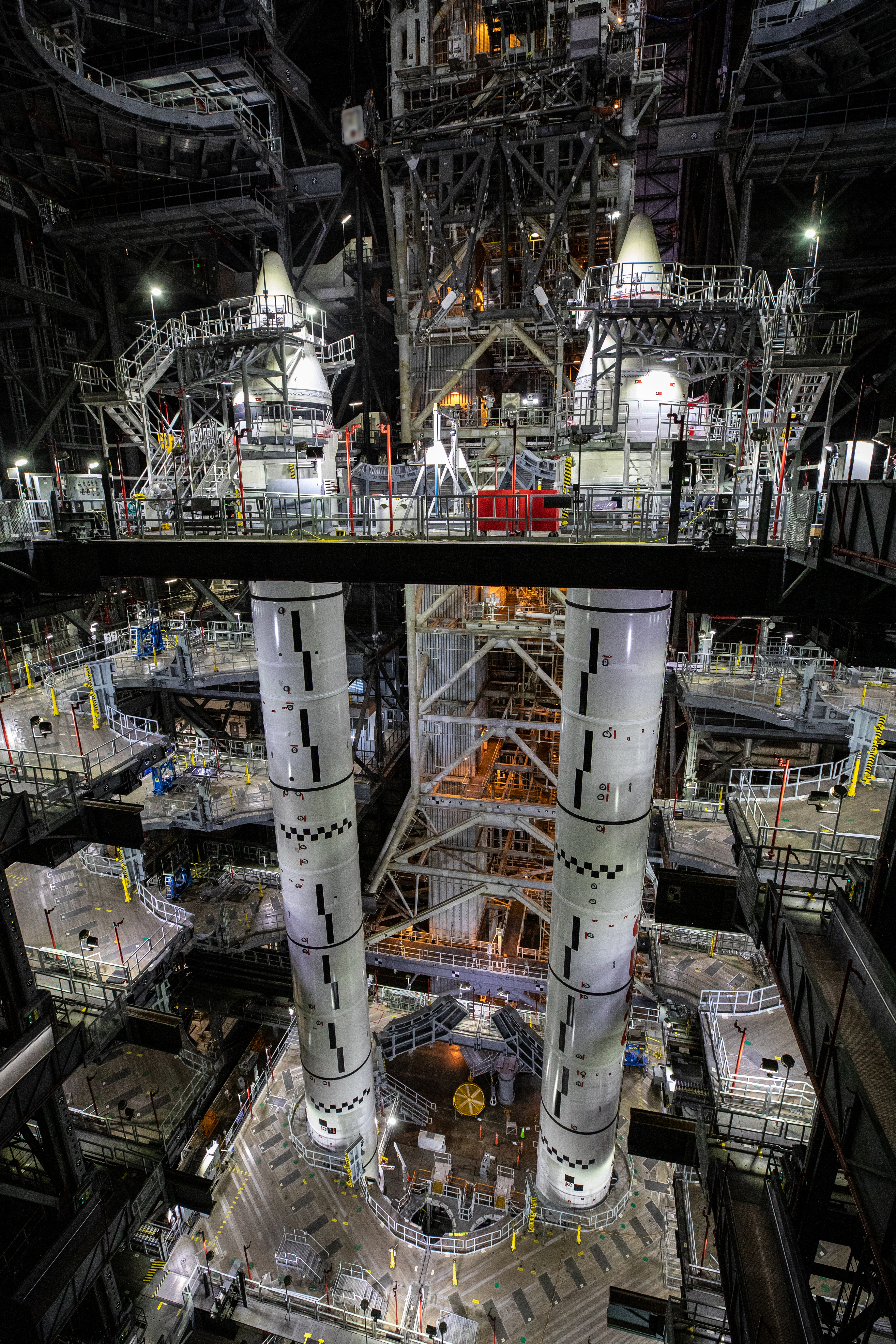
Solid propellant motor used to augment the thrust of a rocket
A solid rocket booster (SRB) is a solid propellant motor used to provide thrust in spacecraft launches from initial launch through the first ascent. Many launch vehicles, including the Atlas V, SLS and Space Shuttle, have used SRBs to give launch vehicles much of the thrust required to place the vehicle into orbit.
The Space Shuttle used two Space Shuttle SRBs, which were the largest solid propellant motors ever built until the Space Launch System and the first designed for recovery and reuse. The propellant for each solid rocket motor on the Space Shuttle weighed approximately 500,000 kilograms.
Advantages
_rocket_with_Deep_Impact.jpg)
Compared to liquid propellant rockets, the solid-propellant motors (SRMs) have been capable of providing large amounts of thrust with a relatively simple design. They provide greater thrust without significant refrigeration and insulation requirements, and produce large amounts of thrust for their size. Adding detachable SRBs to a vehicle also powered by liquid-propelled rockets known as staging reduces the amount of liquid propellant needed and lowers the launch rig mass. Solid boosters are cheaper to design, test, and produce in the long run compared to the equivalent liquid propellant boosters. Reusability of components across multiple flights, as in the Shuttle assembly, also has decreased hardware costs.
One example of increased performance provided by SRBs is the Ariane 4 rocket. The basic 40 model with no additional boosters was capable of lifting a 4,795 lb (2,175 kg) payload to geostationary transfer orbit. The 44P model with 4 solid boosters has a payload of 7,639 lb (3,465 kg) to the same orbit.
Disadvantages
Solid propellant boosters are not controllable and must generally burn until exhaustion after ignition, unlike liquid propellant or cold-gas propulsion systems. However, launch abort systems and range safety destruct systems can attempt to cut off propellant flow by using shaped charges. estimates for SRB failure rates have ranged from 1 in 1,000 to 1 in 100,000. SRB assemblies have failed suddenly and catastrophically. Nozzle blocking or deformation can lead to overpressure or a reduction in thrust, while defects in the booster's casing or stage couplings can cause the assembly to break apart by increasing aerodynamic stresses. Additional failure modes include bore choking and combustion instability. Failure of an O-ring seal on the Challenger space shuttle's right solid rocket booster led to its disintegration shortly after liftoff.
Solid rocket motors can present a handling risk on the ground, as a fully fueled booster carries a risk of accidental ignition. Such an accident occurred in the August 2003 Brazilian rocket explosion at the Brazilian Centro de Lançamento de Alcântara VLS rocket launch pad, killing 21 technicians.
Launchers that use solid rocket boosters
Some launchers use a fixed number of boosters :
- Space Launch System: two (SLS Solid Rocket Boosters)
- Space Shuttle: two (Space Shuttle Solid Rocket Boosters)
- Ariane 5: two (P241/P238)
- LVM3 : two (S200)
Some launchers use a variable number of boosters depending on payload and target orbit :
- Atlas V: zero, 1, 2, 3, 4, or 5 (GEM-63)
- Delta II. Often launched with 9 SRBs, but sometimes fewer.
- Delta IV Medium: zero, 2, or 4 Graphite-Epoxy Motors (GEM 60s) strap-on boosters
- PSLV: 2, 4, or 6 (S9/S12) and S139 First Stage
- Ariane 6: two or four (P120C)
- Vulcan Centaur: zero, 2, 4, or 6 (GEM 63XL)
References
References
- "Assets". Lockheed Martin.
- "HSF - The Shuttle".
- (2009-08-09). "Solid rocket boosters". NASA.
- "What are the types of rocket propulsion?".
- Hoover, Kurt. "Doomed from the Beginning:The Solid Rocket Boosters for the Space Shuttle". University of Texas.
- "Ariane 4". Astronautix.
- "Ariane 44P". Astronautix.
- Tasker, Douglas G.. (1986-08-01). "Shock Initiation Studies of the NASA Solid Rocket Booster Abort System".
- WINES, MICHAEL. (1986-03-05). "NASA Estimate of Rocket Risk Disputed". Los Angeles Times.
- "Solid Rocket Motor Failure Prediction - Introduction".
- [http://www.astronautix.com/lvs/vls.htm VLS] {{webarchive. link. (2005-08-12)
This article was imported from Wikipedia and is available under the Creative Commons Attribution-ShareAlike 4.0 License. Content has been adapted to SurfDoc format. Original contributors can be found on the article history page.
Ask Mako anything about Solid rocket booster — get instant answers, deeper analysis, and related topics.
Research with MakoFree with your Surf account
Create a free account to save articles, ask Mako questions, and organize your research.
Sign up freeThis content may have been generated or modified by AI. CloudSurf Software LLC is not responsible for the accuracy, completeness, or reliability of AI-generated content. Always verify important information from primary sources.
Report