From Surf Wiki (app.surf) — the open knowledge base
Solar eclipse of June 30, 1973
Total eclipse
Total eclipse
| Field | Value |
|---|---|
| previous | Solar eclipse of January 4, 1973 |
| next | Solar eclipse of December 24, 1973 |
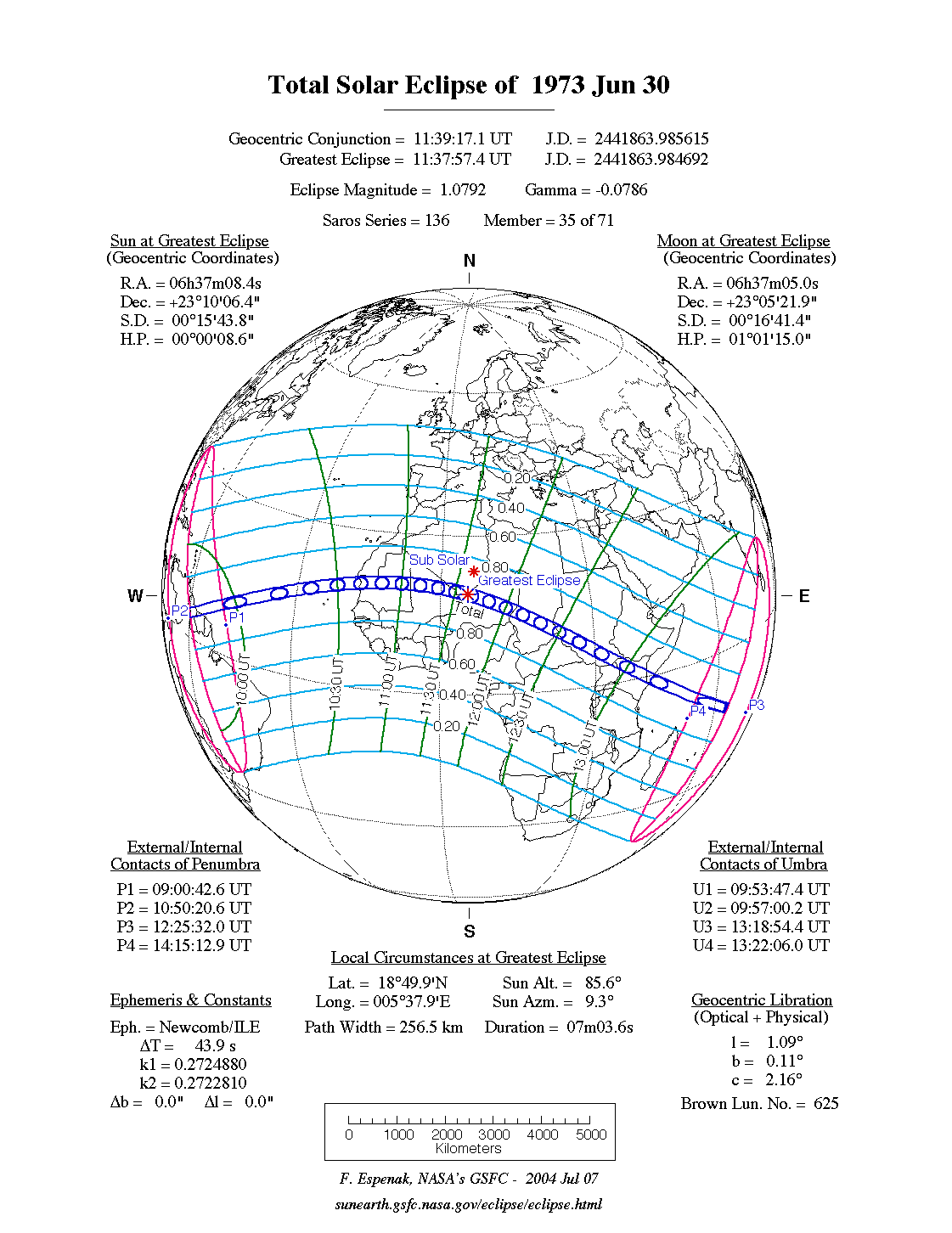
A total solar eclipse occurred at the Moon's descending node of orbit on Saturday, June 30, 1973, with a magnitude of 1.0792. A solar eclipse occurs when the Moon passes between Earth and the Sun, thereby totally or partly obscuring the image of the Sun for a viewer on Earth. A total solar eclipse occurs when the Moon's apparent diameter is larger than the Sun's, blocking all direct sunlight, turning day into darkness. Totality occurs in a narrow path across Earth's surface, with the partial solar eclipse visible over a surrounding region thousands of kilometres wide. Occurring about 11 hours after perigee (on June 30, 1973, at 0:50 UTC), the Moon's apparent diameter was larger.
With a maximum eclipse of 7 minutes and 3.55 seconds, this was the last total solar eclipse that exceeds 7 minutes in this series. There will not be a longer total solar eclipse until June 25, 2150.
The greatest eclipse occurred in the Agadez area in the northwest of Niger not far from Algeria inside the Sahara Desert somewhat 40 km east of the small mountain of Ebenenanoua at 18.8 N and 5.6 E and occurred at 11:38 UTC.
The umbral portion of the path started near the border of Guyana and the Brazilian state Roraima, passed northern Dutch Guiana (today's Suriname), headed into the Atlantic, included one of the Portuguese Cape Verde (today's Cape Verde) Islands, which was Santo Antão, Nouadhibou and Nouakchott and other parts of Central Mauritania, northern Mali, the southernmost of Algeria, the middle and southeastern Niger, the middle of Chad, the Sudan including Darfur and parts that are now in the South Sudan including Kodok, a part of the northernmost Uganda, a part of northern Kenya, the southernmost of Somalia, and the Alphonse Group of British Seychelles (today's Seychelles). A partial eclipse was visible for parts of eastern South America, Africa, Southern Europe, and the Middle East.
Observations
This eclipse was observed by a group of scientists, which included Donald Liebenberg, from the Los Alamos National Laboratory. They used two airplanes to extend the apparent time of totality by flying along the eclipse path in the same direction as the Moon's shadow as it passed over Africa. One of the planes was a prototype (c/n 001) of what was later to become the Concorde, which has a top speed of almost 1300 mph (Mach 2). This enabled scientists from Los Alamos, the Paris Observatory, the Kitt Peak National Observatory, Queen Mary University of London, the University of Aberdeen and CNRS to extend totality to more than 74 minutes; nearly 10 times longer than is possible when viewing a total solar eclipse from a stationary location. The Concorde was specially modified with rooftop portholes for the mission, and is currently on display with the Solar Eclipse mission livery at Musée de l’air et de l’espace. The data gathered resulted in three papers published in Nature and a book.
The eclipse was also observed by a charter flight from Mount San Antonio College in Southern California. The DC-8 with 150 passengers intercepted the eclipse at 35000 ft just off the east coast of Africa and tracked the eclipse for three minutes. The passengers rotated seats every 20 seconds so that each passenger had three 20 second opportunities at the window to observe and take pictures. A separate observation opportunity was provided on a specialized commercial cruise by the S.S. Canberra, which traveled from New York City to the Canary Islands and Dakar, Senegal, observing 5 minutes and 44 seconds of totality out in the Atlantic between those two stops in Africa. That cruise's passengers included notables in the scientific community such as Neil Armstrong, Scott Carpenter, Isaac Asimov, Walter Sullivan, and the then 15-year old Neil deGrasse Tyson.
Eclipse details
Shown below are two tables displaying details about this particular solar eclipse. The first table outlines times at which the Moon's penumbra or umbra attains the specific parameter, and the second table describes various other parameters pertaining to this eclipse.
| Event | Time (UTC) |
|---|---|
| First Penumbral External Contact | 1973 June 30 at 09:01:25.6 UTC |
| First Umbral External Contact | 1973 June 30 at 09:54:30.6 UTC |
| First Central Line | 1973 June 30 at 09:56:07.0 UTC |
| First Umbral Internal Contact | 1973 June 30 at 09:57:43.4 UTC |
| First Penumbral Internal Contact | 1973 June 30 at 10:51:03.8 UTC |
| Greatest Duration | 1973 June 30 at 11:34:54.0 UTC |
| Greatest Eclipse | 1973 June 30 at 11:38:40.6 UTC |
| Ecliptic Conjunction | 1973 June 30 at 11:39:28.6 UTC |
| Equatorial Conjunction | 1973 June 30 at 11:40:00.2 UTC |
| Last Penumbral Internal Contact | 1973 June 30 at 12:26:15.2 UTC |
| Last Umbral Internal Contact | 1973 June 30 at 13:19:37.6 UTC |
| Last Central Line | 1973 June 30 at 13:21:13.4 UTC |
| Last Umbral External Contact | 1973 June 30 at 13:22:49.2 UTC |
| Last Penumbral External Contact | 1973 June 30 at 14:15:56.2 UTC |
| Parameter | Value |
|---|---|
| Eclipse Magnitude | 1.07921 |
| Eclipse Obscuration | 1.16470 |
| Gamma | −0.07853 |
| Sun Right Ascension | 06h37m08.4s |
| Sun Declination | +23°10'06.4" |
| Sun Semi-Diameter | 15'43.8" |
| Sun Equatorial Horizontal Parallax | 08.6" |
| Moon Right Ascension | 06h37m05.0s |
| Moon Declination | +23°05'22.3" |
| Moon Semi-Diameter | 16'41.4" |
| Moon Equatorial Horizontal Parallax | 1°01'15.1" |
| ΔT | 43.9 s |
Eclipse season
This eclipse is part of an eclipse season, a period, roughly every six months, when eclipses occur. Only two (or occasionally three) eclipse seasons occur each year, and each season lasts about 35 days and repeats just short of six months (173 days) later; thus two full eclipse seasons always occur each year. Either two or three eclipses happen each eclipse season. In the sequence below, each eclipse is separated by a fortnight. The first and last eclipse in this sequence is separated by one synodic month.
| June 15 | |||||
|---|---|---|---|---|---|
| Ascending node (full moon) | |||||
| June 30 | |||||
| Descending node (new moon) | |||||
| July 15 | |||||
| Ascending node (full moon) | |||||
| [[File:Lunar eclipse chart close-1973Jun15.png | 200px]] | [[File:SE1973Jun30T.png | 200px]] | [[File:Lunar eclipse chart close-1973Jul15.png | 200px]] |
| Penumbral lunar eclipse | |||||
| Lunar Saros 110 | Total solar eclipse | ||||
| Solar Saros 136 | Penumbral lunar eclipse | ||||
| Lunar Saros 148 |
Notes
References
References
- "June 30, 1973 Total Solar Eclipse". timeanddate.
- Hatherill, Chris. (March 9, 2016). "When Astronomers Chased a Total Eclipse in a Concorde".
- "Moon Distances for London, United Kingdom, England". timeanddate.
- Mulkin, Barb. (1981). "In Flight: The Story of Los Alamos Eclipse Missions". Los Alamos National Laboratory.
- Chris Hatherill. (9 March 2016). "When Astronomers Chased a Total Eclipse in a Concorde". Vice.
- (9 March 2016). "When Astronomers Chased a Total Eclipse in a Concorde". [[Vice (magazine).
- (2015). "Racing the Moon's Shadow with Concorde 001". Springer.
- Stewart Leber, Bay. (July 12, 1973). "Voyage to Darkness". Honolulu Star-Ledger.
- Sullivan, Walter. (July 1, 1973). "Rare Eclipse Sweeps Across Width of Africa". The New York Times.
- Asimov, Isaac. (April 1, 1980). "In Joy Still Felt". Doubleday.
- DeGrasse Tyson, Neil. (May 1, 2004). "The Sky is Not the Limit". Prometheus Books.
- "Total Solar Eclipse of 1973 Jun 30". EclipseWise.com.
This article was imported from Wikipedia and is available under the Creative Commons Attribution-ShareAlike 4.0 License. Content has been adapted to SurfDoc format. Original contributors can be found on the article history page.
Ask Mako anything about Solar eclipse of June 30, 1973 — get instant answers, deeper analysis, and related topics.
Research with MakoFree with your Surf account
Create a free account to save articles, ask Mako questions, and organize your research.
Sign up freeThis content may have been generated or modified by AI. CloudSurf Software LLC is not responsible for the accuracy, completeness, or reliability of AI-generated content. Always verify important information from primary sources.
Report