From Surf Wiki (app.surf) — the open knowledge base
Solar eclipse of June 16, 1806
Total eclipse
Total eclipse
| Field | Value |
|---|---|
| previous | Solar eclipse of December 21, 1805 |
| next | Solar eclipse of December 10, 1806 |
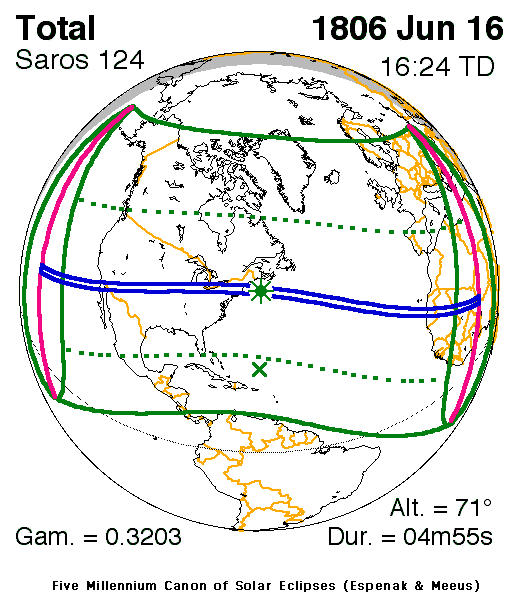
A total solar eclipse occurred at the Moon's descending node of orbit on Monday, June 16, 1806 (sometimes dubbed Tecumseh's Eclipse), with a magnitude of 1.0604. A solar eclipse occurs when the Moon passes between Earth and the Sun, thereby totally or partly obscuring the image of the Sun for a viewer on Earth. A total solar eclipse occurs when the Moon's apparent diameter is larger than the Sun's, blocking all direct sunlight, turning day into darkness. Totality occurs in a narrow path across Earth's surface, with the partial solar eclipse visible over a surrounding region thousands of kilometres wide. Occurring about 1.7 days before perigee (on June 18, 1806, at 9:30 UTC), the Moon's apparent diameter was larger.
The path of totality was visible from parts of modern-day northwestern Mexico, the states of Arizona, New Mexico, Colorado, northwestern Texas, Oklahoma, Kansas, Missouri, southeastern Iowa, Illinois, Indiana, Michigan, Ohio, Pennsylvania, New York, Connecticut, Massachusetts, Vermont, New Hampshire, Rhode Island, and Maine in the United States, Western Sahara, Mauritania, Mali, and Niger. A partial solar eclipse was also visible for parts of North America, Central America, the Caribbean, Europe, and West Africa.
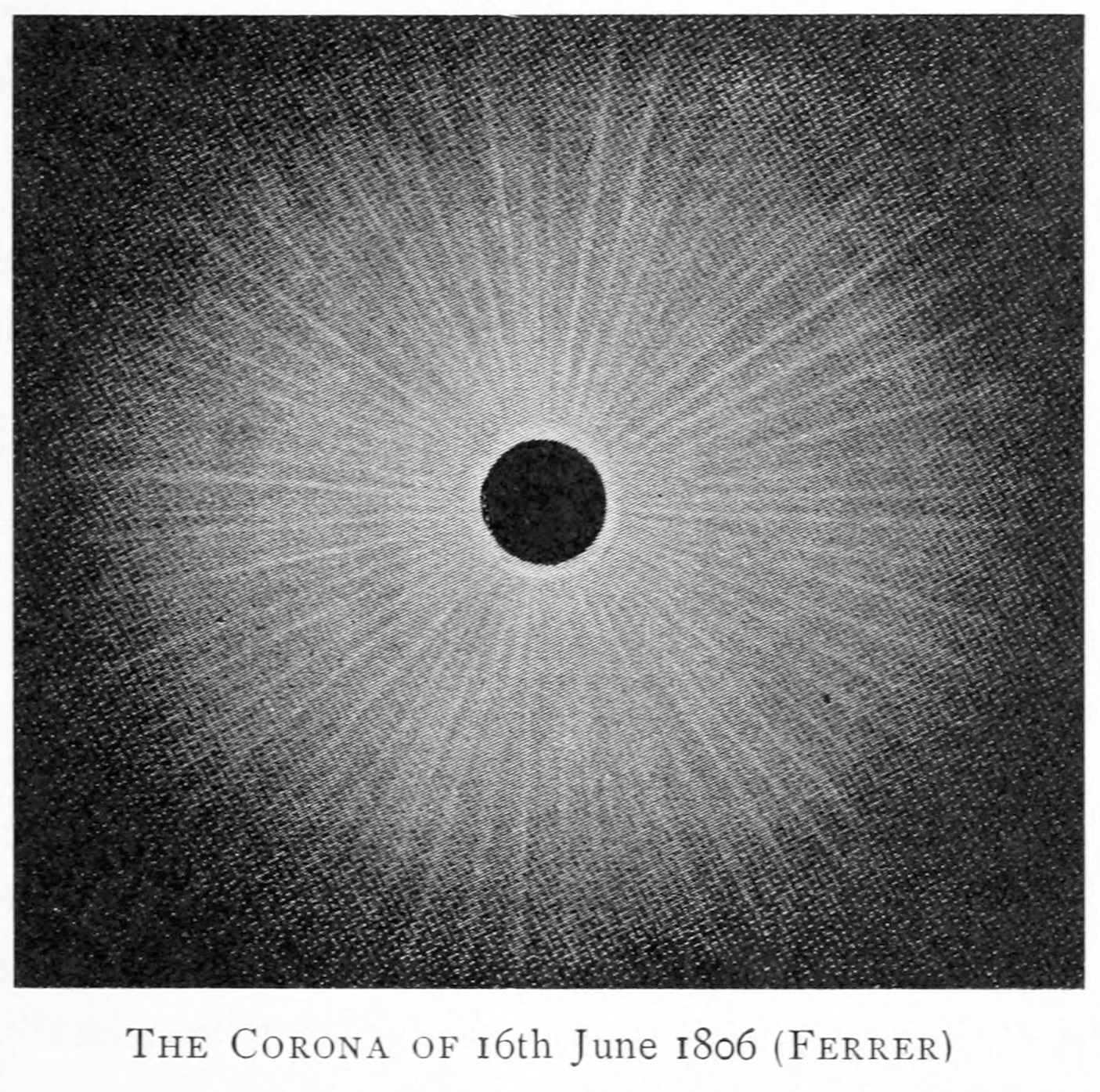
The eclipse was predicted by Shawnee prophet Tenskwatawa and its appearance aided unity among the Indigenous peoples of North America. Astronomer José Joaquín de Ferrer observed and named the solar corona during this eclipse.
Tenskwatawa's prediction
It has been called Tecumseh's Eclipse after the Shawnee chief, Tecumseh. He realized that the only hope for the various tribes in east and central North America was to join. He was assisted by his brother, Tenskwatawa, called The Prophet, who called for a rejection of European influence and a return to traditional values. This tribal unity threatened William Henry Harrison, the Territorial Governor of Indiana and future 9th President of the United States. Harrison tried to discredit the Shawnee leader by challenging Tenskwatawa to prove his powers. He wrote: "If he (Tenskwatawa) is really a prophet, ask him to cause the Sun to stand still or the Moon to alter its course, the rivers to cease to flow or the dead to rise from their graves."
Tenskwatawa declared that the Great Spirit was angry at Harrison and would give a sign. "Fifty days from this day there will be no cloud in the sky. Yet, when the Sun has reached its highest point, at that moment will the Great Spirit take it into her hand and hide it from us. The darkness of night will thereupon cover us and the stars will shine round about us. The birds will roost and the night creatures will awaken and stir." On that day, there was an eclipse, and Harrison's attempt to divide the Shawnee people backfired spectacularly. Then, Tecumseh ordered the Great Spirit to release the sun.
Observations
José Joaquín de Ferrer observed from Kinderhook, New York and gave the name corona to the glow of the faint outer atmosphere of the Sun seen during a total eclipse. He proposed that the corona must belong to the Sun, not the Moon, because of its great size. Ferrer also stated that during the total eclipse of 1806, the irregularities of the Moon's surface were plainly discernible.
Capel Lofft observed from the United Kingdom of Great Britain and Ireland.
Eclipse details
Shown below are two tables displaying details about this particular solar eclipse. The first table outlines times at which the Moon's penumbra or umbra attains the specific parameter, and the second table describes various other parameters pertaining to this eclipse.
| Event | Time (UTC) |
|---|---|
| First Penumbral External Contact | 1806 June 16 at 13:47:18.5 UTC |
| First Umbral External Contact | 1806 June 16 at 14:44:05.8 UTC |
| First Central Line | 1806 June 16 at 14:45:19.5 UTC |
| First Umbral Internal Contact | 1806 June 16 at 14:46:33.4 UTC |
| First Penumbral Internal Contact | 1806 June 16 at 15:49:22.2 UTC |
| Ecliptic Conjunction | 1806 June 16 at 16:21:07.3 UTC |
| Equatorial Conjunction | 1806 June 16 at 16:22:27.7 UTC |
| Greatest Duration | 1806 June 16 at 16:24:24.6 UTC |
| Greatest Eclipse | 1806 June 16 at 16:24:26.5 UTC |
| Last Penumbral Internal Contact | 1806 June 16 at 16:59:34.4 UTC |
| Last Umbral Internal Contact | 1806 June 16 at 18:02:18.7 UTC |
| Last Central Line | 1806 June 16 at 18:03:34.3 UTC |
| Last Umbral External Contact | 1806 June 16 at 18:04:49.9 UTC |
| Last Penumbral External Contact | 1806 June 16 at 19:01:31.5 UTC |
| Parameter | Value |
|---|---|
| Eclipse Magnitude | 1.06042 |
| Eclipse Obscuration | 1.12449 |
| Gamma | 0.32035 |
| Sun Right Ascension | 05h37m06.5s |
| Sun Declination | +23°21'35.2" |
| Sun Semi-Diameter | 15'44.3" |
| Sun Equatorial Horizontal Parallax | 08.7" |
| Moon Right Ascension | 05h37m11.4s |
| Moon Declination | +23°40'49.1" |
| Moon Semi-Diameter | 16'25.5" |
| Moon Equatorial Horizontal Parallax | 1°00'17.0" |
| ΔT | 12.1 s |
Eclipse season
This eclipse is part of an eclipse season, a period, roughly every six months, when eclipses occur. Only two (or occasionally three) eclipse seasons occur each year, and each season lasts about 35 days and repeats just short of six months (173 days) later; thus two full eclipse seasons always occur each year. Either two or three eclipses happen each eclipse season. In the sequence below, each eclipse is separated by a fortnight.
| June 16 | ||
|---|---|---|
| Descending node (new moon) | ||
| June 30 | ||
| Ascending node (full moon) | ||
| [[File:SE1806Jun16T.png | 200px]] | |
| Total solar eclipse | ||
| Solar Saros 124 | Partial lunar eclipse | |
| Lunar Saros 136 |
Notes
References
References
- "Moon Distances for London, United Kingdom, England". timeanddate.
- "An Account of 1806, June 16 eclipse from a sorrow in our heart: A life of Tecumseh" by Allan W. Eckert.
- [https://play.google.com/books/reader?id=aiZbAAAAcAAJ&printsec=frontcover&output=reader&hl=en&pg=GBS.PA402 History of Physical Astronomy, January 1852]
- (1796). "The Monthly magazine. v.22 (1806). - Full View {{!}} HathiTrust Digital Library {{!}} HathiTrust Digital Library". Monthly Magazine and Critical Register of Books.
- "Total Solar Eclipse of 1806 Jun 16". EclipseWise.com.
This article was imported from Wikipedia and is available under the Creative Commons Attribution-ShareAlike 4.0 License. Content has been adapted to SurfDoc format. Original contributors can be found on the article history page.
Ask Mako anything about Solar eclipse of June 16, 1806 — get instant answers, deeper analysis, and related topics.
Research with MakoFree with your Surf account
Create a free account to save articles, ask Mako questions, and organize your research.
Sign up freeThis content may have been generated or modified by AI. CloudSurf Software LLC is not responsible for the accuracy, completeness, or reliability of AI-generated content. Always verify important information from primary sources.
Report