From Surf Wiki (app.surf) — the open knowledge base
Solar eclipse of December 22, 1889
Total eclipse
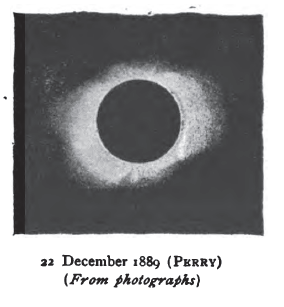
Total eclipse
| Field | Value |
|---|---|
| previous | Solar eclipse of June 28, 1889 |
| next | Solar eclipse of June 17, 1890 |
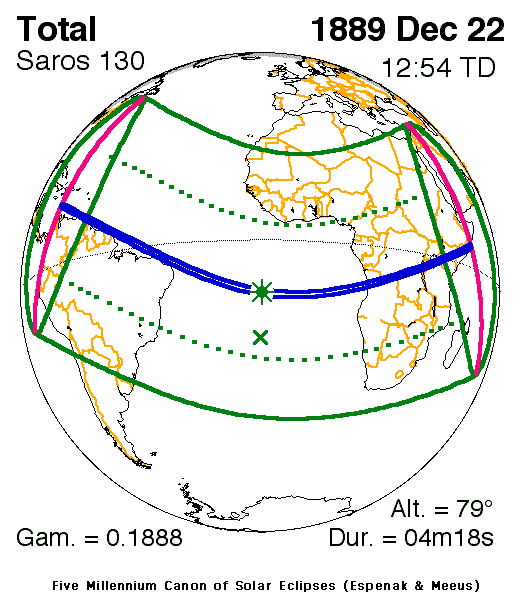
A total solar eclipse occurred at the Moon's descending node of orbit on Sunday, December 22, 1889, with a magnitude of 1.0449. A solar eclipse occurs when the Moon passes between Earth and the Sun, thereby totally or partly obscuring the image of the Sun for a viewer on Earth. A total solar eclipse occurs when the Moon's apparent diameter is larger than the Sun's, blocking all direct sunlight, turning day into darkness. Totality occurs in a narrow path across Earth's surface, with the partial solar eclipse visible over a surrounding region thousands of kilometres wide. Occurring about 12.5 hours before perigee (on December 23, 1889, at 1:30 UTC), the Moon's apparent diameter was larger.
The path of totality was visible from parts of modern-day Trinidad and Tobago, northern French Guiana, Angola, the Democratic Republic of the Congo, Rwanda, Burundi, Tanzania, Kenya, and Somalia. A partial solar eclipse was also visible for parts of the eastern Caribbean, northern and central South America, and Africa.
The eclipse was the focus of a 242-day United States scientific expedition, roughly 70 miles south of Luanda.
Observations
The eclipse was the focus of a scientific expedition from the United States, led by David P. Todd of Amherst College and including a team of at least six. Among the members was E. J. Loomis from the American Ephemeris and Nautical Almanac office. It set sail October 16 on the USS Pensacola and set up the eclipse base camp in December, roughly 70 miles south of Luanda in Cape Ledo. Totality was completely obscured by cloud cover. The ship returned to New York after 242 days, with the expedition performing a variety of other scientific studies along the way.
Eclipse details
Shown below are two tables displaying details about this particular solar eclipse. The first table outlines times at which the Moon's penumbra or umbra attains the specific parameter, and the second table describes various other parameters pertaining to this eclipse.
| Event | Time (UTC) |
|---|---|
| First Penumbral External Contact | 1889 December 22 at 10:16:37.8 UTC |
| First Umbral External Contact | 1889 December 22 at 11:12:11.2 UTC |
| First Central Line | 1889 December 22 at 11:12:55.8 UTC |
| First Umbral Internal Contact | 1889 December 22 at 11:13:40.4 UTC |
| First Penumbral Internal Contact | 1889 December 22 at 12:10:55.7 UTC |
| Ecliptic Conjunction | 1889 December 22 at 12:52:18.2 UTC |
| Equatorial Conjunction | 1889 December 22 at 12:52:26.5 UTC |
| Greatest Eclipse | 1889 December 22 at 12:54:14.4 UTC |
| Greatest Duration | 1889 December 22 at 12:56:22.0 UTC |
| Last Penumbral Internal Contact | 1889 December 22 at 13:37:36.0 UTC |
| Last Umbral Internal Contact | 1889 December 22 at 14:34:48.8 UTC |
| Last Central Line | 1889 December 22 at 14:35:34.0 UTC |
| Last Umbral External Contact | 1889 December 22 at 14:36:19.3 UTC |
| Last Penumbral External Contact | 1889 December 22 at 15:31:50.3 UTC |
| Parameter | Value |
|---|---|
| Eclipse Magnitude | 1.04489 |
| Eclipse Obscuration | 1.09179 |
| Gamma | 0.18881 |
| Sun Right Ascension | 18h04m04.9s |
| Sun Declination | -23°26'59.9" |
| Sun Semi-Diameter | 16'15.7" |
| Sun Equatorial Horizontal Parallax | 08.9" |
| Moon Right Ascension | 18h04m09.5s |
| Moon Declination | -23°15'29.9" |
| Moon Semi-Diameter | 16'42.5" |
| Moon Equatorial Horizontal Parallax | 1°01'19.2" |
| ΔT | -6.2 s |
Eclipse season
This eclipse is part of an eclipse season, a period, roughly every six months, when eclipses occur. Only two (or occasionally three) eclipse seasons occur each year, and each season lasts about 35 days and repeats just short of six months (173 days) later; thus two full eclipse seasons always occur each year. Either two or three eclipses happen each eclipse season. In the sequence below, each eclipse is separated by a fortnight.
| December 22 | |
|---|---|
| Descending node (new moon) | |
| January 6 | |
| Ascending node (full moon) | |
| [[File:SE1889Dec22T.png | 200px]] |
| Total solar eclipse | |
| Solar Saros 130 |
References
| access-date=2021-06-10 | postscript=. }}
- NASA graphic
- Sketchs of Solar Corona December 22, 1889
- Eclipse of December 21, 1889 (Cayenne). Contact print from the original glass negative. Lick Observatory Plate Archive, Mt. Hamilton.
- On Board the Pensacola--The Eclipse Expedition to the West Coast of Africa by Albert Bergman (A Man Before the Mast), New York, 1890
References
- "Moon Distances for London, United Kingdom, England". timeanddate.
- "Total Solar Eclipse of 1889 Dec 22". EclipseWise.com.
This article was imported from Wikipedia and is available under the Creative Commons Attribution-ShareAlike 4.0 License. Content has been adapted to SurfDoc format. Original contributors can be found on the article history page.
Ask Mako anything about Solar eclipse of December 22, 1889 — get instant answers, deeper analysis, and related topics.
Research with MakoFree with your Surf account
Create a free account to save articles, ask Mako questions, and organize your research.
Sign up freeThis content may have been generated or modified by AI. CloudSurf Software LLC is not responsible for the accuracy, completeness, or reliability of AI-generated content. Always verify important information from primary sources.
Report