From Surf Wiki (app.surf) — the open knowledge base
Solar eclipse of August 21, 2017
Total eclipse visible from the mainland US

Total eclipse visible from the mainland US
| Field | Value |
|---|---|
| previous | Solar eclipse of February 26, 2017 |
| next | Solar eclipse of February 15, 2018 |
The solar eclipse of August 21, 2017, dubbed the "Great American Eclipse" by some media, was a total solar eclipse visible within a band that spanned the contiguous United States from the Pacific to the Atlantic coasts. It was also visible as a partial solar eclipse from as far north as Nunavut in northern Canada to as far south as northern South America. In northwestern Europe and Africa, it was partially visible in the late evening. In northeastern Asia, it was partially visible at sunrise.
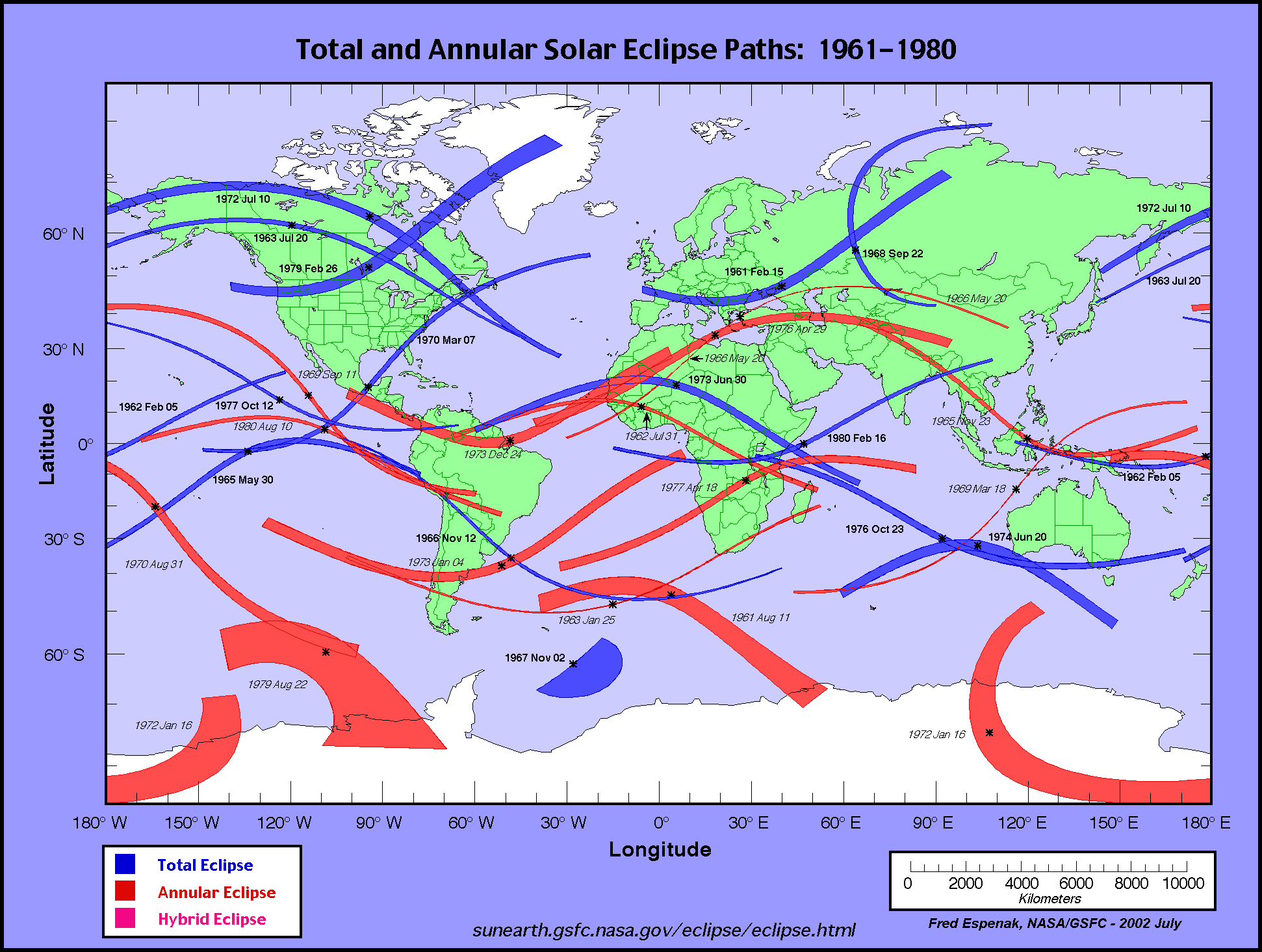
Prior to this event, no solar eclipse had been visible across the entirety of the United States since June 8, 1918; not since the February 1979 eclipse had a total eclipse been visible from anywhere in the mainland United States. The path of totality touched 14 states, and the rest of the U.S. had a partial eclipse. with most of this area over the ocean, not land. The event's shadow began to cover land on the Oregon coast as a partial eclipse at 4:05 p.m. UTC (9:05 a.m. PDT), with the total eclipse beginning there at 5:16 p.m. UTC (10:16 a.m. PDT); the total eclipse's land coverage ended along the South Carolina coast at about 6:44 p.m. UTC (2:44 p.m. EDT).
This total solar eclipse marked the first such event in the smartphone and social media era in the United States. Information, personal communication, and photography were widely available as never before, capturing popular attention and enhancing the social experience. The event was received with much enthusiasm across the nation; people gathered outside their homes to watch it, and many parties were set up in the path of the eclipse. Many people left their homes and traveled hundreds of miles just to get a glimpse of totality, which few ever get to experience. Marriage proposals were timed to coincide with the eclipse, as was at least one wedding. Logistical problems arose with the influx of visitors, especially for smaller communities. The sale of counterfeit eclipse glasses was also anticipated to be a hazard for eye injuries.
The next solar eclipse that crossed the United States occurred on April 8, 2024 (12 states). Future solar eclipses that cross the United States will occur on August 23, 2044 (3 states), and on August 12, 2045 (10 states). Annular solar eclipses—wherein the Moon appears smaller than the Sun—occurred in October 2023 (9 states) and will occur in June 2048 (9 states).
Visibility
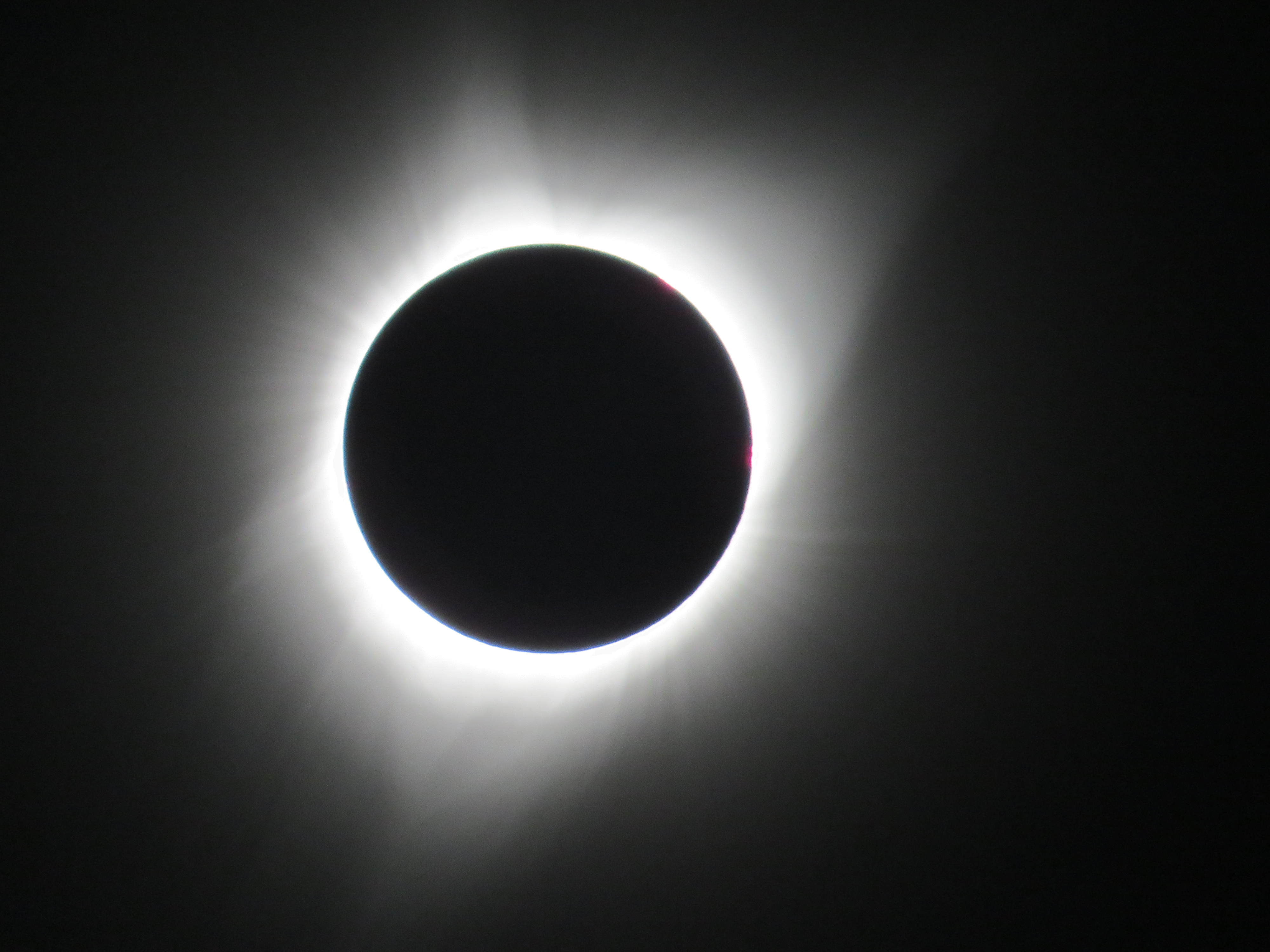
The total eclipse occurred at the Moon's ascending node of orbit and had a magnitude of 1.0306. Occurring about 3.2 days after perigee (on August 18, 2017, at 14:20 UTC), the Moon's apparent diameter was larger during this eclipse. It was visible within a narrow corridor 70 mile wide, crossing 14 of the contiguous United States: Oregon, Idaho, Montana, Wyoming, Nebraska, Kansas, Iowa, Missouri, Illinois, Kentucky, Tennessee, Georgia, North Carolina, and South Carolina. It was first seen from land in the U.S. shortly after 10:15 am PDT (17:15 UTC) at Oregon's Pacific coast, and then it progressed eastward through Salem, Oregon; Idaho Falls, Idaho; Casper, Wyoming; Lincoln, Nebraska; Kansas City, Missouri; St. Louis, Missouri; Hopkinsville, Kentucky; and Nashville, Tennessee; before reaching Columbia, South Carolina about 2:41 pm; and finally Charleston, South Carolina. A partial eclipse was seen for a greater time period, beginning shortly after 9:00 am PDT along the Pacific Coast of Oregon. Weather forecasts predicted clear skies in Western U.S. and some Eastern states, but clouds in the Midwest and East Coast.
The longest ground duration of totality was 2 minutes 41.6 seconds at about in Giant City State Park, just south of Carbondale, Illinois, and the greatest extent (width) was at near the village of Cerulean, Kentucky, located in between Hopkinsville and Princeton. This was the first total solar eclipse visible from the Southeastern United States since the solar eclipse of March 7, 1970. Two NASA WB-57Fs flew above the clouds, prolonging the observation time spent in the umbra. A partial solar eclipse was seen from the much broader path of the Moon's penumbra, including all of North America, particularly areas just south of the totality pass, where the eclipse lasted about 3–5 hours, Hawaii, Central America, the Caribbean, northern South America, Western Europe, and some of West Africa and Northeast Asia.
| [[File:DSCOVR - EPIC View of 2017 Eclipse Across America.gif | thumb | upright=1.3 | View of the lunar shadow tracking across Earth from the [[Deep Space Climate Observatory]] satellite]] |
|---|
At one location in Wyoming, a small group of astronomers used telescopic lenses to photograph the sun as it was in partial eclipse, while the International Space Station was also seen to briefly transit the sun. Similar images were captured by NASA from a location in Washington. (See Gallery – partial eclipse section).
Other celestial bodies
During the eclipse for a long span of its path of totality, several bright stars and four planets were visible. The star system Regulus was almost in conjunction with the Sun. Mars was 8° to the right, and Venus 34° right. Mercury was 10° left, and Jupiter 51° left.
| [[File:August 21 2017 total eclipse planets.png | upright=1.1 | thumb | During totality, stars and four planets were visible.]] | [[File:Eclipse with Regulus.jpg | thumb | upright | Solar eclipse and star system [[Regulus]] (upper left) viewed from [[Cullowhee, North Carolina]]]] |
|---|
Other eclipses over the United States
This was the first total solar eclipse visible from the United States since that of July 11, 1991—which was seen only from part of Hawaii—and the first visible from the contiguous United States since 1979. An eclipse of comparable length (up to 3 minutes, 8 seconds, with the longest eclipse being 6 minutes and 54 seconds) occurred over the contiguous United States on March 7, 1970 along the southern portions of the Eastern Seaboard, from Florida to Virginia.
The path of totality of the solar eclipse of February 26, 1979 crossed only the states of Washington, Oregon, Idaho, Montana, and North Dakota. Many enthusiasts traveled to the Pacific Northwest to view the eclipse, since it would be the last chance to view such an eclipse in the contiguous United States for almost four decades.

The August 2017 eclipse was the first with a path of totality crossing the Pacific and Atlantic coasts of the U.S. since the solar eclipse of 1918. Also, its path of totality made landfall exclusively within the United States, making it the first such eclipse since the country's declaration of independence in 1776. Prior to this, the path of totality of the eclipse of June 13, 1257, was the last to make landfall exclusively on lands currently part of the United States.
The path of the solar eclipse of April 8, 2024 crossed the path of the August 2017 eclipse, with the intersection occurring in southern Illinois in Makanda Township at Cedar Lake, just south of Carbondale. An area of about 9,000 sqmi, including the cities of Makanda, Carbondale, Cape Girardeau, Missouri, and Paducah, Kentucky, thus experienced two total solar eclipses within a span of less than seven years. This occurrence is considered to be unusual, since the average interval for any given spot on Earth observing a total solar eclipse is about once every 375 years.
The solar eclipse of August 12, 2045, will have a very similar path of totality over the U.S. to that of the 2017 eclipse: about 400 km (250 mi) to the southwest, also crossing the Pacific and Atlantic coasts of the country; however, totality will be more than twice as long, and it will be seen in other countries besides the United States. It will also be seen in the Americas.
Eclipse timing
Places experiencing total eclipse
| U.S. state | City or place | Start of partial eclipse | Start of total eclipse | Maximum eclipse | End of total eclipse | End of partial eclipse | Duration of totality (min:s) | Duration of eclipse (hr:min) | Maximum magnitude | References: |
|---|---|---|---|---|---|---|---|---|---|---|
| Oregon Oregon | Salem | 09:05:14 | 10:17:09 | 10:18:07 | 10:19:04 | 11:37:40 | 1:55 | 2:32 | 1.0097 | |
| Oregon Oregon | Ontario | 10:09:55 | 11:25:22 | 11:26:04 | 11:26:47 | 12:48:27 | 1:25 | 2:39 | 1.0037 | |
| Wyoming Wyoming | Jackson | 10:16:32 | 11:34:44 | 11:35:51 | 11:36:59 | 13:00:19 | 2:15 | 2:44 | 1.0109 | |
| Nebraska Nebraska | Harrison | 10:25:34 | 11:47:21 | 11:48:11 | 11:49:01 | 13:14:02 | 1:40 | 2:48 | 1.0042 | |
| Nebraska Nebraska | Scottsbluff | 10:25:37 | 11:48:00 | 11:48:50 | 11:49:40 | 13:15:16 | 1:40 | 2:50 | 1.004 | |
| Nebraska Nebraska | North Platte | 11:30:04 | 12:53:51 | 12:54:45 | 12:55:38 | 14:21:37 | 1:47 | 2:52 | 1.0044 | |
| Nebraska Nebraska | Kearney | 11:32:50 | 12:57:23 | 12:58:19 | 12:59:16 | 14:25:21 | 1:53 | 2:53 | 1.005 | |
| Nebraska Nebraska | Fairbury | 11:36:10 | 13:01:32 | 13:02:31 | 13:03:30 | 14:29:37 | 1:58 | 2:53 | 1.0054 | |
| Nebraska Nebraska | Lincoln | 11:37:04 | 13:02:20 | 13:03:05 | 13:03:50 | 14:29:40 | 1:30 | 2:53 | 1.003 | |
| Missouri Missouri | St. Joseph | 11:40:27 | 13:06:14 | 13:07:34 | 13:08:54 | 14:34:25 | 2:40 | 2:54 | 1.0153 | |
| Kansas Kansas | Kansas City | 11:40:59 | 13:08:28 | 13:08:35 | 13:08:42 | 14:35:45 | 0:14 | 2:55 | 1.0003 | |
| Missouri Missouri | Kansas City | 11:41:05 | 13:08:31 | 13:08:41 | 13:08:51 | 14:35:51 | 0:20 | 2:55 | 1.0004 | |
| Missouri Missouri | Independence | 11:41:24 | 13:08:29 | 13:09:02 | 13:09:36 | 14:36:10 | 1:07 | 2:55 | 1.0017 | |
| Missouri Missouri | Columbia | 11:45:27 | 13:12:10 | 13:13:29 | 13:14:48 | 14:40:05 | 2:38 | 2:55 | 1.0131 | |
| Missouri Missouri | Jefferson City | 11:45:53 | 13:12:56 | 13:14:10 | 13:15:25 | 14:40:56 | 2:29 | 2:55 | 1.0098 | |
| Illinois Illinois | Carbondale | 11:52:12 | 13:19:54 | 13:21:14 | 13:22:33 | 14:47:20 | 2:39 | 2:55 | 1.0135 | |
| Kentucky Kentucky | Paducah | 11:53:50 | 13:22:05 | 13:23:16 | 13:24:26 | 14:49:24 | 2:21 | 2:56 | 1.0081 | |
| Tennessee Tennessee | Clarksville | 11:56:48 | 13:25:23 | 13:26:32 | 13:27:40 | 14:52:21 | 2:17 | 2:56 | 1.0075 | |
| Kentucky Kentucky | Bowling Green | 11:58:27 | 13:27:18 | 13:27:48 | 13:28:17 | 14:53:00 | 0:59 | 2:55 | 1.0014 | |
| Tennessee Tennessee | Nashville | 11:58:18 | 13:27:16 | 13:28:13 | 13:29:10 | 14:53:54 | 1:54 | 2:56 | 1.0047 | |
| Tennessee Tennessee | Murfreesboro | 11:59:21 | 13:29:01 | 13:29:25 | 13:29:49 | 14:55:02 | 0:48 | 2:56 | 1.001 | |
| Tennessee Tennessee | Cookeville | 12:01:03 | 13:29:32 | 13:30:49 | 13:32:07 | 14:55:53 | 2:35 | 2:55 | 1.0118 | |
| Tennessee Tennessee | Cleveland | 13:03:13 | 14:33:01 | 14:33:30 | 14:33:59 | 15:58:35 | 0:58 | 2:55 | 1.0013 | |
| North Carolina North Carolina | Brevard | 13:07:53 | 14:37:05 | 14:37:41 | 14:38:18 | 16:01:37 | 1:13 | 2:54 | 1.0021 | |
| South Carolina South Carolina | Anderson | 13:08:45 | 14:37:40 | 14:38:57 | 14:40:14 | 16:03:02 | 2:34 | 2:54 | 1.0118 | |
| South Carolina South Carolina | Taylors | 13:09:09 | 14:38:07 | 14:39:00 | 14:39:54 | 16:02:47 | 1:47 | 2:54 | 1.0043 | |
| South Carolina South Carolina | Columbia | 13:12:53 | 14:41:39 | 14:42:54 | 14:44:10 | 16:06:12 | 2:31 | 2:53 | 1.0117 | |
| South Carolina South Carolina | Kingstree | 13:15:58 | 14:44:52 | 14:45:46 | 14:46:39 | 16:08:24 | 1:47 | 2:52 | 1.0046 | |
| South Carolina South Carolina | Summerville | 13:15:54 | 14:45:07 | 14:46:08 | 14:47:09 | 16:09:07 | 2:02 | 2:53 | 1.0059 | |
| South Carolina South Carolina | Charleston | 13:16:43 | 14:46:12 | 14:46:57 | 14:47:43 | 16:09:50 | 1:31 | 2:53 | 1.0032 |
Places experiencing partial eclipse
| Country or territory | City or place | Start of partial eclipse | Maximum eclipse | End of partial eclipse | Duration of eclipse (hr:min) | Maximum coverage | References: |
|---|---|---|---|---|---|---|---|
| Vancouver | 09:09:59 | 10:20:59 | 11:37:31 | 2:28 | 85.97% | ||
| Toronto | 13:10:25 | 14:31:53 | 15:49:06 | 2:39 | 70.67% | ||
| Montreal | 13:21:41 | 14:38:16 | 15:50:18 | 2:29 | 58.38% | ||
| Washington, D.C. | 13:17:38 | 14:42:37 | 16:01:30 | 2:44 | 81.15% | ||
| Havana | 13:27:07 | 14:58:12 | 16:20:24 | 2:53 | 65.75% | ||
| Nassau | 13:34:30 | 15:05:03 | 16:25:47 | 2:51 | 81.19% | ||
| Hamilton | 14:51:07 | 16:12:33 | 17:25:14 | 2:34 | 81.21% | ||
| Kingston | 12:51:30 | 14:18:25 | 15:34:55 | 2:43 | 59.44% | ||
| Cockburn Town | 13:55:17 | 15:22:08 | 16:38:10 | 2:43 | 80.77% | ||
| Port-au-Prince | 13:59:12 | 15:25:10 | 16:40:18 | 2:41 | 69.30% | ||
| Santo Domingo | 14:04:09 | 15:29:02 | 16:43:00 | 2:39 | 73.31% | ||
| San Juan | 14:11:28 | 15:34:20 | 16:46:26 | 2:35 | 79.93% | ||
| Cruz Bay | 14:14:11 | 15:36:13 | 16:47:35 | 2:33 | 81.71% | ||
| Road Town | 14:14:19 | 15:36:17 | 16:47:36 | 2:33 | 82.30% | ||
| Spanish Town | 14:14:36 | 15:36:29 | 16:47:42 | 2:33 | 82.69% | ||
| The Valley | 14:17:30 | 15:38:27 | 16:48:53 | 2:31 | 84.19% | ||
| Marigot | 14:17:47 | 15:38:40 | 16:49:03 | 2:31 | 83.67% | ||
| Philipsburg | 14:17:55 | 15:38:47 | 16:49:07 | 2:31 | 83.61% | ||
| The Bottom | 14:18:22 | 15:39:10 | 16:49:27 | 2:31 | 81.98% | ||
| Gustavia | 14:18:32 | 15:39:12 | 16:49:24 | 2:31 | 83.50% | ||
| Basseterre | 14:19:57 | 15:40:17 | 16:50:09 | 2:30 | 81.77% | ||
| St. John's | 14:21:48 | 15:41:31 | 16:50:52 | 2:29 | 82.60% | ||
| Brades | 14:21:50 | 15:41:37 | 16:51:01 | 2:29 | 80.96% | ||
| Basse-Terre | 14:24:13 | 15:43:19 | 16:52:08 | 2:28 | 79.15% | ||
| Roseau | 14:26:11 | 15:44:43 | 16:53:02 | 2:27 | 77.41% | ||
| Caracas | 14:28:38 | 15:45:26 | 16:52:23 | 2:24 | 52.91% | ||
| Fort-de-France | 14:28:06 | 15:46:02 | 16:53:52 | 2:26 | 75.64% | ||
| Castries | 14:29:27 | 15:46:59 | 16:54:27 | 2:25 | 73.81% | ||
| Bridgetown | 14:33:21 | 15:49:33 | 16:55:57 | 2:23 | 72.94% | ||
| Praia | 18:00:27 | 18:51:05 | 18:53:20 (sunset) | 0:53 | 79.56% |
Total eclipse viewing events
Oregon
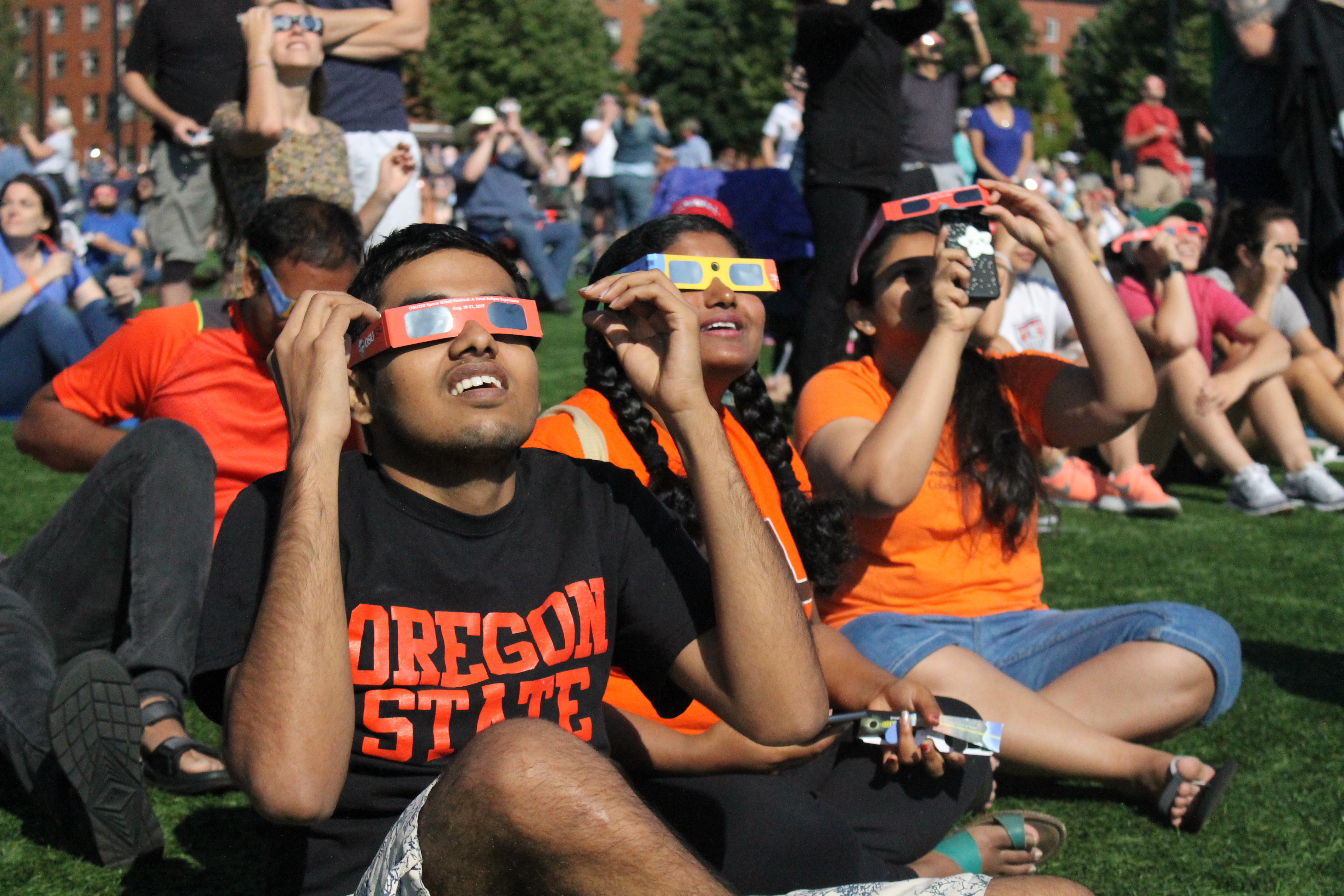


- Corvallis – The Corvallis campus of Oregon State University hosted "OSU150 Space Grant Festival: A Total Eclipse Experience", a weekend-long celebration of the eclipse. A watch party was also hosted on campus the day of the eclipse.
- Huntington – Historic Farewell Bend State Recreation Area hosted the RASC: Yukon Centre (Yukon Astronomical Society) and the RASC: Okanagan Centre. Solar viewing and presentations on the eclipse were given along with a dark-sky presentation.
- Keizer – The Salem-Keizer Volcanoes, a Class A baseball team, played a morning game against the visiting Hillsboro Hops that featured the first ever "eclipse delay" in baseball history.
- Madras – The city sponsored a four-day Solarfest at two locations.
- Ontario – Treasure Valley Community College hosted an eclipse viewing event.
- Prineville – Symbiosis Gathering hosted a seven-day eclipse festival which included rave-style music dubbed "Oregon Eclipse".
- Rickreall – The Polk County Fairgrounds organized a series of events and an eclipse gathering.
- Salem – The Oregon Museum of Science and Industry hosted an event at the Oregon State Fairgrounds.
Idaho

- Arco – High altitude balloon launches by the USC Astronautical Engineering department and NASA.
- Craters of the Moon – The National Monument and Preserve hosted NASA presentations, evening star parties hosted by the Idaho Falls Astronomical Society, and presentations by the New Mexico Chapter of the Charlie Bates Solar Astronomy Project.
- Idaho Falls – Free entertainment and educational seminars and an eclipse-watching event at the Museum of Idaho (an official NASA viewing site) and elsewhere, and a free eclipse-watching event at Melaleuca Field.
- Rexburg – Brigham Young University Idaho offered a series of eclipse-related educational events.
- Weiser – The city sponsored a five-day festival prior to the eclipse.
Wyoming
.jpg)
- Crowheart – The YouTube channel Smarter Every Day, collaborating with photographer Trevor Mahlmann, observed and captured a simultaneous transit of the International Space Station during the partial phase of the eclipse.
- Casper – The Astronomical League, an alliance of amateur astronomy clubs, held its annual Astrocon conference, and there were other public events, called Wyoming Eclipse Festival 2017.
- Fort Laramie – Fort Laramie held an eclipse viewing event, which included a Special "Great American Eclipse" Program.
- Riverton – The biggest Polish expedition conducted as the Great Expedition of Polish Society of Amateur Astronomers was flocked between Riverton and Shoshoni in the central line of totality.
Nebraska
.jpg)
- Alliance – Entertainment and educational seminars were offered. ABC News reported live from Carhenge during totality.
- Auburn – Nemaha County Hospital hosted an eclipse viewing event, including sharing safety tips from Lifetime Vision Center.
- Beatrice – Homestead National Monument of America – Events were held with Bill Nye the Science Guy as well as representatives from NASA on Saturday, Sunday and the day of the eclipse.
- Grand Island – Stuhr Museum hosted an eclipse viewing event, including the launch of a NASA eclipse observing balloon.
- Lincoln – At Haymarket Park, the Lincoln Saltdogs, an independent baseball team in the American Association, defeated the Gary SouthShore RailCats 8–5 in a special eclipse game, with 6,956 in attendance. The game was paused for 26 minutes in the middle of the third inning to observe the eclipse. The Saltdogs players wore special eclipse-themed uniforms that were auctioned off after the game.
Kansas
- Atchison – Benedictine College hosted thousands in its football stadium. There were students from schools from Kansas, Missouri, Nebraska, and Oklahoma attending, plus numerous other guests who heard from, amongst others, astronomers from the Vatican Observatory.
Missouri
- Columbia – The Cosmo Park and the Gans Creek Park were open for the eclipse. There was a watch party on campus for the students at the University of Missouri coordinated by Angela Speck, and the MU Health Care system released eye safety information.
- Kansas City – A 5-mile (8 km) bicycle ride from downtown KCMO (where totality only lasted about 30 seconds) to Macken Park in North Kansas City (where totality lasted 1 minute 13 seconds) was organized by KC Pedal Party Club, a local Meetup group.
- Lathrop – The city celebrated its 150th anniversary with an eclipse festival.
- Parkville – TotalEclipseofthePark – August 20 educational program featuring NASA Glenn Research Center Hall of Famer Lynn Bondurant, '61, and August 21 watch party organized by Park University.
- Potosi – Hora Eclipse, an Israeli folkdance camp coordinated with the eclipse, was held at YMCA Trout Lodge and Camp Lakewood, near the Mark Twain National Forest. More information at the event's website, especially its post-mortem page.
- St. Clair – An event organized by the St. Clair City Chamber of Commerce.
- St. Joseph – An event organized by Front Page Science was held at Rosecrans Memorial Airport.
- St. Louis – David Tipper hosted his Tipper & Friends 4321 electronic music event at Astral Valley Art Park featuring 5 days of music, art, and eclipse viewing.
Illinois
- Carbondale – Southern Illinois University sponsored many eclipse related educational events, including the two day Crossroads Astronomy, Science and Technology Expo, and viewing at Saluki Stadium. Amtrak ran a special train, the Eclipse Express, from Chicago to Carbondale. NASA EDGE was broadcasting live from Southern Illinois University Carbondale with a four-hour and thirty-minute show (11:45 a.m. – 4:15 p.m. EDT).
- Carterville – A three-day rock festival called Moonstock was headlined by Ozzy Osbourne, who performed during the eclipse.
- Goreville – The University of Illinois Astronomy Department hosted a viewing event in town, which was the closest village to the point of longest duration.{{cite web |url= http://eclipse.illinois.edu/goreville_public.html
Kentucky

- Bowling Green – Western Kentucky University hosted thousands of K-12 students in its football stadium. At Bowling Green Ballpark, the Bowling Green Hot Rods, a Class A baseball team, played an eclipse game against the visiting West Michigan Whitecaps.
- Hopkinsville – A four-day eclipse festival was held at Jefferson Davis State Historic Site.
Tennessee

- Athens – The City of Athens hosted "Total Eclipse of the Park" at Athens Regional Park, including entertainment, food, and vendors.
- Clarksville – Austin Peay State University presented several educational events, including an appearance by astronaut Rhea Seddon.
- Cookeville – Tennessee Tech hosted a solar eclipse viewing party at Tucker Stadium. Cookeville hosted special events from Saturday to Monday.
- McMinnville – celebrated the eclipse by hosting BLACKOUT 2017, an eclipse viewing event held in the city square. In addition to the viewing, a selection of food trucks and musical acts which features The Pink Floyd Appreciation Society band who performed Pink Floyd's The Dark Side of the Moon in its entirety prior to the totality event.
- Memphis – At AutoZone Park, the Memphis Redbirds, a Class AAA baseball team, played an eclipse game against the visiting New Orleans Baby Cakes.
- Nashville – offered many special events, including the Music City Eclipse Science & Technology Festival at the Adventure Science Center. The Italian Lights Festival hosted the largest Eclipse Viewing Party in Nashville, a free NASA-Certified Eclipse Event held at the Bicentennial Mall. Two astrophysicists from NASA's Jet Propulsion Laboratory emceed the countdown.
North Carolina
- Bryson City – Planetarium shows were offered, as well as rides on the Great Smoky Mountains Railroad to an eclipse location.
- Cullowhee – The eclipse was visible in totality, and classes were cancelled for several hours during the first day of classes at Western Carolina University.
- Rosman – Pisgah Astronomical Research Institute (PARI) hosted a viewing event. The event at PARI has garnered international attention and the visitors included amateur astronomers.
Georgia
- Athens – Viewing at Sanford Stadium at the University of Georgia.
- Blairsville – Get off the Grid Festival on three days preceding the eclipse.
- Elbert County – Approximately 400 people gathered at the Georgia Guidestones.
South Carolina
- Anderson – Viewing at the Green Pond Landing on Lake Hartwell with food trucks, astronomer, and music. Clouds blocked the sun at the beginning of totality, but almost completely disappeared throughout.
- Charleston – The College of Charleston hosted NASA's "eclipse headquarters" broadcast as part of an afternoon eclipse viewing celebration on the green behind the campus library.
- Clemson – Viewing at Clemson University.
- Columbia – The South Carolina State Museum hosted four days of educational events, including an appearance by Apollo 16 astronaut Charles Duke. At Spirit Communications Park, the Columbia Fireflies, a Class A baseball team, played an eclipse game against the visiting Rome Braves.
- Greenville – Viewing at Furman University. Events include streaming coverage from NASA, educational activities, and live music. At Fluor Field, the Greenville Drive, a Class A baseball team, played an eclipse game against the visiting West Virginia Power.
- Sumter – Viewing at Dillon Park. Eclipse viewing glasses given away for free.
- Goose Creek – The clouds blocked the Eclipse that day much like in Anderson.
Viewing from outside the United States
Canada
A partial eclipse was visible across the width of Canada, ranging from 89 percent in Victoria, British Columbia to 11 percent in Resolute, Nunavut.{{cite news | access-date= July 2, 2017
Mexico, Central America, Caribbean islands, South America
A partial eclipse was visible from Central America, Mexico, the Caribbean islands, and ships and aircraft in and above the adjacent oceans, as well as the northern countries of South America such as Colombia, Venezuela, and several others.
On the Caribbean Sea, Bonnie Tyler performed her 1983 song "Total Eclipse of the Heart" live with the pop group DNCE on board the cruise ship Oasis of the Seas, as the ship entered the eclipse's totality path, east of The Bahamas.
Europe

In northwestern Europe, a partial eclipse was visible in the evening or at sunset. Only those in Iceland, Ireland, Scotland and the Portuguese Azores archipelago saw the eclipse from beginning to end; in Wales, England, Norway, the Netherlands, Belgium, France, Spain, and Portugal, sunset occurred before the end of the eclipse. In Germany, the beginning of the eclipse was visible just at sunset only in the extreme northwest of the country. In all regions east of the orange line on the map, the eclipse was not visible.
Asian Russia
A partial eclipse was visible during sunrise or morning hours in Russian Far East (including Severnaya Zemlya and New Siberian Islands archipelagos). For big cities in Russia, the maximal obscuration was in Anadyr, and it was 27.82%.
West Africa
In some locations in West Africa and western North Africa, a partial eclipse was seen just before and during sunset. The most favorable conditions to see this eclipse gained the Cape Verde Archipelago with nearly 0.9 magnitude at the Pico del Fogo volcano.
Media and scientific coverage

A large number of media outlets broadcast coverage of the eclipse, including television and internet outlets. NASA announced plans to offer streaming coverage through its NASA TV and NASA Edge outlets, using cameras stationed on the ground along the path of totality, along with cameras on high-altitude balloons, jets, and coverage from the International Space Station; NASA stated that "never before will a celestial event be viewed by so many and explored from so many vantage points—from space, from the air, and from the ground." ABC, CBS, and NBC announced that they would respectively broadcast live television specials to cover the eclipse with correspondents stationed across the path of totality, along with CNN, Fox News Channel, Science, and The Weather Channel. The PBS series Nova presented streaming coverage on Facebook hosted by Miles O'Brien, and aired a special episode chronicling the event—"Eclipse Over America"—later in the day (which marked the fastest production turnaround time in Nova history).
Other institutions and services also announced plans to stream their perspectives of the eclipse, including the Exploratorium in San Francisco, the Elephant Sanctuary of Hohenwald, Tennessee, the Slooh robotic telescope app, and The Virtual Telescope Project. The Eclipse Ballooning Project, a consortium of schools and colleges that sent 50 high-altitude balloons into the sky during the eclipse to conduct experiments, provided streams of footage and GPS tracking of its launches. Contact with one balloon with $13,000 of scientific equipment, launched under the aegis of the LGF Museum of Natural History near Vale, Oregon, was lost at 20,000 feet. Given that the balloon was believed to have burst at 100,000 feet, it could have parachuted down anywhere from eastern Oregon to Caldwell, Idaho (most likely) to Sun Valley, Idaho; a $1,000 reward is offered for its recovery.
The National Solar Observatory organized Citizen CATE volunteers to man 60 identical telescopes and instrumentation packages along the totality path to study changes in the corona over the duration of the eclipse.
.jpg)
In orbit, the International Space Station and the satellites Lunar Reconnaissance Orbiter, Solar Dynamics Observatory, Moderate Resolution Imaging Spectroradiometer, Solar and Heliospheric Observatory, and Hinode gathered data from the eclipse.
A viewing party was held at the White House, during which President Donald Trump appeared on the Truman Balcony with First Lady Melania Trump. With the Sun partially eclipsed, President Trump looked briefly in the general direction of the Sun before using solar viewing glasses. Late-night comedians Trevor Noah and Conan O’Brien joked about Trump not wearing glasses, and The Independent described it as "perhaps one of the most enduring images of Donald Trump's presidency".
The rapper Joey Badass boasted of watching the solar eclipse without viewing glasses, considering that "our ancestors ain't have no fancy eyewear [and] they ain't all go blind". Unlike the US president, he did not wear viewing glasses during the entire eclipse. Later, he complained of vision problems and had to cancel his Cleveland, Chicago & Toronto shows on the Everybody Tour, due to "unforeseen circumstances".
The eclipse generated reports of abnormal behavior in animal and plant life. Some chickens came out from beneath their coops and began grooming, usually an evening activity. Horses displayed increased whinnying, running, and jumping after the event. Cicadas were reported to grow louder before going silent during totality. Various birds were also observed flying in unusually large formations. Flowers such as the Hibiscus closed their petals which typically happens at night, before opening again after the solar event.
Pornhub, a pornographic video-sharing website provided an unusual sociological and statistical report: its traffic dropped precipitously along the path of totality, so much so that its researchers were themselves surprised.
NASA reported over 90 million page views of the eclipse on its websites, making it the agency's biggest online event ever, beating the previous web traffic record about seven times over.
Counterfeit eclipse glasses
.jpg)
In the months leading up to the eclipse, many counterfeit glasses were put up for sale. Effective eclipse glasses must not only block most visible light, but most UV and infrared light as well. For visible light, the user should only be able to see the Sun, sunlight reflected off shiny metal, halogen bulbs, the filament in unfrosted incandescent bulbs, and similarly intense sources. Determining whether the glasses effectively block enough UV and infrared light requires the use of spectrophotometer, which is a rather expensive piece of lab equipment.
The eye's retina lacks pain receptors, and thus damage can occur without one's awareness.
The American Astronomical Society (AAS) said products meeting the ISO 12312-2 standard avoid risk to one's eyes and issued a list of reputable vendors of eclipse glasses. The organization warned against products claiming ISO certification or even citing the same number, but not tested by an accredited laboratory. Another problem was counterfeits of reputable vendors' products, some even claiming the company's name such as with American Paper Optics which published information detailing the differences between its glasses and counterfeits.
Andrew Lund, the owner of a company which produces eclipse glasses, noted that not all counterfeit glasses were necessarily unsafe. He stated to Quartz that the counterfeits he tested blocked the majority of harmful light spectrum, concluding that "the IP is getting ripped off, but the good news is there are no long-term harmful effects." As one example, the Springdale Library in metropolitan Pittsburgh, Pennsylvania, accidentally passed out dozens of pairs of counterfeit eclipse glasses, but as of August 23 had not received any reports of eye damage.
On July 27, 2017, Amazon required all eclipse viewing products sold on its website have a submission of origin and safety information, and proof of an accredited ISO certification. In mid-August 2017, Amazon recalled and pulled listings for eclipse viewing glasses that "may not comply with industry standards" and gave refunds to customers who had purchased them.
Camera equipment damage
Lensrentals, a camera rental company based in Tennessee, reported that many of its customers returned cameras and lenses with extensive damage. The most common problem reported was damage to the camera's sensor. This most often happens when shooting in live view mode, where the sensor is continuously exposed to the eclipse image and becomes damaged by the Sun's light. Another problem was the heat and brightness of the eclipse destroying the lens iris, which mechanically regulates the amount of light that enters the camera. Another problem reported was one of a cinema camera's neutral-density filter being damaged by the heat and light of the eclipse. The cost of all of this damage likely amounted to thousands of dollars.
Planning
.jpg)
Officials inside and near the path of totality plannedsometimes for yearsfor the sudden influx of people. Smaller towns struggled to arrange viewing sites and logistics for what could have been a tourism boom or a disaster.
In the American West, illegal camping was a major concern, including near cities like Jackson Hole, Wyoming. Idaho's Office of Emergency Management said Idaho was a prime viewing state, and advised jurisdictions to prepare for service load increases; nearly every hotel and motel room, campground, and in some cases backyards for nearly 100 mile north and south of the path of totality had been reserved several months, if not years, in advance. The state anticipated up to 500,000 visitors to join its 1.6 million residents.
Oregon deployed six National Guard aircraft and 150 soldiers because the influx of visitors coincided with the state's fire season. Hospital staffing, and supplies of blood and antisnake bite antidote, were augmented along the totality line.
Also in Oregon, there were reports of hoteliers canceling existing reservations made at the regular market rate and increasing their rate, sometimes threefold or more, for guests staying to view the eclipse. The Oregon Department of Justice (DOJ) investigated various complaints and reached settlements with affected customers of at least 10 hotels in the state. These settlements included refunds to the customers and fines paid to the DOJ.
Post-eclipse traffic problems
Although traffic to areas within the path of totality was somewhat spread out over the days prior to the eclipse, there were widespread traffic problems across the United States after the event ended. Michael Zeiler, an eclipse cartographer, had estimated that between 1.85 million and 7.4 million people would travel to the path of the eclipse. Following the eclipse, it was estimated that 5 million people had travelled to the areas inside the path of totality to see the eclipse, which led to large-scale traffic jams after the end of totality. US officials anticipated a potentially even bigger travel turnout for the April 2024 solar eclipse 7 years later; ultimately, over 20 million people travelled to witness totality for the latter eclipse.
In Oregon, because an estimated one million people were expected to arrive, the Oregon National Guard was called in to help manage traffic in Madras along US 26 and US 97. Madras Municipal Airport received more than 400 mostly personal planes that queued for hours while waiting to leave after the eclipse.
Officials in Idaho, where the totality path crossed the center of the state, began planning for the eclipse a year in advance. The state Transportation Department suspended construction projects along Interstate 15, which traverses Eastern Idaho, from August 18–22 in order to have all lanes open; their counterparts in neighboring Utah, where many were expected to travel the 220 mi north via the highway from the Salt Lake City metropolitan area, did the same. On the morning of the eclipse, many drivers left before dawn, creating traffic volume along I-15 normally not seen until morning rush hour; northbound traffic on the interstate in Box Elder County north of Salt Lake City slowed to 10 –. The Idaho State Police (ISP) stationed a patrol car along I-15 every 15 mi between Shelley and the Utah border. After the eclipse, traffic more than doubled along I-15 southbound, with extensive traffic jams continuing for eight hours as viewers who had traveled north into the totality path from Utah returned there and to points south. The ISP tweeted a picture of bumper-to-bumper traffic stalled on the interstate just south of Idaho Falls. Motorists reported to local news outlets that it was taking them two hours to travel the 47 mile from that city to Pocatello to the south, a journey that normally takes 45 minutes. Others reported that it took three hours to travel from Idaho Falls to the closer city of Blackfoot, 30 mile farther north of Pocatello.
In the rest of the state the impact was less severe. Traffic nearly doubled on US 93, and was up 55 percent on US 20.
For some northbound travelers on I-15, the Montana Department of Transportation had failed to make similar plans to those in Idaho, scheduling a road construction project to begin on August 21 that narrowed a section of the highway to a single northbound lane, near the exit to Clark Canyon Dam south of Dillon. Though that stretch of highway generally has a traffic count of less than 1,000 vehicles per day, on the day of the eclipse there were over a thousand vehicles per hour at peak times. As a result, traffic backed up as far as Lima, creating a delay of at least an hour for travelers heading northward. Further, as construction had not yet begun, drivers observed cones set up but no workers present on the road. While the state traditionally halts construction projects during high traffic periods, a state official admitted "we ... probably made a bad mistake here in this regard."

In Wyoming, estimates were that the population of the state, officially 585,000, may have doubled or even tripled, with traffic counts on August 21 showing 536,000 more cars than the five-year average for the third Monday in August; a 68 percent increase. One official offered an estimate of "two people in every car" to arrive at a one-million-visitor figure, and others noted that one million was a conservative estimate based on a one-day traffic count of limited portions of major highways. There were additional arrivals by aircraft, plus travelers who arrived early or stayed for additional days. Two days before the eclipse, traffic increased 18 percent over a five-year average, with an additional 131,000 vehicles on the road. Sunday saw an additional 217,000-vehicle increase.
Following the eclipse, more than 500,000 vehicles traveled Wyoming roads, creating large traffic jams, particularly on southbound and eastbound highways. Drivers reported that it took up to 10 hours to travel 160 mi into northern Colorado. There was one traffic fatality, and another fatality related to an off-highway ATV accident, but in general there were far fewer incidents and traffic citations than authorities had anticipated.
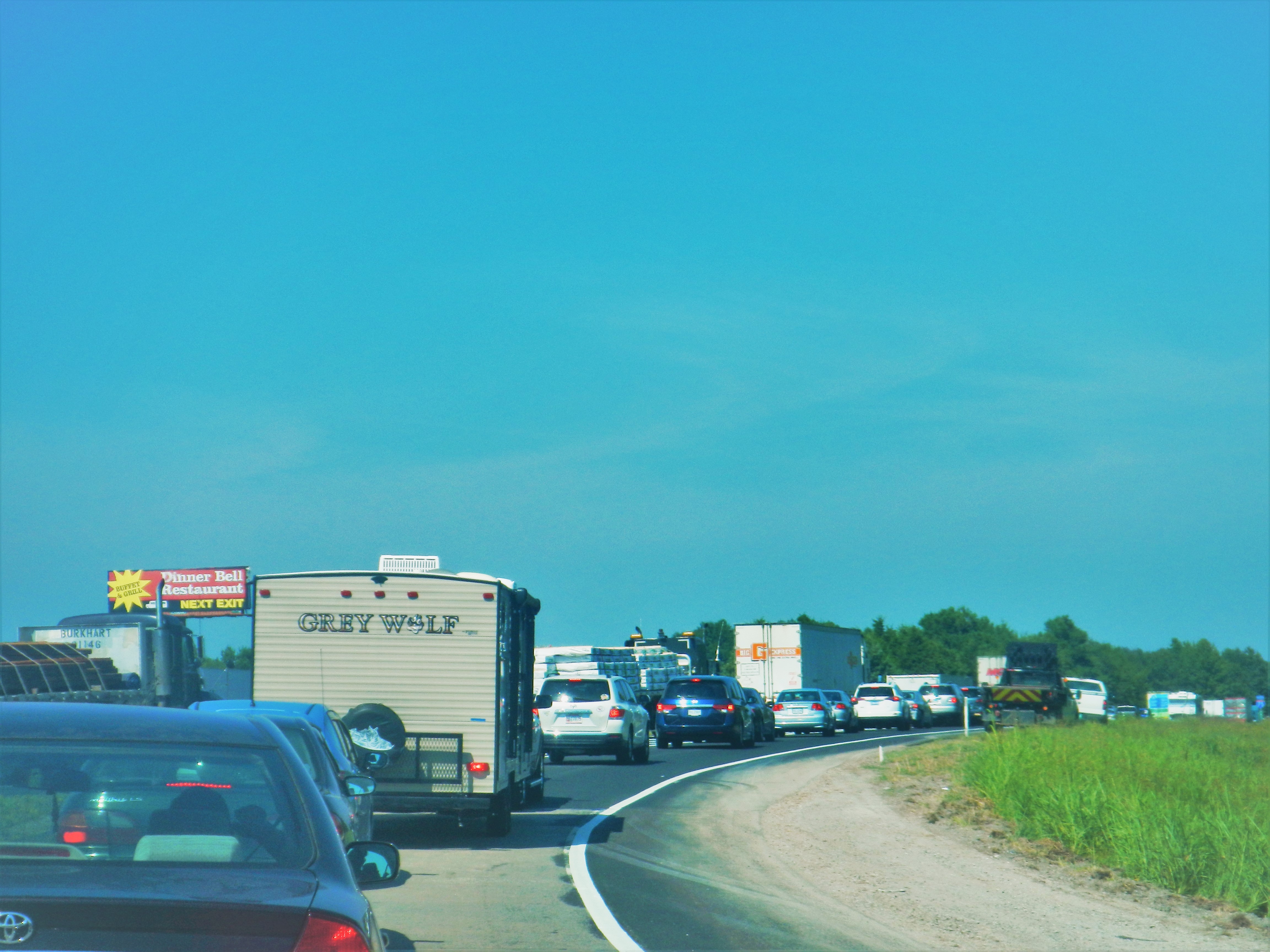
In Tennessee, the Knoxville News Sentinel described the traffic problems created by the eclipse as the worst ever seen in that part of the state. One backup along Interstate 75 reached 34 mi in length, between Niota and the Interstate 40 interchange at Farragut. A spokesman for the state's Department of Transportation allowed that the traffic jams were the worst he had seen in six and a half years on the job, noting that accidents had aggravated the already heavy traffic flows, attributed the I-75 congestion to Knoxville-area residents heading for the totality path at Sweetwater and returning during what was the city's normal afternoon rush hour.
Before the eclipse, state officials had described their traffic expectations as equivalent to that generated by the Bonnaroo Music Festival, the twice-a-season NASCAR Cup Series races at Bristol or the formerly-held Boomsday fireworks festival. "Maybe they should have considered a tsunami of traffic combining all three of those heavily attended events", the News Sentinel commented. The Tennessee Highway Patrol made sure that "[e]very trooper not on sick leave or military leave or pre-approved leave [wa]s working" the day of the eclipse; the state DOT made sure its full complement of emergency-aid HELP trucks were available as well. Alert signs on the highways also warned motorists not to pull over onto the shoulders to watch the eclipse as it could increase the risk of dangerous accidents and block the path of emergency vehicles.
In North Carolina, the Department of Transportation added cameras, message boards and safety patrols in the counties where the total eclipse would take place, as well as stopping road work. The department warned that due to "unprecedented" traffic ordinary activities requiring driving might prove difficult, and advised people to act as if there were snow.
In Kentucky, particularly around the Hopkinsville area, which was dubbed "Eclipseville, USA", post-eclipse traffic caused extensive delays. The en masse departure of tourists via Interstate 69 as well as the Western Kentucky Parkway resulted in commute times double or even triple of normal. The Hopkinsville-to-Lexington commute under normal circumstances lasts three and a half hours.
Impact on solar power
An eclipse causes a reduction of solar power generation where the Moon shadow covers any solar panel, as do clouds.
The North American Electric Reliability Corporation predicted minor impacts, and attempted to measure the impact of the 2017 eclipse. In California, solar power was projected to decrease by 4–6,000 megawatts at 70 MW/minute, and then ramp up by 90 MW/minute as the shadow passes. CAISO's typical ramp rate is 29 megawatts per minute. Around 4 GW mainly in North Carolina and Georgia were expected to be 90 percent obscured.
After the 2017 eclipse, grid operators in California reported having lost 3,000–3,500 megawatts of utility-scale solar power, which was made up for by hydropower and gas reliably and as expected, mimicking the usual duck curve. Energy demand management was also used to mitigate the solar drop, and NEST customers reduced their demand by 700 MW.
NV Energy prepared for the solar eclipse months in advance and collaborated with 17 western states. When the eclipse began covering California with partial darkness, which reduced its usual amount of solar-generated electricity, NV Energy sent power there. Likewise, when Nevada received less sunlight, other west coast states supplied electricity to it. During the solar eclipse, the state of Nevada lost about 450 megawatts of electricity, the amount used by about a quarter million typical residences.
Commemorative stamp
Main article: 2017 Total Solar Eclipse stamp
On June 20, 2017, the USPS released the first application of thermochromic ink to postage stamps in its Total Eclipse of the Sun Forever stamp to commemorate the eclipse. When pressed with a finger, body heat turns the dark image into an image of the full moon. The stamp was released prior to August 21, so uses an image from the eclipse of March 29, 2006 seen in Jalu, Libya.
Videos
File:Greenville SC 2017 eclipse totality time-lapse.webm|Time-lapse footage of Falls Park on the Reedy in Greenville, South Carolina File:Shadow bands from solar eclipse 2017-08-21 gamma 0.2.webm|Shadow bands on the ground in Simpsonville, South Carolina File:Aug21-2017SolarEclipse.gif|Animation of shadow movement from space File:2017 Total Solar Eclipse in the U.S.webm|Illustration of umbra (black oval), penumbra (concentric shaded ovals), and path of totality (red) File:Visualizing the 2017 All-American Eclipse.webm|Illustration featuring several visualizations of the event File:Eclipse_August_21_2017_(short_time-lapse_video).webm|Short time-lapse of umbra as it moves across the clouds File:Total Solar Eclipse over Newberry, South Carolina.webm|Video of the moment totality occurred in Newberry, South Carolina
Gallery
Totality
File:SolarEclipseCorvallis Aug 21 2017.jpg|Sequence starting at 9:06am, totality at 10:19am, and ending at 10:21am PDT, as seen from Corvallis, Oregon File:Solar eclipse 2017, Glenrock, Wyoming 11.jpg|Totality and prominences as seen from Glenrock, Wyoming File:Total solar eclipse as seen from Columbia, MO.png|Totality as seen from Columbia, Missouri File:Uplne zatmenie slnka 2017 Sweetwater Tennessee.jpg|Totality as seen from Sweetwater, Tennessee File:Solar Eclipse 21082017 01 Kuebi.JPG|Totality as seen from Saint Paul, Clarendon County, South Carolina File:Total Solar Eclipse over Newberry, South Carolina.jpg|Totality as seen from Newberry, South Carolina File:Corona20170821.jpg|Totality as seen from Grand Teton National Park, Wyoming File:Totaleclipse2017.tif|Totality with stars as seen from Makanda, Illinois
Transition
File:Solar eclipse 2017, Glenrock, Wyoming 09.jpg|Beginning of Diamond ring as seen from Glenrock, Wyoming File:JayEmSolarEclipse.jpg|Diamond ring as seen from Jay Em, Wyoming File:August 21 2017 solar eclipse baily beads TLR2.jpg|Baily's beads before totality from far western Nebraska File:SolarEclipseDiamondRing.jpg|Diamond ring as seen from Corvallis, Oregon File:Solar Eclipse 21082017 02 Kuebi.JPG|Diamond ring as seen from Saint Paul, South Carolina File:Diamond Ring over Newberry, South Carolina.jpg|Diamond ring as seen from Newberry, South Carolina File:Solar eclipse viewed from Cullowhee, NC on August 21, 2017.jpg|Diamond ring (with large flare) as seen from Cullowhee, NC File:BaileyBeads20170821.jpg|Diamond ring as seen from Grand Teton National Park, Wyoming
Partial
File:Partial Eclipse Near Seattle- 1.jpg|Seattle, Washington File:2017 Total Solar Eclipse - ISS Transit (NHQ201708210304).jpg|North Cascades National Park, Washington. The ISS is visible as it transits the Sun during the eclipse (4 frame composite image). File:SanFrancisco2017eclipse.jpg|San Francisco, California File:Solar eclipse as seen from Mira Mesa, San Diego, California.jpg|Mira Mesa in San Diego, California File:Solar eclipse of August 21, 2017 Nebraska TLR1.jpg|Far western Nebraska File:Eclipse 21-8-2017 (C1 with Sun Spots) 1.jpg|White House, Tennessee File:The Maine Partial Eclipse A Few Minutes Before The Maximum Coverage.jpg|Maine at 2:41 p.m. EDT before maximum 68% coverage at 2:45 p.m. File:Solar Eclipse August 21 2017 from Brooklyn NY.jpg|Brooklyn, New York File:8-21-17 Solar Eclipse from Maryland, USA.jpg|Ellicott City, Maryland shortly before maximum eclipse (~80%) File:2017-08-21 solar eclipse virginia Beach.jpg|Virginia Beach, Virginia File:Solar eclipse partial 2017-08-21 fl=1600mm f8 iso200 1-320th.sec ND5 filter.jpg|Simpsonville, South Carolina File:Partial solar eclipse (2017).jpg|Paoli, Pennsylvania File:Partial Solar Eclipse over Newberry, South Carolina.jpg|Newberry, South Carolina
Images produced by natural pinholes
(Images of the eclipse created by natural pinholes formed by tree leaves) The_dappled_sunlight_under_the_trees_was_very_strange_before_and_after_totality._(36330876490).jpg|North Cascade mountains (British Columbia and Washington) Solar Eclipse August 21 2017.jpg|East Wenatchee, Washington 8-21-17 Eclipse tree shadows in Pittsburgh, Pennsylvania.jpg|Moon, Pennsylvania Solar eclipse crescent projections on Cowrock Mountain, GA - August 21, 2017.jpg|Cowrock Mountain, Georgia
Views outside of the US
File:Eclipse 21-08-2017 Puebla.jpg|Photograph of the eclipse projected with binoculars in Puebla, Mexico File:Eclipse solar 21 de agosto 2017 desde Puebla, México.jpg|Photograph of the eclipse projected with binoculars in Puebla, Mexico File:Eclipse_Parcial_de_Sol,_del_21_de_Agosto_2017_01.jpg|Tuxtla Gutierrez (Chiapas), Mexico at 12:36 GMT-6 File:Eclipse solar del 21 de agosto de 2017 desde Chihuahua, México.jpg|Chihuahua, Mexico at 11:40 a.m. File:2017ko abuztuaren 21eko eklipsea Zarauztik.jpg|Sunset from Zarautz, Basque Country, Spain File:Eclipse-20170821201032-partial-Coimbra.jpg|Sunset, viewed from Coimbra, Portugal
Eclipse details
Shown below are two tables displaying details about this particular solar eclipse. The first table outlines times at which the Moon's penumbra or umbra attains the specific parameter, and the second table describes various other parameters pertaining to this eclipse.
| Event | Time (UTC) |
|---|---|
| First Penumbral External Contact | 2017 August 21 at 15:47:59.9 UTC |
| First Umbral External Contact | 2017 August 21 at 16:49:44.5 UTC |
| First Central Line | 2017 August 21 at 16:50:14.5 UTC |
| First Umbral Internal Contact | 2017 August 21 at 16:50:44.6 UTC |
| First Penumbral Internal Contact | 2017 August 21 at 18:13:05.6 UTC |
| Equatorial Conjunction | 2017 August 21 at 18:14:22.8 UTC |
| Greatest Duration | 2017 August 21 at 18:22:57.5 UTC |
| Greatest Eclipse | 2017 August 21 at 18:26:40.3 UTC |
| Ecliptic Conjunction | 2017 August 21 at 18:31:19.6 UTC |
| Last Penumbral Internal Contact | 2017 August 21 at 18:40:33.4 UTC |
| Last Umbral Internal Contact | 2017 August 21 at 20:02:48.0 UTC |
| Last Central Line | 2017 August 21 at 20:03:15.4 UTC |
| Last Umbral External Contact | 2017 August 21 at 20:03:42.8 UTC |
| Last Penumbral External Contact | 2017 August 21 at 21:05:31.9 UTC |
| Parameter | Value |
|---|---|
| Eclipse Magnitude | 1.03059 |
| Eclipse Obscuration | 1.06211 |
| Gamma | 0.43671 |
| Sun Right Ascension | 10h04m03.9s |
| Sun Declination | +11°51'43.0" |
| Sun Semi-Diameter | 15'48.7" |
| Sun Equatorial Horizontal Parallax | 08.7" |
| Moon Right Ascension | 10h04m30.6s |
| Moon Declination | +12°16'32.8" |
| Moon Semi-Diameter | 16'03.4" |
| Moon Equatorial Horizontal Parallax | 0°58'55.7" |
| ΔT | 68.8 s |
Eclipse season
This eclipse is part of an eclipse season, a period, roughly every six months, when eclipses occur. Only two (or occasionally three) eclipse seasons occur each year, and each season lasts about 35 days and repeats just short of six months (173 days) later; thus two full eclipse seasons always occur each year. Either two or three eclipses happen each eclipse season. In the sequence below, each eclipse is separated by a fortnight.
| August 7 | |||
|---|---|---|---|
| Descending node (full moon) | |||
| August 21 | |||
| Ascending node (new moon) | |||
| [[File:Lunar eclipse chart close-2017Aug07.png | 200px]] | [[File:SE2017Aug21T.png | 200px]] |
| Partial lunar eclipse | |||
| Lunar Saros 119 | Total solar eclipse | ||
| Solar Saros 145 |
References
References
- Steed, Edward. (September 4, 2017). "The Great American Eclipse of 2017". [[Science Channel]].
- Chan, Melissa. (July 25, 2017). "The 2017 Total Solar Eclipse: Everything You Need to Know".
- Wolfram, Stephen. (August 15, 2017). "When Exactly Will the Eclipse Happen? A Multimillenium Tale of Computation".
- ABC News. (August 22, 2017). "Total solar eclipse experience from coast to coast".
- Celestron. (September 26, 2017). "Eclipse Across America".
- "Moon Distances for London, United Kingdom, England". timeanddate.
- "Eclipse: Who? What? Where? When? and How?". [[NASA]].
- "Voyages of Discovery: 2017 Total Solar Eclipse". Astro Adventures.
- Malik, Tariq. (August 18, 2017). "Here's a Timeline of When the 2017 Solar Eclipse Begins and Ends". [[space.com]].
- (August 21, 2017). "The Solar Eclipse: What to Expect". The New York Times.
- "2017 August 21 Total Solar Eclipse". USNO.
- Nicholls, Will. (August 3, 2017). "NASA to Chase Solar Eclipse with Jets for Clearest Ever Photos of Corona". PetaPixel.
- SmarterEveryDay. (August 22, 2017). "Space Station Transiting 2017 ECLIPSE, My Brain Stopped Working – Smarter Every Day 175".
- (August 21, 2017). "See 4 planets during the total eclipse - EarthSky.org".
- "The Great Baja Eclipse", ''[[Discover (magazine). Discover]]'' January 1991. p. 90.
- "Total and Annular Solar Eclipse Paths 1981–2000". NASA.
- "Total and Annular Solar Eclipse Paths 1961–1980". NASA.
- Espenak, Fred. "Total Solar Eclipse of 1970 Mar 07". NASA.
- "Thousands Go West for a Total Solar Eclipse Tomorrow; Data May Aid Energy Research Partial Eclipse for New York Best Types of Film Image of Sun on Screen", ''[[The New York Times]]'' February 25, 1979. p. 26.
- Browne, Malcolm W.. (February 27, 1979). "Total Eclipse of the Sun Darkens Skies in Northwest; Total Eclipse Casts Two Minutes of Darkness in West Temperature Falls Sharply Learned of Weather Peculiarities Data on Plasma Sought". The New York Times.
- "NASA – Total Solar Eclipse of 1257 June 13". NASA.
- (June 28, 2016). "X Marks the Spot: Two Total Solar Eclipses in Seven Years".
- Gordon Telepun. (7 April 2020). "2024 total solar eclipse: The novelty of "the cross"". [[AccuWeather]].
- "Total Solar Eclipse 2017 – Path Overlap with the 2024 Eclipse".
- Jubier, Xavier M.. (2011). "Google Earth Gallery for Solar and Lunar Eclipses".
- "August 21, 2017 Total Solar Eclipse". timeanddate.
- (April 20, 2017). "OSU150 Space Grant Festival: A Total Eclipse Experience". Oregon State University.
- (July 7, 2017). "Where to watch the total solar eclipse in Eastern Oregon".
- "EclipseFest". Salem-Keizer Volcanoes.
- Flaccus, Gillian. (June 23, 2017). "Eclipse chasers blaze trail to Oregon for view of a lifetime". The Seattle Times.
- Marrow, Hunter. (August 22, 2017). "'Tremendous event': Man describes viewing eclipse as 'caveman like'". The Argus Observer.
- (November 11, 2016). "Oregon Scores International Collaborative Festival With 'Oregon Eclipse'". Dance Music NW.
- "Oregon Eclipse — A Total Solar Eclipse Gathering 17–23 August, 2017".
- Colin Day. (September 6, 2017). "Oregon Eclipse 2017 – Symbiosis".
- "Saturday Oregon solar eclipse updates on traffic, crowds and events". Statesman Journal.
- "OMSI Total Solar Eclipse Viewing in Salem, Oregon — August 21, 2017". NASA.
- (June 2025). "Event Details – Craters Of The Moon National Monument & Preserve". U.S. National Park Service.
- (October 24, 2016). "Events Around Eastern Idaho". Eastern Idaho Eclipse.
- (March 22, 2017). "Idaho Falls Eclipse". Big Kid Science.
- "Total Solar Eclipse 2017". [[Brigham Young University Idaho]].
- "Eclipse Festival and Map".
- (August 22, 2017). "Space Station Transiting 2017 ECLIPSE, My Brain Stopped Working - Smarter Every Day 175".
- "2017Astrocon, Casper, Wyoming". [[Astronomical League]].
- "Wyoming Eclipse Festival 2017".
- "2017 Great American Eclipse, Fort Laramie". [[National Park Service]].
- (August 7, 2017). "zaćmienie Słońca i ciemne niebo".
- "Eclipse Events".
- [https://www.youtube.com/watch?v=HAlKNPur4UA Crowds at Carhenge in Nebraska eager to view solar eclipse] (ABC News, August 21, 2017)
- "Eclipse Lunch on the Lawn". Nemaha County Hospital.
- "Total Solar Eclipse Weekend of Events at Homestead National Monument of America – Homestead National Monument of America". U.S. National Park Service.
- [https://www.youtube.com/watch?v=VAEUYM4Een4 YouTube: Eclipse 2017: One Nation Under the Sun] Published August 27, 2017, (National Monument displayed at 0:58, 4:42 4:53, 6:31; Lincoln baseball game at 0:44, 1:36, 5:47).
- "Gem of the Prairie Eclipse Event". [[Stuhr Museum]].
- (August 21, 2017). "Eight-run Inning Carries Saltdogs Over Railcats in Special Solar Eclipse Game". Lincoln Saltdogs.
- "The Great American Eclipse Viewing at Benedictine College". Benedictine College.
- "Show me totality COMO".
- (August 19, 2017). "MU hosts weekend full of events leading to Mondays solar eclipse".
- "Eclipse 2017".
- "Total solar eclipse ride". KC-PPC.
- "Total Solar Eclipse/150 Years Festival".
- "Eclipsing Park University". Park University.
- "Darkening of the Sun – Eclipse 2017 – St. Clair MO".
- "St. Joseph Eclipse". Front Page Science.
- Armstrong, Bethany. (August 1, 2017). "The 4321 Event w/ Tipper & Friends Set to Amaze during 2017's Total Solar Eclipse".
- (May 5, 2016). "Southern Illinois: eclipse crossroads of America". [[Southern Illinois University Carbondale]].
- Johnston, Bob. (August 7, 2017). "Amtrak announces 'Eclipse Express' special to southern Illinois". Trains.
- "Southern Illinois University Carbondale (NASA EDGE)". NASA.
- Carley, Sean. (March 28, 2017). "Remainder of "Moonstock" eclipse festival lineup announced". [[Daily Egyptian]].
- "WKU Eclipse Events". Western Kentucky University.
- Stephen, Eric. (August 21, 2017). "Solar eclipse 2017: The 5 minor league games being played during Aug. 21 event". SBNation.
- "A Monumental Solar Eclipse Festival: August 18 – August 21".
- "Total Eclipse of the Park". Athens Area Chamber of Commerce.
- "Eclipse: Events". [[Austin Peay State University]].
- "Blackout 2017". Main Street McMinville.
- "Eclipse-Themed Programs & Events".
- "Nashville's Italian Lights festival is official NASA location for solar eclipse". WKRN News2.
- "Solar Eclipse 2017 Viewing Event, Free Music City Eclipse Party".
- "The 2017 Total Solar Eclipse Will Pass Through the Great Smoky Mountains of North Carolina". Bryson City North Carolina.
- Reinhart, Vince. (August 21, 2017). "Eclipse – Cullowhee North Carolina".
- (August 21, 2017}}{{Dead link). "Eclipse leaves thousands breathless at UGA's Sanford Stadium". WXIA.
- "Get Off the Grid Fest".
- [http://onlineathens.com/local-news/2017-08-21/eclipse-awes-those-gathered-georgia-guidestones Eclipse awes those gathered at Georgia Guidestones], by Wayne Ford (Athens Banner-Herald, August 21, 2017)
- (June 21, 2017). "NASA to Broadcast Eclipse from .CofC".
- Melvin, Jim. (August 21, 2017). "Watch Live: When, where and how to watch the total solar eclipse at Clemson University". [[Clemson University]].
- "Solar Eclipse 2017 at the South Carolina State Museum". [[South Carolina State Museum]].
- "Eclipse at Furman". Furman University.
- "Total Eclipse Watch Party". City of Sumter.
- (August 20, 2017). "Eclipse viewing party at Canada Aviation and Space Museum {{!}} CTV News".
- (August 20, 2017). "Where to watch the eclipse in the Toronto area {{!}} Toronto Star".
- (August 19, 2017). "Bonnie Tyler Will Sing 'Total Eclipse of the Heart' During the Actual Total Solar Eclipse". Space.com.
- Melissa Mahtani. (August 21, 2017). "Bonnie Tyler sings 'Total Eclipse of the Heart' live on CNN". CNN.
- Chabeli Herrera. (August 22, 2017). "Here's Bonnie Tyler singing 'Total Eclipse of the Heart' during the eclipse". Miami Herald.
- Littmann, Espenak, Willcox: Totality: Eclipses of the Sun. pp 253ff
- "Total Eclipse of the Sun".
- [https://www.timeanddate.com/eclipse/map/2017-august-21 Map of Total Solar Eclipse on August 21, 2017 — timeanddate.com]
- "Local Circumstances of the partial eclipse in Anadyr".
- Rubin, Molly. (August 15, 2017). "How to watch the Great American Eclipse, no matter where you are in the world". Quartz.
- Katz, A.J.. (August 17, 2017). "Here Are The TV Network Plans For Covering the Total Solar Eclipse". Adweek.
- Nyren, Erin. (August 18, 2017). "Solar Eclipse Coverage: TV Goes Totally Looney for Lunar Moment". Variety.
- Potenza, Alessandra. (August 15, 2017). "Why NASA is sending bacteria into the sky on balloons during the eclipse".
- MOELLER, KATY. (August 24, 2017). "Eclipse observation balloon went missing. Did it land in Treasure Valley?".
- (August 21, 2017). "The Eclipse 2017 Umbra Viewed from Space".
- Wong, Herman. "Trump celebrates solar eclipse by looking up without special viewing glasses". The Washington Post.
- Parker, Ryan. (August 21, 2017). "Trump Looking at Eclipse Without Glasses Becomes Instant Meme". [[The Hollywood Reporter]].
- Nevins, Jake. (August 22, 2017). "Late-night hosts on the solar eclipse: 'That was Melania's chance to escape'". [[The Guardian]].
- O'Connell, Oliver. (April 8, 2024). "Trump trolled ahead of eclipse for staring directly at the sun". [[The Independent]].
- "Joey Bada$$ cancels Toronto concert after claiming he viewed solar eclipse without protection - Toronto {{!}} Globalnews.ca".
- Ghose, Tia. (August 22, 2017). "The Solar Eclipse Had a Spooky Effect on Nature". Live Science.
- Gaudette, Emily. (August 23, 2017). "Pornhub Was Shocked by How Total Solar Eclipse Affected Their Viewers: The great cosmic ballet briefly distracted people from porn.".
- (August 26, 2017). "The solar eclipse was viewed over 90 million times on NASA website". The Economic Times.
- Pittman, Travis. (August 18, 2017). "Here's How Fast Your Retina Could Burn Looking at Eclipse Unprotected". [[KUSA (TV).
- "Eclipse Glasses Safety".
- (February 23, 2017). "How to Tell If Your Eclipse Glasses or Handheld Solar Viewers Are Safe". American Astronomical Society.
- Wolfson, Elijah. (July 27, 2017). "Solar-eclipse fever means counterfeit glasses are flooding Amazon's market". Quartz.
- Czebiniak, Madasyn. (August 23, 2017). "Springdale library 'sickened' by discovery of counterfeit eclipse glasses". Trib Live.
- Elliott, Matt. (August 19, 2017). "How to tell if your solar eclipse glasses are safe or fake". CNET.
- (August 15, 2017). "Amazon offers refunds to customers who bought fake eclipse glasses". CBC News.
- (September 1, 2017). "Rental Camera Gear Destroyed by the Solar Eclipse of 2017". LensRentals Blog.
- Mariano, Nick. (June 17, 2016). "Local tourism, businesses make plans for solar eclipse in 2017".
- Serven, Ruth. (July 13, 2017). "Total solar eclipse offers small towns a tourism boom—if they can get ready".
- (August 19, 2017). "Wyoming prepares for total solar eclipse in 2017".
- Richy, Brad. (July 29, 2017). "Letter to Eclipse Communities". Idaho Office of Emergency Management.
- Moeller, Katy. (August 17, 2017). "Oregon eclipse traffic is already backing up. Idaho has an app for that.".
- (July 27, 2017). "Oregon governor authorizes National Guard for solar eclipse". KBTX-TV.
- Lynne, Terry. (August 10, 2017). "Eclipse 2017: Hospitals stock up on blood, rattlesnake bite antidote".
- Hale, Jamie. (April 3, 2017). "Oregon hotels unapologetic, silent about widespread eclipse cancellations". [[OregonLive.com]].
- Guevarra, Ericka. (July 28, 2017). "Customers Get Payments From Oregon Hotels That Canceled, Raised Prices For Eclipse". [[Oregon Public Broadcasting]].
- Bach, Jonathan. (July 31, 2017). "Grand Hotel to pay customers for eclipse reservation problems". [[Statesman Journal]].
- Rao, Joe. (August 19, 2017). "Get Ready for Major Traffic Jams During the 2017 Solar Eclipse". Space.com.
- Solcyré Burga. (3 April 2024). "'20 or 30 Super Bowls.' Drivers and Officials Brace for Massive Eclipse Traffic Jams". [[Time (magazine).
- (14 April 2024). "Total Solar Eclipse of April 8, 2024: A Retrospective on Travel and Attendance". Eclipse Optics.
- Mitchell, Russ. (August 20, 2017). "Solar eclipse gridlock: It was so busy in Madras, Ore., they called in the National Guard". Los Angeles Times.
- Harbager, Molly. (August 21, 2017). "Eclipse jams traffic on runways, not just roads, with hundreds of planes in Madras waiting". The Oregonian.
- (August 17, 2017). "I-15 projects to shut down for eclipse". [[KIFI-TV]].
- Mims, Bob. (August 21, 2017). "Traffic into Utah jammed as eclipse fans head home on Interstate 15". [[Salt Lake Tribune]].
- (August 21, 2017). "Solar Eclipse Traffic: Interstates Busy as Final Travelers Hit the Road". The Weather Channel.
- Sunderland, Nate. (August 21, 2017). "Bumper-to-bumper traffic on I-15 as eclipse viewers leave Idaho". [[KSL-TV]].
- (August 18, 2017). "Solar Eclipse Traffic Counts". Idaho Transportation Department.
- (August 23, 2017). "Eclipse: Construction causes huge I-15 traffic jam; Montana official apologizes".
- (August 23, 2017). "More than a million people may have visited Wyoming for eclipse; one person came by sea plane".
- (August 20, 2017). "Traffic increases 18 percent over a five-year average on Saturday as Aug. 21 eclipse nears". Wyoming Department of Transportation.
- Rainey, Libby. (August 22, 2017). "Wyoming solar eclipse traffic jam was one for the record books".
- (August 23, 2017). "Highway patrol releases new details about Colorado motorcyclist killed in Eclipse traffic".
- (August 23, 2017). "Eclipse keeps highway patrol busy, but local authorities respond to fewer incidents than expected".
- Jacobs, Don. (August 21, 2017). "Worst traffic snarls ever seen in East Tennessee.". [[Knoxville News Sentinel]].
- (August 21, 2017). "Western NC ready for eclipse, but roads clogged". [[Winston-Salem Journal]].
- Williams, Chris. (July 22, 2017). "Welcome to 'Eclipseville,' Hopkinsville, Ky, USA". WHAS.
- Stunson, Mike. (August 22, 2017). "The rare eclipse was memorable. The ride home was something they want to forget.". Lexington Herald-Leader.
- Helmer, Katrina. (August 21, 2017). "As solar eclipse ends, traffic stalls heading out of Hopkinsville". WDRB.
- (April 2017). "A Wide-Area Perspective on the August 21, 2017 Total Solar Eclipse". [[North American Electric Reliability Corporation]].
- (December 2016). "2016 Long-Term Reliability Assessment". [[North American Electric Reliability Corporation]].
- (August 7, 2017). "Solar eclipse on August 21 will affect photovoltaic generators across the country – Today in Energy". U.S. Energy Information Administration (EIA).
- Pyper, Julia. (May 11, 2017). "This Summer's Eclipse Will Put California's Solar-Powered Grid to the Test". Greentech Media.
- Grandoni, Dino. (August 21, 2017). "California is the state that most depends on the sun for energy. It survived the eclipse without losing any.". The Washington Post.
- Baker, David R.. (August 21, 2017). "California power grid survives solar eclipse unscathed". SFGate.
- Pyper, Julia. (August 21, 2017). "Looking Beyond the Eclipse: How the Historic Event Tested Customer Engagement on the Electric Grid".
- (July 19, 2018). "DR Dialogue: Nest's Solar Eclipse Rush Hour Rewards Program".
- (April 27, 2017). "Total Eclipse of the Sun to be commemorated on a Forever Stamp".
- "Total Eclipse of the Sun".
- "Total Solar Eclipse of 2017 Aug 21". EclipseWise.com.

This article was imported from Wikipedia and is available under the Creative Commons Attribution-ShareAlike 4.0 License. Content has been adapted to SurfDoc format. Original contributors can be found on the article history page.
Ask Mako anything about Solar eclipse of August 21, 2017 — get instant answers, deeper analysis, and related topics.
Research with MakoFree with your Surf account
Create a free account to save articles, ask Mako questions, and organize your research.
Sign up freeThis content may have been generated or modified by AI. CloudSurf Software LLC is not responsible for the accuracy, completeness, or reliability of AI-generated content. Always verify important information from primary sources.
Report