From Surf Wiki (app.surf) — the open knowledge base
Solar Dynamics Observatory
NASA mission, launched in 2010 to GSO
NASA mission, launched in 2010 to GSO
| Field | Value | ||||||
|---|---|---|---|---|---|---|---|
| name | Solar Dynamics Observatory | ||||||
| names_list | SDO | ||||||
| image | Solar Dynamics Observatory 1.jpg | ||||||
| image_caption | Solar Dynamics Observatory satellite | ||||||
| image_size | 300px | ||||||
| mission_type | Solar research | ||||||
| operator | NASA GSFC{{cite web | author=Dean Pesnell | author2=Kevin Addison | title=Solar Dynamics Observatory: SDO Specifications | |||
| url | http://sdo.gsfc.nasa.gov/mission/project/specs.php | publisher=NASA | date=5 February 2010 | access-date=2010-02-13 | url-status=dead | archive-url=https://web.archive.org/web/20100130050903/http://sdo.gsfc.nasa.gov/mission/project/specs.php | archive-date=30 January 2010}} |
| COSPAR_ID | 2010-005A | ||||||
| SATCAT | 36395 | ||||||
| website | http://sdo.gsfc.nasa.gov | ||||||
| mission_duration | 5 years (planned) | ||||||
| (elapsed) | |||||||
| spacecraft_type | Solar Dynamics Observatory | ||||||
| manufacturer | Goddard Space Flight Center | ||||||
| dry_mass | 1700 kg | ||||||
| launch_mass | 3100 kg | ||||||
| payload_mass | 290 kg | ||||||
| launch_date | 11 February 2010, 15:23:00 UTC | ||||||
| launch_rocket | Atlas V 401 | ||||||
| launch_site | Cape Canaveral, SLC-41 | ||||||
| launch_contractor | United Launch Alliance | ||||||
| orbit_reference | Geocentric orbit | ||||||
| orbit_regime | Geosynchronous orbit | ||||||
| orbit_longitude | 102° West | ||||||
| apsis | gee | ||||||
| insignia | Solar Dynamics Observatory insignia.png | ||||||
| insignia_caption | Solar Dynamics Observatory patch | ||||||
| insignia_size | 220px | ||||||
| programme | Large Strategic Science Missions | ||||||
| Heliophysics Division | |||||||
| next_mission | Van Allen Probes | ||||||
| programme2 | Living With a Star program |
(elapsed)
Heliophysics Division
The Solar Dynamics Observatory (SDO) is a NASA mission which has been observing the Sun since 2010. Launched on 11 February 2010, the observatory is part of the Living With a Star (LWS) program.
The goal of the LWS program is to develop the scientific understanding necessary to effectively address those aspects of the connected Sun–Earth system directly affecting life on Earth and its society. The goal of the SDO is to understand the influence of the Sun on the Earth and near-Earth space by studying the solar atmosphere on small scales of space and time and in many wavelengths simultaneously. SDO has been investigating how the Sun's magnetic field is generated and structured, how this stored magnetic energy is converted and released into the heliosphere and geospace in the form of solar wind, energetic particles, and variations in the solar irradiance.{{cite web|author=Dean Pesnell|author2=Kevin Addison|title=Solar Dynamics Observatory: About The SDO Mission
General
The SDO spacecraft was developed at NASA's Goddard Space Flight Center in Greenbelt, Maryland, and launched on 11 February 2010, from Cape Canaveral Air Force Station (CCAFS). The primary mission lasted five years and three months, with expendables expected to last at least ten years.
SDO is a three-axis stabilized spacecraft, with two solar arrays, and two high-gain antennas, in an inclined geosynchronous orbit around Earth.
The spacecraft includes three instruments:
- the Extreme Ultraviolet Variability Experiment (EVE) built in partnership with the University of Colorado Boulder's Laboratory for Atmospheric and Space Physics (LASP),
- the Helioseismic and Magnetic Imager (HMI) built in partnership with Stanford University, and
- the Atmospheric Imaging Assembly (AIA) built in partnership with the Lockheed Martin Solar and Astrophysics Laboratory (LMSAL).
Data which are collected by the craft are made available as soon as possible after reception.
Extended mission
As of February 2020, SDO is expected to remain operational until 2030. In August 2025, Nasa and IBM unveiled Surya Heliophysics Foundational Model, an artificial intelligence model trained on 9 years of observations from SDO. The model can be used to provide early warnings to satellite operators and helps scientists predict how the Sun’s ultraviolet output affects Earth’s upper atmosphere.
Instruments
Helioseismic and Magnetic Imager (HMI)

The Helioseismic and Magnetic Imager (HMI), led from Stanford University in Stanford, California, studies solar variability and characterizes the Sun's interior and the various components of magnetic activity. HMI takes high-resolution measurements of the longitudinal and vector magnetic field by viewing the entirety of the Sun's disk, with emphasis on various concentrations of metals in the Sun; specifically it passes the light (the variety of usable frequencies of which are centered on the solar spectrum's 617.3-nm Fraunhofer line) through five filter instruments including a Lyot filter and two Michelson interferometers to rapidly and frequently create Doppler images and magnetograms. The full-disk focus and advanced magnetometers improve on the capabilities of SOHO's MDI instrument which could only focus within the line of sight with limited magnetic data.{{cite web|author=Dean Pesnell|author2=Kevin Addison|title=Solar Dynamics Observatory: SDO Instruments
HMI produces data to determine the interior sources and mechanisms of solar variability and how the physical processes inside the Sun are related to surface magnetic field and activity. It also produces data to enable estimates of the coronal magnetic field for studies of variability in the extended solar atmosphere. HMI observations will enable establishing the relationships between the internal dynamics and magnetic activity in order to understand solar variability and its effects.
Extreme Ultraviolet Variability Experiment (EVE)
The Extreme Ultraviolet Variability Experiment (EVE) measures the Sun's extreme ultraviolet irradiance with improved spectral resolution, temporal cadence, accuracy, and precision over preceding measurements made by TIMED SEE, SOHO, and SORCE XPS. Some key requirements for EVE are to measure the solar EUV irradiance spectrum with 0.1 nm spectral resolution and with 20 sec cadence. These drive the EVE design to include grating spectrographs with array detectors so that all EUV wavelengths can be measured simultaneously. The instrument incorporates physics-based models in order to further scientific understanding of the relationship between solar EUV variations and magnetic variation changes in the Sun.
The Sun's output of energetic extreme ultraviolet photons is primarily what heats the Earth's upper atmosphere and creates the ionosphere. Solar EUV radiation output undergoes constant changes, both moment to moment and over the Sun's 11-year solar cycle, and these changes are important to understand because they have a significant impact on atmospheric heating, satellite drag, and communications system degradation, including disruption of the Global Positioning System.
The EVE instrument package was built by the University of Colorado Boulder's Laboratory for Atmospheric and Space Physics (LASP), with Dr. Tom Woods as principal investigator, The instrument provides improvements of up to 70% in spectral resolution measurements in the wavelengths below 30 nm, and a 30% improvement in time cadence by taking measurements every 10 seconds over a 100% duty cycle.
Atmospheric Imaging Assembly (AIA)
The Atmospheric Imaging Assembly (AIA), led from the Lockheed Martin Solar and Astrophysics Laboratory (LMSAL), provides continuous full-disk observations of the solar chromosphere and corona in seven extreme ultraviolet (EUV) channels, spanning a temperature range from approximately 20,000 Kelvin to in excess of 20 million Kelvin. The 12-second cadence of the image stream with 4096 by 4096 pixel images at 0.6 arcsec/pixel provides unprecedented views of the various phenomena that occur within the evolving solar outer atmosphere.
The AIA science investigation is led by LMSAL, which also operates the instrument and – jointly with Stanford University – runs the Joint Science Operations Center from which all of the data are served to the worldwide scientific community, as well as the general public. LMSAL designed the overall instrumentation and led its development and integration. The four telescopes providing the individual light feeds for the instrument were designed and built at the Smithsonian Astrophysical Observatory (SAO). Since beginning its operational phase on 1 May 2010, AIA has operated successfully with unprecedented EUV image quality.
| AIA wavelength channel | Source | Region of solar atmosphere | Characteristic |
|---|---|---|---|
| temperature | |||
| White light (450 nm) | continuum | Photosphere | 5000 K |
| 170 nm | continuum | Temperature minimum, photosphere | 5000 K |
| 160 nm | C IV + continuum | Transition region and upper photosphere | 100,000 and 5,000 K |
| 33.5 nm | Fe XVI | Active region corona | 2.5 million K |
| 30.4 nm | He II | Chromosphere and transition region | 50,000 K |
| 21.1 nm | Fe XIV | Active region corona | 2 million K |
| 19.3 nm | Fe XII, XXIV | Corona and hot flare plasma | 1.2 million and 20 million K |
| 17.1 nm | Fe IX | Quiet corona, upper transition region | 630,000 K |
| 13.1 nm | Fe VIII, XX, XXIII | Flaring regions | 400,000, 10 million, and 16 million K |
| 9.4 nm | Fe XVIII | Flaring regions | 6.3 million K |
Photographs of the Sun in these various regions of the spectrum can be seen at NASA's SDO Data website. Images and movies of the Sun seen on any day of the mission, including within the last half-hour, can be found at The Sun Today.
Communications
SDO down-links science data (K-band) from its two onboard high-gain antennas, and telemetry (S-band) from its two onboard omnidirectional antennas. The ground station consists of two dedicated (redundant) 18-meter radio antennas in White Sands Missile Range, New Mexico, constructed specifically for SDO. Mission controllers operate the spacecraft remotely from the Mission Operations Center at NASA Goddard Space Flight Center. The combined data rate is about 130 Mbit/s (150 Mbit/s with overhead, or 300 Msymbols/s with rate 1/2 convolutional encoding), and the craft generates approximately 1.5 Terabytes of data per day (equivalent to downloading around 500,000 songs).
Launch
NASA's Launch Services Program at Kennedy Space Center managed the payload integration and launch. The SDO launched from Cape Canaveral Space Launch Complex 41 (SLC-41), utilizing an Atlas V-401 rocket with a RD-180 powered Common Core Booster, which has been developed to meet the Evolved Expendable Launch Vehicle (EELV) program requirements.
Sun dog phenomenon: Moments after launch, SDO's Atlas V rocket penetrated a cirrus cloud which created visible shock waves in the sky and destroyed the alignment of ice crystals that were forming a sun dog visible to onlookers.
After launch, the spacecraft was deployed from the Atlas V into an orbit around the Earth with an initial perigee of about 2500 km.
Transfer to final Orbit
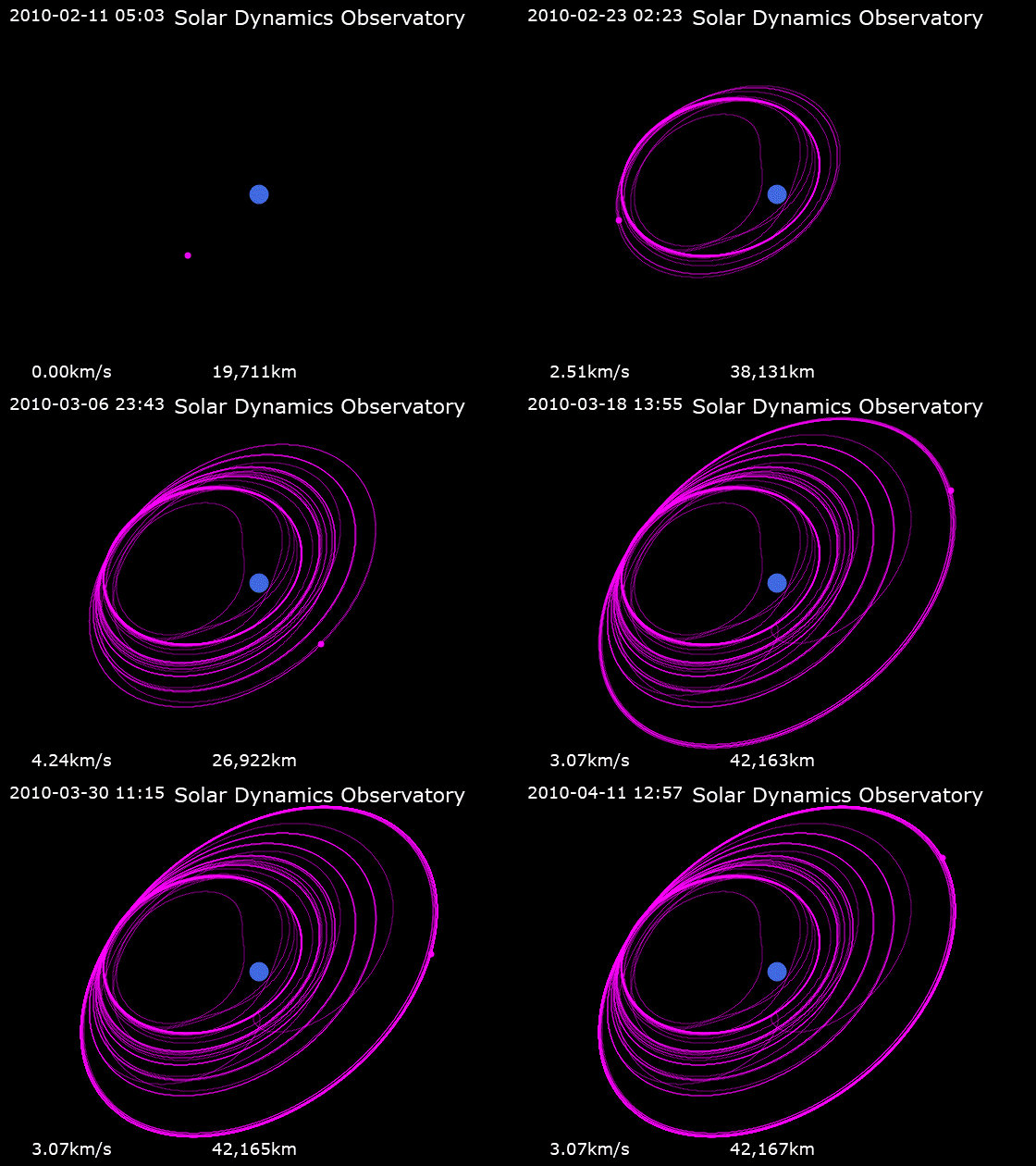
SDO then underwent a series of orbit-raising maneuvers over a few weeks which adjusted its orbit until the spacecraft reached its planned circular, geosynchronous orbit at an altitude of 35789 km, at 102° West longitude, inclined at 28.5°. This orbit was chosen to allow 24/7 communications to/from the fixed ground station, and to minimise solar eclipses to about an hour a day for only a few weeks a year.
Mission mascot - Camilla
Camilla Corona is a rubber chicken and is the mission mascot for SDO. It is part of the Education and public outreach team and assists with various functions to help educate the public, mainly children, about the SDO mission, facts about the Sun and Space weather. Camilla also assists in cross-informing the public about other NASA missions and space related projects. Camilla Corona SDO uses social media to interact with fans.
Image gallery
File:11742 SDO-Year 5 ProRes 1920x1080 2997.webm|SDO: Year 5 File:Camilla Corona SDO.jpg|Camilla Corona SDO File:Solar Dynamics Observatory.png|SDO 3-D schematic File:SDO spacecraft detailed.jpg|SDO Instruments File:SDO from above.jpg|SDO ready to be placed on Atlas rocket for launch. File:SDO Launch and Deployment.ogg|An animation showing the deployment of SDO. File:SDO first light.png|First light image from the SDO showing a prominence eruption. File:SDO's Ultra-high Definition View of 2012 Venus Transit (304 Angstrom Full Disc 02).jpg|An image of the 2012 transit of Venus taken by SDO. File:Solar Dynamics Observatory - Argo view.ogg|This movie opens with a full-disk view of the Sun in visible wavelengths. Then the filters are applied to small pie-shaped wedges of the Sun. File:NASA's Solar Dynamics Observatory- Year 7 Ultra HD (4k).webm|SDO has now captured nearly seven years worth of ultra-high resolution solar footage. This time lapse shows that full run from two of SDO's instruments.
Stamps

In 2021, the United States Postal Service released a series of forever stamps using images of the Sun taken by the Solar Dynamics Observatory.
References
References
- "SDO Our Eye on the Sun". NASA.
- (24 January 2015). "SDO 2010-005A". N2YO.
- Bourkland, Kristin L.. (25 July 2011). "Verification of the Solar Dynamics Observatory High Gain Antenna Pointing Algorithm Using Flight Data". American Institute of Aeronautics and Astronautics.
- Justin Ray. "Mission Status Center: Atlas V SDO". Spaceflight Now.
- (February 9, 2010). "Solar and Heliospheric Observatory Homepage". NASA /ESA.
- "Solar Dynamics Observatory — Exploring the Sun in High Definition". NASA.
- Johnson-Groh, Mara. (February 11, 2020). "Ten Things We've Learned About the Sun From NASA's SDO This Decade". NASA.
- (2025-08-20). "NASA, IBM’s ‘Hot’ New AI Model Unlocks Secrets of Sun - NASA Science".
- (March 4, 2011). "Helioseismic and Magnetic Imager for SDO".
- Solar Physics Research Group. "Helioseismic and Magnetic Imager Investigation". Stanford University.
- (May 27, 2010). "SDO – EVE-Extreme ultraviolet Variability Experiment". Laboratory for Atmospheric and Space Physics (LASP).
- Woods, Tom. (September 12, 2007). "Extreme Ultraviolet Variability Experiment (EVE) on the Solar Dynamics Observatory (SDO) {{!}} Analogy on How the SDO EVE Measurements of the Solar Extreme Ultraviolet Irradiance will be Greatly Improved". Laboratory for Atmospheric and Space Physics (LASP).
- (3 February 2010). "AIA – Atmospheric Imaging Assembly". Lockheed Martin.
- "Atmospheric Imaging Assembly – Descriptions and Manuals of Instruments, Data, and Software Packages". Lockheed Martin.
- "Solar Dynamics Observatory". NASA.
- (February 1, 2010). "Solar Dynamics Observatory — Our Eye on the Sky". NASA.
- Dunn, Marcia. "Stiff wind delays NASA launch of solar observatory".
- "AFD-070716-027". United States Airforce, 45th Weather Squadron.
- "A New Eye on the Sun". NASA.
- "SDO Launch Services Program".
- Phillips, Tony. (February 11, 2011). "SDO Sundog Mystery". NASA.
- Wilson, Jim. (February 11, 2010). "Solar Dynamics Observatory".
- "Solar Dynamics Observatory".
- (15 January 2021). "The U.S. Postal Service to Issue NASA Sun Science Forever Stamps". NASA.
This article was imported from Wikipedia and is available under the Creative Commons Attribution-ShareAlike 4.0 License. Content has been adapted to SurfDoc format. Original contributors can be found on the article history page.
Ask Mako anything about Solar Dynamics Observatory — get instant answers, deeper analysis, and related topics.
Research with MakoFree with your Surf account
Create a free account to save articles, ask Mako questions, and organize your research.
Sign up freeThis content may have been generated or modified by AI. CloudSurf Software LLC is not responsible for the accuracy, completeness, or reliability of AI-generated content. Always verify important information from primary sources.
Report