From Surf Wiki (app.surf) — the open knowledge base
Solar cycle 23
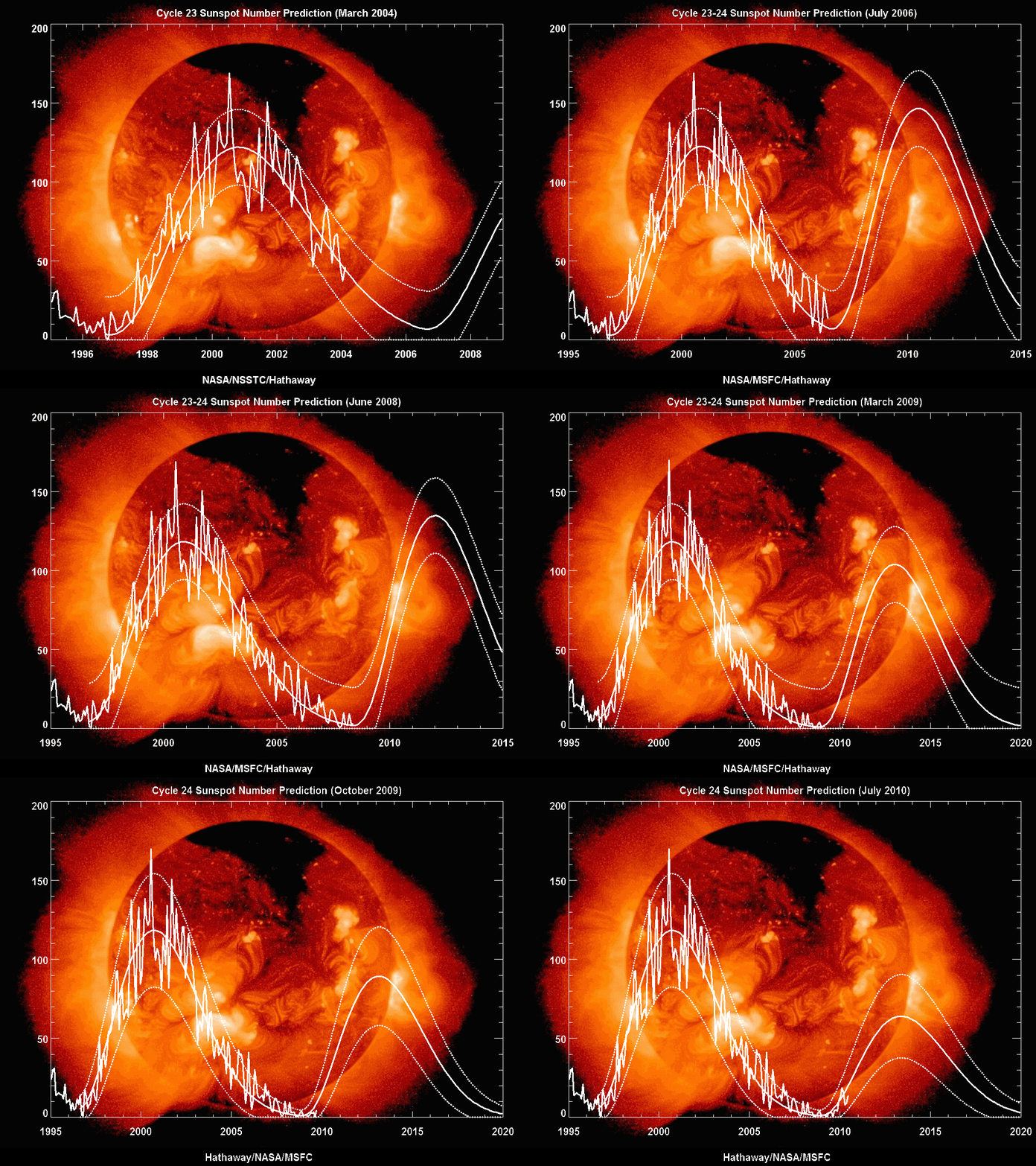
| Field | Value |
|---|---|
| image | Sun with sunspots.JPG |
| caption | The Sun, with some sunspots visible, during solar cycle 23 (2003) |
| cycle_num | 23 |
| start_date | August 1996 |
| end_date | December 2008 |
| duration | 12.3 |
| max_count | 180.3 |
| max_count_date | November 2001 |
| min_count | 11.2 |
| spotless_count | 817 |
| prev_name | Solar cycle 22 |
| next_name | Solar cycle 24 |
| prev_dates | 1986–1996 |
| next_dates | 2008–late 2019 |
Solar cycle 23 was the 23rd solar cycle since 1755, when extensive recording of solar sunspot activity began. The solar cycle lasted 12.6 years, beginning in August 1996 and ending in December 2008. The maximum smoothed sunspot number observed during the solar cycle was 180.3 (November 2001), and the starting minimum was 11.2. During the minimum transit from solar cycle 23 to 24, there were a total of 817 days with no sunspots. Compared to the last several solar cycles, it was fairly average in terms of activity.
History
Large solar flares and coronal mass ejections (CMEs) occurred on 7 September 2005 (X17), 15 April 2001 (X14.4) and 29 October 2003 (X10), with auroras visible in mid-latitudes.
2000
One of the first major aurora displays of solar cycle 23 occurred on 6 April 2000, with bright red auroras visible as far south as Florida and South Europe. On 14 July 2000, the CME hurled by a X5.7 solar flare provoked an extreme (G5 level) geomagnetic storm the next day. Known as the Bastille Day event, this storm caused damage to GPS systems and some power systems. Auroras were visible as far south as Texas.
2001
Another major aurora display was observed on 1 April 2001, due to a coronal mass ejection hitting the Earth's magnetosphere. Auroras were observed as far south as Mexico and South Europe. A large solar flare (the second-most powerful ever recorded) occurred on 2 April 2001, an X20-class, but the blast was directed away from Earth.
2003
In late October 2003, a series of large solar flares occurred. A X17.2-class flare ejected on 28 October 2003 produced auroras visible as far south as Florida and Texas. A G5 level geomagnetic storm blasted the Earth's magnetosphere over the next two days. A few days later, the largest solar flare ever measured with instruments occurred on 4 November; initially measured at X28, it was later upgraded to an X45-class. This flare was not Earth-oriented and thus only resulted in high-latitude auroras. The whole sequence of events that occurred from 28 October to 4 November is known as the Halloween Solar Storm.
References
References
- (2002). "Some Implications Using the Group Sunspot Number Reconstruction". Solar Physics.
- "The Sun: Did You Say the Sun Has Spots?". Space Today Online.
- (13 August 2010). "Sun's 'quiet period' explained". [[BBC News]].
- "SIDC Monthly Smoothed Sunspot Number".
- "Spotless Days".
- Dr. Tony Phillips. (11 July 2008). "What's Wrong with the Sun? (Nothing)". NASA.
- (25 April 2000). "Brushfires in the Sky". nasa.gov.
- "Minor Damage Reported from Geomagnetic Storm".
- (14 July 2000). "A Solar Radiation Storm". nasa.gov.
- "Hotshot". nasa.gov.
- "Hotshot". nasa.gov.
- (15 March 2004). "Biggest ever solar flare was even bigger than thought". spaceref.com.
This article was imported from Wikipedia and is available under the Creative Commons Attribution-ShareAlike 4.0 License. Content has been adapted to SurfDoc format. Original contributors can be found on the article history page.
Ask Mako anything about Solar cycle 23 — get instant answers, deeper analysis, and related topics.
Research with MakoFree with your Surf account
Create a free account to save articles, ask Mako questions, and organize your research.
Sign up freeThis content may have been generated or modified by AI. CloudSurf Software LLC is not responsible for the accuracy, completeness, or reliability of AI-generated content. Always verify important information from primary sources.
Report