From Surf Wiki (app.surf) — the open knowledge base
Sol Invictus
Late Roman solar deity

Late Roman solar deity
| Field | Value |
|---|---|
| type | Roman |
| name | Sol Invictus |
| deity_of | God of the Sun |
| image | Naiskos with relief of Sol (Lyon, Mus Gal-Rom 2001.0.326) 01.jpg |
| alt | |
| caption | A relief of Sol from Roman Lugdunum, 2nd–3rd century AD |
| other_names | Elagabalus |
| cult_center | Temple of the Sun |
| symbols | Sunburst, halo, radiate crown |
| abode | The sky |
| planet | Sun |
| day | Sunday |
| gender | Male |
| Greek_equivalent | Helios |
| equivalent1_type | Palmyran |
| equivalent1 | Utu |
| festivals | Dies Natalis Solis Invicti (25 December) |
the Roman sun god
Sol Invictus (, "Invincible Sun" or "Unconquered Sun") was the official sun god of the late Roman Empire and a later aspect of, or replacement for, the old Latin god Sol. The emperor Aurelian revived his cult in AD 274 and promoted Sol Invictus as the chief god of the empire. From Aurelian onward, Sol Invictus often appeared on imperial coinage, usually shown wearing a sun crown and driving a horse-drawn chariot through the sky. His prominence lasted until the emperor Constantine I legalized Christianity and restricted paganism. The last known inscription referring to Sol Invictus dates to AD 387, although there were enough devotees in the fifth century that the Christian theologian Augustine found it necessary to preach against them.
In recent years, the scholarly community has become divided on Sol between traditionalists and a growing group of revisionists. In the traditional view, Sol Invictus was the second of two different sun gods in Rome. The first of these, Sol Indiges, or Sol, was believed to be an early Roman god of minor importance whose cult had petered out by the first century AD. Sol Invictus, on the other hand, was believed to be a Syrian sun god whose cult was first promoted in Rome under Elagabalus, without success. Some fifty years later, in 274 AD, Aurelian established the cult of Sol Invictus as an official religion. There has never been consensus on which Syrian sun god he might have been: some scholars opted for the sky god of Emesa, Elagabal, while others preferred Malakbel of Palmyra. In the revisionist view, there was only one cult of Sol in Rome, continuous from the monarchy to the end of antiquity. There were at least three temples of Sol in Rome, all active during the Empire and all dating from the earlier Republic.
''Invictus'' as epithet
Invictus ("unconquered, invincible") was an epithet utilized for several Roman deities, including Jupiter, Mars, Hercules, Apollo, and Silvanus. It had been in use from the 3rd century BC. The Roman cult to Sol is continuous from the "earliest history" of the city until the institution of Christianity as the exclusive state religion. Scholars have sometimes regarded the traditional Sol Indiges and Sol Invictus as two separate deities, but the rejection of this view by S. E. Hijmans has found supporters.
An inscription of AD 102 records a restoration of a portico of Sol in what is now the Trastevere area of Rome by a certain Gaius Iulius Anicetus. While he may have had in mind an allusion to his own cognomen, which is the Latinized form of the Greek equivalent of Invictus, i.e. Ἀνίκητος (Anikētos, Romanized: Anicetus), the earliest extant dated inscription that uses Invictus as an epithet of Sol is from AD 158. Another, stylistically dated to the 2nd century, is inscribed on a Roman phalera (ornamental disk): ("I glorify the unconquerable sun, the creator of light.") Augustus is a regular epithet linking deities to the Imperial cult. Sol Invictus played a prominent role in the Mithraic mysteries, and was equated with Mithras. The relation of the Mithraic Sol Invictus to the public cult of the deity with the same name is unclear and perhaps non-existent.
Elagabalus
According to the Historia Augusta, Elagabalus, the teenaged Severan heir, adopted the name of his deity and brought his cult image from Emesa to Rome. Once installed as emperor, he neglected Rome's traditional State deities and promoted his own as Rome's most powerful deity. This ended with his murder in 222. The Historia Augusta equates the deity Elagabalus with Jupiter and Sol: fuit autem Heliogabali vel Iovis vel Solis sacerdos, "He was also a priest of Heliogabalus, or Jove, or Sol". While this has been seen as an attempt to import the Syrian sun god to Rome, the Roman cult of Sol had existed in Rome at least since the early Republic.
Aurelian

The Roman gens Aurelia was associated with the cult of Sol. and brought the total number of temples for the god in Rome to (at least) four. He also instituted games in honor of the sun god, held every four years from 274 onwards.
The identity of Aurelian's Sol Invictus has long been a subject of scholarly debate. Based on the Augustan History, some scholars have argued that it was based on Sol Elagablus (or Elagabla) of Emesa. Others, basing their argument on Zosimus, suggest that it was based on Malakbel, the solar god of Palmyra on the grounds that Aurelian placed and consecrated a cult statue of the sun god looted from Palmyra in the temple of Sol Invictus. Forsythe (2012) discusses these arguments and adds a third more recent one, based on the work of Steven Hijmans. Hijmans argues that Aurelian's solar deity was simply the traditional Greco-Roman .
Constantine

Emperors portrayed on their official coinage, with a wide range of legends, only a few of which incorporated the epithet , such as the legend , claiming the "Unconquered Sun" as a companion to the Emperor, used with particular frequency by Constantine. Statuettes of Sol Invictus, carried by the standard-bearers, appear in three places in reliefs on the Arch of Constantine. Constantine's official coinage continues to bear images of Sol until 325/326. A solidus of Constantine as well as a gold medallion from his reign depict the Emperor's bust in profile twinned (jugate) with Sol Invictus, with the legend
Constantine decreed (March 7, 321) the day of the Sun, "Sunday"as the Roman day of rest
Constantine's triumphal arch was carefully positioned to align with the colossal statue of Sol by the Colosseum, so that Sol formed the dominant backdrop when seen from the direction of the main approach towards the arch.
Sol and later Roman Emperors
Berrens (2004) deals with coin-evidence of Imperial connection to the Solar cult. Sol is depicted sporadically on imperial coins in the 1st and 2nd centuries AD, then more frequently from Septimius Severus onwards until AD 325–326. appears on coin legends from AD 261, well before the reign of Aurelian.
| [[File:Licinius315 Soli Invicto Comiti.JPG | thumb | Identical reverse as the coin of Constantine I but with Emperor [[Licinius]] on head]] | [[File:ProbusCoin.jpg | thumb | Coin of Emperor [[Marcus Aurelius Probus | Probus]], c. 280, with Sol Invictus riding a [[quadriga]], with legend , "to the Unconquered Sun": the Emperor (at left) wears a radiated [[solar crown]], worn also by the god on the [[obverse]]]] | [[File:Antoninianus-Aurelianus-Palmyra-s3262.jpg | thumb | [[Aurelian]] in his radiate crown, on a silvered bronze coin struck at Rome, 274–275]] |
|---|
Connections between the imperial radiate crown and the cult of Sol are postulated. Augustus was posthumously depicted with radiate crown, as were living emperors from Nero (after AD 65) to Constantine. Some modern scholarship interprets the imperial radiate crown as a divine, solar association rather than an overt symbol of Sol; Bergmann calls it a pseudo-object designed to disguise the divine and solar connotations that would otherwise be politically controversial but there is broad agreement that coin-images showing the imperial radiate crown are stylistically distinct from those of the solar crown of rays; the imperial radiate crown is depicted as a real object rather than as symbolic light.
Hijmans argues that the Imperial radiate crown represents the honorary wreath awarded to Augustus, perhaps posthumously, to commemorate his victory at the Battle of Actium; he points out that henceforth, living emperors were depicted with radiate crowns, but state divi were not. Hijmans believes this implies that the radiate crown of living emperors is a symbolic link to Augustus. His successors automatically inherited (or sometimes acquired) the same offices and honours due to Octavian as "saviour of the Republic" through his victory at Actium, piously attributed to Apollo-Helios.
Furthermore, radiate crowns were not solely worn by emperors: The wreaths awarded to victors at the Actian Games were radiate.
Festival of ''Dies Natalis Solis Invicti''

According to some scholars, the emperor Aurelian instituted in AD 274 the festival Dies Natalis Solis Invicti ('birthday of the Invincible Sun') on 25 December, the date of the winter solstice in the Roman calendar. In Rome, this yearly festival was celebrated with thirty chariot races. Gary Forsythe, Professor of Ancient History, says "This celebration would have formed a welcome addition to the seven-day period of the Saturnalia (December 17–23), Rome's most joyous holiday season since Republican times, characterized by parties, banquets, and exchanges of gifts". Before Aurelian, the Calendar of Antiochus of Athens, second century AD, had marked 25 December as the "birthday of the Sun" but did not refer to any religious festival being held on that date. Around AD 238, Censorinus had written in De Die Natali that the winter solstice was the "birth of the Sun".
The festival of Natalis Invicti on December 25 is marked in the Chronograph of 354 (or Calendar of Filocalus). Historians generally agree that this part of the text was written in Rome in AD 336, and most scholars see this as referring to the Natalis Solis Invicti. Steven Hijmans questions whether this actually refers to a feast of Sol Invictus, as "Sol" is not included in the festival name, and the number of chariot races given for the feast is not a multiple of twelve unlike other feasts dedicated to him. Hijmans argues that there is no evidence for a feast dedicated to Sol Invictus at the Roman winter solstice before Julian, and doubts that the feast was actually instituted by Aurelian. Wallraff (2001) says there is limited evidence for the festival before the mid-4th century.{{efn|"An inscription of unique interest from the reign of Licinius embodies the official prescription for the annual celebration by his army of a festival of Sol Invictus on December 19". The inscription
Aurelian also instituted the Agon Solis (sacred contest for Sol), held every fourth year, as St Jerome's Chronicon attests. In AD 362, the emperor Julian wrote in his Hymn to King Helios that the Agon Solis was held in late December, between the end of the Saturnalia and the New Year. Julian says it is dedicated to Helios and the "Invincible Sun". Most scholars therefore date the festival to December 25 and associate it with the Natalis Solis Invicti. Dissenting from this view, Hijmans argues that Julian never said the Agon Solis was held on that date, but believes Julian celebrated a different festival of Sol at the winter solstice.
Legacy
Christianity
A widely-held hypothesis is that the early Church chose December 25 as Jesus Christ's birthday (Dies Natalis Christi) to appropriate the festival of Sol Invictus's birthday (Dies Natalis Solis Invicti), held on the same date. The Calendar of Filocalus (336 AD) is the earliest record of both the Natalis Invicti and Christ's birthday being marked on December 25. Steven Hijmans argues that the earliest certain evidence for a festival of Sol Invictus on December 25 is from Julian, thirty years later; he suggests that the pagan feast might have been a reaction to the Christian one rather than vice versa.
The early Church linked Jesus Christ to the Sun and referred to him as the 'true Sun' (Sol verus), or the 'Sun of Righteousness' (Sol Justitiae) prophesied by Malachi. The Christian treatise De solstitiis et aequinoctiis, from the late fourth century AD, associates Jesus' birth with the "birthday of the sun" and Sol Invictus:
In a late fourth century Christmas sermon, Augustine of Hippo said:
The hypothesis is mentioned in an annotation of uncertain date added to a manuscript by 12th-century Syrian bishop Jacob Bar-Salibi. The scribe wrote:
Another hypothesis is that Christmas was calculated as nine months after a date chosen as Christ's conception (the Annunciation): March 25, the Roman date of the spring equinox. This hypothesis was first proposed by French priest and historian Louis Duchesne in 1889.
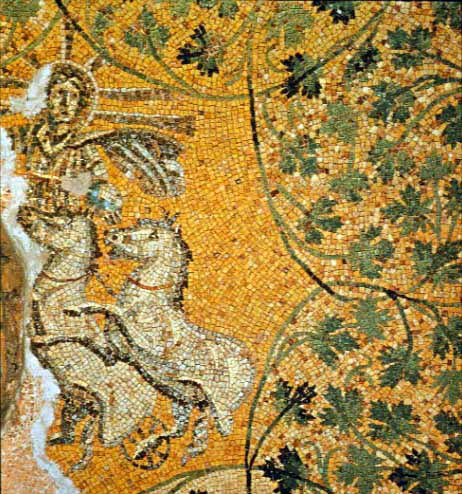
Imagery of Sol may have been appropriated by Christians. A mosaic dated to around 300 AD in the Tomb of the Julii, an apparently Christian tomb in the Vatican Necropolis, is generally thought to depict Jesus as Sol, Helios, or Apollo. Steven Hijmans suggests that it is simply a representation of Sol, or a figure representing the Sun.
Judaism
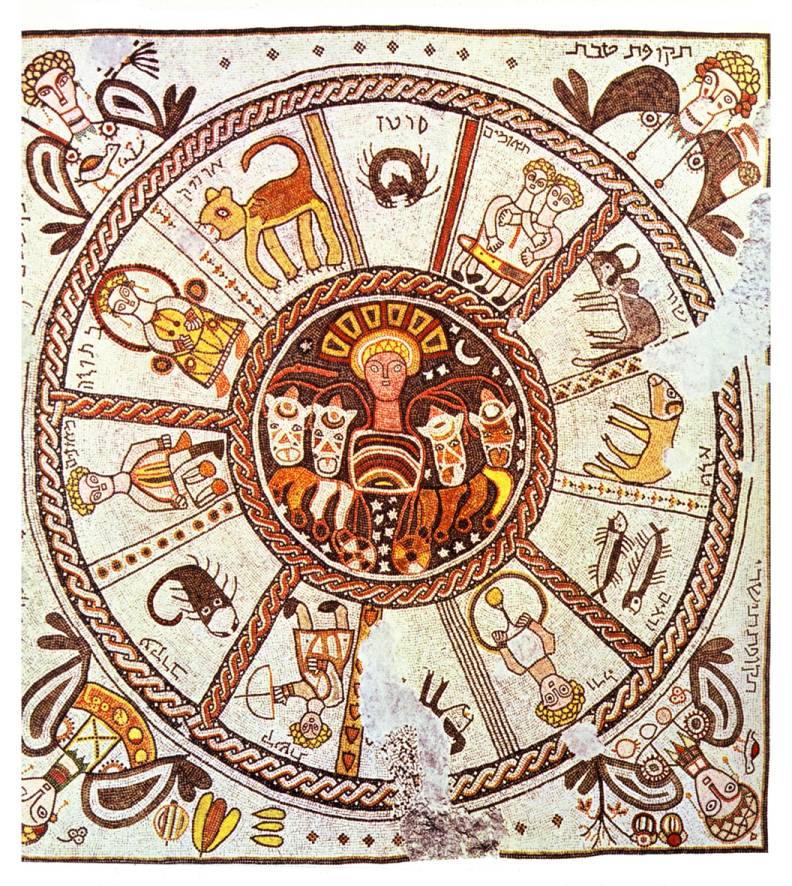
A mosaic floor in Hamat Tiberias presents David as Helios surrounded by a ring with the signs of the zodiac. As well as in Hamat Tiberias, figures of Helios or Sol Invictus also appear in several of the very few surviving schemes of decoration surviving from Late Antique synagogues, including Beth Alpha, Husefa, all now in Israel, and Naaran in the West Bank. He is shown in floor mosaics, with the usual radiate halo, and sometimes in a quadriga, in the central roundel of a circular representation of the zodiac or the seasons. These combinations "may have represented to an agricultural Jewish community the perpetuation of the annual cycle of the universe or ... the central part of a calendar".
Footnotes
References
--
|trans-title=The Rays of the Rulers: Theomorphic Image of Rulers and Political Symbolism in Hellenism and the Roman Imperial Period
|access-date=29 May 2020 |via=Google Books
--
Corpus Inscriptionum Latinarum |access-date=2009-11-12 |url-status=dead |archive-url=https://web.archive.org/web/20110716024700/http://www1.ku-eichstaett.de/epigr/uah-bilder.php?bild=PH0008364 |archive-date=2011-07-16}}
Corpus Inscriptionum Latinarum –
Corpus Inscriptionum Latinarum
|url-status=live |archive-url=https://web.archive.org/web/20151208141034/https://books.google.nl/books?id=_LfXg2r6FT0C&pg=PA169 |archive-date=2015-12-08
|editor-first=C.C. |editor-last=Mattusch |book-title=Common ground. Archaeology, art, science, and humanities |publication-date=2006
--
|access-date=9 April 2021
Bishop Jacob Bar-Salabi, cited in
|url-status=live |archive-url=https://web.archive.org/web/20141223171025/https://melkite.org/tag/feast-of-the-annunciation |archive-date=23 December 2014
|access-date=6 March 2021
--
--
|orig-year=1944 |edition=reprint
|orig-year=1871 |edition=revised |year=1889
--
|editor-last=Weitzmann |editor-first=Kurt |editor-link=Kurt Weitzmann
References
- "Sol {{!}} Roman god {{!}} Britannica".
- (2016-10-21). "Sol - Roman God".
- Hijmans, Steven. (1996). "The sun that did not rise in the east". Babesch.
- "Sol Invictus and Christmas".
- ''[[Corpus Inscriptionum Latinarum]]'' {{CIL. 6. 31181
- "Historia Augusta". Loeb.
- See in particular {{harvnb. Halsberghe. 1972.
- Clauss, Manfred. (2001). "Die römischen Kaiser – 55 historische Portraits von Caesar bis Iustinian". C.H.Beck.
- (1867). "From Constantine the Great to Gregory the Great, A.D. 311-600". C. Scribner.
- Excellent discussion of this decree by {{harvnb. Wallraff. 2001
- "Regio IV – Insula X – Terme di Porta Marina (IV, X, 1–2)".
- (2020). "The Oxford Handbook of Christmas". Oxford University Press.
- (2012). "Time in Roman Religion: One Thousand Years of Religious History". Routledge.
- (2006). "The Religion of the Mithras Cult in the Roman Empire: Mysteries of the Unconquered Sun". Oxford University Press.
- [[Censorinus]], ''The Natal Day'', trans. by W. Maude. Cambridge Encyclopedia Co., 1900. p.33
- Hoey (1939) 480 {{full citation needed. (June 2021)
- "Online text of inscription, Parts 6 and 12".
- (2015). "The End of Greek Athletics in Late Antiquity". Cambridge University Press.
- "The Works of the Emperor Julian (Volume 1) with an English Translation by Wilmer Cave Wright". Harvard University Press.
- (2012). "Sons of Hellenism, Fathers of the Church". University of California Press.
- "Necropolis (Scavi) Tomb M".
- Kelly, Joseph F., ''The Origins of Christmas'', Liturgical Press, 2004, pp. 80–81.
- Roll, Susan K.. (1995). "Towards the Origin of Christmas". Kok Pharos Publishing.
- Hijmans, Steven, "Sol Invictus, the winter solstice, and the origins of Christmas", in: ''[[Mouseion (journal). Mouseion III]]'' (2003), pp.379-380
- Martindale, Cyril Charles. (1908). "Christmas". Robert Appleton Company.
- (1992). "A Dictionary of Biblical Tradition in English Literature". Eerdmans.
- Roll, Susan K.. (1995). "Towards the Origin of Christmas". Kok Pharos Publishing.
- ''Christianity and Paganism in the Fourth to Eighth Centuries'', [[Ramsay MacMullen]]. Yale:1997, p. 155).
- {{harvnb. Hijmans. 2009
- (2000). "Understanding Early Christian Art". Routledge.
- (2010). "Cyprian and Roman Carthage". Cambridge University Press.
This article was imported from Wikipedia and is available under the Creative Commons Attribution-ShareAlike 4.0 License. Content has been adapted to SurfDoc format. Original contributors can be found on the article history page.
Ask Mako anything about Sol Invictus — get instant answers, deeper analysis, and related topics.
Research with MakoFree with your Surf account
Create a free account to save articles, ask Mako questions, and organize your research.
Sign up freeThis content may have been generated or modified by AI. CloudSurf Software LLC is not responsible for the accuracy, completeness, or reliability of AI-generated content. Always verify important information from primary sources.
Report