From Surf Wiki (app.surf) — the open knowledge base
Sodium/potassium/calcium exchanger 5
Protein

Protein
Sodium/potassium/calcium exchanger 5 (NCKX5), also known as solute carrier family 24 member 5 (SLC24A5), is a protein that in humans is encoded by the SLC24A5 gene that has a major influence on natural skin colour variation. The NCKX5 protein is a member of the potassium-dependent sodium/calcium exchanger family. Sequence variation in the SLC24A5 gene, particularly a non-synonymous SNP changing the amino acid at position 111 in NCKX5 from alanine to threonine, has been associated with differences in skin pigmentation.
The SLC24A5 gene's derived threonine or Ala111Thr allele (rs1426654) has been shown to be a major factor in the light skin tone of Europeans compared to Sub-Saharan Africans, and is believed to represent as much as 25–40% of the average skin tone difference between Europeans and West Africans.
- Possibly originating as long as 19,000 years ago, it has been the subject of selection in the ancestors of Europeans as recently as within the last 5,000 years, and is fixed in modern European populations. It was introduced into Khoisan people via "back-to-Africa" migration around 2,000 years ago is partly responsible for their differing skin tone to most other African populations.
Gene
The SLC24A5 gene, in humans, is located on the long (q) arm of chromosome 15 on position 21.1, from base pair 46,200,461 to base pair 46,221,881.
Protein
NCKX5 is a 43 kDa protein that is partially localized to the trans-Golgi network in melanocytes. Removal of the NCKX5 protein disrupts melanogenesis in human and mouse melanocytes, causing a significant reduction in melanin pigment production. Site-directed mutagenesis corresponding to a non-synonymous single nucleotide polymorphism in SLC24A5 alters a residue in NCKX5 (A111T) that is important for NCKX5 sodium-calcium exchanger activity.
Effect on skin color
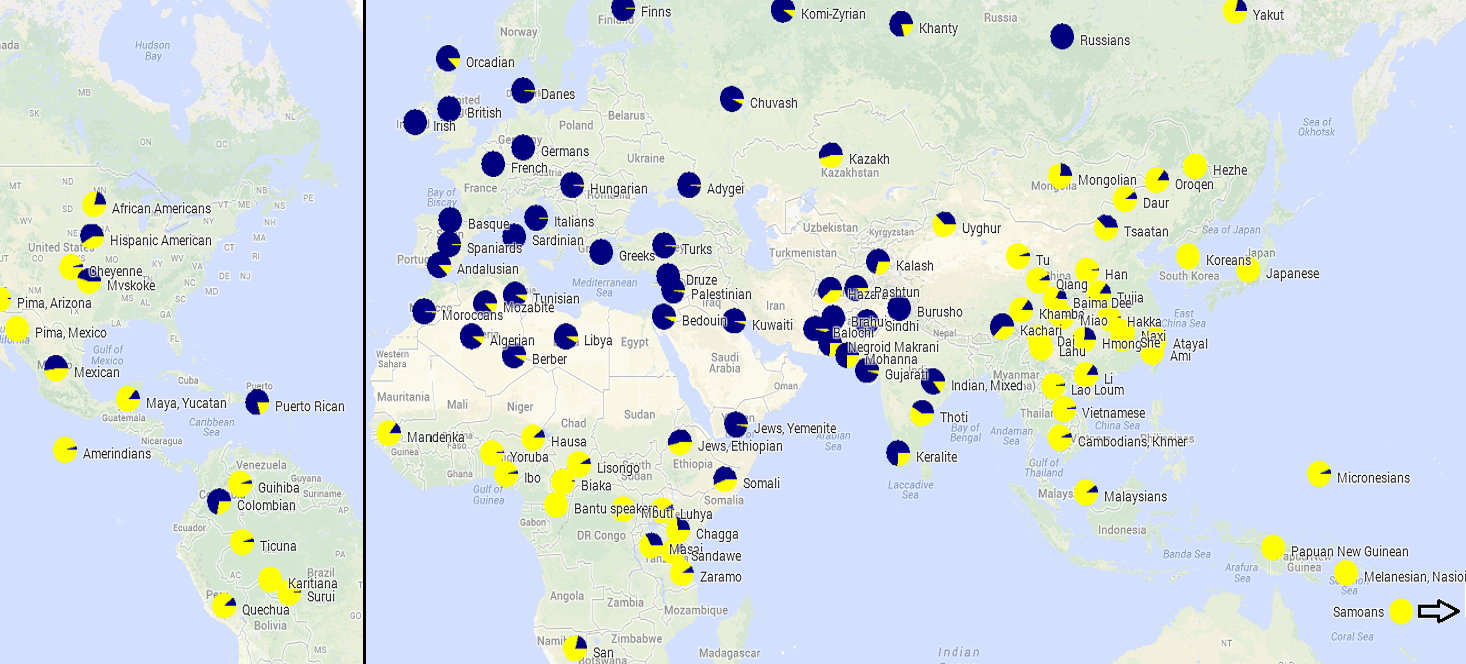
SLC24A5 appears to have played a key role in the evolution of light skin in humans of European ancestry. The gene's function in pigmentation was discovered in zebrafish as a result of the positional cloning of the gene responsible for the "golden" variety of this common pet store fish. Evidence in the International HapMap Project database of genetic variation in human populations showed that Europeans, represented by the "CEU" population, had two primary alleles differing by only one nucleotide, changing the 111th amino acid from alanine to threonine, abbreviated "A111T".

The derived threonine allele (Ala111Thr; also known as A111T or Thr111) represented 98.7 to 100% of the alleles in European samples, while the ancestral or alanine form was found in 93 to 100% of samples of Sub-Saharan Africans, East Asians and Indigenous Americans. The variation is a SNP polymorphism rs1426654, which had been previously shown to be second among 3011 tabulated SNPs ranked as ancestry-informative markers. This single change in SLC24A5 explains between 25 and 38% of the difference in skin melanin index between peoples of sub-Saharan African and European ancestry.
The SNP rs2470102 independently affects skin pigmentation variation among the South Asian population.
Furthermore, the European mutation is associated with the largest region of diminished genetic variation in the CEU HapMap population, suggesting the possibility that the A111T mutation may be the subject of the single largest degree of selection in human populations of European ancestry. It is hypothesized that selection for the derived allele is based on the need for sunlight to produce the essential nutrient vitamin D. In northerly latitudes, where there is less sun, greater requirement for body coverage due to colder climate, and frequently, diets poor in vitamin D, making lighter skin more suitable for survival.
The earliest known sample of the threonine allele is 13,000 years old from Satsurblia Cave in Georgia. The allele was widespread from Anatolia to Ukraine and Iran at the beginning of the Neolithic.
This allele forms part of the HIrisplex DNA test system used to estimate pigmentation in forensic investigations.
References
References
- (December 2005). "SLC24A5, a putative cation exchanger, affects pigmentation in zebrafish and humans". Science.
- (February 2008). "SLC24A5 encodes a trans-Golgi network protein with potassium-dependent sodium-calcium exchange activity that regulates human epidermal melanogenesis". The Journal of Biological Chemistry.
- [https://www.ncbi.nlm.nih.gov/snp/rs1426654 Reference SNP(refSNP) Cluster Report: rs1426654 clinically associated]. Ncbi.nlm.nih.gov (2008-12-30). Retrieved on 2011-02-27.
- (April 2014). "Direct evidence for positive selection of skin, hair, and eye pigmentation in Europeans during the last 5,000 y". Proceedings of the National Academy of Sciences of the United States of America.
- (January 2013). "The timing of pigmentation lightening in Europeans". Molecular Biology and Evolution.
- (January 2007). "Population differences of two coding SNPs in pigmentation-related genes SLC24A5 and SLC45A2". International Journal of Legal Medicine.
- (2012). "Skin color variation in Orang Asli tribes of Peninsular Malaysia". PLOS ONE.
- (December 2018). "Rapid evolution of a skin-lightening allele in southern African KhoeSan". Proceedings of the National Academy of Sciences of the United States of America.
- (2005-12-16). "Key gene 'controls skin colour'". BBC News.
- (2005-12-16). "Fish gene sheds light on human skin color variation". Penn State University.
- (2016-11-20). "CCMB scientists unravel skin colour genetics of Indians". The Hindu.
- (July 2000). "The evolution of human skin coloration". Journal of Human Evolution.
- (November 2015). "Upper Palaeolithic genomes reveal deep roots of modern Eurasians". Nature Communications.
- (July 2016). "Early Neolithic genomes from the eastern Fertile Crescent". Science.
- (2015-10-10). "Eight thousand years of natural selection in Europe".
- (February 2017). "The Neolithic Transition in the Baltic was Not Driven by Admixture with Early European Farmers". Current Biology.
- (23 February 2015). "Building a Face, and a Case, on DNA". New York Times.
This article was imported from Wikipedia and is available under the Creative Commons Attribution-ShareAlike 4.0 License. Content has been adapted to SurfDoc format. Original contributors can be found on the article history page.
Ask Mako anything about Sodium/potassium/calcium exchanger 5 — get instant answers, deeper analysis, and related topics.
Research with MakoFree with your Surf account
Create a free account to save articles, ask Mako questions, and organize your research.
Sign up freeThis content may have been generated or modified by AI. CloudSurf Software LLC is not responsible for the accuracy, completeness, or reliability of AI-generated content. Always verify important information from primary sources.
Report