From Surf Wiki (app.surf) — the open knowledge base
Sodium/iodide cotransporter
Mammalian protein found in Homo sapiens
Mammalian protein found in Homo sapiens
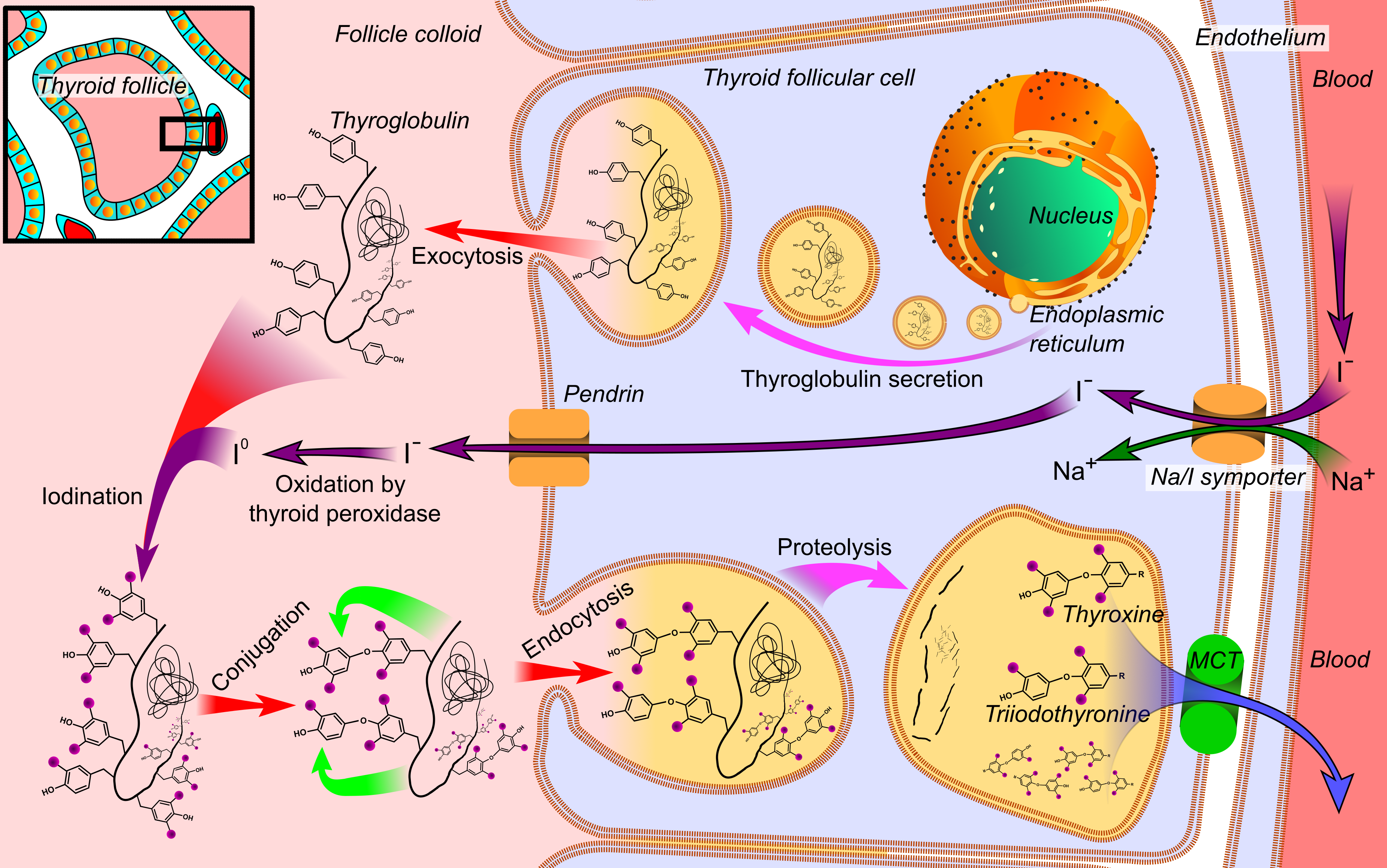
The sodium/iodide cotransporter, also known as the sodium/iodide symporter (NIS), is a protein that in humans is encoded by the SLC5A5 gene. It is a transmembrane glycoprotein with a molecular weight of 87 kDa and 13 transmembrane domains, which transports two sodium cations (Na+) for each iodide anion (I−) into the cell. NIS mediated uptake of iodide into follicular cells of the thyroid gland is the first step in the synthesis of thyroid hormone.
Iodine uptake
Iodine uptake mediated by thyroid follicular cells from the blood plasma is the first step for the synthesis of thyroid hormones. This ingested iodine is bound to serum proteins, especially to albumins. The rest of the iodine which remains unlinked and free in bloodstream, is removed from the body through urine (the kidney is essential in the removal of iodine from extracellular space).
Iodine uptake is a result of an active transport mechanism mediated by the NIS protein, which is found in the basolateral membrane of thyroid follicular cells. As a result of this active transport, iodide concentration inside follicular cells of thyroid tissue is 20 to 50 times higher than in the plasma. The transport of iodide across the cell membrane is driven by the electrochemical gradient of sodium (the intracellular concentration of sodium is approximately 12 mM and extracellular concentration 140 mM). Once inside the follicular cells, the iodide diffuses to the apical membrane, where it is metabolically oxidized through the action of thyroid peroxidase to iodinium (I+) which in turn iodinates tyrosine residues of the thyroglobulin proteins in the follicle colloid. Thus, NIS is essential for the synthesis of thyroid hormones (T3 and T4).
Apart from thyroid cells NIS can also be found, although less expressed, in other tissues such as the salivary glands, the gastric mucosa, the kidney, the placenta, the ovaries and the mammary glands during pregnancy and lactation. NIS expression in the mammary glands is quite a relevant fact since the regulation of iodide absorption and its presence in the breast milk is the main source of iodine for a newborn. Note that the regulation of NIS expression in thyroid is done by the thyroid-stimulating hormone (TSH), whereas in breast is done by a combination of three molecules: prolactin, oxytocin and β-estradiol.
Inhibition by Environmental Chemicals
Some anions like perchlorate, pertechnetate and thiocyanate, can affect iodide capture by competitive inhibition because they can use the symporter when their concentration in plasma is high, even though they have less affinity for NIS than iodide has. Many plant cyanogenic glycosides, which are important pesticides, also act via inhibition of NIS in a large part of animal cells of herbivores and parasites and not in plant cells. Some evidence suggests that fluoride, such as that present in drinking water, may decrease cellular expression of the sodium/iodide symporter.
A validated in vitro radioactive iodide uptake (RAIU) assay suggested that besides the traditionally known anions such as perchlorate, organic chemicals may also pose inhibition of iodide uptake via NIS.
Regulation in iodine uptake
The iodine transport mechanisms are closely submitted to the regulation of NIS expression. There are two kinds of regulation on NIS expression: positive and negative regulation. Positive regulation depends on TSH, which acts by transcriptional and posttranslational mechanisms. On the other hand, negative regulation depends on the plasmatic concentrations of iodide.
Transcriptional regulation
At a transcriptional level, TSH regulates the thyroid's function through cAMP. TSH first binds to its receptors which are joined to G proteins, and then induces the activation of the enzyme adenylate cyclase, which will raise the intracellular levels of cAMP. This can activate the CREB transcription factor (cAMP Response Element-Binding) that will bind to the CRE (cAMP Responsive Element). However, this might not occur and, instead, the increase in cAMP can be followed by PKA (Protein kinase A) activation and, as a result, the activation of the transcription factor Pax8 after phosphorylation.
These two transcription factors influence the activity of NUE (NIS Upstream Enhancer), which is essential for initiating transcription of NIS. NUE's activity depends on 4 relevant sites which have been identified by mutational analysis. The transcriptional factor Pax8 binds in two of these sites. Pax8 mutations lead to a decrease in the transcriptional activity of NUE. Another binding-site is the CRE, where the CREB binds, taking part in NIS transcription.
In contrast, growth factors such as IGF-1 and TGF-β (which is induced by the BRAF-V600E oncogene) suppress NIS gene expression, not letting NIS localize in the membrane.
Posttranslational regulation
The TSH can also regulate the iodide uptake at a posttranslational level, since, if it's absent, the NIS can be resorted from the basolateral membrane of the cell in to the cytoplasm where it is no longer functional. Therefore, the iodide uptake is reduced.
Thyroid diseases
The lack of iodide transport inside follicular cells tends to cause goitres. There are some mutations in the NIS DNA that cause hypothyroidism and thyroid dyshormonogenesis.
Moreover, antibodies anti-NIS have been found in thyroid autoimmune diseases. Using RT-PCR tests, it has been proved that there is no expression of NIS in cancer cells (which forms a thyroid carcinoma). Nevertheless, thanks to immunohistochemical techniques it is known that NIS is not functional in these cells, since it is mainly localized in the cytosol, and not in the basolateral membrane.
There is also a connection between the V600E mutation of the BRAF oncogene and papillary thyroid cancer that cannot concentrate iodine into its follicular cells.
Use with radioiodine (131I)
The main goal for the treatment of non-thyroid carcinoma is the research of less aggressive procedures that could also provide less toxicity. One of these therapies is based on transferring NIS in cancer cells of different origin (breast, colon, prostate...) using adenoviruses or retroviruses (viral vectors). This genetic technique is called gene targeting. Once NIS is transferred in these cells, the patient is treated with radioiodine (131I), being the result a low cancer cell survival rate. Therefore, a lot is expected from these therapies.
References
References
- Glossary, [https://www.uniprot.org/uniprot/Q92911 UniProt Consortium ]
- "Entrez Gene: SLC5A5 solute carrier family 5 (sodium iodide symporter), member 5".
- (February 1996). "Cloning and characterization of the thyroid iodide transporter". Nature.
- (August 1997). "Expression, exon-intron organization, and chromosome mapping of the human sodium iodide symporter". Endocrinology.
- (February 2003). "The sodium/iodide Symporter (NIS): characterization, regulation, and medical significance". Endocrine Reviews.
- (2022). "StatPearls". StatPearls Publishing.
- (2001). "Iodide handling by the thyroid epithelial cell". Experimental and Clinical Endocrinology & Diabetes.
- (April 1997). "Iodine metabolism and thyroid physiology: current concepts". Thyroid.
- (2022). "StatPearls". StatPearls Publishing.
- (2022). "StatPearls". StatPearls Publishing.
- (June 2010). "Effect of thyroid statuses on sodium/iodide symporter (NIS) gene expression in the extrathyroidal tissues in mice". Thyroid Research.
- (September 2018). "Glycosylation in the Thyroid Gland: Vital Aspects of Glycoprotein Function in Thyrocyte Physiology and Thyroid Disorders". International Journal of Molecular Sciences.
- (January 2011). "The sodium iodide symporter (NIS) and potential regulators in normal, benign and malignant human breast tissue". PLOS ONE.
- (March 2019). "Fluoride Exposure Induces Inhibition of Sodium/Iodide Symporter (NIS) Contributing to Impaired Iodine Absorption and Iodine Deficiency: Molecular Mechanisms of Inhibition and Implications for Public Health". International Journal of Environmental Research and Public Health.
- (April 2017). "Development of a screening approach to detect thyroid disrupting chemicals that inhibit the human sodium iodide symporter (NIS)". Toxicology in Vitro.
- (May 2018). "High-Throughput Screening and Quantitative Chemical Ranking for Sodium-Iodide Symporter Inhibitors in ToxCast Phase I Chemical Library". Environmental Science & Technology.
- (September 2012). "The sodium iodide symporter (NIS): regulation and approaches to targeting for cancer therapeutics". Pharmacology & Therapeutics.
- (August 2001). "The TSH receptor and its role in thyroid disease". Cellular and Molecular Life Sciences.
- (2018). "cAMP Response Element-Binding Protein (CREB): A Possible Signaling Molecule Link in the Pathophysiology of Schizophrenia". Frontiers in Molecular Neuroscience.
- (March 1999). "The paired-domain transcription factor Pax8 binds to the upstream enhancer of the rat sodium/iodide symporter gene and participates in both thyroid-specific and cyclic-AMP-dependent transcription". Molecular and Cellular Biology.
- (November 2009). "The BRAFV600E oncogene induces transforming growth factor beta secretion leading to sodium iodide symporter repression and increased malignancy in thyroid cancer". Cancer Research.
- (July 2010). "MTOR downregulates iodide uptake in thyrocytes". The Journal of Endocrinology.
- (July 2007). "The importance of sodium/iodide symporter (NIS) for thyroid cancer management". Arquivos Brasileiros de Endocrinologia e Metabologia.
- (July 2000). "Molecular analysis of the sodium/iodide symporter: impact on thyroid and extrathyroid pathophysiology". Physiological Reviews.
- (January 2018). "NIS expression in thyroid tumors, relation with prognosis clinicopathological and molecular features". Endocrine Connections.
- (March 2008). "BRAF(V600E) mutation and the biology of papillary thyroid cancer". Endocrine-Related Cancer.
- (December 2018). "NCCN Guidelines Insights: Thyroid Carcinoma, Version 2.2018". Journal of the National Comprehensive Cancer Network.
- (July 2020). "Breast cancer: Biology, biomarkers, and treatments". International Immunopharmacology.
- (2019). "Prostate Cancer".
- (November 2000). "Treatment of prostate cancer by radioiodine therapy after tissue-specific expression of the sodium iodide symporter". Cancer Research.
This article was imported from Wikipedia and is available under the Creative Commons Attribution-ShareAlike 4.0 License. Content has been adapted to SurfDoc format. Original contributors can be found on the article history page.
Ask Mako anything about Sodium/iodide cotransporter — get instant answers, deeper analysis, and related topics.
Research with MakoFree with your Surf account
Create a free account to save articles, ask Mako questions, and organize your research.
Sign up freeThis content may have been generated or modified by AI. CloudSurf Software LLC is not responsible for the accuracy, completeness, or reliability of AI-generated content. Always verify important information from primary sources.
Report