From Surf Wiki (app.surf) — the open knowledge base
Sociogram
Graphic representation of social links
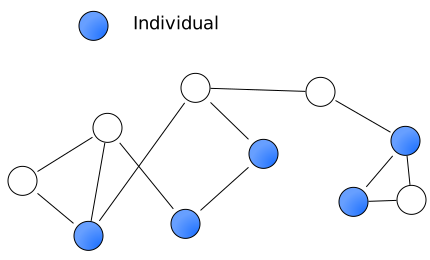
Graphic representation of social links
A sociogram is a graphic representation of social links that a person has. It is a graph drawing that plots the structure of interpersonal relations in a group situation.
Overview
Sociograms were developed by Jacob L. Moreno to analyze choices or preferences within a group.{{citation | author-link = Jacob L. Moreno
Those points on a sociogram who have many choices are called stars. Those with few or no choices are called isolates. Individuals who choose each other are known to have made a mutual choice. One-way choice refers to individuals who choose someone but the choice is not reciprocated. Cliques are groups of three or more people within a larger group who all choose each other (mutual choice).
Sociograms are the charts or tools used to find the sociometry of a social space.
Under the social discipline model, sociograms are sometimes used to reduce misbehavior in a classroom environment. A sociogram is constructed after students answer a series of questions probing for affiliations with other classmates. The diagram can then be used to identify pathways for social acceptance for misbehaving students. In this context, the resulting sociograms are known as a friendship chart. Often, the most important person/thing is in a bigger bubble in relation to everyone else. The size of the bubble represents the importance, with the biggest bubble meaning most important and the smallest representing the least important.
Gallery
Moreno Sociogram 1st Grade.png|1st grade Moreno Sociogram 2nd Grade.png|2nd grade Moreno Sociogram 3rd Grade.png|3rd grade Moreno Sociogram 4th Grade.png|4th grade Moreno Sociogram 5th Grade.png|5th grade Moreno Sociogram 6th Grade.png|6th grade Moreno Sociogram 7th Grade.png|7th grade Moreno Sociogram 8th Grade.png|8th grade
References
References
- [http://www.merriam-webster.com/dictionary/sociogram Sociogram] at merriam-webster.com.
- "An Experiential Approach to Organization Development 7th ed."Brown, Donald R.and Harvey, Don. Page 134
- Wolfgang, Charles H., ''Solving Discipline And Classroom Management Problems: Methods and Models for Today’s Teachers''; U.S.A, John Wiley and Sons, 2001.; p. 116
This article was imported from Wikipedia and is available under the Creative Commons Attribution-ShareAlike 4.0 License. Content has been adapted to SurfDoc format. Original contributors can be found on the article history page.
Ask Mako anything about Sociogram — get instant answers, deeper analysis, and related topics.
Research with MakoFree with your Surf account
Create a free account to save articles, ask Mako questions, and organize your research.
Sign up freeThis content may have been generated or modified by AI. CloudSurf Software LLC is not responsible for the accuracy, completeness, or reliability of AI-generated content. Always verify important information from primary sources.
Report