From Surf Wiki (app.surf) — the open knowledge base
Socialism of the 21st century
Interpretation of socialist principles

Interpretation of socialist principles
Socialism of the 21st century is an interpretation of socialist principles first advocated by German sociologist and political analyst Heinz Dieterich and taken up by a number of Latin American leaders. Dieterich argued in 1996 that free-market and industrial capitalism and Marxism–Leninism have failed to solve urgent problems of humanity such as poverty, hunger, exploitation of labour, economic oppression, sexism, racism, the destruction of natural resources and the absence of true democracy. Socialism of the 21st century has democratic socialist elements but also resembles Marxist revisionism.
Leaders who have advocated for this form of socialism include Hugo Chávez of Venezuela, Rafael Correa of Ecuador, Evo Morales of Bolivia, Néstor Kirchner and Cristina Fernández de Kirchner of Argentina, Luiz Inácio Lula da Silva of Brazil and Michelle Bachelet of Chile. Because of the local unique historical conditions, socialism of the 21st century is often contrasted with previous applications of socialism in other countries, with a major difference being the effort towards a more effective economic planning process. Outside Latin America, socialism of the 21st century has been promoted by left-wing leaders such as Mark Drakeford and Jeremy Corbyn in the United Kingdom and Lothar Bisky, Egon Krenz and Oskar Lafontaine in Germany, and also by parties such as the Communist Party of Spain and United Left in Spain and the Communist Party of the Russian Federation and Just Russia.
Historical foundations
After a series of structural adjustment loans and debt restructuring led by the International Monetary Fund in the late 20th century, Latin America experienced a significant increase in inequality. Between 1990 and 1999, the Gini coefficient, a measure of inequality in the income or wealth distribution, rose in almost every Latin American country. Volatile prices and inflation led to dissatisfaction. In 2000, only 37% of Latin Americans were satisfied with their democracies (20 points less than Europeans and 10 points less than sub-Saharan Africans). In this context, a wave of left-leaning socio-political movements, called the Pink tide, on behalf of indigenous rights, cocaleros, labor rights, women's rights, land rights and educational reform emerged to eventually provide momentum for the election of socialist leaders. Socialism of the 21st century draws on indigenous traditions of communal governance and previous Latin America socialist and communist movements, including those of Salvador Allende, Fidel Castro, Che Guevara and the Sandinista National Liberation Front.
Theoretical tenets
According to Dieterich, this form of socialism is revolutionary in that the existing society is altered to be qualitatively different, but the process itself should be gradual and non-violent, instead utilising democracy to secure power, education, scientific knowledge about society and international cooperation. Dieterich suggests the construction of four basic institutions within the new reality of post-capitalist civilisation:
- Equivalent economy based on the Marxian economic labor theory of value and democratically determined by those who directly create value instead of principles of market economies.
- Majority democracy which makes use of referendums to decide upon important societal questions.
- Basic state democracy with a suitable protection of minority rights.
- Citizens who are responsible, rational and self-determined.
Post-neoliberalism
Post-neoliberalism, also known as anti-neoliberalism, is a set of ideals characterized by its rejection of neoliberalism and the economic policies embodied by the Washington Consensus. While there is scholarly debate about the defining features of post-neoliberalism, it is often associated with economic progressivism as a response to neoliberalism's perceived excesses or failures, ranging from nationalization and wealth redistribution to embracing protectionism and revival of trade unions; it can also refer to left-wing politics more generally.
The movement has had particular influence in Latin America, where the pink tide brought about a substantial shift towards left-wing governments in the 2000s. Examples of post-neoliberal governments include the former governments of Evo Morales in Bolivia and Rafael Correa in Ecuador. It has also been claimed by some analysts that the Joe Biden administration in the United States exhibited post-neoliberal characteristics.
History
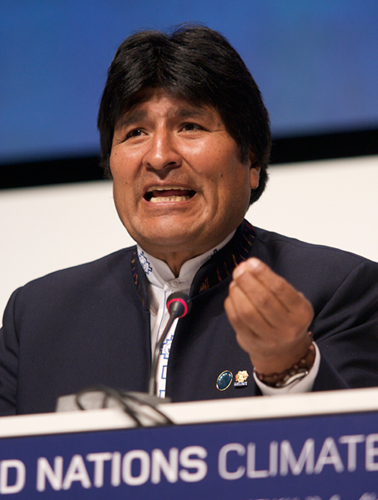
The idea of post-neoliberalism arose during the pink tide of the 1990s and 2000s, in which left-wing Latin American critics of neoliberalism like Hugo Chávez and Evo Morales were thrust into power. According to researchers, the election of Chávez as the president of Venezuela in 1999 marked a definite start to the pink tide and post-neoliberal movement. Following his election, Rafael Correa, Néstor Kirchner, Evo Morales, and numerous other leaders associated with the post-neoliberal movement were elected in Latin America during the 2000s and 2010s. Into the 2020s, the Chilean president-elect Gabriel Boric, who emerged victorious in the 2021 Chilean general election, pledged to end the country's neoliberal economic model, stating: "If Chile was the cradle of neoliberalism, it will also be its grave."
While the ideas of post-neoliberalism are not exclusive to Latin America, they are largely associated with the region. Post-neoliberalism has drawn criticism from the right of the political spectrum; right-wing and far-right critics have claimed that the term itself is vague and populistic, while also arguing that "post-neoliberal" policies harm international investment and economic development.
Ideology
Post-neoliberalism seeks to fundamentally change the role of the state in countries where the Washington Consensus once prevailed. To achieve this, post-neoliberal leaders in Latin America have advocated for the nationalization of several industries, notably the gas, mining, and oil industries. Post-neoliberalism also advocates for the expansion of welfare benefits, greater governmental investment in poverty reduction, and increased state intervention in the economy.
Latin American application
Regional integration
The model of socialism of the 21st century encourages economic and political integration among nations in Latin America and the Caribbean. This is often accompanied with opposition to North American influence. Regional organizations like ALBA and CELAC promote cooperation with Latin America and exclude North American countries. ALBA is most explicitly related to socialism of the 21st century while other organizations focus on economic integration, ALBA promotes social, political and economic integration among countries that subscribe to democratic socialism. Its creation was announced in direct opposition to George W. Bush's attempts to establish a Free Trade Area of the Americas that included the United States. In 2008, ALBA introduced a monetary union using the SUCRE as its regional currency.
Bolivarian process
Former Venezuelan President Hugo Chávez initiated a process of social reforms in Venezuela known as the Bolivarian Revolution. This approach was more heavily influenced by the theories of István Mészáros, Michael Lebowitz and Marta Harnecker (who was Chávez's adviser between 2004 and 2011) than by those of Heinz Dieterich. The process draws its name from Latin American liberator Simón Bolívar and is a contemporary example of Bolivarianism.
''Buen vivir''
Often translated to good living or living well, the concept of buen vivir is related to the movement for indigenous rights and rights of nature. It focuses on living sustainably as the member of a community that includes both human beings and Nature. Buen vivir is enshrined in 2008 Constitution of Ecuador as an alternative to neoliberal development. The constitution outlines a set of rights, one of which is the rights of nature. In line with the assertion of these rights, buen vivir seeks to change the relationship between nature and humans to a more bio-pluralistic view, eliminating the separation between nature and society. This approach has been applied to the Yasuní-ITT Initiative. Buen vivir is sometimes conceptualised as collaborative consumption in a sharing economy and the term is used to look at the world in way sharply differentiated from natural, social or human capital.
Criticism
Authoritarianism
Critics claim that socialism of the 21st century in Latin America acts as a façade for authoritarianism. The charisma of figures like Hugo Chávez and mottoes like "Country, Socialism, or Death!" have drawn comparisons to the Latin American dictators and caudillos of the past. According to Steven Levitsky of Harvard University, "Only under the dictatorships of the past ... were presidents reelected for life", with Levitsky further stating that while Latin America experienced democracy, citizens opposed "indefinite reelection, because of the dictatorships of the past". Levitsky then observed: "In Nicaragua, Venezuela and Ecuador, reelection is associated with the same problems of 100 years ago."
In 2015, The Economist stated that the Bolivarian Revolution in Venezuela—now under Nicolás Maduro after Chávez's death in 2013—was devolving from authoritarianism to dictatorship as opposition politicians were jailed for plotting to undermine the government, violence was widespread and opposition media shut down. Western media coverage of Chávez and other Latin American leaders from the 21st-century socialist movement has been criticised as unfair by their supporters and leftist media critics.
Economics
The sustainability and stability of economic reforms associated with governments adhering to socialism of the 21st century have been questioned. Latin American countries have primarily financed their social programs with extractive exports like petroleum, natural gas and minerals, creating a dependency that some economists claim has caused inflation and slowed growth. For the Bolivarian government of Venezuela, their economic policies led to shortages in Venezuela, a high inflation rate and a dysfunctional economy. However, the economic policy of the Hugo Chávez administration and Maduro governments have attributed Venezuela's economic problems to the decline in oil prices, sanctions imposed by the United States and economic sabotage by the opposition. In 2015, Venezuela's economy was performing poorly—the currency had collapsed, it had the world's highest inflation rate and its gross domestic product shrank into an economic collapse in 2016.
Populism
Although democratic socialist intellectuals have welcomed a socialism of the 21st century, some have been skeptical of Latin America's examples. While citing their progressive role, they argue that the appropriate label for these governments is populist rather than socialist. Similarly, some of the left-wing pink tide governments were criticised for turning from socialism to authoritarianism and populism.
List of anti-neoliberal or post-neoliberal political parties
South America:
- Argentina: Union for the Homeland, Frente de Todos, Front for Victory, Patria Grande Front
- Bolivia: Movement for Socialism
- Chile: Social Convergence
- Ecuador: Citizen Revolution Movement, PAIS Alliance under Rafael Correa
- Venezuela: Fifth Republic Movement, Great Patriotic Pole, United Socialist Party of Venezuela, under Hugo Chávez, Communist Party of Venezuela
North America:
- Canada: Québec Solidaire, Green Party of Quebec
- Mexico: Morena
- Honduras: Liberty and Refoundation
- United States: Democratic Socialists of America, Party for Socialism and Liberation Working Families Party
Asia
- Japan: Social Democratic Party
- South Korea: Progressive Party
- Sri Lanka: National People's Power
- Turkey: Communist Party of Turkey, Patriotic Party, Labour and Freedom Alliance
Europe
- France: New Anticapitalist Party
- Iceland: Socialist Party of Iceland
- Ireland: Independents 4 Change
- Italy: Power to the People
- Norway: Red Party
Oceania
- Australia: Australian Greens
References
References
- Heinz Dieterich: ''Der Sozialismus des 21. Jahrhunderts – Wirtschaft, Gesellschaft und Demokratie nach dem globalen Kapitalismus'', Einleitung
Socialism of the 21st Century – Economy, Society, and Democracy in the era of global Capitalism, Introduction. - (2013). "Latin America's Turbulent Transitions". [[Zed Books]].
- Montañez, Julio Ramírez. (27 June 2016). "The XXI century socialism in the context of the new Latin American left". Universidad Pontificia Bolivariana.
- [[Partido dos Trabalhadores]]. "Resoluções do 3º Congresso do PT".
- Wilkinson, Michael. (28 September 2016). "Jeremy Corbyn pledges 'socialism for 21st century' as he plans business tax hike and benefits free-for-all". The Telegraph.
- (28 September 2016). "Labour must prepare for a 2017 general election, says Corbyn". Financial Times.
- Osborne, Rob. (12 November 2018). "Mark Drakeford on drugs, the monarchy and his vision for Wales, as he launches his manifesto". ITV News.
- Herzinger, Richard. (5 June 2007). "Eingemauert". Jüdische Allgemeine.
- (19 March 2010). "Linkspartei: Auf der Suche nach einem Grundsatzprogramm".
- [http://www.tercerainformacion.es/spip.php?article7838 "Hay que emprender, como ya han hecho otros países, el camino del socialismo del"], 14 de abril de 2009.
- [https://web.archive.org/web/20091220002903/http://izquierda-unida.es/noticia.php?id=4966 "Hemos decidido que queremos construir el socialismo del y, para ello, se necesita mucha movilización"], ''[[Cayo Lara]]'', coordinador general de IU, 14 de abril de 2009.
- (12 August 2009). "Politics in Translation / A Fair and Just Russia, Part 2". The School of Russian and Asian Studies.
- ECLAC. (2002). "Economic Commission for Latin America and the Caribbean". Social Panorama of Latin America 2000-2001.
- "Encuesta Latinobarómetro 1999-2000".
- (2021). "Post-Neoliberalism? An Introduction". [[Theory, Culture & Society]].
- (November 2003). "Rethinking the Emerging Post-Washington Consensus: A Critical Appraisal". Middle Eastern Technical University.
- (2017). "Post-Neoliberalism in Latin America: A Conceptual Review". Third World Quarterly.
- (2009). "Postneoliberalism – A Beginning Debate". Dag Hammarskjöld Foundation.
- Encarnación, Omar G.. (9 May 2018). "The Rise and Fall of the Latin American Left".
- Merino, Roger. (4 October 2011). "What is 'Post' in Post-Neoliberal Economic Policy? Extractive Industry Dependence and Indigenous Land Rights in Bolivia and Ecuador". University of Bath - Department of Social & Policy Sciences.
- Levitz, Eric. (May 3, 2023). "The Biden Administration Just Declared the Death of Neoliberalism". Vox Media Network.
- Ward, Ian. (September 9, 2022). "The Unexpected Ways Joe Biden Is Ushering In a New Economic Paradigm". Axel Springer SE.
- Bachtell, John. (August 10, 2023). "Is 'Bidenomics' a break from neoliberalism?". Long View Publishing Co., Inc..
- (2009). "The Concise Oxford Dictionary of Politics". Oxford University Press.
- (2009). "Post-Neoliberalism in the Americas: An Introduction". Palgrave Macmillan.
- Cambero, Fabian. (20 December 2021). "Student protest leader to president-elect: Gabriel Boric caps rise of Chile's left". Reuters.
- (2012). "Post-neoliberalism in Latin America: Rebuilding and Reclaiming the State after Crisis". Blackwell Publishing/International Institute of Social Studies.
- (2017). "Post-Neoliberalism in Latin America: A Conceptual Review". Routledge.
- Wylde, Cristopher. (2012). "Latin America After Neoliberalism". Palgrave Macmillan.
- Kaltwasser, Cristóbal Rovira. (2011). "Toward Post-Neoliberalism in Latin America?". Latin America Research Commons on behalf of Latin American Studies Association.
- Cochrane, Regine. (Summer 2014). "Climate Change, Buen Vivir, and the Dialectic of Enlightenment: Toward a Feminist Critical Philosophy of Climate Justice". [[Hypatia (journal).
- [[Eduardo Gudynas. Gudynas, Eduardo]]. 2011. Buen Vivir: Today's Tomorrow Development 54(4):441-447.
- SENPLADES. [http://plan2009.senplades.gob.ec/web/en/presentation 2009 National Plan for Good Living]. Electronic document. Retrieved May 2012.
- (2013). "Buen vivir: the social philosophy inspiring movements in South America". [[The Guardian]].
- (9 March 2013). "Venezuela after Chávez: Now for the Reckoning". [[The Economist]].
- (11 April 2014). "Does Ecuador's leader aspire to a perpetual presidency?".
- (15 March 2014). "Ecuador's popular, powerful president Rafael Correa is a study in contradictions".
- (28 February 2015). "A slow-motion coup. The authoritarian regime is becoming a naked dictatorship. The region must react.". [[The Economist]].
- [https://www.laprogressive.com/oliver-stone-interview-specter-haunting-latin-america-specter-21st-century-socialism/ "Oliver Stone Interview: There's a Specter Haunting Latin America, the Specter of 21st Century Socialism"].
- Hart, Peter. (8 March 2013). "NYT Debates Hugo Chavez- Minus the Debate". Fairness and Accuracy in Reporting (FAIR).
- Roth, Charles. (6 March 2013). "Venezuela's Economy Under Chávez, by the Numbers". [[Wall Street Journal]].
- (16 May 2013). "Venezuela toilet paper shortage an anti-Bolivarian conspiracy, gov't claims".
- Martin, Abby. (22 June 2017). "Empire Files: Venezuela Economy Minister – Sabotage, Not Socialism, Is the Problem".
- (16 March 2015). "Why Venezuela is the world's worst performing economy, in three charts". [[Quartz (publication).
- Munck, Ronaldo. (2012). "Contemporary Latin America". [[Palgrave Macmillan]].
- Iber, Patrick. (Spring 2016). "The Path to Democratic Socialism: Lessons from Latin America". Dissent.
- Lopes, Arthur. (Spring 2016). "¿Viva la Contrarrevolución? South America's Left Begins to Wave Goodbye". Harvard International Review.
- (January–April 2016). "When Foreign Policy Meets Social Demands in Latin America". [[Pontifícia Universidade Católica do Rio de Janeiro]].
- (20 December 2021). "Gabriel Boric: From student protest leader to Chile's president". BBC.
- (27 October 2018). "Un frente antineoliberal". Página/12.
- Tharoor, Ishaan. (29 October 2019). "The anti-neoliberal wave rocking Latin America". The Washington Post.
- (27 October 2018). "Un frente anti neoliberal | Grabois lanza el Frente Patria Grande junto a otros dirigentes sociales".
- (20 December 2021). "Socialist Gabriel Boric elected Chile's youngest ever president with highest ever vote tally". Morning Star.
- (December 2014). "Declaración de principios de MORENA". Morena.
- (22 January 2008). "Zhèngcè". Social Democratic Party.
- (26 May 2020). "Bagnojaui hangug, angwa bakk nolaeleul bulleossdaga 'joein'i doeneun nala, daehanmingug". The Hankyoreh.
- http://www.columbia.edu/~lnp3/turkey.pdf, pg. 176
- Duvar, Gazete. (2022-09-24). "Emek ve Özgürlük İttifakı deklarasyonu açıklandı".
- (30 January 2015). "NPA recherche anciens militants: où sont-ils partis?". HuffPost.
- "Vindum ofan af nýfrjálshyggjunni".
- (2021-10-24). "Independents 4 Change {{!}} left".
- (2019). "Prinsipprogram for Rødt – Bokmål, pg 17".
- "Australian Greens Are Building a Movement to End Neoliberalism".
This article was imported from Wikipedia and is available under the Creative Commons Attribution-ShareAlike 4.0 License. Content has been adapted to SurfDoc format. Original contributors can be found on the article history page.
Ask Mako anything about Socialism of the 21st century — get instant answers, deeper analysis, and related topics.
Research with MakoFree with your Surf account
Create a free account to save articles, ask Mako questions, and organize your research.
Sign up freeThis content may have been generated or modified by AI. CloudSurf Software LLC is not responsible for the accuracy, completeness, or reliability of AI-generated content. Always verify important information from primary sources.
Report