From Surf Wiki (app.surf) — the open knowledge base
Social impact of YouTube
None

None
YouTube's impact on the world outside the website itself
"An Anthropological Introduction to YouTube" Presentation to the Library of Congress The American online video sharing and social media platform YouTube has had social impact in many fields, with some individual videos of the site having directly shaped world events. It is the world's largest video hosting website and Similarweb, and used by 81% of U.S. adults.
Constituting one of the world's most popular search engines, YouTube enables inexpensive distribution of educational content, including course material from educational institutions and "how to" videos from individuals. Worldwide video access has spurred innovation by enabling geographically distributed individuals to build upon each other's work, to collaborate, or to crowdsource.
YouTube has facilitated engagement between institutions and individuals, such as between universities and prospective students, and between businesses and employees. Also, some YouTube videos increase awareness of social issues (such as bullying, suicide and LGBT issues), allow broadened social contact (especially important for the elderly or mobility-impaired), and overcome stereotypes of minorities and minority viewpoints. However, other videos have included potentially harmful content, such as those triggering audiences, inducing self-harm, or inspiring additional bullying or suicides. Further, the website's recommendation algorithm has been found to recommend harmful content to children, and has promoted dangerous practices such as the Tide Pod challenge.
YouTube has become an important "visual journalism" platform, both for conventionally produced content from established news organizations and for citizen eyewitness contributions. Certain independent or alternative news organizations have established YouTube channels that reach a wider audience than traditional broadcast television.
YouTube has promoted democracy through free expression of individual political views, for example enabling Arab Spring protest videos to transcend national boundaries, causing certain regimes to censor or ban the website. YouTube has affected conventional politics, becoming even more important than direct mail in political campaigning, with politicians and governments using the website to directly engage citizens and promote policies. However, its recommendation algorithm has been shown to recommend extremist content, especially far-right and conspiracy propaganda, leading to claims that YouTube has been used as a tool for political radicalization. Concurrently, the website has been criticized for inadequately policing against false or misleading content.
YouTube streaming data (video views) has been used to gauge consumer opinion for marketing decisions. Celebrities and large companies, especially major music labels, have used YouTube as a focused advertising tool for targeted mass marketing and audience growth by placing banner ads and by contracting with video producers for embedded-product marketing. Conversely, individuals have partnered with advertisers to grow their own audiences, the "Partner Program" enabling individual content creators to monetize videos and even earn livelihoods directly from posting content, with top earners exceeding $30–50 million per year.
Effects on culture
Education and proliferation of knowledge
|File:Chris Anderson 2007 (cropped).jpg|TED curator Chris Anderson asserted in 2010 that video contributors may be about to launch "the biggest learning cycle in human history". |File:Salman Khan TED 2011.jpg|Salman Khan speaks at TED 2011 about the Khan Academy, which began on YouTube and became what was called "the largest school in the world". In his 2010 TED Talk on crowd-accelerated innovation, TED curator Chris Anderson preliminarily noted that human brains are "uniquely wired" to decode high-bandwidth video, and that unlike written text, face-to-face communication of the type that online videos convey has been "fine-tuned by millions of years of evolution."
Khan Academy founder Salman Khan, a former hedge fund analyst, grew YouTube video tutoring sessions for his cousin in 2006 into what Forbes Michael Noer called "the largest school in the world"—a non-profit with ten million students and a reported $7 million annual operating budget (2012). Noer reasoned that technology had finally become poised to disrupt how people learn, given the advent of widespread broadband, low costs to create and distribute content, rapidly proliferating mobile devices, a shift in social norms to accept the efficacy of online learning and a generation of tech-savvy people willing to embrace it, with students watching lectures and working on their own schedule at their own pace.
Certain public school systems, non-profits, and charter schools use YouTube videos of outstanding educators in the training and professional development of teachers.
About 2,500 TED video lectures—delivery of which having been described by technology journalist Steven Levy as "an aspirational peak for the thinking set"—have collectively been viewed almost 250 million times on YouTube's "TEDtalksDirector" channel's network.
At a more micro level, individuals use YouTube to carry "how to" videos sharing their knowledge in areas such as cosmetics, and companies such as Ford Models use "how-to" videos to build their brands.
Studies by public health researchers have expressed concern about the impact of healthcare information available on YouTube, citing the potential harm to patients if inaccurate or dubious claims are presented as facts.
Searchable information repository
Beyond being what a Forrester Research analyst characterized as the largest video platform on the globe, as of January 2012 YouTube was also the world's second most popular search engine. However, YouTube keyword searches are confined to metadata—video titles and labels—rather than the video content itself.
Spurring innovation through distributed communities
In the year following YouTube's 2005 launch, some early video creators gained large viewing audiences, while others created small, tight communities among mutual watchers. Such fields include dance and music, with Chu saying the Internet was causing dance to evolve,
Originally posted anonymously by a guitarist seeking suggestions on his playing, a 2005 YouTube cover of the "Canon Rock" adaptation of Pachelbel's Canon received millions of views and spawned hundreds of imitators in "a process of influence, imitation and inspiration". Journalist Virginia Heffernan asserted in The New York Times that such videos have "surprising implications" not only for YouTube, but also for the dissemination of culture and even the future of classical music.
YouTube has provided inventors an audience for market testing their concepts, and a platform—albeit an inherently profitless one—for disseminating innovations more quickly and more widely than writing papers or speaking at conferences.
Three years after Google purchased YouTube and larger production companies had begun to dominate,
Collaboration and crowdsourcing

In projects such as the YouTube Symphony Orchestra and at the Academy Awards ceremonies (2010).
A further step is to mix geographically distributed performances into a single work, without the performers ever physically meeting each other. Like-minded or compatibly talented individuals have used Internet communication to overcome geographic separation to create crowdsourced YouTube videos to encourage donations, such as Lisa Lavie's 57-contributor charity collaboration video "We Are the World 25 for Haiti (YouTube edition)" to benefit victims of the 2010 Haiti earthquake. The Tokyo Times noted J Rice's "We Pray for You" YouTube video, benefitting victims of the 2011 Tōhoku earthquake and tsunami, as an example of a trend to use such crowdsourcing for charitable purposes.
The 2011 film Life in a Day, a feature-length YouTube-partnered documentary comprising scenes selected from 4,500 hours of amateur video footage from 80,000 submitters, was the first crowdsourced, user-generated film to be shown in cinemas.
Broadening awareness of social issues

The anti-bullying It Gets Better Project expanded from a single YouTube video directed to discouraged or suicidal LGBT teens. and, with two months, by U.S. President Barack Obama, White House staff, and several cabinet secretaries. In addition to "flashcard" testimonials by bullying victims and adults' encouragement videos, anti-bullying PSAs have taken the form of YouTube music videos;
Fifteen-year-old Amanda Todd's video, titled "My story: Struggling, bullying, suicide, self harm" and posted to YouTube the month before her suicide, became what the National Post called an "international sensation" after her death. In addition to strong public reaction, legislative action was undertaken almost immediately to study the prevalence of bullying and form a national anti-bullying strategy.
YouTube personalities have used their celebrity status for charitable purposes, such as Tyler Oakley's outspoken support of and raising of tens of thousands of dollars for The Trevor Project, an organization for crisis and suicide prevention for LGBTQ youth.
The 2006 Bus Uncle video, recording a man's tirade against a fellow Hong Kong bus passenger who had asked him to speak more quietly on his cellphone, inspired a significant amount of social and cultural analysis.
Effects on values and standards
YouTube was included in Entertainment Weekly's "100 Greatest" list in 2009—though with the ironic praise, "a safe home for piano-playing cats, celeb goof-ups, and overzealous lip-synchers since 2005". In 2010, citing YouTube's then most viewed video Charlie Bit My Finger as an example of viewers not choosing what might have traditionally been judged "quality", Advertising Age journalist Michael Learmonth asserted that for information and entertainment the Internet had both killed and redefined the concept of quality. Conversely, in 2012 the head of YouTube's programming strategy Ben Relles was quoted as saying that most viral videos were scripted productions that did not go viral serendipitously, and that "the poetics of YouTube favor authenticity over production values."
Personal connection and identity
In 2008, cultural anthropologist Michael Wesch observed that both YouTube vloggers and their viewers can experience a profound sense of connection, the distance and anonymity between them enabling them to avoid the constraining effect of conventional social norms (such as not staring at people).
In 2011, Willow Scobie asserted the anthropological significance of YouTube and noted evidence of a "transformative experience" for some people, and that some could actually identify as being a "YouTuber".
Disruption of conventional media
Discussing music streaming services, music critic Chris Richards wrote in The Washington Post that YouTube, "a site that never really intended to become a music platform(,) accidentally became our most visited, most variegated music platform".
Within twenty years of its founding, YouTube had disrupted traditional television with its billions of videos catering to niche interests. In the fourth quarter of 2023, 16 of the top 30 audio podcasts were available as YouTube videos—more than twice the fraction of a year earlier. Also by 2025, YouTube had become the second most popular search engine (after Google) and the second most popular social network (after Facebook).
Negative effects on viewers
Videos that frighten or excite children were found to receive the most views, often because of algorithm-driven demand measurement and automated editorial oversight, Very young children tend to watch the same video many times and were thus found to be particular vulnerable, including to videos with bizarre, sexual, scatological or violent content. Researchers, parents and consumer groups say that, despite YouTube's years of vowing to police inappropriate content, the website's recommendation algorithm and default autoplay feature continue to reach children with "violent imagery, drug references, sexually suggestive sequences and foul, racially charged language", making parental monitoring impractical. Separately, in September 2019 YouTube's owner Google agreed to pay a $170 million fine—exceeding the previous $5.7 million FTC record though only 1.7% of Google's profit for the quarter—for illegally collecting personal information from children without parental consent, in violation of the Children's Online Privacy Protection Act (COPPA).
Some YouTube content creators have used the website's algorithm to gain more views at the cost of endangering viewers' physical safety, such as the Tide Pod challenge Internet meme that dared teenagers to consume pods containing the laundry detergent.
Journalism
A Pew Research Center study found that a new kind of "visual journalism" had developed, in which citizen eyewitnesses and established news organizations share in content creation. Though YouTube executives denied the company itself intends to get into content creation, YouTube's news manager described it as a "catalyst" for creating new original content by developing partnerships with news organizations, the Pew Research study concluding that the website was "becoming an important platform by which people acquire news."
Independent or alternative news organizations, such as Baltimore-based The Real News, Qatar-based Al Jazeera English, or Russian TV Rain have established channels on YouTube that reach a wider audience than traditional broadcast television.
In July–August 2012, YouTube provided the first live-stream coverage of the events in the Summer Olympic Games. In August 2012 YouTube formed its "Elections Hub" that streamed speeches from American national political party conventions and featured content from eight major news organizations.
Direct effect on world events
.jpg)
The YouTube video Innocence of Muslims (2012), produced privately within the United States, was interpreted by some Muslims as blasphemous in its mocking of Muhammad, and spurred protests and related anti-American violence internationally despite official condemnation of the video by U.S. government officials.
A cellphone camera video showing the 2009 death of Iranian student Neda Agha-Soltan during the 2009 Iranian presidential election protests received a George Polk Award in journalism, the first bestowed to an anonymous work.
Videos of al-Qaeda militant Anwar al-Awlaki, including some urging attacks against the United States, were posted to YouTube.
A United Arab Emirates (UAE) court in 2013 sentenced eight individuals to as much as one year imprisonment for uploading a mock documentary YouTube video spoofing a supposed "gangsta culture" of UAE teens, but portraying the teens as mild-mannered, for example, throwing sandals as weapons. The imprisonments provoked criticism from the Emirates Centre for Human Rights, which asserted the case exposed the country's problems with due legal process and restrictive Internet laws.
"Propaganda operatives" from terrorist organization Islamic State of Iraq and the Levant (IS, Daesh or ISIS) published propaganda and recruiting videos on YouTube, causing law enforcement agencies to work closely with social media companies to take countermeasures, including quickly removing gruesome content or violations of anti-terror laws, and suspending user accounts.
Engagement between people and institutions
Engagement between citizens and government

In at least the CNN/YouTube presidential debates (2007) ordinary people and prominent YouTubers submitted questions to U.S. presidential candidates via YouTube video. Remarking that YouTube "put power in the hands of the camera holder", New York Times journalist Katharine Q. Seelye noted that because visual images can be more powerful than written words, videos have the potential to elicit emotional responses from the candidates and frame the election in new ways. with seven of the sixteen 2008 presidential candidates announcing their campaigns on YouTube. Campaigns allowed their videos to be embedded, critiqued, and recut per YouTube's technical features, thus surrendering control over the context of their videos.
Though television advertising still dominated how 2012 U.S. political campaigns initially reached voters—with only about 10% of advertising budgets being directed at the Internet—the YouTube platform provided quick communication and engaged people in a "one-click" approach to actively participate by volunteering, sharing content or pledging financial support.
Various government entities, such as the U.S. Congress and the Vatican in early 2009, began to use YouTube to directly disseminate information by video. Barack Obama's U.S. presidency, the first to begin (2009) after YouTube gained popularity, was quickly noted for its "overall virtuosity on the visual Internet" and "nonstop cinematography".
Paradoxically, the burgeoning presence of digital media did not coarsen public figures' behavior, but instead by 2009 appeared to have induced a cautious reserve attributed to a mindful avoidance of possible mockery by video parodists; Whereas politicians became more known and accessible than a decade previously, politicians also learned to by-pass undesirable questions from traditional media by using self-produced videos to communicate with the electorate directly. Extensive advance vetting of politicians' public utterances led The Washington Post's Chris Cillizza to assert in 2015 that "spontaneity in politics has been killed—or at least mortally wounded—by YouTube."
In November 2013, a video, "There is a Way Forward", was posted to the YouTube channel of Iranian foreign minister Mohammad Javad Zarif as part of an apparent attempt to "set the tone and context" of ensuing nuclear power limitation negotiations between Iran and six world powers.

In February 2014, U.S. President Obama held a meeting at the White House with prominent YouTube content creators. Though promoting awareness of the Affordable Care Act ("Obamacare") was a main topic, Whereas YouTube's inherent ability to enable presidents to directly connect with average citizens was noted, the YouTube content creators' new media savvy was perceived necessary to better cope with the website's distracting content and fickle audience. Obama followed in January 2015 by arranging to be interviewed by three of the most popular YouTube content creators in what a White House spokesman described as "an effort to engage as many Americans as possible in various venues".
Video public service announcements, such as those promoting water conservation, have been produced both by governmental entities and in school competitions.
In 2021, the Biden administration paid as much as $1,000 per month to influencers who promote COVID-19 vaccines to their followers, consistent with a 2018 study finding that young people are more likely to trust advice of their favorite content creator than a mainstream celebrity.
Engagement between individuals and private institutions
Institutions, including old-line law firms, use video to attract new talent in members of what is called the "YouTube generation"—creating videos and websites having the look and feel of YouTube to persuade prospects that the firms are young-thinking. Similarly, hundreds of U.S. and Canadian universities have a presence on YouTube, and universities such as Princeton University have used YouTube videos as a way of communicating with prospective students, including videos containing admissions officers' tips and expectations, the university's learning expectations, sample lectures, and student descriptions of campus social life. Conversely, institutions such as Tufts University invited student applicants to submit videos as part of their application package.
Personal expression
Broadened expression of political ideas
YouTube was awarded a 2008 George Foster Peabody Award, the website being described as a Speakers' Corner that "both embodies and promotes democracy." A 2012 Pew Research Center study explicitly found it noteworthy that protest was the second most popular topic on YouTube, but was not among the leading subjects on conventional network evening news.
In the Arab Spring (2010- ), protestors uploaded videos showing protests and political commentary, Numerous national governments have censored or banned YouTube to limit public exposure to content that may ignite social or political unrest, to prevent violations of ethics- or morality-based law, or to block videos mocking national leaders or historical figures.
When governments of countries such as Syria began to examine user-generated YouTube videos to identify and arrest dissidents, in 2012 YouTube provided a tool by which uploaders may blur subjects' faces to protect their identities.
In countries with more restrictive political and social environments, performers such as comedians in Saudi Arabia have found freer speech to be acceptable through their YouTube channels. Similarly, Bassem Youssef—formerly a physician who had aided the wounded in Tahrir Square during the Egyptian Revolution of 2011—was convinced to post political satire videos to YouTube, which launched a similarly themed career in Egyptian television that led to Youssef's arrest for insulting Islam and then-President Morsi and to becoming what Deutsche Welle called "perhaps the most famous personality in the Arab world at the moment."
YouTube served as a platform for individuals to voice their views about the parliamentary (2011) and presidential elections (2012) in Russia, in either a serious or satirical manner, one of which—the satire "Arrest of Vladimir Putin: a report from the courtroom"—was viewed enough times to make the list of most popular videos on YouTube for two consecutive weeks.
More than a third of the U.S. Senate introduced a bipartisan resolution condemning International Criminal Court indictee Joseph Kony 16 days after the Invisible Children, Inc.'s video "Kony 2012" was posted to YouTube. In 2015 The Washington Post's Caitlin Dewey posited that the video served as a social model for every subsequent online movement, and was "the first deployment of this thing we're now calling 'emergent opinion-based social identity'."
Promotion of extremist views
A 2017 New York Times Magazine article posited that YouTube had become "the new Conservative talk radio" for the far right. Research published in September 2018 by the Data & Society Research Institute reported that a collection of far-right political influencers use YouTube's recommendation engine—in concert with conventional brand-building techniques such as cross-marketing—to attract followers, and profit from monetization of engagements thus obtained. Though a 2019 New York Times article called the website "a godsend for hyper-partisans on all sides", the few progressive YouTube channels that flourished from 2012 to 2016 "were dwarfed by creators on the right".
Research conducted by the Universidade Federal de Minas Gerais and École polytechnique fédérale de Lausanne and presented at the ACM Conference on Fairness, Accountability, and Transparency 2020 used information from the earlier Data & Society research and the Anti-Defamation League to categorize the levels of extremism of 360 YouTube channels and tracked users over 11 years by analysing 72 million comments, 2 million video recommendations, and 10,000 channel recommendations. The research found that users who engaged with less radical right-wing content tended over time to engage with more extremist content, which the researchers argued provides evidence for a "radicalization pipeline". According to a 2020 study published in The International Journal of Press/Politics, "An emerging journalistic consensus theorizes the central role played by the video 'recommendation engine,' but we believe that this is premature. Instead, we propose the 'Supply and Demand' framework for analyzing politics on YouTube." A 2021 study published in the Proceedings of the National Academy of Sciences found "no evidence that engagement with far-right content is caused by YouTube recommendations systematically, nor do we find clear evidence that anti-woke channels serve as a gateway to the far right. Rather, consumption of political content on YouTube appears to reflect individual preferences that extend across the web as a whole." A 2022 study published by the City University of New York found that "despite widespread concerns that YouTube's algorithms send people down 'rabbit holes' with recommendations to extremist videos, little systematic evidence exists to support this conjecture", "exposure to alternative and extremist channel videos on YouTube is heavily concentrated among a small group of people with high prior levels of gender and racial resentment.", and "contrary to the 'rabbit holes' narrative, non-subscribers are rarely recommended videos from alternative and extremist channels and seldom follow such recommendations when offered."*
Given the tendency of YouTube's recommendation engine to suggest more radical videos (a tendency denied by YouTube officials Ezra Klein wrote on Vox that "this is arguably the first time we’ve seen a distinctive ideological coalition emerging atop social media platforms and under the influence of social media algorithms". In accord, U.S. Senator Richard Blumenthal said that "YouTube is repeatedly used by malign actors... promoting very dangerous, disruptive narratives", adding that the website "tends to tolerate messaging and narratives that seem to be at the very, very extreme end of the political spectrum".
Almost a year before YouTube's January 2019 announcement that it would begin a "gradual change" of "reducing recommendations of borderline content and content that could misinform users in harmful ways", Zeynep Tufekci had written in The New York Times that, "(g)iven its billion or so users, YouTube may be one of the most powerful radicalizing instruments of the 21st century". For example, in Brazil—where YouTube is more widely watched than all but one TV channel—the website's recommendation engine was found to favor right-wing, conspiracy-filled channels including those of "a wave of right-wing YouTube stars (who) ran for office alongside (far-right president) Bolsonaro".
Though viewership of far-right videos peaked in 2017—before YouTube's 2019 algorithm changes—through at least 2020 YouTube remained the only major social networking platform that was more popular among right-leaning users. In 2019–2020, mainstream conservatives fueled most growth in both video production and viewership.
Under YouTube's 2016-2019 changes to its recommendation engine, the most recommended channel evolved from conspiracy theorist Alex Jones to Fox News, especially Fox's "unabashedly conservative pundits". Following the 2020 election, "fringe, right-wing news channels aggressively pushing unfounded claims of widespread voter fraud" saw a greater percentage increase in views, while Fox News saw a decrease despite YouTube treating Fox as a "promoted, authoritative source". After the 2021 storming of the U.S. Capitol, YouTube took less aggressive action than other major social networking platforms toward Donald Trump, with CNBC noting that YouTube has historically taken a more hands-off approach to moderating content. Typically, YouTube has maintained a low profile as Facebook and Twitter took the brunt of backlashes in times of crisis, such as Russian interference in the 2016 elections and after the 2021 Capitol attack.
False political content
Disinformation on YouTube has been described as "rampant, unchecked". Lies and fallacies may spread through YouTube videos without labels or warnings. Observers have noted how YouTube policies lack transparency, are inconsistent across countries, and do not explicitly prohibit the spread of false information. According to Nobel laureate Maria Ressa, content on such platforms as YouTube and Facebook are being used to spread disinformation, promote historical denialism, and affect the integrity of elections.
In 2019, CBS News said that "compared to TV, online ads can spread lies at an alarming rate—bolstered by machine-learning algorithms that can identify target audiences at enormous speed and scale". CBS News reported that a group of Russian internet trolls posted over 1,100 videos largely meant to influence African-American voters in the 2016 presidential election. In December 2019, the YouTube CEO said that a Donald Trump false ad about Joe Biden was "not a violation of our policies", though "technically manipulated" misleading videos had been taken down, as were 300 of Trump's video ads mostly over the summer of 2019—though after having been run for a few days. In the week of the 2020 U.S. election, YouTube videos endorsing false claims of voter fraud were viewed more than 138 million times, though YouTube has said that videos disputing such fraud were more widely viewed.
In the Philippines, YouTube videos containing lies and urban legends are used to push a narrative that Ferdinand Marcos was a misunderstood hero and not a dictator who plundered the country. According to stories that appear on Rappler, the videos form part of a systematic disinformation campaign that help Marcos family members get elected to public office.
False scientific content
Anti-intellectual beliefs flourish on YouTube. One well-publicized example is the network of content creators supporting the view that the Earth is flat, not a sphere. Researchers found that the YouTubers publishing "Flat Earth" content aim to polarize their audiences through arguments that build upon an anti-scientific narrative.
A study published in July 2019 concluded that most climate change-related videos support worldviews that are opposed to the scientific consensus on climate change. Though YouTube claimed in December 2019 that new recommendation policies reduced "borderline" recommendations by 70%, a January 2020 Avaaz study found that, for videos retrieved by the search terms "climate change", "global warming", and "climate manipulation", YouTube's "up next" sidebar presented videos containing information contradicting the scientific consensus 8%, 16% and 21% of the time, respectively. Avaaz argued that this "misinformation rabbit hole" means YouTube helps to spread climate denialism, and profits from it.
In November 2020, YouTube issued a one-week suspension of the account of One America News Network and permanently de-monetized its videos because of OANN's repeated violations of YouTube's policy prohibiting videos claiming sham cures for COVID-19.
On August 1, 2021, YouTube barred Sky News Australia from uploading new content for a week for breaking YouTube's rules on spreading COVID-19 misinformation. In September 2021, more than a year after YouTube said it would take down misinformation about the coronavirus vaccines, the accounts of six out of twelve anti-vaccine activists identified by the nonprofit Center for Countering Digital Hate were still searchable and still posting videos.
In October 2021, YouTube's owner Google announced it would no longer permit YouTube creators to earn advertising money for content that "contradicts well-established scientific consensus around the existence and causes of climate change", and that it will not allow ads that promote such views. In spite of this policy, many videos that included misinformation about climate change were not de-monetized. Earlier, climate change deniers' online YouTube content focused on denying global warming, or saying such warming is not caused by humans burning fossil fuel.
Expression of minorities and minority viewpoints
The Washington Post reported that a disproportionate share—8 of 20 in April 2012—of YouTube's most subscribed channels feature minorities, contrasting with mainstream American television, in which the stars are largely white. Such channels thus target an audience largely neglected by traditional networks, which feel pressure to appeal to a broader audience. According to the study, online media offer a way to push back against enduring stereotypes.
Science journalist Anna Rothschild wrote in 2019 that YouTube can be viewed as a "marvelous force for democratizing science and education" and has helped more young people find science role models than ever before, but its production and sponsorship models—still dominated by established media entities—increasingly resemble those of traditional media in a manner disfavoring women and racial minorities, with the Forbes list of highest-earning YouTubers in 2018 containing no black or female creators.
Sharing of personal information
Benefits of sharing personal information
After the 2010 repeal of the U.S. military's Don't ask, don't tell policy, numerous coming out videos—characterized as possibly being crucial to the individuals' self-actualization and growth, and even preventing suicide—were posted to YouTube.
People, especially the elderly, post "legacy project" videos to share their life stories, and can receive feedback from viewers enabling them to expand their social contacts.
Because mainstream media presents few representations of persons with disabilities, YouTube content creators with disabilities are said to benefit from increased support and acceptance, discovery of other people with similar conditions, information sharing, and income.
Dangers of sharing personal information
Some personal-information videos, such as those depicting uploaders' self-harm, may have a negative impact on viewers.
The ability of videos to bring fame to oneself or humiliation to others, has motivated physical violence, such as the video-recorded beating of a 16-year-old Florida cheerleader by six teenage girls over a half-hour time period, causing a concussion and temporary loss of hearing and sight, and inspiring the 2011 Lifetime television network movie Girl Fight.
Some YouTube content creators have taken advantage of their perceived celebrity status and have abused their relationships with fans, sometimes perpetrating emotional manipulation or sexual abuse on teenagers younger than the age of consent.
Advertising and marketing
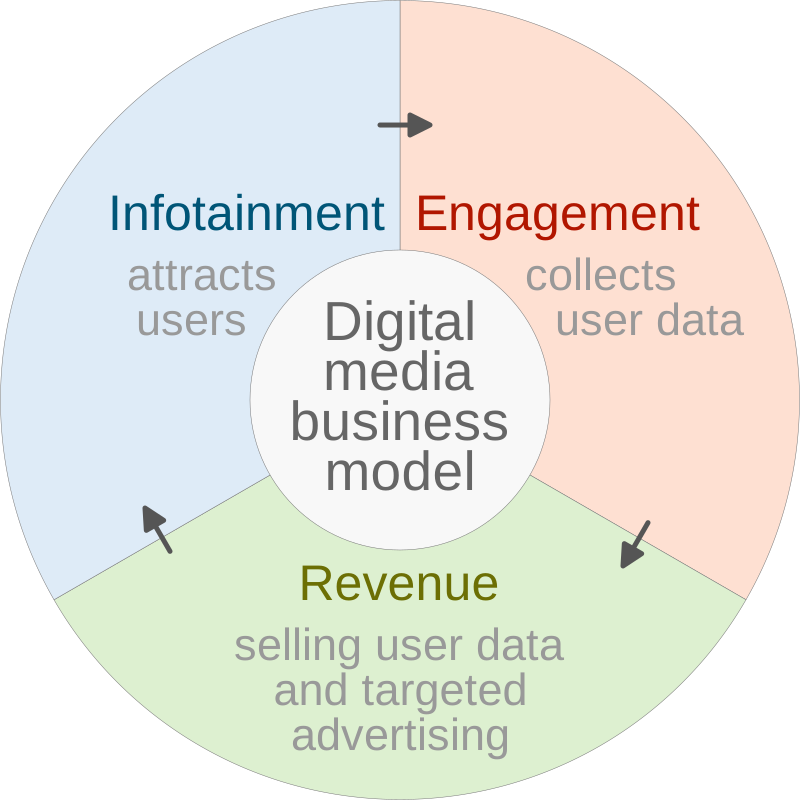
Online video, especially dominant player YouTube, has enabled small businesses to reach customers in ways previously accessible only to large companies that could afford television ads, and enables them to form "brand channels", track viewer metrics, and provide instructional videos to reduce the need for costly customer support. Large companies "amortize" the large cost of their Super Bowl television commercials by trying to maximize post-game video plays.
YouTube has focused on developing channels rather than creating content per se, the channels fragmenting the audience into niches in much the same way that decades earlier hundreds of niche-audience cable TV channels fragmented the audience previously dominated by the Big Three television networks. Based on YouTube's channel development plans, including YouTube Original Channels, journalist John Seabrook projected that "the niches will get nichier", with audiences being more engaged and much more quantifiable, enabling advertising to be more highly focused.
Measurement of mainstream opinion
In the year following its 2005 formation, YouTube, with its display of view counts, was likened to "a survey of cultural whims", whose more popular artists attracted the interest of established production companies. In YouTube's first years, however, music labels had trouble gauging the commercial value of online popularity, perceiving that the Internet's "convenience factor" made an artist's online following less indicative of audience attachment than direct measures such as CD sales and concert attendance. Putting online listens on the same footing as actual song purchases to determine hits was described as reflecting "the latest shift in power in the music industry: from record labels and radio DJs to listeners".
Later in 2013, ''Forbes''' Katheryn Thayer noted that, though booking the right concert venues and radio and television stations once propelled artists to fame, social media activity had become "unquestionably important".
Reaching wider audiences
YouTube has been used to grow audiences, both by undiscovered individual artists and by large production companies.
Evolution of YouTube as a platform for individuals and companies
Within the year following YouTube's 2005 launch—which one commentator called "the biggest jolt to Internet video" then singer Justin Bieber (through Usher), and physician-become-political satirist Bassem Youssef (through an Egyptian television network).
Old media celebrities also moved into the website at the invitation of a YouTube management that witnessed early content creators accruing substantial followings, and perceived audience sizes potentially larger than that attainable by television. In October 2006, Google paid $1.65 billion to purchase the 67-employee YouTube, seeking a lucrative marketing platform as both audiences and advertisers migrated from television to the Internet. Google made the website more business-driven,
Independent artists built grassroots followings numbering in the thousands at very little cost or effort, but mass retail and radio promotion—areas still dominated by record labels—proved problematic. Meanwhile, as early as 2006, YouTube management convinced four major music labels—who initially had been wary of the website because of its large quantity of their copyrighted material—to enter into a partnership with YouTube, convincing them that YouTube could help them make more money by connecting them with growing Internet audiences. Paradoxically, it was the production companies eventually formed by pioneering YouTubers that created about one-third of these new "originals" channels.
By 2012, the CMU business editor had characterized YouTube as "a free-to-use... promotional platform for the music labels", and in 2013 the videos of the 2.5% of artists categorized as "mega", "mainstream" and "mid-sized" received 90.3% of the relevant views on YouTube and Vevo. In 2014 YouTube announced that it would block videos from labels that do not sign licensing contracts for the website's premium (paid subscription) music streaming service, in effect excluding independent record labels who have refused to sign contracts having terms inferior to those having already been agreed to by all the major labels. Yet, content creators continued to grow audiences by inspiring rapidly-forming "ecosystems of supplementary content" such as "reaction videos", causing a Washington Post editor to comment in 2019 that, more than slower-to-react conventional ratings such as the Billboard charts, "YouTubers are the tastemakers for millions of younger music fans".
In 2016, YouTube's demonetization of user videos that had "controversial or sensitive subjects and events ... even if graphic imagery is not shown”—thereby disallowing ad revenue—angered content creators who perceived the policy as "rampant censorship" and inspired a #YouTubeIsOverParty hashtag on social media.
Posting videos as a livelihood

Enabling a new way of earning a livelihood, YouTube's "Partner Program", an ad-revenue-sharing arrangement begun in 2007, grew by January 2012 to about 30,000 partners, its top five hundred partners each earning more than $100,000 annually and some earning "much more". In the twelve months ending June 1, 2017, the ten highest earners grossed $127 million with the highest-earning individual channel grossing $16.5 million, these figures rising to $180.5 million and $22 million, respectively, in 2018 $162 million and $26 million (2019), $211 million and $29.5 million (2020), $300 million and $54 million (2021), and $314.5 million and $54 million (2022).
A study found that in 2016 the top 3% of channels (with 1.4 million views per month) got 90 percent of the website's viewership, and that someone with that many views would receive less than $17,000 per year. A 2019 study found that only 11.6% of videos receive 1,000 views, and 0.77% reach 100,000 views.
References
References
- (October 17, 2018). "YouTube back working again after going down across the world". [[Newshub]].
- (March 6, 2020). "The top 500 sites on the web / Global".
- "Top Websites Ranking".
- (June 1, 2021). "10 facts about Americans and Facebook". Pew Research Center.
- Anderson, Chris. (July 2010). "How web video powers global innovation". [[TED (conference).
- "Khan Academy channel's 'About' page (statistics reported by YouTube)". YouTube.
- Noer, Michael. (November 2, 2012). "One Man, One Computer, 10 Million Students: How Khan Academy Is Reinventing Education".
- Motoko, Rich. (August 16, 2012). "Videos of Top Teachers Explaining Their Craft". The New York Times.
- Levy, Steven. (March 2, 2012). "TED and Meta TED: On-Scene Musings From the Wonderdome".
- (January 2, 2014). "TED - Ideas Worth Spreading". YouTube's reporting of 'TEDtalksDirector' channel's statistics.
- Fischler, Marcelle S.. (June 21, 2007). "Putting on Lip Gloss, and a Show, for YouTube Viewers". The New York Times.
- (September 1, 2015). "Healthcare information on YouTube: A systematic review". Health Informatics Journal.
- (January 1, 2012). "Social media in health--what are the safety concerns for health consumers?". The HIM Journal.
- Chu, Jon M.. (February 2010). "The LXD: In the Internet age, dance evolves". [[TED (conference).
- Berlin, Leslie. (October 25, 2008). "If No One Sees It, Is It an Invention?". The New York Times.
- Heffernan, Virginia. (September 3, 2009). "Uploading the Avant-Garde".
- (April 14, 2009). "YouTube orchestra prepares for Carnegie debut". Reuters.
- Levs, Josh. (March 6, 2010). "CNN Newsroom". CNN.
- Smart, Richard. (May 11, 2011). "Crowdsourcing: After Quakebook, We Pray For You". The Tokyo Times.
- Goto, Yumi. (August 1, 2011). "From Midnight to Midnight: Life in a Day".
- ''Seattle Times'' staff. (June 2, 2011). "Syndicated columnist Dan Savage wins Webby Award". The Seattle Times.
- Hartlaub, Peter. (October 8, 2010). "Dan Savage overwhelmed by gay outreach's response". San Francisco Chronicle.
- (2010). "It Gets Better".
- Wiseman, Rosalind. (April 9, 2011). "What Makes a Good Bullying PSA?". The Huffington Post (education).
- Blackwell, Tom. (January 3, 2014). "As media coverage of suicides becomes more common, debate rages over whether that is a positive change".
- (October 14, 2012). "In wake of Amanda Todd suicide, MPs to debate anti-bullying motion". CTV News.
- Varrati, Michael. (March 18, 2013). "Tyler Oakley's Trevor Project Birthday". The Huffington Post.
- Bray, Marianne. (June 9, 2006). "Irate HK man unlikely Web hero". CNN (Asia edition).
- (December 4, 2009). "100 Greatest Movies, TV Shows, and More".
- Learmonth, Michael. (February 22, 2010). "Lowered Expectations: Web Redefines 'Quality'".
- Wesch, Michael. (June 23, 2008). "An Anthropological Introduction to YouTube".
- Scobie, Willow. (November 2011). "An Anthropological Introduction to YouTube by Michael Wesch". American Anthropologist.
- (July 31, 2019). "How did YouTube become the most popular music streaming site? By sounding like the world itself.". The Washington Post.
- (23 April 2025). "YouTube Turns 20: From 'Lazy Sunday' to 'Hot Ones'". The New York Times.
- (18 April 2025). "From weird elephant videos to revolutionising TV: 20 years of YouTube". The Guardian.
- (23 April 2025). "YouTube is everything and everything is YouTube". The Verge.
- (January 4, 2018). "It's Not Just Logan Paul and YouTube—The Moral Compass of Social Media is Broken".
- (December 22, 2017). "2017 Was YouTube's Best Year Ever. It Was Also Its Worst".
- (March 14, 2019). "YouTube says it bans preteens from its site. But it's still delivering troubling content to young children.". The Washington Post.
- (September 6, 2019). "The Week in Tech: YouTube Fined $170 Million Over Child Privacy Violations". The New York Times.
- (January 18, 2018). "YouTube is pulling Tide Pod Challenge videos". TechCrunch.
- Journalism Project Staff. (July 16, 2012). "PEJ: YouTube & News: A New Kind of Visual Journalism Is Developing, but Ethics of Attribution Have Yet to Emerge".
- Journalism Project Staff. (July 16, 2012). "YouTube and News: A New Kind of Visual News". [[Pew Research Center]].
- Ivry, Sara. (April 16, 2007). "Now on YouTube: The Latest News From Al Jazeera, in English". The New York Times.
- (September 14, 2012). "U.S. warns of rising threat of violence amid outrage over anti-Islam video". CNN.
- Stelter, Brian. (February 21, 2010). "Honoring Citizen Journalists". The New York Times.
- Shane, Scott. (March 4, 2011). "Radical Cleric Still Speaks on YouTube". The New York Times.
- (December 23, 2013). "UAE court convicts eight over 'spoof documentary video'". BBC News.
- Malik, Shiv. (September 24, 2014). "Isis in duel with Twitter and YouTube to spread extremist propaganda". The Guardian.
- (January 17, 2016). "Transcript of the Democratic Presidential Debate". The New York Times.
- Lidsky, David. (February 1, 2010). "The Brief But Impactful History of YouTube".
- Heffernan, Virginia. (November 14, 2008). "Clicking and Choosing". The New York Times Magazine.
- Peters, Jeremy W.. (March 14, 2012). "With Video, Obama Looks to Expand Campaign's Reach Through Social Media". The New York Times.
- Journalism Project Staff. (July 16, 2012). "YouTube Video Creation–A Shared Process".
- Heffernan, Virginia. (April 10, 2009). "The YouTube Presidency".
- (April 23, 2015). "YouTube is 10 years old. Here's how it has changed politics forever.". The Washington Post.
- Hauser, Christine. (November 19, 2013). "On YouTube, Iranian Minister Says 'Join Us' in Ending Crisis". The New York Times.
- Jenkins, Brad L.. (March 6, 2014). "YouTube Stars Talk Health Care (and Make History) at the White House".
- McMorris-Santoro, Evan. (March 2, 2014). "Obama Enlisted YouTube Personalities For Final Health Care Enrollment Push Last Week".
- Cohen, Joshua. (March 2, 2014). "Obama Meets With YouTube Advisors On How To Reach Online Audiences".
- Reston, Maeve. (December 12, 2013). "Round 2: Obamacare and Hollywood open new social media campaign". Los Angeles Times.
- (January 22, 2015). "Obama Seeks Broader Audience Through YouTube Personalities". The New York Times.
- Barringer, Felicity. (September 20, 2012). "Via YouTube, a New Conservation Genre". The New York Times.
- (August 1, 2021). "To Fight Vaccine Lies, Authorities Recruit an 'Influencer Army'". The New York Times.
- Donovan, Karen. (September 28, 2007). "Law Firms Go a Bit Hollywood to Recruit the YouTube Generation". The New York Times.
- (August 2, 2012). "A YouTube Introduction to U.S. Colleges, by Just Clicking Play". The New York Times.
- Lewin, Tamar. (February 22, 2010). "To Impress, Tufts Prospects Turn to YouTube". The New York Times.
- Poniewozik, James. (April 1, 2009). "Peabody Awards Announced".
- Journalism Project Staff. (July 16, 2012). "YouTube and News: Leading topics".
- (April 2011). "YouTube Censored: A Recent History".
- Preston, Jennifer. (July 18, 2012). "YouTube Offers a Way to Blur Faces, Protecting Identities in Videos". The New York Times.
- MacFarquhar, Neil. (June 11, 2011). "In Saudi Arabia, Comedy Cautiously Pushes Limits". The New York Times.
- Simon, Bob. (March 16, 2014). "Meet the "Jon Stewart of Egypt": Bassem Youssef". CBS News (60 Minutes transcript).
- (February 7, 2014). "Youssef: 'Important to have other opinions'". Deutsche Welle.
- Journalism Project Staff. (July 16, 2012). "YouTube and News: Top Stories".
- Wong, Scott. (March 22, 2012). "Joseph Kony captures Congress' attention".
- (April 21, 2015). "Three years after it fell apart, Kony 2012 may have finally changed the world". The Washington Post.
- (August 3, 2017). "For the New Far Right, YouTube Has Become the New Talk Radio".
- (September 19, 2018). "YouTube's secret life as an engine for right-wing radicalization". Columbia Journalism Review.
- (June 8, 2019). "The Making of a YouTube Radical". The New York Times.
- Lomas, Natasha. (January 28, 2020). "Study of YouTube comments finds evidence of radicalization effect".
- Newton, Casey. (2019-08-28). "YouTube may push users to more radical views over time, a new paper argues".
- (2020-10-21). "Right-Wing YouTube: A Supply and Demand Perspective". The International Journal of Press/Politics.
- (2022-02-14). "Examining the consumption of radical content on You ''Tube''". Proceedings of the National Academy of Sciences.
- (September 24, 2018). "The rise of YouTube's reactionary right - How demographic change and YouTube's algorithms are building a new right".
- (December 10, 2018). "Two years after #Pizzagate showed the dangers of hateful conspiracies, they're still rampant on YouTube". The Washington Post.
- (January 25, 2019). "Continuing our work to improve recommendations on YouTube".
- (March 10, 2018). "YouTube, the Great Radicalizer". The New York Times.
- (August 11, 2019). "How YouTube Radicalized Brazil". The New York Times.
- (October 21, 2020). ["Right-Wing YouTube: A Supply and Demand Perspective"](https://orca.cardiff.ac.uk/id/eprint/171689/1/Youtube_Supply_Demand.pdf }} ([https://osf.io/368xz/download downloadable PDF] {{Webarchive). The International Journal of Press/Politics.
- (3 November 2020). "YouTube Cut Down Misinformation. Then It Boosted Fox News / To battle false information, YouTube cut its recommendations to fringe channels and instead promoted major networks, especially Fox News.". The New York Times.
- (November 16, 2020). "Fox News's 'partisan right' audience on YouTube is dropping, researchers say". The New York Times.
- (January 17, 2021). "YouTube stands alone as other social media providers race to deplatform Trump". CNBC.
- (August 25, 2021). "'YouTube magic dust': How America's second-largest social platform ducks controversies". The Washington Post.
- Toquero, Loreben. (2021-09-22). "Red flag for 2022: Political lies go unchecked on YouTube showbiz channels".
- Tantuco, Vernise. (2021-04-15). "YouTube's unclear policies allow lies, disinformation to thrive".
- Vick, Karl. (2021-10-08). "'It Is a Battle for Facts.' What Nobel Peace Prize Winner Maria Ressa Understands About Why She Was Chosen".
- (December 1, 2019). "How does YouTube handle the site's misinformation, conspiracy theories and hate?".
- (December 1, 2019). "300+ Trump ads taken down by Google, YouTube". 60 Minutes.
- (November 18, 2020). "Election misinformation often evaded YouTube's efforts to stop it". The New York Times.
- Mendoza, Gemma. (2019-04-20). "Networked propaganda: How the Marcoses are using social media to reclaim Malacañang".
- (2019). "The role of conspiracy mentality in denial of science and susceptibility to viral deception about science". Politics and the Life Sciences.
- (2023). "Disinformation and Echo Chambers: How Disinformation Circulates on Social Media Through Identity-Driven Controversies". Journal of Public Policy & Marketing.
- (July 25, 2019). "Science and Environmental Communication on YouTube: Strategically Distorted Communications in Online Videos on Climate Change and Climate Engineering". Front. Commun..
- (January 16, 2020). "YouTube Has Been 'Actively Promoting' Videos Spreading Climate Denialism, According to New Report".
- (24 November 2020). "OANN suspended from YouTube after promoting a sham cure for Covid-19". The Guardian.
- (2021-08-01). "Sky News Australia barred for week by YouTube over Covid misinformation". BBC News.
- (September 28, 2021). "YouTube is banning prominent anti-vaccine activists and blocking all anti-vaccine content". The Washington Post.
- (October 7, 2021). "Google bans ads on content, including YouTube videos, with false claims about climate change.". The New York Times.
- (May 4, 2023). "Google profiting from climate misinformation on YouTube, report finds". The Independent.
- (16 January 2024). "YouTube making money off new breed of climate denial, monitoring group says". Reuters.
- Tsukayama, Hayley. (April 20, 2012). "In online video, minorities find an audience". The Washington Post.
- (April 11, 2019). "So you want to be a science YouTube star...". The Washington Post.
- (July 26, 2019). "YouTube Made Them Famous. Now, They're Done With It. What Happened?". [[Refinery29]].
- Considine, Austin. (October 14, 2011). "Coming Out to the World on the Web". The New York Times.
- Schneider, Keith. (April 10, 2007). "For Keeps: Lives on the Record and on the Web". The New York Times.
- (October 6, 2019). "On YouTube, people with disabilities create content to show and normalize their experiences". The Washington Post.
- (February 21, 2011). "The Scope of Nonsuicidal Self-Injury on YouTube". Pediatrics.
- Ave, Melanie. (April 9, 2008). "Video of Lakeland teen's beating evokes outrage". Tampa Bay Times.
- Pleasant, Matthew. (October 2, 2011). "Local Teen Beating Inspires Movie". The Ledger.
- Huynh, Terence. (March 20, 2014). "Crossing the line: YouTube community in crisis as sexual assault allegations are made public".
- Diaz Ruiz, Carlos. (2023-10-30). "Disinformation on digital media platforms: A market-shaping approach". New Media & Society.
- Pattison, Kermit. (March 16, 2011). "Online Video Offers Low-Cost Marketing For Your Company". The New York Times.
- Elliott, Stuart. (February 5, 2008). "For Marketing, the Most Valuable Player Might Be YouTube". The New York Times.
- Seabrook, John. (January 16, 2012). "Streaming Dreams".
- Feifer, Jason. (June 11, 2006). "Video makers find a vast and eager audience".
- ''Billboard'' staff. (February 20, 2013). "Hot 100 News: Billboard and Nielsen Add YouTube Video Streaming to Platforms".
- Diamond, Jason. (November 16, 2012). "From Jukeboxes to YouTube: How Billboard Is Catching Up With The Times".
- Thayer, Katheryn. (October 29, 2013). "The Youtube Music Awards: Why Artists Should Care".
- Herrera, Monica. (March 19, 2010). "Justin Bieber - The Billboard Cover Story".
- (October 10, 2006). "Google buys YouTube for $1.65 billion". NBC News.
- Bruno, Antony. (February 25, 2007). "YouTube stars don't always welcome record deals". Reuters.
- Walker, Rob. (June 28, 2012). "On YouTube, Amateur Is the New Pro". The New York Times.
- (December 21, 2012). "Gangnam Style hits one billion views on YouTube". BBC News.
- (January 2014). "2013: Year in Rewind (report title) / Mapping the Landscape (specific section title)".
- (June 17, 2014). "YouTube to block indie labels who don't sign up to new music service". The Guardian.
- (April 13, 2019). "There's an entire ecosystem around 'Old Town Road.' Welcome to music YouTube.". The Washington Post.
- (September 1, 2016). "Why YouTubers are accusing the site of rampant 'censorship'". The Washington Post.
- (December 7, 2017). "The Highest-Paid YouTube Stars 2017: Gamer DanTDM Takes The Crown With $16.5 Million".
- (December 3, 2018). "Highest-Paid YouTube Stars 2018: Markiplier, Jake Paul, PewDiePie And More".
- (December 18, 2019). "The Highest-Paid YouTube Stars of 2019: The Kids Are Killing It".
- (December 18, 2020). "The Highest-Paid YouTube Stars Of 2020".
- (April 14, 2022). "The Highest-Paid YouTube Stars: MrBeast, Jake Paul And Markiplier Score Massive Paydays".
- (21 April 2023). "10 highest paid YouTubers in the world; their earnings will shock you!".
- (2017). "Even YouTube Stars With 1.4 Million Monthly Viewers Earn Less Than $17,000 a Year, Research Shows / You should probably buy lottery tickets instead".
- (August 10, 2020). "Almost 90% of all uploaded YouTube videos will never reach 1,000 views". [[9to5Google]].
This article was imported from Wikipedia and is available under the Creative Commons Attribution-ShareAlike 4.0 License. Content has been adapted to SurfDoc format. Original contributors can be found on the article history page.
Ask Mako anything about Social impact of YouTube — get instant answers, deeper analysis, and related topics.
Research with MakoFree with your Surf account
Create a free account to save articles, ask Mako questions, and organize your research.
Sign up freeThis content may have been generated or modified by AI. CloudSurf Software LLC is not responsible for the accuracy, completeness, or reliability of AI-generated content. Always verify important information from primary sources.
Report