From Surf Wiki (app.surf) — the open knowledge base
Snowy owl
Species of owl

Species of owl
- Strix nyctea Linnaeus, 1758
- Nyctea scandiaca (Linnaeus, 1758)
The snowy owl (Bubo scandiacus), also known as the polar owl, the white owl and the Arctic owl, is a large, white owl of the true owl family. Snowy owls are native to the Arctic regions of both North America and the Palearctic, breeding mostly on the tundra. One of the largest species of owl, it is the only owl with mainly white plumage. Juvenile male snowy owls have dark markings and may appear similar to females until maturity, at which point they typically turn whiter. The composition of brown markings about the wing, although not foolproof, is the most reliable technique for aging and sexing individual snowy owls.
Most owls sleep during the day and hunt at night, but the snowy owl is often active during the day, especially in the summertime. The snowy owl lays a very large clutch of eggs, often from about 5 to 11, with the laying and hatching of eggs considerably staggered. Despite the short Arctic summer, the development of the young takes a relatively long time and independence is sought in autumn.
The snowy owl is a nomadic bird, rarely breeding at the same locations or with the same mates on an annual basis and often not breeding at all if prey is unavailable. Given the difficulty of surveying such an unpredictable bird, there was little in-depth knowledge historically about the snowy owl's status. However, recent data suggests the species is declining precipitously. Whereas the global population was once estimated at over 200,000 individuals, recent data suggests that there are probably fewer than 100,000 individuals globally and that the number of successful breeding pairs is 28,000 or even considerably less. While the causes are not well understood, numerous, complex environmental factors often correlated with global warming are probably at the forefront of the fragility of the snowy owl's existence.
Taxonomy
The snowy owl was one of the many bird species originally described by Carl Linnaeus in his landmark 1758 10th edition of Systema Naturae, where it was given the binomial name Strix scandiaca. The genus name Bubo is Latin for "horned owl" and scandiacus is Neo-Latin for "of Scandinavia". The former generic name Nyctea is derived from Greek meaning "night". Until recently, the snowy owl was regarded as the sole member of a distinct genus, as Nyctea scandiaca, but mtDNA cytochrome b sequence data shows that it is very closely related to the horned owls in the genus Bubo and the species is now thusly often considered inclusive with that genus. However, some authorities debate this classification, still preferring Nyctea. Often authorities are motivated to retain the separate genus on the grounds of osteological distinctions.
Genetic testing revealed a reasonably distinct genetic makeup for snowy owls, being about 8% genetically distinct from other Bubo owls, perhaps giving credence to those who count the species as separate under Nyctea. However, a fairly recent shared origin in evolutionary history has been illustrated through a combination of genetic study and fossil review and there is little, other than osteology of the tarsometatarsus, to outright distinguish the snowy owl from other modern species like the Eurasian eagle-owl (Bubo bubo).
On a broader scale, owls in general have, through genetic materials, been determined to be a highly distinct group, with outwardly similar groups such as Caprimulgiformes revealed to not be at all closely related. Within the owl order, typical owls are highly divergent from barn-owls. A number, but not all, of extant typical owls seem to have evolved from an ancient shared common ancestor with the Bubo owls. In addition to the question of relationship of the traditional Bubo owls to the snowy owls, ongoing ambiguity of the relationship of other similarly large-sized owls has been persistent. These have sometimes either been included in the genus or within separate genera, i.e. the Ketupu or fish owls and the Scotopelia or fishing owls. Despite the adaptive distinctions, the grouping of these large owls (i.e. Bubo, snowy, fish and perhaps fishing owls) appears to be borne out via research of karyotypes.
The fossil history of snowy owls is fairly well documented despite some early confusion on how to distinguish the skeletal structure of the snowy owls from eagle-owls. It was determined that the snowy owl once was distributed much more widely and far farther to the south during the Quaternary glaciation when much of the Northern Hemisphere was in the midst of an ice age. and much of the Italian Peninsula. Pleistocene era fossils from France, i.e. B. s. gallica, showed that the snowy owls of the time were somewhat bulkier (though still notably smaller than contemporary eagle-owls of the times, which were larger than the eagle-owls of today) and osteologically more sexually dimorphic in size than the modern form (9.9% dimorphism in favor of females in the fossils against 4.8% in the same features today). There are no subspecific or other geographical variations reported in the modern snowy owls, with individuals of vastly different origins breeding together readily due to their nomadic habits.
Hybrids
Snowy owls are not known to interbreed with other owl species in the wild, and accordingly, no hybrids of snowy owls and other owl species have yet been sighted in the wild. However, a hobby falconer in Kollnburg, Germany, bred hybrids from a male snowy owl and a female Eurasian eagle-owl (Bubo bubo) in 2013. The two resulting male hybrid owls possessed the prominent ear-tufts (generally absent in snowy owls), general size, orange eyes, and the same pattern of black markings on their plumage from their Eurasian eagle-owl mother, while retaining the generally black-and-white plumage colours from their snowy owl father. The hybrids were dubbed "Schnuhus" from the German words for snowy owl and Eurasian eagle-owl (Schnee-Eule and Uhu, respectively). As of 2014, the hybrids had grown to maturity and were healthy.
Description

,_Vlieland,_Netherlands.jpg)
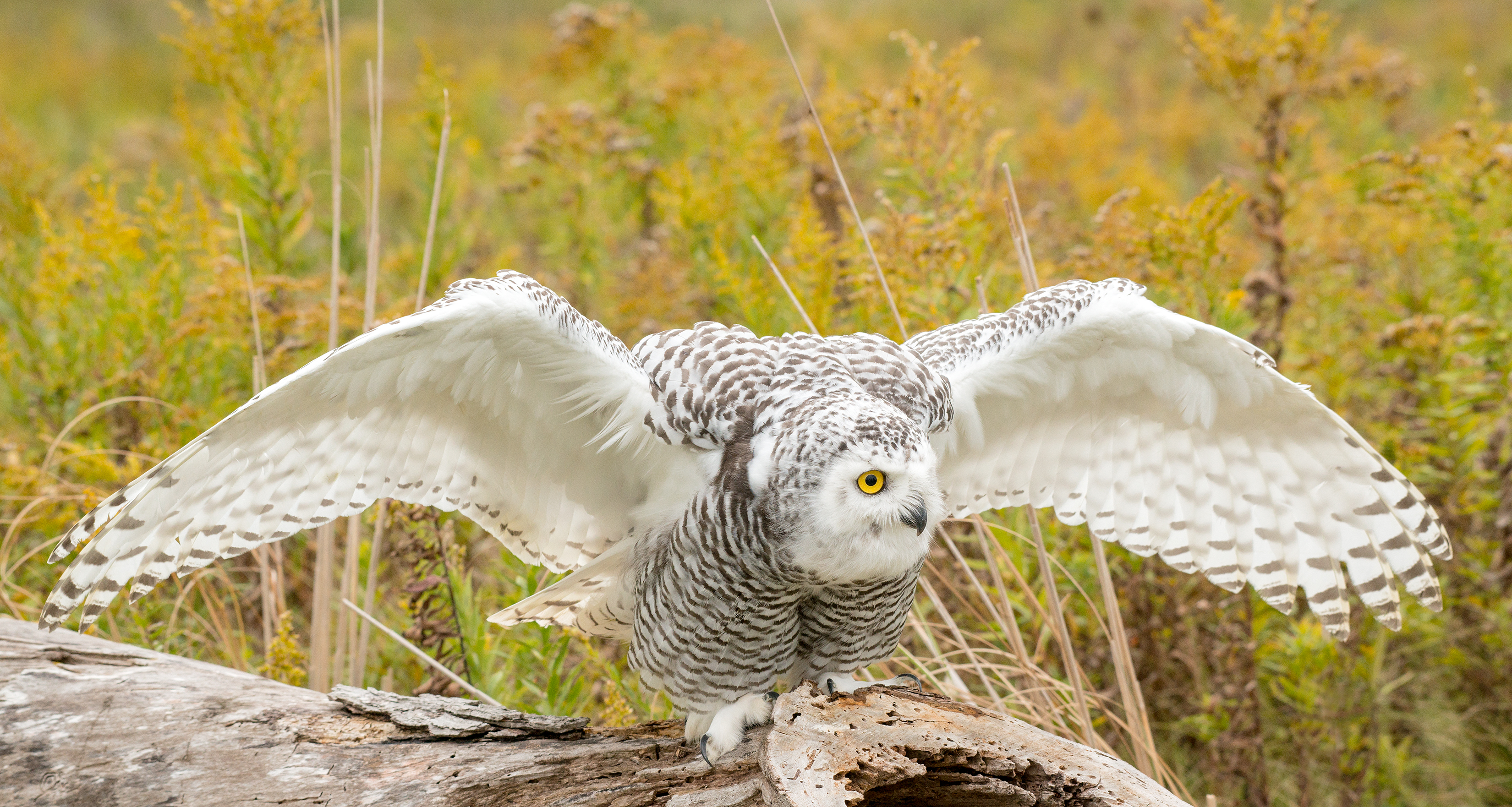
The snowy owl is mostly white. They are purer white than predatory mammals such as polar bears (Ursus maritimus) and Arctic fox (Vulpes lagopus). Often when seen in the field, these owls can resemble a pale rock or a lump of snow on the ground. They usually appear to lack ear tufts but very short (and probably vestigial) tufts can be erected in some situations, perhaps most frequently by the female when she is sitting on the nest. The ear tufts measure about 20 to and consist of about 10 small feathers. The snowy owl has bright yellow eyes. The head is relatively small and, even for the relatively simply adapted hearing mechanism of a Bubo owl, the facial disc is shallow and the ear is uncomplicated. 1 male had ear slits of merely 21 x on left and 21 x on the right.
Females are almost invariably more duskily patterned than like-age males. However, the very darkest males and the lightest females are nearly indistinguishable by plumage.
On rare occasions, a female can appear almost pure white, as has been recorded in both the field and in captivity. There is some evidence that some of the species grow paler with age after maturity. One study's conclusions were that males were usually but not always lighter and that correctly aging is extremely difficult, sometimes individuals either get lighter, darker or do not change their appearance with age. After a fresh moult, some adult females that previously appeared relatively pale newly evidenced dark, heavy markings. On the contrary, some banded individuals over at least four years were observed to have been almost entirely unchanged in the extent of their markings.
The chicks are initially grayish white but quickly transition to dark gray-brown in the mesoptile plumage. This type of plumage camouflages effectively against the variously colored lichens that dot the tundra ground. The juvenile plumage resembles that of adult females but averages slightly darker on average.
Moults usually occur from July and September, non-breeding birds moulting later and more extensively, and are never extensive enough to render the owls flightless. Generally speaking, moults of snowy owls occur more quickly than do those of Eurasian eagle-owls.
The toes of the snowy owl are extremely thickly feathered white, while the claws are black. Occasionally, snowy owls may show a faint blackish edge to the eyes and have a dark gray cere, though this is often not visible from the feather coverage, and a black bill. The conspicuously notched primaries of the snowy owl appear to give an advantage over similar owls in long-distance flight and more extensive flapping flight.
The snowy owl does have some of the noise-canceling serrations and comb-like wing feathers that render the flight of most owls functionally silent, but they have fewer than most related Bubo owls. Therefore, in combination with its less soft feathers, the flight of a snowy owl can be somewhat audible at close range. The flight of snowy owls tends to be steady and direct and is reminiscent to some of the flight of a large, slow-flying falcon. Though normally performing "flap-and-glide" flight style, there is no evidence that snowy owls will soar. This owl species can occasionally demonstrate speed and agility in the air while chasing avian prey. Hovering flight is sometimes used by snowy owls as a hunting method, despite their large size. It is said that the species seldom exceeds a flying height of around 150 m even during passage. While the feet are sometimes described as "enormous", the tarsus is in osteological terms relatively short at 68% the length of those of a Eurasian eagle-owl but the claws are nearly as large, at 89% of the size of those of the eagle-owl.
Despite its relatively short length, the tarsus is of similar circumference as in other Bubo owls. Also compared to an eagle-owl, the snowy owl has a relatively short decurved rostrum, a proportionately greater length to the interorbital roof and a much longer sclerotic ring surrounding the eyes while the anterior opening are the greatest known in any owl. Owls have extremely large eyes which are nearly the same size in large species such as the snowy owl as those of humans.
The snowy owl's eye, at about 23.4 mm in diameter, is slightly smaller than those of great horned and Eurasian eagle-owls but is slightly larger than those of some other large owls. Snowy owls must be able to see from great distances and in highly variable conditions but probably possess less acute night vision than many other owls. Despite their visual limits, snowy owls may have up to 1.5 times more visual acuity than humans. Owls have the largest brains of any bird (increasing in sync with the size of the owl species), with the size of the brain and eye related less to intelligence than perhaps to increased nocturnality and predatory behavior.
Size

The snowy owl is a very large owl. This species is the heaviest and longest winged owl (as well as the second longest) in North America, the second heaviest and longest winged owl in Europe (and third longest) but is outsized in bulk by 3 or 4 other species in Asia. Despite being sometimes described as of similar size, the snowy owl is somewhat larger in all aspects of average size than the great horned owl while the similarly specialized taiga-dwelling great grey owl (Strix nebulosa), is longer in total length and of similar dimensions in standard measurements, but is shorter winged and much less heavy than the snowy owl.
In Eurasia, the Eurasian eagle-owl is larger in all standards of measurements than the snowy owl not to mention two additional species each from Africa and Asia that are slightly to considerably heavier on average than the snowy owl. Females are sometimes described as "giant" whereas males appear relatively "neat and compact".
Male snowy owls have been known to measure from 52.5 to in total length, with an average from four large samples of 58.7 cm and a maximum length, perhaps in need of verification, of reportedly 70.7 cm. In wingspan, males may range from 116 to, with a mean of 146.6 cm. In females, total length has been known to range from 54 to, with a mean of 63.7 cm and an unverified maximum length of perhaps 76.7 cm (if so they would have the second longest maximum length of any living owl, after only the great grey owl).
Female wingspans have reportedly measured from 146 to, with a mean of 159 cm. Body mass in females can average from 1706.7 to, with a median of 2101.8 g and a full weight range of 1330 to. Larger than the aforementioned body mass studies, a massive pooled dataset at six wintering sites in North America showed that 995 males averaged at 1636 g while 1,189 females were found to average 2109 g. Reported weights of down to 710 g for males and of 780 to for females are probably in reference to owls in a state of starvation. Such emaciated individuals are known to highly impaired and starvation deaths are probably not infrequent in winters with poor food accesses.
_(14755679525).jpg)
Standard measurements have been even more widely reported than length and wingspan. The wing chord of females can vary from 380 to, averaging from 416.2 to with a median of 435.5 mm. The tail length of males can vary on average from 209.6 to, with a full range of 188 to and a median of 227 mm. The tail length of females can average from 228.5 to, with a full range of 205 to and a median of 244.4 mm.
Data indicates that slightly longer wing chord and tail lengths were reported on average in Russian data than in American research, however the weights were not significantly different in the two regions. Less widely taken measurements include the culmen, which can measure from 24.6 to with a median average of 26.3 mm in males and 27.9 mm in females, and the total bill length which is from 25 to, with an average in both sexes of 35.6 mm. Tarsal length in males averages about 63.6 mm, with a range of 53 to, and averages about 66 mm, with a range of 54 to, in females.
Identification
The snowy owl is certainly one of the most unmistakable owls (or perhaps even animals) in the world.
More similar owls such as the Eurasian eagle-owl and the great horned owl attain a fairly pale, sometimes white-washed look in their northernmost races. These species do not normally breed nearly as far north as snowy owls but overlaps certainly do occur with snowy owls when the latter owl sometimes comes south in winter. However, even the most pale great horned and Eurasian eagle-owls are still considerably more heavily marked with darker base colors than snowy owls (the whitest eagle-owls are paler than the whitest great horned owls), possess much larger and more conspicuous ear tufts and lack the bicolored appearance of the darkest snowy owls. While the great horned owl has yellow eyes like the snowy owl, the Eurasian eagle-owl tends to have bright orange eyes. The open terrain habitats normally used by wintering snowy owls are also distinct from the typical edge and rocky habitats usually favored by the great horned and Eurasian eagle-owls, respectively.
Vocalizations
The snowy owl differ in their calls from other Bubo owls, with a much more barking quality to their version of a hooting song. The main vocalization is a monotonous sequence that normally contains 2–6 (but occasionally more), rough notes similar to the rhythm of a barking dog: krooh krooh krooh krooh...
The calls of this species may carry exceptionally far in the thin air of Arctic, certainly over more than 3 km, and maybe even to as much 10 to away. The alarm call is a loud, grating, hoarse keeea.
Another raspier bark is recorded, sometimes called a "watchman's rattle" call, and may be transcribed as rick, rick, rick, ha, how, quack, quock or kre, kre, kre, kre, kre. They may also clap their beak in response to threats or annoyances. While called clapping, it is believed this sound may actually be a clicking of the tongue, not the beak.
Though largely only vocal in the breeding season, leading to some erroneous older accounts describing the snowy owl as completely silent, some vocalizations have been recorded in winter in the northern United States. Initially, the young of the snowy owl have a high pitched and soft begging call which develops into a strong, wheezy scream at around 2 weeks. At the point when the young owls leave the nest around 3 weeks, the shrill squeals they emit may allow the mothers to locate them.
Distribution and habitat
Breeding range
The snowy owl is typically found in the northern circumpolar region, where it makes its summer home north of latitude 60° north though sometimes down to 55 degrees north. Snowy owls nest in the Arctic tundra of the northernmost stretches of Alaska, Northern Canada, and the Euro-Siberian region.

Between 1967 and 1975, snowy owls bred on the remote island of Fetlar in the Shetland Isles north of mainland Scotland, discovered by the Shetland RSPB warden, Bobby Tulloch. Females summered as recently as 1993, but their status in the British Isles is now that of a rare winter visitor to Shetland, the Outer Hebrides and the Cairngorms. Vagrant snowy owls have occasionally been found as far south as Lincolnshire. Older records show that the snowy owls may have once semi-regularly bred elsewhere in Shetland. They range in northern Greenland (mostly Peary Land) and, rarely in "isolated parts of the highlands", Iceland.
They also range in much of northern Russia, including northern Siberia, Anadyr, Koryakland, Taymyr Peninsula, Yugorsky Peninsula, Sakha (especially the Chukochya River) and Sakhalin. They range throughout most of the Arctic isles of Russia such as Novaya Zemlya, Severnaya Zemlya, New Siberian Islands, Wrangel Island, Commander and Hall Islands.
In North America, the breeding range has been known in modern times to include the Aleutian Islands (i.e. Buldir and Attu) and much of northern Alaska, most frequently from the Arctic National Wildlife Refuge to Utqiaġvik, and more sporadically down along the coastal-western parts such as through Nome, Hooper Bay, the Yukon Delta National Wildlife Refuge, and rarely even south to the Shumagin Islands. Since breeding and distribution is very small, local and inconsistent in northern Europe, northern Canada and northern Alaska represent the core part of the breeding range for snowy owls along with several parts of northern and northeastern/coastal Russia.
Regular wintering range

During the winter months, many snowy owls leave the dark Arctic to migrate to regions further south. Southern limits of the regular winter range are difficult to delineate given the inconsistency of appearances south of the Arctic. Furthermore, not infrequently, many snowy owls will overwinter somewhere in the Arctic through the winter, though seldom appear to do so in the same sites where they have bred. Due in no small part to the difficulty and hazardousness of observation for biologists during these harsh times, there is very limited data on overwintering snowy owls in the tundra, including how many occur, where they winter and what their ecology is at this season.
The regular wintering range has at times been thought to include Iceland, Ireland and Scotland and across northern Eurasia such as southern Scandinavia, the Baltics, central Russia, southwestern Siberia, Sakhalin southern Kamchatka and, rarely, north China and sometimes the Altai Republic.
In February 1886, a snowy owl landed on the rigging of the Nova Scotia steamship Ulunda on the edge of the Grand Banks of Newfoundland, over 800 km from the nearest land. It was captured and later preserved at the Nova Scotia Museum. Surprisingly, some studies have determined that after a high lemming year in North America, a higher percentage of snowy owls were using marine environments rather than inland ones.
Irruptive range
Large winter irruptions at temperate latitudes are thought to be due to good breeding conditions resulting in more juvenile migrants. They have been reported, as well as in all northerly states in the contiguous states, as far south as Georgia, Kentucky, South Carolina, nearly all the Gulf Coast of the United States, Colorado, Nevada, Texas, Utah, California and even Hawaii. In January 2009, a snowy owl appeared in Spring Hill, Tennessee, the first reported sighting in the state since 1987. Also notable is the mass southern migration in the winter of 2011/2012, when thousands of snowy owls were spotted in various locations across the United States. This was then followed by an even larger mass southern migration in 2013/2014 with the first snowy owls seen in Florida for decades. The nature of irruptions is less well-documented in Eurasia, in part due to the paucity of this owl in the European side, but accidental occurrence, presumably during irruptions, has been described in the Mediterranean area, France, Crimea, the Caspian part of Iran, Kazakhstan, northern Pakistan, northwestern India, Korea and Japan. Stragglers may too turn up as far south as the Azores and Bermuda.
Habitat

Snowy owls are one of the best known inhabitants of the open Arctic tundra. Frequently, the earth in snowy owl breeding grounds is covered with mosses, lichens and some rocks. Often the species preferentially occurs in areas with some rising elevation such as hummocks, knolls, ridges, bluffs and rocky outcrops. Breeding sites are usually at low elevations, usually less than 300 m above sea level, but when breeding to the south in inland mountains, such as in Norway, they may nest at as high as 1000 m. Outside the breeding season, snowy owls may occupy nearly any open landscape.
Typically wintering sites are rather windswept with meager cover. During irruption years when they are found in the northeastern United States, juveniles frequent developed areas including urban areas and golf courses, as well as the expected grasslands and agricultural areas that older birds primarily use.
On the plains of Alberta, observed snowy owls spent 30% of their time in stubble-fields, 30% in summer fallow, 14% in hayfield and the remainder of the time in pasture, natural grasslands and sloughs. The agricultural areas, large untouched by the farmers in winter, may have had more concentrated prey than the others in Alberta.
Perhaps the most consistently attractive habitat in North America to wintering snowy owls in modern times may be airports, which not only tend to have the flat, grassy characteristics of their preferred habitats but also by winter host a particular diversity of prey, both pests which rely on humans as well as wildlife attracted to the extensively grassy and marshy strips that dot the large airport vicinities. For example, Logan International Airport in Massachusetts has relatively one of the most reliable annual populations known in the United States in winter. All ages spend a fair amount of their time over water in the Bering Sea, the Atlantic Ocean and even the Great Lakes, mostly on ice floes. These marine and ocean-like freshwater areas were observed to account for 22–31% of habitat used in 34 radio-tagged American snowy owls over two irruptive years, with the tagged owls occurring a mean of 3 km from the nearest land (while 35–58% used the expected preferred habitats of grassland, pasture and other agricultural land).
Behavior

Snowy owls may be active to some extent at both day, from dawn to dusk, and night. Reportedly, the peak time of activity during summer is between 9:00 pm and 3:00 am in Norway. The peak time of activity for those owls that once nested on Fetlar was reported between 10:00 and 11:00 pm.
According to one authority, the least active times are at noon and midnight. The variation of activity is probably in correspondence with their primary prey, the lemmings, and like them, the snowy owl may be considered cathemeral. This species can withstand extremely cold temperatures, having been recorded in temperatures as low as minus 62.5 degrees Celsius with no obvious discomfort and also withstood a 5-hour exposure to minus 93 degrees Celsius but may have struggled with oxygen consumption by the end of this period. The snowy owl has perhaps the second lowest thermal conduction to the plumage on average of any bird after only the Adelie penguin (Pygoscelis adeliae) and rivals the best insulated mammals, such as Dall sheep (Ovis dalli) and Arctic fox, as the best insulated polar creature. Presumably as many as seven rodents would need to be eaten daily to survive an extremely cold winter's day.
Adults and young both have been seen to shelter behind rocks to shield themselves from particularly harsh winds or storms. Snowy owls often spending a majority of time on the ground, perched mostly on a slight rise of elevation. It has been interpreted from the morphology of their skeletal structure (i.e. their short, broad legs) that snowy owls are not well-suited to perching extensively in trees or rocks and prefer a flat surface to sit upon. However, they may perch more so in winter though do so only mainly when hunting, at times on hummocks, fenceposts, telegraph poles by roads, radio and transmission towers, haystacks, chimneys and the roofs of houses and large buildings. Rocks may be used as perches at times in all seasons. Though often relatively sluggish owls, like most related species, they are capable of sudden dashing movements in various contexts.
Snowy owls can walk and run quite quickly, using outstretched wings for balance if necessary.

Snowy owls will fight with conspecifics in all seasons occasionally but this is relatively infrequent during breeding and rarer still during winter. Dogfights and talon interlocking may ensue if the fight between two snowy owls continues to escalate. It is known that during winter in Alberta that female snowy owls are territorial towards one another and may not leave an area for up to 80 days but males are nomadic, usually only staying 1–2 days in an area (seldom to 3–17 days). The females spent on average seven times as long in a given area than did males.
During threat displays, individuals will lower the front of the body, stretch the head low and forward, with partially extended wings and feathers on the head and raise their back. Although snowy owls have been considered as semi-colonial, they do not appear to fit this mold well. Nesting sites can be loosely clustered but this is a coincidental response to concentrated prey and each pair tends to be somewhat intolerant of each other. During winter, snowy owls are usually solitary but some aggregations have been recorded, especially nearer the Arctic when more narrow food selection can lead to up to 20–30 owls gathering in an area of about 20 to. Congregations were also recorded in the winter in Montana, where 31–35 owls wintered in a 2.6 km2 area, owls mostly grouped in loose aggregations of 5–10 owls each or occasionally side-by-side or about 20 m apart.
In extreme cases in Utqiaġvik, the owls may have exceptionally close active nests that may be down to only 800 to apart.
In Southampton Island in a year when the owls nested there, nest spacing averaged 3.5 km, with the closest two 1 km apart and density per nest was 22 km2. In Nunavut, densities could go from 1 owl per 2.6 km2 in a productive year to 1 owl per 26 km2 in a poor year and from 36 nests in a 100 km2 area to none at all. Owl density on Wrangel Island in Russia was observed be a single bird each 0.11 to.
The first known study of winter territories took place in Horicon Marsh where owls ranged from 0.5 to each.

Migration
It is fair to say that the snowy owl is a partial, if fairly irregular, migrant, having a very broad but patchy wintering range. The snowy owl likely covers more ground than almost any other owl in movements but many complex individual variations are known in movements, and they often do not take the traditional north–south direction that might be assumed.
Some variety of movements recorded each autumn and snowy owls winter annually in plains of Siberia and Mongolia and prairies and marshlands of Canada. Wintering snowy owls, a total of 419, recorded in Duluth, Minnesota from 1974 to 2012 would occur in larger numbers in years where rats were more plentiful. The amount of individual returns among 43 Duluth-wintering owls was fairly low in subsequent winters (8 for 1 year, a small handful in the next few years, and 9 in non-consecutive years).
Sometimes surveys appeared to reveal hundreds of wintering snowy owls on coastal sea ice during an irruptive year. Three siblings that hatched in same nest in Cambridge Bay were recovered in drastically different spots at least a year later: one in eastern Ontario, one in Hudson Bay and one in Sakhalin Island. A nestling banded in Hordaland was recovered 1380 km to the northeast in Finnmark. In the Logan Airport, 17 of 452 owls were recorded to return, eleven the following year, three two years later, and then singles variously six, ten and 16 years later. A banded female from Utqiaġvik was recorded to migrate over 1928 km along seacoast down to Russia, returning over 1528 km and covering at least 3476 km in total. Another banded young female from Utqiaġvik went to the same Russian areas, returned to Utqiaġvik and then onto Victoria Island, but did appear to breed, while another also covered a similar route but ended up nesting on Banks Island. Another female migrated to the Canada–United States border, then moved back to the Gulf of Alaska, then to winter in the same border areas and then finally to both Banks and Victoria Island.
Snowy owls from the Canadian Arctic were monitored to have covered an average of 1100 km in one autumn then covered an average of 2900 km a year later. In late winter, owls from the same area were found to have covered a mean of 4093 km of ground in the tundra and spent a mean of 108 days, apparently searching for a suitable nesting situation the entire time.

In no fewer than 24 winters between 1882 and 1988, large numbers have occurred in Canada and the United States. These were irruption years. This connection of irruptions to high years of productivity was confirmed in a study by Robillard et al. (2016). About 90% of the snowy owls seen in irruptive years from 1991 to 2016 that were ageable were identified as juveniles.
Diet and hunting
Hunting techniques
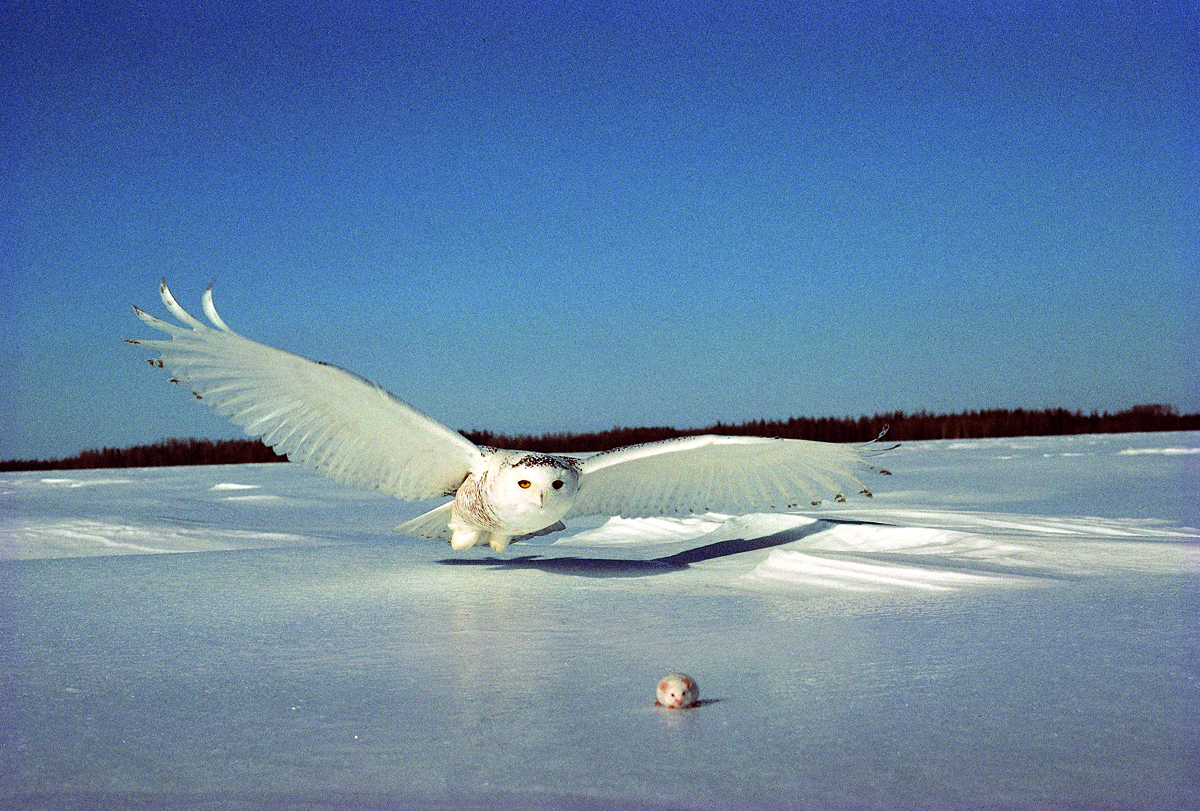
Snowy owls may hunt at nearly any time of the day or night, but may not attempt to do so during particularly severe weather. Larger prey is often torn apart, sometimes including removal of the head, with the large muscles, such as the humerus or breast, typically eaten first.
The aptitude for hunting by day, hunting from the ground and hunting in almost always completely open and treeless areas are the primary ways in which the snowy owl differs in hunting from other Bubo owls. Otherwise, the hunting habits are similar. It is thought, due to their less refined hearing compared to other owls, prey is usually perceived via vision and movement. In Utqiaġvik, snowy owls may most frequently engage in a brief pursuit hunting style. In high winds capable of keeping their bulk aloft, snowy owls may too engage in a brief hovering flight before dropping onto prey.
When hunting fish, apparently, some snowy owls will hover in a style reminiscent of the osprey (Pandion haliaetus), although in at least one other case a snowy owl was observed to capture fish by lying on its belly upon a rock by a fishing hole. A dashing stoop or pounce down onto their prey, ending in a high-impact "wallop", is fairly commonly recorded. In winter, snowy owls have been shown to be able to "snow plunge" to capture prey in the subnivean zone, under at least 20 cm of snow. Perhaps least frequently, snowy owls may pursue their prey on foot, in doing so never taking wing.
Snowy owls have been known to capture night-migrating passerines and shorebirds, sometimes perhaps on the wing, as well as large and/or potentially dangerous birds that were caught in air by snowy owls during daylight. Few variations of hunting technique were observed in winter observations from Alberta, almost all of the hunts being with the sit-and-wait method (also known as still-hunts). Adult females in Alberta had a considerably better hunting rate than juvenile females.
Much as in Alberta, in Syracuse, New York, 90% of 51 hunts were still-hunting, with the sweep variant used after perch departure in 31% of hunts and the pounce method in 45% of hunts. The Syracuse-wintering owls used tall perches, a mixture of manmade objects and trees of around 6 m high, in nearly 61% of hunts, while nearly 14% were from low perches (i.e. fence-posts, snow banks and scrap piles) about half as high as the tall perches and started from a ground position nearly 10% of the time. In Sweden, males hunted from a perch more so than did females and adults both focused on significantly smaller prey (small mammals) and may have had more success hunting than juvenile snowy owls. Some snowy owls can survive a fast for up to about 40 days off of fat reserves. These owls were found to have extremely thick subcutaneous fat deposits of 19 to and it is likely owls that overwinter in the Arctic rely heavily on these to survive during this scarce time, in combination with lethargic, energy-conserving behavior.
Snowy owls may not infrequently exploit prey inadvertently provided or compromised by human activities, including ducks injured by duck hunters, birds maimed by antenna wires, various animals caught in human traps and traplines as well as domestic or wild prey being bred or farmed by humans in enclosures.
A wide variety of accrued reports show that the snowy owl that scavenging on carrion is not uncommon (despite having once been thought to be very rare in all owls), including instances of reindeer (Rangifer tarandus) body parts brought to nests and owls following polar bears to secondarily feed on their kills. Even huge marine mammals such as walrus (Odobenus rosmarus) and whales can be fed upon by these owls when the opportunity occurs. Snowy owls produce a pellet that in different areas averages a median of about 80 x, averaging up to 92 mm in length as in Europe.
Prey spectrum
.jpeg)
The snowy owl is primarily a hunter of mammals. It is R-selected, meaning that it is an opportunistic breeder capable of taking advantage of increases in prey numbers and diversity, despite its apparent specialization. It also takes carrion outside the breeding season. All told, more than 200 prey species have been known to be taken by snowy owls around the world.
Generally, like other large owls (including even bigger owls like the Eurasian eagle-owl), prey selection tends toward quite small prey, usually small mammals, but they can alternate freely with prey that is much larger than typical given the opportunity or even bigger than themselves, including relatively large mammals and several types of large bird of almost any age. One study estimated for the biomes of Alaska and Canada, mean prey sizes for snowy owls were 49.1 g, in western North America, the mean prey size was 506 g and in eastern North America was 59.7 g, while the mean prey size in northern Fennoscandia was similar (at 55.4 g).
The mean number of prey species for snowy owls per biome ranged from 12 to 28.
Summer diet

The snowy owl's biology is closely tied to the availability of lemmings. These herbivorous rodents are largish members of the vole clan that are the predominant mammal of the tundra ecosystem alongside the reindeer and probably make up the majority of the mammalian biomass of the ecosystem. Lemmings are key architects of the soil, microtopography and plant life of the entire tundra. In the American lower Arctic areas, brown lemming of the Lemmus genus are predominant and tend to be found in lower, wetter habitats (feeding by preference on grasses sedges and mosses) while collared lemmings of the Dicrostonyx genus were in more arid, often higher elevation habitats with heathland and ate by preference willow leaves and forbs. The southerly brown lemmings behave differently than more northern collared lemming type, increasing almost limitlessly within preferred habitat whereas the collared type tends to spread to suboptimal habitats and therefore does not appear reach the high regional densities of the brown.
Authorities now generally agree that there appears to be no synchrony between the brown and collared lemmings and the feeding access of snowy owls is irregular as a result, but snowy owls can likely alternate between the two lemming types as one or the other increases as they nomadically use different parts of the Arctic. It is possible that the rare coincidental mutual peak of both lemming types within a year results in the erratic high productivity that results in irruptions. A very similar number of lemmings (nearly 100%) were found over 25 years of study in Utqiaġvik, amongst 42,177 cumulative prey items.
In some areas, snowy owls can breed where lemmings are uncommon to essentially absent. A somewhat varying diet was also reported in Prince of Wales Island, Nunavut where 78.3% of the biomass was lemmings, with 17.8% from waterfowl, 3.3% from weasel and about 1% from other birds.
In northern Sweden, a more homogenous diet was found with the Norway lemming constituting about 90% of the foods. In the Yamal Peninsula, 40% of the diet was collared lemmings, 34% were Siberian brown lemming (Lemmus sibiricus), 13% were Microtus voles and ptarmigan and ducks both constituting 8% and with other birds making up much of the remaining balance. In some parts of the tundra, snowy owls may opportunistically prey upon Arctic ground squirrels (Spermophilus parryii). In the Hooper Bay area (much farther south than they usually nest), various rodents, in highland areas, and waterfowl, in marshland, were taken while breeding.
When historically breeding on Fetlar in Shetland, the main prey for snowy owls was European rabbits (Oryctolagus cuniculus), Eurasian oystercatcher (Haematopus ostralegus), parasitic jaegers (Stercorarius parasiticus) and Eurasian whimbrel (Numenius phaeopus), in roughly that order, followed by other bird species with most (rabbits and secondary birds) prey taken as adults but for the oystercatchers and jaegers which were taken largely as fully grown but only recently fledged juveniles. 22–26% of oystercatcher and jaeger young in the island were estimated to be taken by snowy owls.
Bird predation by nesting snowy owls is highly opportunistic. Evidence was found in the Yamal Peninsula that the snowy owls became the primary predator of willow ptarmigan and that the predation was so frequent, it may have been the cause of the change of their habitat usage to willow thickets by the local ptarmigan. The reliance on ptarmigan has caused some conservation trickle-down concern for the owls because ptarmigan are hunted in large numbers, with the hunters of Norway permitted to cull up to 30% of the regional population.
In North America, avian prey on the breeding ground regularly varies from small passerines like snow buntings (Plectrophenax nivalis) and Lapland longspurs (Calcarius lapponicus) to large waterfowl like king (Somateria spectabilis) and common eider (Somateria mollissima) and usually the goslings but also occasionally adults of geese such as brants (Branta bernicla), snow geese (Anser caerulescens) and cackling geese (Branta hutchinsii). The threatened and declining Steller's eider (Polysticta stelleri) when nesting in the Utqiaġvik area would appear to avoid the vicinity of snowy owl nests when selecting their own nesting sites due to the predation risk. Intermediately sized seabirds are often focused on in lieu of available lemmings.
On the isle of Agattu, the diet consisted entirely of birds, as there are no mammals found there. The much favored food in Agattu was the ancient murrelet (Synthliboramphus antiquus), at 68.4% of the biomass and 46% by number, while the secondary prey were followed numerically by smaller Leach's storm-petrels (Oceanodroma leucorhoa) (20.8%) and Lapland longspurs (10%) and in biomass by smallish ducks, the green-winged teal (Anas carolinensis) and harlequin duck (Histrionicus histrionicus) (13.4% biomass collectively).
Winter diet
.jpeg)
On the wintering grounds, mammals often predominate in the snowy owl's food inland doing so less in coastal areas. Overall wintering snowy owls eat more diverse foods they do whilst breeding, furthermore coastal wintering snowy owls had more diverse diets than inland ones. The diet in 62 pellets, amongst at least 75 prey items, from coastal Oregon showed the main foods as black rat (Rattus rattus) (at an estimated 40%), red phalarope (Phalaropus fulicarius) (31%) and bufflehead (Bucephala albeola) (19%). Witnessed attacks were mostly upon buffleheads in Oregon.
In coastal southwestern British Columbia, the diet among 139 prey items was 100% avian. The predominant prey were water birds, mostly snatched directly from surface of the water and largely weighing 400 to, i.e. buffleheads (at 24% by number and 17.4% by biomass of foods) and horned grebes (Podiceps auritus) (at 34.9% by number and 24.6% by biomass), followed by variously other water birds, often the slightly larger species of glaucous-winged gull (Larus glaucescens) and the American wigeon (Mareca americana). A different study of this area also showed the predominance of ducks and other water birds to wintering snowy owls here, although Townsend's vole (Microtus townsendii ) (10.65%) and snowshoe hare (Lepus americanus) (5.7%) were also notably in a sample of 122 prey items.
During winter, snowy owls consume more strongly nocturnal prey than lemmings such as Peromyscus mice and northern pocket gophers (Thomomys talpoides). In southern Alberta, 248 prey items were found with North American deermouse (Peromyscus maniculatus), at 54.8% by number, and meadow voles (Microtus pennsylvanica), at 27% by number, as the main foods of snowy owls over two years. Other prey in Alberta were grey partridge (Perdix perdix) (at 5.79% of total), jackrabbits, weasels and owls. Richardson's ground squirrels (Urocitellus richardsonii) were consumed heavily in the Alberta study in a brief converged times of hibernation emergence and overwintering snowy owls.
Snowy owls found in Michigan took meadow voles for 86% of the diet, white-footed mouse (Peromyscus leucopus) for 10.3% and northern short-tailed shrew (Blarina brevicauda) for 3.2%. Of 127 stomachs in New England in four irruptive winters from 1927 to 1942, of 155 prey items, 24.5% were brown rats, 11.6% were meadow voles and 10.3% were dovekie (Alle alle), with a smaller balance of snowshoe hare and birds from snow buntings to American black ducks (Anas rubripes). During the same years, stomach contents in Ontario included 40 identified prey items, led by brown rats (20%), white-footed mice (17.5%) and meadow voles (15%); of 81 prey items from Pennsylvania in 60 stomachs that were not empty, eastern cottontail (Sylvilagus floridanus) (32%), meadow vole (11.1%), domestic chicken (Gallus gallus domesticus) (11.1%) and northern bobwhite (Colinus virginianus) (5%) were the most often identified prey species. Introduced common pheasants were found to be somewhat more vulnerable than native American gamebirds like ruffed grouse due to their tendency to crouch rather than flush when approached by a flighted predator like the snowy owl in a glade or field. A small study of 20 prey items in an irruptive winter in Kansas found that 35% of the prey were red-winged blackbird (Agelaius phoeniceus), 15% prairie voles (Microtus ochrogaster) and 10% each by American coot (Fulica americana) and hispid cotton rats (Sigmodon hispidus).
On the isle of St. Kilda, 24 pellets were found for non-breeding snowy owls that stayed through the early summer. Of 46 prey items, the St Kilda field mouse (Apodemus sylvaticus hirtensis) was predominant by number at 69.6% but constituted 16.8% of biomass while adult Atlantic puffin (Fratercula arctica) constituted 63.5% of the prey biomass and 26% by number (rest of the balance being juvenile puffins and great skuas (Stercorarius skua)). The main subspecies of wood mouse was similarly dominant in the diet within County Mayo, Ireland and were presumably snatched at night due to their strict nocturnality. In Knockando, the winter diet was led by European rabbits (40.1%), red grouse (Lagopus lagopus scotica) (26.4%) and adult mountain hare (Lepus timidus) (20.9%) (in 156 pellets); in Ben Macdui, the diet was led by rock ptarmigan (72.3%), field voles (Microtus agrestis) and juvenile mountain hare (8.5%) (33 pellets); in Cabrach, the diet was led by red grouse (40%), mountain hare (20%) and European rabbit (15%) (16 pellets).
Among 110 prey items found for snowy owls found wintering during irruption in southern Finland, all but 1 prey item were field voles (the only other prey being a single long-tailed duck (Clangula hyemalis)). In a wintering population in Kurgaldga Nature Reserve of Kazakhstan, the main foods were grey red-backed voles at 47.4%, winter white dwarf hamster (Phodopus sungorus) at 18.4%, steppe pika (Ochotona pusilla) at 7.9%, muskrat at 7.9%, Eurasian skylark (Alauda arvensis) at 7.9%, grey partridge at 5.3%, and both steppe polecat (Mustela eversmanii) and yellowhammer (Emberiza citrinella) at 2.6%. On the Kuril Islands, wintering snowy owls' main foods were reported as tundra voles, brown rats, ermines, and whimbrel, in roughly that order.
While most of the prey species are relatively small, snowy owls can prey on a fairly diverse size of birds and mammals. Data from the Logan Airport in over 6,000 pellets shows that meadow vole and brown rats predominated the diet in the area, supplanted by assorted birds both small and large. Additionally, other birds as large as western capercaillie (Tetrao urogallus) (of both sexes), greater sage-grouse (Centrocercus urophasianus), yellow-billed loons (Gavia adamsii) and cygnets of Bewick's swans (Cygnus columbianus bewickii) can be taken by snowy owl.
Among large mammalian prey species, snowy owls prey on both young and adults of large leporids such as Arctic hare (Lepus arcticus), mountain hare and white-tailed jackrabbits (Lepus townsendii). Fish are rarely taken anywhere but the snowy owl has been known to prey upon Arctic char (Salvelinus alpinus) and lake trout (Salvelinus namaycush).
Interspecific predatory relationships
The snowy owl is in many ways a very unique owl and differs from other species of owl in its ecological niche.
Most of the lemming predators are intolerant of the competition given the scattered nature of lemming populations and will displace and/or kill one another given the chance. However, given the need to conserve energy in the extreme environment, the predators may react passively to one another. When unusually breeding south in the Subarctic such as western Alaska, Scandinavia and central Russia, the number of predators with which the snowy owls are obligated to share prey and compete with may be too numerous to name. The taking of the young and eggs of snowy owls has been committed by a large number of predators: hawks and eagles, the northern jaegers, peregrine and gyrfalcons, glaucous gulls, common ravens, Arctic wolves (Canis lupus arctos), polar bears, brown bears (Ursus arctos), wolverines (Gulo gulo) and perhaps especially the Arctic fox. Adult snowy owls on the breeding grounds are far less vulnerable and can be justifiably qualified as an apex predator. Instances of the killing of adult snowy owls on the breeding grounds have been witnessed to be committed by a pair of pomarine jaegers on an incubating adult female snowy owl (possibly merely a competitive attack as she was left uneaten) and by an Arctic fox that killed an adult male snowy owl.
_(21138120888).jpg)
When it goes south to winter outside of the Arctic, the snowy owl has the potential to interact with a number of additional predators. Given their mildly slighter size, it is unlikely that great horned owls (unlike the larger eagle-owl) would regularly dominate snowy owls in interactions and either species may give way to others depending on the size and disposition of the owls involved.
Additionally, golden eagles (Aquila chrysaetos) have been known to prey on snowy owls as well as all northern sea eagles: the bald (Haliaeetus leucocephalus), white-tailed (Haliaeetus albicilla) and Steller's sea eagles (Haliaeetus pelagicus). Snowy owls are also sometimes killed by birds that are mobbing them. In one instance, a peregrine falcon killed a snowy owl in a stoop after the owl had killed a fledgling falcon. In another, a huge throng of Arctic terns (Sterna paradisaea) relentlessly swarmed and attacked a snowy owl until it met its demise.
Almost certainly more often than being a victim of other predators, snowy owls are known to dominate, kill and feed on a large diversity of other predators.
While owls are likely encountered during corresponding hunting times, it is likely that the swift falcons are usually ambushed at night (much as other Bubo owls will do). In addition, snowy owls have been known to prey on northern harriers,
A wintering snowy owl in Saskatchewan was observed to have preyed on an adult red fox (Vulpes vulpes) weighing around 6 kg which may be the largest known prey known for snowy owls. Other relatively large carnivoran prey include adult house cat (felis catus), American mink (Mustela vision), and striped skunk (Mephitis mephitis). Also, several members of the weasel family, both small and relatively large, are known to be opportunistically hunted by snowy owls.
As a result of its potential predator status, the snowy owl is frequently mobbed at all times of the year by other predatory birds, including fierce dive-bombing by several of the northern falcons on the wintering grounds, including even by the relatively tiny but fierce and very agile merlin (Falco columbarius). The much bulkier snowy owls cannot match the speed and flight ability of a falcon and may be almost relentlessly tormented by some birds such as peregrines.
Breeding
Pair bond and breeding territory
In Utqiaġvik, of 239 recorded breeding attempts, 232 were monogamous, the other 7 social bigamy. On Baffin Island, 1 male bred with 2 females and sired 11 total fledged young. Another case of bigamy was reported in Norway where the 2 females bred to one male were 1.3 km apart in nest site location. On Fetlar from 1967 to 1975, a male bred with two females, 1 younger and was possibly his own daughter. In the Fetlar males first time breeding with both females, he did not bring food to the younger female. However, when older female disappeared the following year, the male and younger female producing 4 young, but disappeared the subsequent year altogether in 1975. There are also unconfirmed cases of polyandry, with 1 female being fed by 2 males. Snowy owls can breed once per year but when food is scarce many do not even attempt to breed.
Despite frequent wandering in search of food, they generally adhere more to a strict breeding season than short-eared owls nesting in the tundra. The breeding territory normally averages about 2.6 km2 as in both Baffin Island and Ellesmere Island but varies in accordance to abundance of food and density of owls. Nesting territories average at Baffin island in the range of 8 to during poor lemming years. Nesting territories may up to 22 km2 on Southampton Island and had a mean distance of 4.5 km between active nests. In Utqiaġvik, nesting pairs can vary from none to at least 7 and the territories average 5 to, with mean nest distances of 1.5 to.
In the Norwegian highlands, nesting occurs only at times of plenty distances of 1.2 to between nests, averaging 2.1 km.
On Southampton Island, at least 20 males observed in late May in a "lemming year". Nesting territory defense displays, not highly different from courtship displays, includes undulating flight and stiffly raised wings with bouts of exaggerated, delayed wing beats, looking like enormous white moths exposing their white wings under the sun. At times, competing males will interlock claws in mid-air. Territorial and nuptial displays are followed by a ground display by the male with the wings arched up in an "angel" posture, visible for well over a mile.
Nest sites
.jpg)
Most individuals arrive at the nest site by April or May with a few overwintering arctic exceptions.
The nest sites are often long-established and naturally created by the freeze-thaw process of the tundra. Gravel bars may be used as well. The female may take the most active role in the nest's condition of any owl species. No owl build their own nests but female snowy owls take about three days constructing a scrape, digging with her claws and rotating until a fairly circular bowl is formed. She will still not construct or add foreign materials to the nest (despite some circumstantial evidence of moss and grass from outside the nest mound being found). In two separate cases in Utqiaġvik, two separate females dug out a second scrape to the side and below the main nests and appeared to have called all chicks to the more secluded nest to ride out severe weather until the skies cleared. The Utqiaġvik nest scrapes averaged 47.7 x in 91 with a mean depth of 9.8 cm while the scrapes were smaller in Hooper Bay, reportedly 25 to diameter and 4 to in depth. Occasionally, in the lower tundra, snowy owls may too use old nests of rough-legged buzzards as well as abandoned eagle nests.
Unlike other northerly breeding raptorial birds, the snowy owl is not known to nest on cliffs and the like, so do not enter into direct competition with eagles, falcons, ravens or other Bubo owls when nesting to the relative south.
Eggs
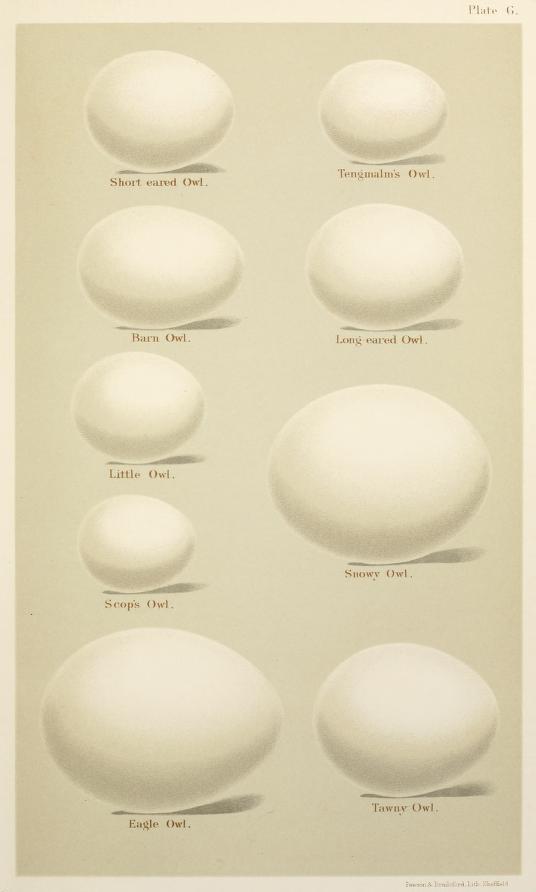
Egg-laying normally begins during early May to the first 10 days of June. Late thaws are harmful to them since they allow too little time for the full breeding process, with particularly importance given to good food supply in May for adults, even more so apparently than food supply in July when young are being fed. Late nests are possible cases of inexperienced pairs, low food supplies, bigamy or even replacement clutches. The clutch is extremely variable in size averaging around 7–9, with up to 15 or 16 eggs recorded in extreme cases. The clutch size very large relative to related species. Mean clutch sizes were 7.5 in a sample of 24 in Hooper Bay (range of 5–11); 6.7 in a sample of seven from Utqiaġvik (4–9); 9 in a sample of a sample of 5 in Baffin Island; 9.8 on Victoria Island; 8.4 (in a sample of 14) on Elsemere Island; 7.4 on Wrangel Island and 7.74 in Finnish Lapland. The average clutch size was 9.8 in a good year in Victoria Island while in a good year in Utqiaġvik the mean was 6.5. The clutch is laid directly to the ground and are pure, glossy white. An average egg is around 56.4 x with a range of heights from 50 to and diameter of 41 to.
Egg weights are around 47.5 to, the median or average being 53 and in different datasets. The average egg size is relatively small, about 20% smaller than Eurasian eagle-owl eggs and 8% smaller than great horned owl eggs. Laying intervals are normally 2 days (41–50 hours mostly). The laying intervals can range up to 3–5 days in inclement weather. The laying of a clutch of 11 eggs can take 20–30 days, while a more typical nest of around 8 takes about up to 16 days. The interval between the 8th and 9th eggs can be up to about 4 days. Incubation begins with the first egg and is by female alone, while she is fed by her mate.
Parental behavior

Food is brought to the nest by males and surplus food is stored nearby. Females in breeding season often develop a very extensive brood patch which in this species is a fairly enormous, high vascularized featherless area of pink belly skin. Incubation lasts 31.8–33 days (unconfirmed and possibly dubious reports from as little as 27 to as much as 38-day incubations). The female alone broods the young, often while simultaneously incubating still unhatched eggs. Sometimes older chicks incidentally brood their younger siblings and females may shelter the young under her wings during inclement weather.
When first feeding the young, the female may dismantle prey to feed the young only the softer body parts then gradually ramping up the size of proportions until they eat a whole prey item. The usual response to sighted humans near the nest is mild but continued approach begins to increasingly irritate the parents. At times, humans are forcefully dive-bombed upon, while other potential threats are dealt with in a "forward-threat" where the male walks towards the intruders, engaging in impressive feather-raising and fanning out of half-spread wings until they run forward and slash with both their feet and bill. Fairly serious injuries have been sustained in the worst of snowy owl defensive attacks, including cranial trauma, requiring researchers to make the long trek back to medical care, although human fatalities are not known.
Snowy owl parents have been seen to aggressively attacked glaucous gulls, arctic fox and dogs in breeding ground in Utqiaġvik.
In other instances, distraction displays are engaged in against predators, with a "broken-wing act" including high, thin squeals interspersed with weird squeaks, often taking flight only to quickly fall from the sky and imitate a struggle. One author recorded a male to draw him about 2 km from the nest before ceasing. 77% of 45 distraction displays in Lapland, Sweden were by females.
Development of young
.jpg)
Hatching intervals are generally from 1 to 3 days, quite often within 37–45 hours apart. New chicks are semi-altricial (i.e. typically helpless and blind), initially being white and rather wet but dry by the end of the first day. The weight of 7 hatchlings was 35 to, with an average of 46 g while 3 were 44.7 g. Due to the pronounced asynchrony of the egg-laying and hatching, the size difference between siblings can be enormous and in some cases when the smallest chick weighs only 20 to, the biggest chick already has attained a weight of around 350 to.
When the oldest chick is about three weeks old, the female will start to hunt as well as the male and both may directly feed the young although in some cases they may not need hunt very much if lemmings are particularly numerous. Leaving the nest is thought to likely be an anti-predator strategy.
The male snowy owl may drop fresh prey deliveries directly on the ground near the wandering young.
Maturity and nesting success

Sexual maturity reached the following year but the first breeding is normally at no sooner than the end of the second year of life. There is little strong evidence of typical age of first breeding but initial breeding by males could be inferred by the plumage of males in Utqiaġvik by plumage. At that stage, which the males were essentially all pure white, most were aged to about three to four years old. The snowy owl seems to markedly inconsistent in regard to breeding every year, often taking at least up to two years between attempts and sometimes as much as nearly a decade. Seven satellite-marking females in Canada proved that they did breed in consecutive years, with one breeding over three consecutive years. In 23 years at Utqiaġvik, snowys bred in 13 of them.
Nesting success can reach 90–100% in even the largest clutches in high lemming years.
Longevity
The snowy owl can live a long life for a bird. Typical lifespans probably reach around 10 years in the wild.
It is often reputed that snowy owls frequently died from starvation, with historical accounts opining that they "had to" leave their breeding grounds due to lemming "crashes" but would starve to the south. However, it was proven fairly early on that snowy owls often do survive throughout the winter. More circumstantial evidence shows a lack of starvation in the eastern part of North America as well.
There is evidence that some adults are known to return to the same wintering areas in ensuing years, areas which are far south of their breeding range. At Logan Airport, most snowy owls that are seen appear to be in good condition.
537 wintering birds in Saskatchewan were studied based on fat reserves, which were superior in females over males and adults over juveniles; while 31% of females lacked fat reserves, at least 45% of males found starving or in a state of infirmity were males and 63% turned into Wildlife rehabilitation centres were also males. In British Columbia, of 177 snowy owl deaths, of owls to die, only a small percentage were due to natural causes, such as assumed starvation at 13% and 12% were "found dead". One fledgling on Fetlar died due to pneumonia and Staphylococcus, while a second died from Aspergillosis.
Evidence shows that in Utqiaġvik during exceptionally prolonged rains (i.e. 2 to 3 days), nest-departed young were vulnerable to starvation, leading to hypothermia and pneumonia. Conversely, they appear to have lower levels of ectoparasites such as chewing lice than other large owls per large samples from Manitoba. The snowy owls averaged about 3.9 chewing lice per host against 7.5 for great grey owls and 10.5 for great horned owls.
Status
This species presence and numbers is dependent on amount of food available. In "lemming years", snowy owls can appear to be quite abundant in habitat.
However, in Sweden as of November 2025, the Swedish Species Information Centre proposed classifying the snowy owl as “extinct” in Sweden in preliminary assessments for its 2025 Red List, after no nesting has been observed since 2015. Birdlife reached the same consensus as no nesting has been observed.A low breeding population within European Russia has been estimated to hold 1,300–4,500 pairs and Greenland to have 500–1,000 pairs. In Europe, the owl is actually classed as ‘Least Concern’ - but this assessment hasn’t been updated since 18 December 2020.
Other than northern part of the American continent, a majority of the snowy owl's breeding range is in northern Russia, but overall estimates are not known. An exact count of 4,871 individuals were seen on surveys between the Indigirka and Kolyma rivers.
The Canadian population of snowy owls was estimated at 10,000–30,000 (in the 1990s) or even to 50,000–100,000 individuals, perhaps improbably. Within Canada, the population on Banks Island was once claimed at up to 15,000–25,000 in productive years and in Queen Elizabeth Islands at about 932 individuals. Alaska is the only American state with breeding snowy owls but has probably quite a bit fewer breeding owls than does Canada. Furthermore, the Partners in Flight and the IUCN estimated that the world population was roughly 200,000–290,000 individuals as recently as the 2000s. However, in the 2010s, it has been discovered that all prior estimates were extremely excessive and that more precise numbers could be estimated with better surveying, phylogeographic data and more insights into the owl's free-wheeling wanderings.
Due to the small and rapidly declining population, the snowy was uplisted in 2017 to being a vulnerable species by the IUCN. Trends are harder to delineate in Scandinavia but a similar downward trend is thought to be occurring. Snowy owls are listed in Appendix II of the Convention on International Trade in Endangered Species (CITES) meaning international trade (including in parts and derivatives) is regulated.
Anthropogenic mortality and persecution
.jpg)
Of 438 band encounters in the USG banding laboratory, almost all causes of death that could be determined, whether intentional or not, were correlated with human interference.
Despite their danger to planes, no human fatalities have been recorded in collisions with this species. Snowy owls are always far outnumbered in Canadian airports in winter by short-eared owls.
The species is locally vulnerable to pesticides.
Snowy owls can be quite wary, as they are not infrequently hunted by Circumpolar peoples.
The consumption of snowy owls by humans has been proven as far back as ancient cave deposits in France and elsewhere, and they have even been considered as one of the most frequent food species for early humans. They do not shun developed areas especially with old field that hold rodents and, due to lack of human experience, can be extremely tame and unable to escape armed humans.
In British Columbia, of 177 snowy owl deaths, the most often diagnosed cause of death was shootings at 25%, often well after legal protection of the species. While the species was once otherwise killed as food and then later shot out of resentment for perceived threats against domestic and favored game stock, the reasoning behind ongoing shooting of snowy owls into the 21st century is not well-understood.
Siberian snowy owls are frequently victim to baited fox traps, with possibly up to around 300 killed in a year based upon very rough estimates. Warfarin poisoning in use as rodenticides are known to kill some wintering snowy owls, including up to six at Logan Airport alone.
Mercury concentrations, most likely through bioaccumulation, have been detected in snowy owls in the Aleutian Islands but it is not known whether fatal mercury poisoning has occurred. PCBs may have killed some snowy owls in concentration. Some airports have advocated and instituted the practice of shooting owls to avoid birdstrikes but successful translocation is possible and preferred given the species protected status.
.jpg)
Climate change is now widely perceived to perhaps the primary driver of the snowy owl's decline. As temperatures continue to rise, abiotic factors such as increased rain and reduced snow are likely to effect lemming populations and, in turn, snowy owls. These and potentially many other issues (possibly including modifying migrating behavior, vegetation composition, increased insect, disease and parasite activities, risk of hyperthermia) are a matter of concern.
Additionally, reduction of sea ice, which snowy owls are now known to rely extensively on, as a result of warming climates, impacts could be significant. The amount of lemming mounds is much less than it once in northern Greenland and any variety of population cycle has been apparently abandoned by what remains of the lemmings.
In popular culture
- The Harry Potter books by J. K. Rowling, and subsequent films of the same name, feature a female snowy owl named Hedwig; the pet of the series' title character. Concern was expressed by some in the media that the popularity of the Harry Potter films would cause an increase in the illicit owl trade of snowy owls. However, there was no strong evidence of an increase in snowy owls confiscated from the black market, despite a larger than typical number of snowy owls being reported at wildlife centres.
- The snowy owl ({{linktext|harfang des neiges}} in French) is the avian symbol of Quebec.
References
References
- "Bubo scandiacus Linnaeus 1758 (snowy owl)".
- BirdLife International.. (2021). "''Bubo scandiacus''".
- "Appendice".
- Lewis, Deane. (4 July 2022). "Snowy Owl ~ ''Bubo scandiacus'' (''Nyctea scandiaca'')".
- (2013). "The Snowy Owl". T&APoyser.
- (2008). "Owls of the World". Christopher Helm.
- Voous, Karel H.. (1988). "Owls of the Northern Hemisphere". London, Collins.
- (4 March 2020). "Snowy Owl (''Bubo scandiacus'')". Cornell Lab of Ornithology, Ithaca, NY, USA.
- (2012). "Wing feather moult and age determination of Snowy Owls ''Bubo scandiacus''". Ornis Norvegica.
- The snowy owl is both a specialized and generalist hunter. Its breeding efforts and global population are closely tied to the availability of tundra-dwelling [[lemming]]s, but in the non-breeding season, and occasionally during breeding, the snowy owl can adapt to almost any available prey – most often other small [[mammal]]s and northerly [[water bird]]s, as well as, opportunistically, [[carrion]]. Snowy owls typically nest on a small rise on the ground of the tundra.Hume, R. (1991). ''Owls of the world''. Running Press, Philadelphia.
- Sindelar Jr., C.. (1966). "A comparison of five consecutive Snowy Owl invasions in Wisconsin". Passenger Pigeon.
- Linnaeus, Carl. (1758). "Systema Naturae per Regna Tria Naturae, Secundum Classes, Ordines, Genera, Species, cum Characteribus, Differentiis, Synonymis, Locis. Tomus I. Editio decima, reformata". (Laurentii Salvii).
- Jobling, James A. (2010). "The Helm Dictionary of Scientific Bird Names". Christopher Helm.
- Lönnberg, E.. (2008). "Olof Rudbeck, Jr., the first Swedish Ornithologist". Ibis.
- Wink, M. & Heidrich, P. (2000). "Molecular systematics of owls (Strigiformes) based on DNA-sequences of the mitochondrial cytochrome b gene", pp. 819–828 in: Chancellor, R.D. & Meyburg, B.U. eds. (2000). ''Raptors at Risk. Proceedings of the V World Conference on Birds of Prey and Owls''. Midrand, Johannesburg, 4–11 August 1998. WWGBP & Hancock House, Berlin & Blaine, Washington.
- Penhallurick, J. M. (2002). "The taxonomy and conservation status of the owls of the world: a review". ''Ecology and conservation of owls''. CSIRO, Collingwood, pp. 343–354.
- Cracraft, J.. (1981). "Toward a Phylogenetic Classification of the Recent Birds of the World (Class Aves)". The Auk.
- Mindell, D. P.. (1997). "Avian molecular evolution and systematics". Academic Press.
- (1991). "A cytogenetic comparison of some North American owl species". Genome.
- (2002). "A new Ninox owl from Sumba, Indonesia". Emu - Austral Ornithology.
- Brodkorb, P.. (1971). "Catalogue of fossil birds, Part 4 (Columbiformes through Piciformes)". Bulletin of the Florida State Museum, Biological Sciences.
- Stewart, J. R.. (2007). "The fossil and archaeological record of the Eagle Owl in Britain". British Birds.
- (October 2001). "1st International Congress "The World of Elephants"". Consiglio Nazionale delle Ricerche.
- Andrews, P. (1990). ''Owls, caves and fossils''. Chicago: University of Chicago Press.
- [http://www.tz.de/bayern/ueberraschende-kreuzung-tierreich-schnuhu-mischung-schneeeule-eule-3069906.html "Schnuhu": Überraschende Kreuzung – Ich bin Bayerns süßester Fratz!]. tz.de Retrieved on 7 October 2016
- McMorris, A. (2011). ''Snowy Owls: Age, Sex and Plumage''. Presentation Delaware Valley Ornithological Club.
- Solheim, Roar. (2016). "Identifying Individual Great Gray Owls (''Strix nebulosa'') and Snowy Owls (''Bubo scandiacus'') Using Wing Feather Bar Patterns". Journal of Raptor Research.
- Averill, C. K.. (1927). "Emargination of the Long Primaries in Relation to Power of Flight and Migration with One Illustration". The Condor.
- (1942). "Measurements of Tarsal Circumferences from Living Raptorial Birds". Bird-Banding.
- Gill, F. (2007). ''Ornithology''. 3rd Edn. (W. H. Freeman Co: New York.
- (1974). "Visual acuity in the tawny owl (''Strix aluco'')". Vision Research.
- (2014). "Ultraviolet vision in birds: the importance of transparent eye media". Proceedings of the Royal Society B: Biological Sciences.
- Burkhardt, Dietrich. (1989). "UV vision: a bird's eye view of feathers". Journal of Comparative Physiology A.
- (2002). "Coevolving avian eye size and brain size in relation to prey capture and nocturnality". Proceedings of the Royal Society of London. Series B: Biological Sciences.
- (2008). "CRC Handbook of Avian Body Masses". CRC Press.
- Lundberg, Arne. (1986). "Adaptive Advantages of Reversed Sexual Size Dimorphism in European Owls". Ornis Scandinavica.
- Weick, Friedhelm. (2007). "Owls (Strigiformes): Annotated and Illustrated Checklist". Springer.
- Korpimaki, Erkki. (1986). "Reversed Size Dimorphism in Birds of Prey, Especially in Tengmalm's Owl ''Aegolius funereus'': A Test of the "Starvation Hypothesis"". Ornis Scandinavica.
- Eckert, A. W. (1987). ''The Owls of North America, North of Mexico: All the Species and Subspecies Illustrated in Color and Fully Described''. Gramercy.
- Parmelee, D. F. (1972). ''Canada's incredible arctic owls''. Beaver no. summer:30–41.
- Priklonskiy, S.G. (1993). ''Snowy Owl — Nyctea scandiaca (Linnaeus, 1758)''. In: ''Birds of Russia and adjoining regions: Pterocliformes, Columbiformes, Cuculiformes, Strigiformes''. Moscow, p. 258–270. (in Russian).
- Keith, L.B.. (1960). "Observations of Snowy Owls at Delta, Manitoba". Canadian Field-Naturalist.
- (1970). "Size Dimorphism and Food Habits of North American Owls". The Condor.
- (1988). "Causes of Mortality, Fat Condition, and Weights of Wintering Snowy Owls". Journal of Field Ornithology.
- National Geographic Society. [https://web.archive.org/web/20070614042408/http://animals.nationalgeographic.com/animals/birds/snowy-owl.html "Snowy Owl"].
- (2016). "Body condition in Snowy Owls wintering on the prairies is greater in females and older individuals and may contribute to sex-biased mortality". The Auk.
- (1932). "The exploration of Southampton Island. Part II, Zoölogy. Section 2.-The birds of Southampton Island". Memoirs of the Carnegie Museum.
- (July 1956). "Breeding of the Snowy Owl in Southeastern Baffin Island". The Condor.
- Hosking, Eric. (2 August 1967). "Snowy Owl with young—an historic photograph". [[The Times]].
- Marter, Hans J.. (28 November 2016). "Reviews / Fond memories of the Bobby the birdman". [[The Shetland News]].
- [https://news.bbc.co.uk/2/hi/uk_news/scotland/highlands_and_islands/7397993.stm "Hope of first owl chicks in years"], [[BBC News]]. 13 May 2008.
- Marquiss, M., Smith, R. & Galbraith, H.. (1989). "Diet of Snowy Owls on Cairn Gorm Plateau in 1980 and 1987". Scottish Birds.
- (16 March 2022). "Snowy Owl Facts".
- Saxby, H. L.. (1863). "Notes on the Snowy Owl". Zoologist.
- (1971). "Winter Observations of Mammals and Birds, St. Matthew Island". Arctic.
- (2011). "An avian terrestrial predator of the Arctic relies on the marine ecosystem during winter". Journal of Avian Biology.
- Conlin, Dan (2 October 2013). [http://marinecurator.blogspot.ca/2013/10/an-owl-oddity.html "An Owl Oddity"], Maritime Museum of the Atlantic.
- (1947). "Cyclic Invasions of the Snowy Owl and the Migration of 1945-1946". The Auk.
- (2018). "Wintering space use and site fidelity in a nomadic species, the snowy owl". Journal of Avian Biology.
- (March 2017). "Winter Use of a Highly Diverse Suite of Habitats by Irruptive Snowy Owls". Northeastern Naturalist.
- Root, T. R. (1988). ''Atlas of Wintering North American Birds: An Analysis of Christmas Bird Count Data''. University of Chicago Press, Chicago, IL, USA.
- [https://stylingowlish.com/blogs/news/snowy-owl-appears-in-middle-tennessee "Snowy Owl Appears in Middle Tennessee."] ''The Styling Owlish.'' 24 January 2009.{{dead link. (October 2017)
- Zuckerman, Laura (28 January 2012). [https://www.reuters.com/article/us-owls-migration-idUSTRE80R0MP20120128 ''Snowy owls soar south from Arctic in rare mass migration'']. Reuters
- Leung, Marlene Leung. (5 January 2014). "Snowy owl invasion: Birds spotted as far south as Florida". CTV News.
- Schwartz, John. (31 January 2014). "A Bird Flies South, and It's News". New York Times.
- (2017). "Seasonal Movements of Female Snowy Owls Breeding in the Western North American Arctic". Journal of Raptor Research.
- (1979). "Habitat selection by wintering Snowy Owls (''Nyctea scandiaca'')". Canadian Field-Naturalist.
- (1969). "Activity Cycles of Snowy Owls at Barrow, Alaska". The Murrelet.
- Hagen, Y. (1960). ''The Snowy Owl on Hardangervidda in the Summer of 1959''. Papers of The Norwegian State Game Research. 2, No. 7.
- Tulloch, R. J.. (1968). "Snowy Owls breeding in Shetland in 1967". British Birds.
- (1989). "Time budgets and activity of wintering Snowy Owls". Journal of Field Ornithology.
- (2010). "Wintering Snowy Owls ''Bubo scandiacus'' integrate plumage colour, behaviour and their environment to maximize efficacy of visual displays". Ibis.
- (2018). "''Seeing sunlit owls in a new light: orienting Snowy Owls may not be displaying.''". Ibis.
- (1982). "Are owls regular? An analysis of pellet regurgitation times of Snowy Owls in the wild". Raptor Research.
- Shelford, V. E.. (1943). "The Abundance of the Collared Lemming (''Dicrostonyx groenlandicus'' (TR). VAR. ''Richardsoni'' Mer.) in the Churchill Area, 1929 to 1940". Ecology.
- Parker, G. R.. (1974). "A population peak and crash of lemmings and Snowy Owls on Southampton Island, Northwest Territories". Canadian Field-Naturalist.
- Manning, T. H., Höhn, E. O. & MacPherson, A. H. (1956). ''The birds of Banks Island''. National Museum of Canada Bulletin 143, Biological Series 48.
- Vaughn, R. (1992). ''In search of Arctic birds''. London: T & AD Poyser, Ltd.
- Menyushina, I. E. (1997). "Snowy Owl (''Nyctea scandiaca'') reproduction in relation to lemming population cycles on Wrangel Island". In: ''Biology and conservation of owls of the Northern Hemisphere: 2nd International Symposium'', J. R. Duncan, D. H. Johnson and T. H. Nicholls (eds.), pp. 572–582. St. Paul: U.S. Dept. of Agriculture, Forest Service, North Central Forest Experiment Station.
- (2018). "Movement patterns and home ranges of male and female Snowy Owls (''Bubo scandiacus'') wintering on the Canadian prairies". Canadian Journal of Zoology.
- (2011). "Diet–tissue discrimination factors of carbon and nitrogen stable isotopes in blood of Snowy Owl (''Bubo scandiacus'')". Canadian Journal of Zoology.
- (2014-06-02). "Irruptive movements and breeding dispersal of snowy owls: a specialized predator exploiting a pulsed resource". Journal of Avian Biology.
- (1945). "The Relation of Snowy Owl Migration to the Abundance of the Collared Lemming". The Auk.
- However, more extensive research has weakened the argument that irruptions are entirely food-based and the data indicates that irruptive movements are far from predictable. This is because a statewide survey in Alaska found no statewide synchrony in lemming numbers. Therefore, rather than decline of lemmings, it is the successful productivity of several pairs that plays the role, resulting in a large number of young owls that then irrupt. However, the snowy owls cannot breed in high numbers unless lemmings are widely available on the tundra.Pitelka, F. A. & Batzli, G. O. (1993). "Distribution, abundance, and habitat use by lemmings on the north slope of Alaska". In: ''The biology of lemmings'', N. C. Stenseth and R. A. Ims (eds.), pp. 213–236. London: Academic Press.
- Krebs, C. J. (1993). "Are lemmings large Microtus or small reindeer? A review of lemming cycles after 25 years and future recommendations for future work". In: ''The biology of lemmings'', N. C. Stenseth and R. Ims (eds.), pp. 247–260. London: Academic Press for the Linnean Society of London.
- (2016). "Pulsed resources at tundra breeding sites affect winter irruptions at temperate latitudes of a top predator, the snowy owl". Oecologia.
- Audubon, J. J. (1840). ''The Birds of America''. Dover Publications, Inc., New York, NY, USA.
- (1982). "Feeding ecology of Snowy Owls (''Nyctea scandiaca'') wintering in S. Alberta". Arctic.
- Winter, R. E. (2016). [https://digitalcommons.esf.edu/honors/79/ ''Hunting Behaviors and Foraging Success of Winter Irruptive Snowy Owls in New York''] {{Webarchive. link. (16 April 2022 . SUNY College of Environmental Science and Forestry, Thesis.)
- (2003). "Wintering Snowy Owls feed on sea ducks in the Belcher Islands, Nunavut, Canada". Journal of Raptor Research.
- König, Claus, Friedhelm Weick, and Jan-Hendrik Becking. Owls of the World. 2nd ed. Bloomsbury Publishing, 2009. Web. 23 May. 2023.
- (1986). "Snowy Owls on Fetlar". British Birds.
- Fitzgerald, B.M. (1981). "Predatory birds and mammals". In ''Tundra ecosystems: a comparative analysis''. Eds L.C. Bliss, 0.W. Heal & J.J. Moore, pp. 485–508. Cambridge University Press, Cambridge. {{ISBN. 9780521227766
- (1980). "Nutritional Ecology of Microtine Rodents: Resource Utilization near Atkasook, Alaska". Arctic and Alpine Research.
- Andersson, N. Å. & Persson, B.. (1971). "Något om fjällugglans Nyctea scandiaca näringsval i Lappland". Vår Fågelvärld.
- (2010). "Habitat selection by arctic ground squirrels (''Spermophilus parryii'')". Journal of Mammalogy.
- Brackney, A. W. & King, R. J. (1991). ''Population shifts by Snowy Owls on the Arctic coastal plain of Alaska. Abstract''. In Alaska Bird Conference and Workshop. Anchorage.
- Potapova, O.. (2001). "Snowy owl ''Nyctea scandiaca'' (Aves: Strigiformes) in the Pleistocene of the Ural Mountains with notes on its ecology and distribution in the Northern Palearctic". Deinsea.
- Tarasov, V. V. (2011). ''Summer flocks of the Willow Ptarmigan in the north of the Yamal Peninsula''. In: R. T. Watson, T. J. Cade, M. Fuller, G. Hunt, and E. Potapov (Eds.). ''Gyrfalcons and Ptarmigan in a Changing World''. The Peregrine Fund, Boise, Idaho, USA.
- (1953). "Foraging activities of the Snowy Owl (''Nyctea scandiaca'') during a period of low lemming population". The Auk.
- (2004). "Breeding biology of Steller's eiders (''Polysticta stelleri'') near Barrow, Alaska, 1991–99". Arctic.
- (1979). "Diet of the Snowy Owl in the Absence of Small Mammals". The Condor.
- In the [[Murman Coast]] of Russia, also in the absence of lemmings, [[seabird]]s formed the largest part of the diet.Krasnov, Y. (1985). ''To the biology of the Snowy Owl in the Eastern Murman. Birds of Prey and Owls in the Nature Reserves of the Russian Federation''. TSNIL GLAVOKHOTA, pp. 110–116.
- (September 2015). "Forensic techniques identify the first record of Snowy Owl (''Bubo scandiacus'') feeding on a Razorbill (''Alca torda'')". The Wilson Journal of Ornithology.
- (Jun 2017). "Variability in stable isotopes of snowy owl feathers and contribution of marine resources to their winter diet". Journal of Avian Biology.
- Patterson, J. M.. (2007). "An analysis of Snowy Owl (''Bubo scandiacus'') diet during the 2005 to 2006 irruption along the Oregon and Washington coasts". Northwestern Naturalist.
- (1978). "Winter Foods of Snowy Owls in Southwestern British Columbia". The Journal of Wildlife Management.
- (2009). "Featured Species – Snowy Owl (''Bubo scandiacus'')". Wildlife Afield.
- Keith, L. B.. (1963). "A note on Snowy Owl food habits". The Wilson Bulletin.
- Chamberlin, M. L.. (1980). "Winter hunting behavior of a snowy owl in Michigan". The Wilson Bulletin.
- (1944). "Food of the Snowy Owl". The Auk.
- (1944). "Food of Hawks and Owls N Maine". The Journal of Wildlife Management.
- Young, E.A., Blake, C., Graham, R., Otte, C., Beckman, M. & Klem, D.. (2014). "Prey items from Snowy Owl (''Bubo scandiacus'') Pellets during the 2011–2012 Irruption in Kansas". Kansas Ornithological Society.
- Miles, W. T. S., & Money, S. (2008). ''Behaviour and diet of non-breeding Snowy Owls on St Kilda''. Scottish Birds, 28, 11.
- (2005). "Dietary analysis from the Snowy Owls pellets ''Nyctea scandiaca'' Linnaeus 1958, from the Mullet Peninsula, Co, Mayo". Irish Naturalists' Journal.
- Savory, J.. (2019). "Unpublished information in the SOC Archive on Snowy Owl diet at three locations in Moray in the 1960s". Scottish Birds.
- Far to the east, wintering owls in the [[Irkutsky District]] were found to subsist mostly on [[narrow-headed vole]]s (''Microtus gregalis'').Maleev, V.G. & Popov, V. V. (2007). ''Birds of forest-steppes of the Upper Angara river basin''. Irkutsk.
- (2017). "Predators, predator removal, and sage-grouse: A review". The Journal of Wildlife Management.
- Uher-Koch, B. D., M. R. North, and J. A. Schmutz (2020). Yellow-billed Loon (''Gavia adamsii''), version 1.0. In Birds of the World (S. M. Billerman, Editor). Cornell Lab of Ornithology, Ithaca, NY, USA.
- Nagy, S., Petkov, N., Rees, E., Solokha, A., Hilton, G., Beekman, J., & Nolet, B. (2012). [https://www.unep-aewa.org/en/publication/international-single-species-action-plan-conservation-northwest-european-population International single species action plan for the conservation of the northwest European population of Bewick's Swan (''Cygnus columbianus bewickii'')]. Wetlands International and The Wildfowl & Wetlands Trust (WWT), AEWA Technical Series, (44).
- Bergman, G.. (January 2026). "The food of birds of prey and owls in Fenno-Scandia". British Birds.
- Maher, W. J.. (1970). "The Pomarine Jaeger as a Brown Lemming predator in northern Alaska". Wilson Bulletin.
- Wiklund, C. G., Angerbjörn, A., Isakson, E., Kjellén, N., & Tannerfeldt, M.. (1999). "Lemming predators on the Siberian tundra". Ambio.
- Anecdotal reports indicate predation by [[gyrfalcon]]s (on snowy owls of unknown age and condition) but it was possibly also an act of mobbing.Heggøy, O., & Øien, I. J. (2014). [https://www.birdlife.no/innhold/bilder/2014/01/29/2586/nof_rapport_12014.pdf ''Conservation status of birds of prey and owls in Norway'']. NOF/BirdLife Norway-Report, 1, 1–129.
- Meinertzhagen, R. (1959). ''Pirates and Predators: The piratical and predatory habits of birds''. Oliver & Boyd.
- (2002). "''Alopex lagopus''". Mammalian Species.
- (1970). "Red Fox Predated by Snowy Owl". Blue Jay.
- (1982). "Possible courtship behavior of Snowy Owls in winter". Wilson Bulletin.
- (1996). "Breeding-site infidelity in greater snow geese: A consequence of constraints on laying date?". Canadian Journal of Zoology.
- (January 2002). "How do Brent Geese (''Branta b. bernicla'') cope with evil". Journal für Ornithologie.
- Smith, P. A. (2003). ''Factors affecting nest site selection and reproductive success of tundra nesting shorebirds'' (Doctoral dissertation, University of British Columbia).
- Schönwetter, M. (1960). ''Handbuch der Oologie'' (Ed. W. ME~SE). Vol. 1. Berlin.
- Pleske, T. (1928). ''Birds of the Eurasian tundra''. Mem. Boston Soc. Nat. Hist. 6:111–485.
- (2008). "The 2005 to 2006 Snowy Owl Irruption Migration to Western Montana". Northwestern Naturalist.
- (2018). "Winter irruptive Snowy Owls (''Bubo scandiacus'') in North America are not starving". Canadian Journal of Zoology.
- (1957). "Notes on the Barred Owl and the Snowy Owl in Alberta". Blue Jay.
- (1980). "Snowy Owl recaptures". Inland Bird Banding.
- (2019). "Infestation parameters for chewing lice (Phthiraptera: Amblycera, Ischnocera) infesting owls (Aves: Strigidae, Tytonidae) in Manitoba, Canada". The Canadian Entomologist.
- (11 December 2025). "Sweden has lost the Snowy Owl".
- https://www.euronews.com/green/2025/12/30/sweden-declares-the-famous-snowy-owl-regionally-extinct-after-a-decade-of-silence
- BirdLife International (2015). ''European Red List of Birds''. Office for Official Publications of the European Communities, Luxembourg
- (2012). "Cross-species amplification of microsatellite markers in the Great Horned Owl ''Bubo virginianus'', Short-eared Owl ''Asio flammeus'' and Snowy Owl ''B. scandiacus'' for use in population genetics, individual identification and parentage studies". Journal of the Yamashina Institute for Ornithology.
- (2006). "Effects of Falconry Harvest on Wild Raptor Populations in the United States: Theoretical Considerations and Management Recommendations". Wildlife Society Bulletin.
- Kirk, D. A., Hussell D. & Dunn, E.. (1995). "Raptor population status and trends in Canada". Bird Trends.
- Reding-License, A. A. (2015). Harfang des neiges (''Bubo scandiacus''). Government of Canada.
- American Ornithologists' Union (1998). ''Check-list of North American Birds, 7th edition''. American Ornithologists' Union, Washington, DC, USA.
- Miller, F. L. (1987). ''Snowy Owl numbers on twelve Queen Elizabeth Islands, Canadian High Arctic''. Journal of Raptor Research 21 (4): 153–157.
- Alaska Department of Fish and Game. State of Alaska special status species 2011.
- PIFSC. ''Partners in Flight Science Committee (2013)''. Population estimates database (Version 2.0) 2013. Available from http://rmbo.org/pifpopestimates {{Webarchive. link. (1 July 2016 .)
- (1981). "Distribution Patterns of Raptors in Relation to Density of Meadow Voles". The Condor.
- Blokpoel, H. (1976). ''Bird hazards to aircraft: problems and prevention of bird/aircraft collisions''. Clarke Irwin;[Ottawa]: Canadian Wildlife Service, Environment Canada: Pub. Centre, Supply and Services Canada.
- Mourer-Chauviré, C.. (1979). "La chasse aux oiseaux pendant la Préhistoire". La Recherche.
- (2016). "Hunting fast-moving, low-turnover small game: The status of the snowy owl (''Bubo scandiacus'') in the Magdalenian". Quaternary International.
- The number [[Poaching
- Ellis, D. H. & D. G. Smith. (1993). "Preliminary report of extensive Gyrfalcon and Snowy Owl mortality in northern Siberia". Raptor-Link.
- (2014). "Mercury concentrations in breast feathers of three upper trophic level marine predators from the western Aleutian Islands, Alaska". Marine Pollution Bulletin.
- (2011). "Gyrfalcons and Ptarmigan in a Changing World".
- "4 reasons Hedwig was better than everyone else at Hogwarts". Pottermore.
- (2017). "Investigating the impact of media on demand for wildlife: A case study of Harry Potter and the UK trade in owls". PLOS ONE.
- "The avian emblem of Quebec". Refuge Pageau.
- (2024). "Emblems of Quebec".
This article was imported from Wikipedia and is available under the Creative Commons Attribution-ShareAlike 4.0 License. Content has been adapted to SurfDoc format. Original contributors can be found on the article history page.
Ask Mako anything about Snowy owl — get instant answers, deeper analysis, and related topics.
Research with MakoFree with your Surf account
Create a free account to save articles, ask Mako questions, and organize your research.
Sign up freeThis content may have been generated or modified by AI. CloudSurf Software LLC is not responsible for the accuracy, completeness, or reliability of AI-generated content. Always verify important information from primary sources.
Report