From Surf Wiki (app.surf) — the open knowledge base
Snow fence
Barrier to combat snowdrift
_-widok_ze_schroniska_na_wysokości_3029_m_n.p.m_-_panoramio.jpg)
Barrier to combat snowdrift
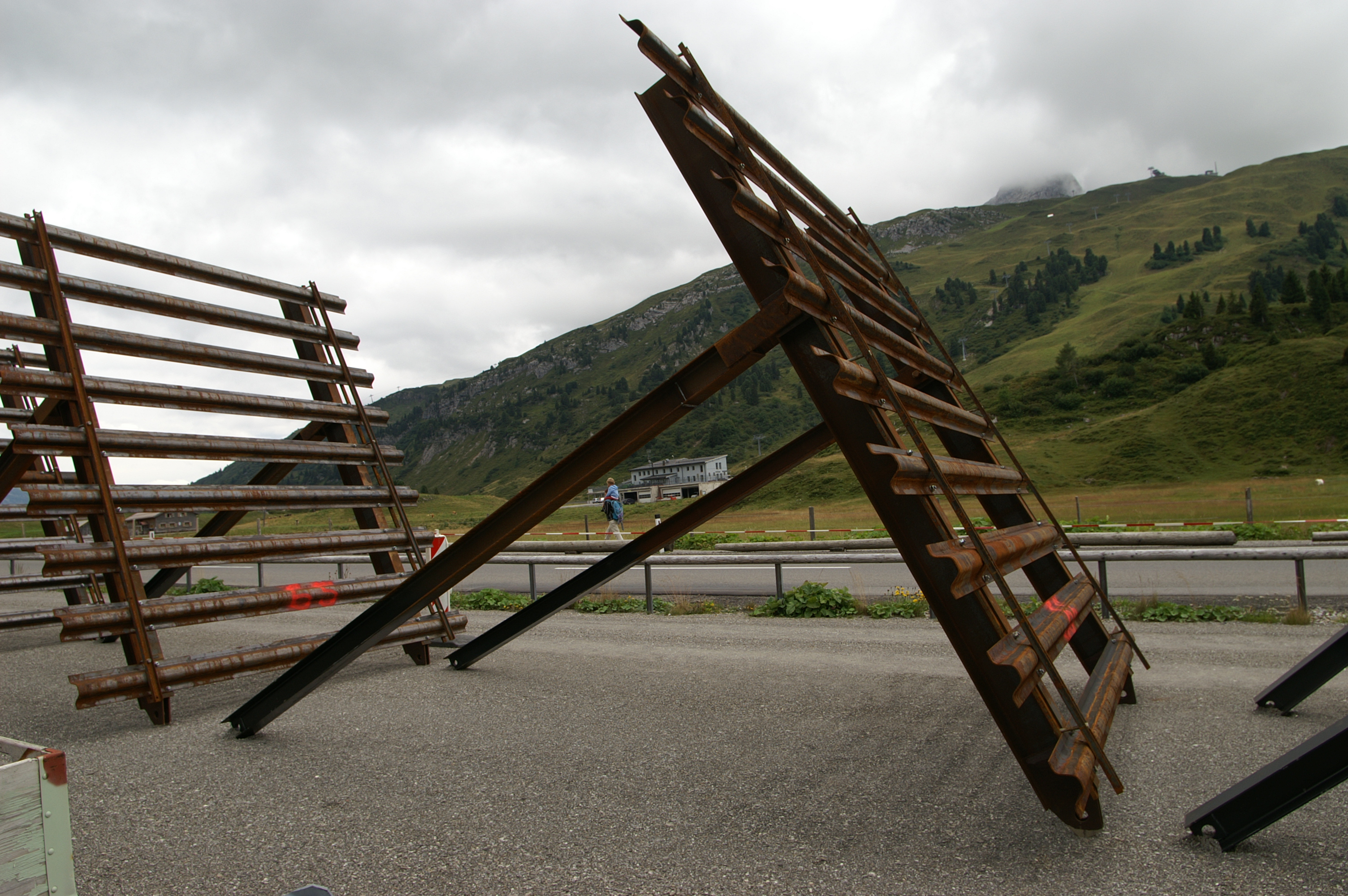
A snow fence is a barrier that, similar to a sand fence, forces windblown, drifting snow to accumulate in a desired place. Snow fences are employed primarily to minimize the amount of snowdrift on roadways and railways. Farmers and ranchers use snow fences to create drifts in basins for a ready spring water supply. Ski resorts also use snow fences to increase snow depth in specified areas, or for avalanche control.
Description and physical mechanism

_on_the_Piibe_highway_in_Estonia_(December_2022).jpg)
Temporary snow fences are usually one of two varieties: perforated orange plastic sheeting attached to stakes at regular intervals (the type usually used for construction site fencing or temporary sports field fencing) or a cedar or other lightweight wood strip and wire fence, also attached to metal stakes. A permanent snow fence usually consists of poles with horizontal planks running across them to cover just over one-half of the total fence area. Taller fences trap more snow. Taking the height of the fence as one unit, it should be placed thirty-five units or more windward of the road or building it is meant to protect. Permanent snow fences can also consist of lines of closely spaced shrubs, conifer trees or maize stalks.
Snow fences work by causing turbulence in the wind, such that it drops much of its snow load on the lee side of the fence. Thus, snow fences cause snow drifts rather than preventing them. The fences are placed to cause snow to drift where beneficial or not harmful so that the snow does not drift onto undesired areas such as roads or buildings.
Snow fences have been reported to save lives and reduce maintenance costs. Snow and ice removal and control cost over $2 billion annually in the US. Studies published by Strategic Highway Research Program (SHRP) of National Research Council in 1991 showed that mechanical snow removal costs about 100 times more than trapping snow with fences.
Snow fences can also trap tumbleweeds.
In Japan

In Tohoku and Hokkaido of Japan, especially in areas with strong wind and snow, such as the coastal areas of the Sea of Japan and the plains, structures that lead to snow fences called "Yukigakoi" made of reeds, chives, and wooden boards have been made for a long time. Even now, the culture of making "Yukigakoi" can be seen in some areas such as Hokkaido.
As for transportation facilities, wooden fences made on railway lines in the 1880s as a measure against snowstorms began. However, initially, it was difficult to predict where the snowdrift would be formed, and it was impossible to control the snowdrift well. There was also a fire accident caused by the sparks generated by the steam locomotive due to the wooden structure, so it was unpopular. It is said that it has replaced the Railroad snow forest in Japan as well.
On the other hand, for roads, a structure called a "Blowing pool type snow fence" was studied and installed for the first time in 1961, referring to the wooden Snow fence used all over the world. Then, in 1967, the Hokkaido Regional Development Bureau Construction machinery workshop (at that time) developed a "blow-off snow fence" that began to be installed on national roads in 1969. Later, the Hokkaido Development Civil Engineering Research Institute (currently, Public Works Research Institute Cold Region Civil Engineering Research Institute) researched "Blow-up prevention type snow fence" and installed it in 1978, and further applied "Blow-up prevention type snow fence" to "Blowing-proof snow fence" from 1981 and since 1988. It came to be installed.
In recent Japanese railways, "blowing pool type" and "blowing-proof" snow fences have been re-evaluated for their usefulness based on the research results and achievements on the road so that they will be used again as railway snow protection measures.
References
References
- (1999). "Snow Management and Windbreaks". [[University of Nebraska–Lincoln]].
- (June 2005). "Iowa's Cooperative Snow Fence Program". Iowa Department of Transportation.
- (2011). "Living Snow Fences: Functions and Benefits". University of Minnesota.
- (November 2006). "Living Snow Fences". University of Iowa.
- Blackburn, Robert R.. (2004-01-01). "Snow and Ice Control: Guidelines for Materials and Methods". Transportation Research Board.
- Takeuchi Masao. (April 10, 2003). "Journal of the Japanese Society of Snow and Ice "SEPPYOU" Volume 65, Issue 3: For the control of blowing snow (5) - Technical development in use of snow - fences -". Yukiken Snow Eaters Co., Ltd..
- Public Works Research Institute Cold Region Civil Engineering Research Institute. "Part 3 Snow fence". Public Works Research Institute Cold Region Civil Engineering Research Institute.
- (March 2018). "Verification and improvement of snow control performance of windbreak fence". Building Research Department Local Independent Administrative Agency Hokkaido Research Organization.
This article was imported from Wikipedia and is available under the Creative Commons Attribution-ShareAlike 4.0 License. Content has been adapted to SurfDoc format. Original contributors can be found on the article history page.
Ask Mako anything about Snow fence — get instant answers, deeper analysis, and related topics.
Research with MakoFree with your Surf account
Create a free account to save articles, ask Mako questions, and organize your research.
Sign up freeThis content may have been generated or modified by AI. CloudSurf Software LLC is not responsible for the accuracy, completeness, or reliability of AI-generated content. Always verify important information from primary sources.
Report