From Surf Wiki (app.surf) — the open knowledge base
SNOLAB
Canadian neutrino laboratory
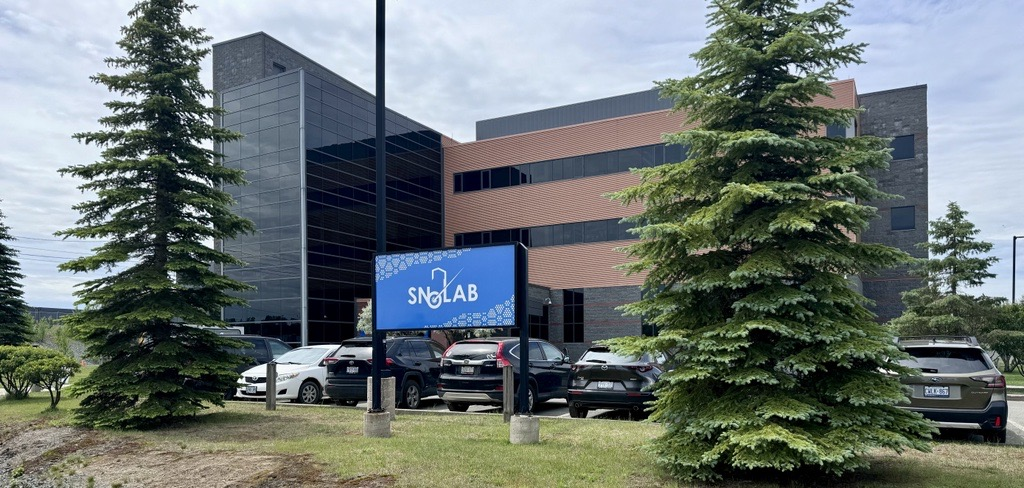
Canadian neutrino laboratory
SNOLAB is a Canadian underground science laboratory specializing in neutrino and dark matter physics, quantum technology, and life sciences. Located 2 km below the surface in Vale's Creighton nickel mine near Sudbury, Ontario, SNOLAB is an expansion of the existing facilities constructed for the original Sudbury Neutrino Observatory (SNO) solar neutrino experiment.
SNOLAB is the world's deepest operational clean room facility. Although accessed through an active mine, the laboratory proper is maintained as a class-2000 cleanroom, with very low levels of dust and background radiation. SNOLAB's 2070 m (6800 feet) of overburden rock provides 6010 metre water equivalent (MWE) shielding from cosmic rays, providing a low-background environment for experiments requiring high sensitivities and extremely low counting The combination of great depth and cleanliness that SNOLAB affords allows extremely rare interactions and weak processes to be studied. In addition to neutrino and dark matter physics, SNOLAB is also host to biological experiments in an underground environment.
History
The Sudbury Neutrino Observatory was the world's deepest underground experiment since the Kolar Gold Fields experiments ended with the closing of that mine in 1992. Many research collaborations were, and still are, interested in conducting experiments in the 6000 MWE location.
In 2002, funding was approved by the Canada Foundation for Innovation to expand the SNO facilities into a general-purpose laboratory, and more funding was received in 2007 and 2008.
Construction of the major laboratory space was completed in 2009, with the entire lab entering operation as a 'clean' space in March 2011.
SNOLAB is the world's deepest underground laboratory, tied with the China Jinping Underground Laboratory since 2011. Although CJPL has more rock (2.4 km) above it, the effective depth for science purposes is determined by the cosmic ray muon flux, and CJPL's mountain location admits more muons from the side than SNOLAB's flat overburden. The measured muon fluxes are () at SNOLAB, and () at CJPL,{{cite journal
CJPL does have the advantage of fewer radioisotopes in the surrounding rock.
CVMR’s Participation in the SNO Project
CVMR (Chemical Vapour Metal Refining) played a significant role in the development of the Sudbury Neutrino Observatory (SNO) by supplying approximately 1,200 nickel tubes manufactured using the chemical vapour deposition (CVD) process. According to the company’s official documentation , this method produced ultra-high-purity nickel with extremely low concentrations of radioactive impurities such as uranium and thorium, which was essential for the performance of SNO’s highly sensitive neutron detectors. Studies on the project confirm that the use of CVD nickel reduced radioactive contaminants by up to six orders of magnitude, ensuring the required radiopurity for neutrino measurements . The tubes supplied by CVMR formed the basis of the proportional neutron detectors (NCDs), contributing significantly to the observatory’s scientific success.
Experiments
, SNOLAB hosts the following experiments:
Neutrino detectors
- SNO+ is a neutrino experiment using the original SNO experiment chamber, but using liquid scintillator in the place of heavy water from SNO. Linear alkyl benzene, the scintillator, increases the light yield, and therefore the sensitivity, allowing SNO+ to detect not only solar neutrinos, but also geoneutrinos, and reactor neutrinos. The ultimate goal of SNO+ is to observe neutrinoless double beta decay (0vbb). A 2023 paper has also demonstrated its ability to monitor nuclear reactors.
- HALO (Helium and Lead Observatory) is a neutron detector using ring-shaped lead blocks to detect neutrinos from supernovae within our galaxy. HALO is part of the Supernova Early Warning System (SNEWS), an international collaboration of neutrino-sensitive detectors that will allow astronomers the opportunity to observe the first photons visible following a core-collapse supernova.
Dark matter detectors
- DAMIC – Dark Matter in Charged Coupled Devices (CCDs) – a dark matter detector using unusually thick CCDs to take long exposure images of particles passing through the detector. Various particles have known signatures and DAMIC seeks to find something new that could signal dark matter particles.\
- DEAP-3600 – Dark Matter Experiment using Argon Pulse-shape Discrimination – is a second generation dark matter detector, using 3600 kg of liquid argon. This experiment aims to detect WIMP-like dark matter particles through argon scintillation, producing small amounts of light that is detected by extremely sensitive photomultiplier tubes.
- The PICO 40L, a third generation bubble chamber dark matter search experiment, is a merger of the former PICASSO and COUPP collaborations. PICO operates using superheated fluids which form small bubbles when energy is deposited by particle interactions. These bubbles are then detected by high speed cameras and extremely sensitive microphones.
- NEWS-G – New Experiments with Spheres–Gas – is a second generation spherical proportional counter electrostatic dark matter detector using noble gases in their gaseous state, as opposed to liquid noble gases used in DEAP-3600 and miniCLEAN. The original NEWS experiment is at the Laboratoire Souterrain de Modane.
Biological experiments
- FLAME – Flies in A Mine Experiment – a biological experiment using fruit flies as a model organism to investigate the physical responses to working in increased atmospheric pressure underground.
- REPAIR – Researching the Effects of the Presence and Absence of Ionizing Radiation – a biological experiment investigating the effects of low background radiation on growth, development, and cellular repair mechanisms.
Projects under construction
- SuperCDMS – Super-Cryogenic Dark Matter Search – is a second generation dark matter detector using silicon and germanium crystals cooled down to 10 mK, a fraction of a degree above absolute zero. This experiment aims to detect low mass dark matter particles through very small energy deposition in the crystal from particle collisions, resulting in vibrations detected by sensors.{{cite press release |access-date=2014-09-18 |archive-date=2019-03-30 |archive-url=https://web.archive.org/web/20190330180557/http://www.snolab.ca/news/2014-07-18-second-generation-dark-matter-experiment-coming-snolab |url-status=dead |contribution-url=http://www-conf.slac.stanford.edu/ssi/2012/Presentations/Saab.pdf |access-date=2012-11-28 |archive-date=2014-10-29 |archive-url=https://web.archive.org/web/20141029055912/http://www-conf.slac.stanford.edu/ssi/2012/Presentations/Saab.pdf |url-status=dead
- PICO-500 is the next generation detector that builds upon the principle demonstrated by PICO-2L, −60, and −40L. PICO-500 will have an active volume of about 250 litres and will use a synthetic quartz vessel, just like versions before it. The PICO collaboration completed the design and is in the process of assembling and constructing the detector in SNOLAB's Cube Hall. PICO is planning to operate PICO-500 with C3F8 to achieve a world leading sensitivity for dark matter coupling to ordinary matter though its spin.
Decommissioned experiments
- The original heavy water based Sudbury Neutrino Observatory experiment,
- The POLARIS underground project at SNOLAB (PUPS), observing seismic signals at depth in very hard rock,
- The first-generation COUPP 4-kg bubble chamber dark matter search, is no longer in operation.
- The DEAP-1 dark matter search, and
- The PICASSO dark matter search.
- MiniCLEAN (Cryogenic Low-Energy Astrophysics with Noble gases) dark matter detector,
Future projects
Additional planned experiments have requested laboratory space such as the next-generation nEXO, and the LEGEND-1000 searches for neutrinoless double beta decay. In 2024, SNOLAB announced plans to host its first quantum computing experiment which will investigate the performance of superconducting qubits when shielded from cosmic rays.
The total size of the SNOLAB underground facilities, including utility spaces and personnel spaces, is:
| Excavated | Clean room | Laboratory | Floor space | Volume |
|---|---|---|---|---|
| 7,215 m² | ||||
| 77,636 ft² | 4,942 m² | |||
| 53,180 ft² | 3,055 m² | |||
| 32,877 ft² | ||||
| 46,648 m³ | ||||
| 1,647,134 ft³ | 37,241 m³ | |||
| 1,314,973 ft³ | 29,555 m³ | |||
| 1,043,579 ft³ |
References
References
- (2006-06-26). "SNOLAB User's Handbook Rev. 2".
- Mondal, Naba K.. (January 2004). "Status of India-based Neutrino Observatory (INO)". Proceedings of the Indian National Science Academy.
- (2002-06-20). "Canada selects 9 projects to lead in international research". Canada Foundation for Innovation.
- (2007-08-21). "Province Supports Expansion of World's Deepest Lab Administered by Carleton University". [[Carleton University]].
- (2008-01-18). "New Funding will Support Underground Lab Operations as SNOLAB nears Completion". SNOLAB.
- Duncan, Fraser. (2009-08-27). "SNOLAB Facility Status".
- "SNOLAB Updates April 2011".
- "CVMR — Nickel".
- "Purification and Radiopurity of CVD Nickel for the SNO NCD Array".
- [http://www.snolab.ca/science/experiments SNOLAB: Current experiments]
- Noble, Tony. (2014-01-31). "Dark Matter Physics at SNOLAB and Future Prospects".
- Duncan, Fraser. (2015-08-24). "Overview of the SNOLAB Facility and Current Programme Evolution".
- Jillings, Chris. (9 September 2015). "The SNOLAB science program".
- Papineau, Chelsea. (2023-03-06). "Sudbury SNOLAB makes scientific breakthrough in monitoring nuclear power". CTV News.
- (2012). "HALO".
- (2012). "Helium and Lead Observatory".
- (2012). "SNEWS: Supernova Early Warning System".
- (2012). "DAMIC".
- (2016-09-01). "DAMIC Overview .".
- (2019-07-29). "DAMIC now running at SNOLAB".
- Cancelo, Gustavo. (2014-01-31). "The DAMIC experiment".
- Field, Louisa. (23 April 2015). "Biggest dark matter detector lies in wait for antisocial WIMPs". New Scientist.
- (2012). "DEAP".
- (2012-11-01). "DEAP-3600 Detector".
- (2019-07-29). "PICO: Searching for dark matter with superheated fluids".
- Crisler, Michael B.. (21 August 2013). "PICO 250-liter Bubble Chamber Dark Matter Experiment".
- Neilson, Russell. (2013-12-16). "COUPP/PICO Status Report".
- (2019-07-29). "PICO: Searching for dark matter with superheated liquids".
- (2012). "NEWS".
- (2019). "New Experiments with Spheres-Gas".
- (2012). "FLAME".
- (2012). "REPAIR".
- (2018-05-07). "Construction Begins on One of the World's Most Sensitive Dark Matter Experiments".
- Rau, Wolfgang. (2016-09-01). "SuperCDMS at SNOLAB".
- "COUPP Experiment – E961".
- [http://www.snolab.ca/science Science at SNOLAB]
- (September 2012). "First dark matter search results from a 4-kg CF3I bubble chamber operated in a deep underground site". [[Physical Review D]].
- Smith, Nigel J.T.. (2013-09-08). "13th International Conference on Topics in Astroparticle and Underground Physics".
- [http://imgur.com/a/SQFC4 "The old COUPP detector using bubble chamber technology to search for dark matter. It is not running right now because they have a bigger detector to assemble and play with!"] (2013-01-18)
- Smith, Nigel. (17 June 2015). "Advanced Instrumentation Techniques in SNOLAB".
- Sinclair, David. (12 September 2013). "The SNOLAB Science Programme".
- Pocar, Andrea. (8 September 2014). "Searching for neutrino-less double beta decay with EXO-200 and nEXO".
- Yang, Liang. (8 July 2016). "Status and Prospects for the EXO-200 and nEXO Experiments".
- "LEGEND-1000 | Legend".
- (2 May 2023). "SNOLAB hosts 2nd International Summit on the Future of Neutrinoless Double Beta Decay".
- Vázquez-Jáuregui, Eric. (2017-07-25). "PICO-500L: Simulations for a 500L Bubble Chamber for Dark Matter Search".
- MacDonald, Darren. (2024-08-13). "SNOLAB event aims to make understanding AI and other emerging technologies easier". CTV News.
- Noble, T.. (2009-02-18). "SNOLAB: AstroParticle-Physics Research in Canada".
- Vázquez-Jáuregui, Eric. (2014-01-30). "Facility and experiment developments at SNOLAB".
This article was imported from Wikipedia and is available under the Creative Commons Attribution-ShareAlike 4.0 License. Content has been adapted to SurfDoc format. Original contributors can be found on the article history page.
Ask Mako anything about SNOLAB — get instant answers, deeper analysis, and related topics.
Research with MakoFree with your Surf account
Create a free account to save articles, ask Mako questions, and organize your research.
Sign up freeThis content may have been generated or modified by AI. CloudSurf Software LLC is not responsible for the accuracy, completeness, or reliability of AI-generated content. Always verify important information from primary sources.
Report