From Surf Wiki (app.surf) — the open knowledge base
SN 1987A
1987 supernova event in the constellation Dorado
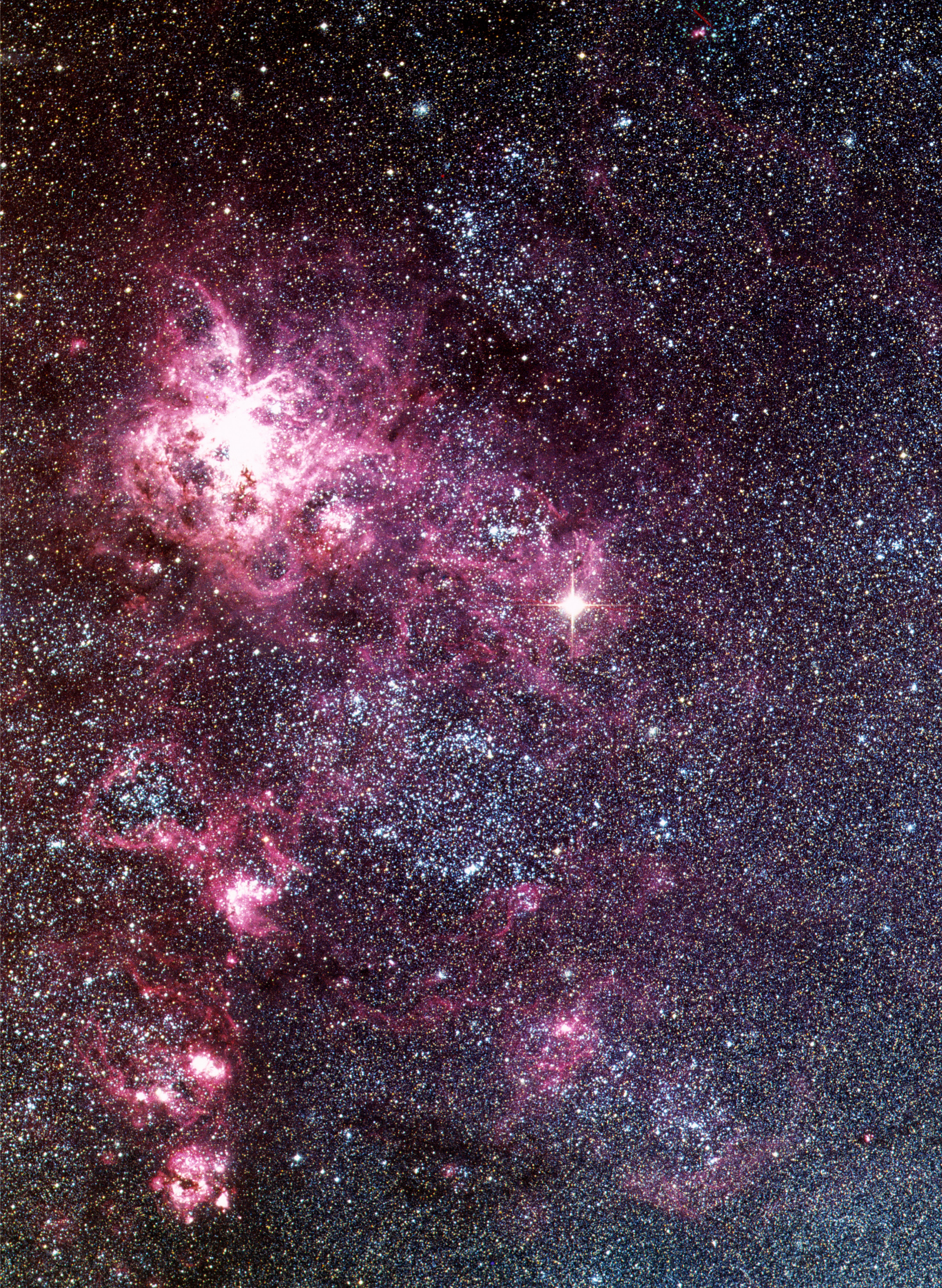
1987 supernova event in the constellation Dorado
| Field | Value | ||
|---|---|---|---|
| name | SN 1987A | ||
| image | Sn87a.jpg | ||
| caption | The expanding ring-shaped remnant of SN 1987A and its interaction with its surroundings, seen in X-ray and visible light. | ||
| epoch | J2000 | ||
| type | Type II (peculiar) | ||
| last1 | Lyman | first1=J. D. | |
| last2 | Bersier | first2=D. | |
| last3 | James | first3=P. A. | |
| year | 2013 | ||
| title | Bolometric corrections for optical light curves of core-collapse supernovae | ||
| journal | Monthly Notices of the Royal Astronomical Society | ||
| volume | 437 | issue=4 | page=3848 |
| arxiv | 1311.1946 | ||
| bibcode | 2014MNRAS.437.3848L | ||
| doi | 10.1093/mnras/stt2187 | ||
| doi-access | free | ||
| s2cid | 56226661 | ||
| host | Large Magellanic Cloud | ||
| constellation | Dorado | ||
| ra | |||
| dec | |||
| gal | G279.7-31.9 | ||
| discovery | |||
| mag_v | +2.9 | ||
| distance | 51.4 kpc | ||
| title | SN1987A in the Large Magellanic Cloud | ||
| url | http://heritage.stsci.edu/1999/04/fast_facts.html | ||
| publisher | Hubble Heritage Project | ||
| access-date | July 25, 2006 | ||
| archive-url | http://arquivo.pt/wayback/20090714230854/http://heritage.stsci.edu/1999/04/fast_facts.html | ||
| archive-date | July 14, 2009 | ||
| url-status | live | ||
| progenitor | Sanduleak -69 202 | ||
| progenitor_type | B3 blue supergiant | ||
| b-v | +0.085 | ||
| notes | Closest recorded supernova since invention of telescope | ||
| event_type | Supernova |
|doi-access=free |access-date=July 25, 2006 |archive-url=http://arquivo.pt/wayback/20090714230854/http://heritage.stsci.edu/1999/04/fast_facts.html |archive-date=July 14, 2009 |url-status=live |b-v = +0.085
SN 1987A was a Type II supernova in the Large Magellanic Cloud, a dwarf satellite galaxy of the Milky Way. It occurred approximately 51.4 kpc from Earth and was the closest observed supernova since Kepler's Supernova in 1604. Light and neutrinos from the explosion reached Earth on February 23, 1987, and it was designated "SN 1987A" as the first supernova discovered that year. Its brightness peaked in May of that year, with an apparent magnitude of about 3, brighter than the constellation's brightest star, Alpha Doradus.
It was the first supernova that modern astronomers were able to study in great detail, and its observations have provided much insight into core-collapse supernovae. SN 1987A provided the first opportunity to confirm by direct observation the radioactive source of the energy for visible light emissions, by detecting predicted gamma-ray line radiation from two of its abundant radioactive nuclei. This proved the radioactive nature of the long-duration post-explosion glow of supernovae.
In 2019, indirect evidence for the presence of a collapsed neutron star within the remnants of SN 1987A was discovered using the Atacama Large Millimeter Array telescope. Further evidence was subsequently uncovered in 2021 through observations conducted by the Chandra and NuSTAR X-ray telescopes.
Discovery
SN 1987A was discovered independently by Ian Shelton and Oscar Duhalde at the Las Campanas Observatory in Chile on February 24, 1987, and within the same 24 hours by Albert Jones in New Zealand. |display-authors=etal |url-status=live |archive-url=https://web.archive.org/web/20141008002032/http://www.cbat.eps.harvard.edu/iauc/04300/04316.html |archive-date=October 8, 2014
Later investigations found photographs showing the supernova brightening rapidly early on February 23. |display-authors=etal
Progenitor
Main article: Sanduleak −69 202
Four days after the event was recorded, the progenitor star was tentatively identified as Sanduleak −69 202 (Sk −69 202), a blue supergiant. |editor-last1=Kafatos |editor-first1=M. |editor-last2=Michalitsianos |editor-first2=A. |editor2-link=Andreas Gerasimos Michalitsianos After the supernova faded, that identification was definitively confirmed, as Sk −69 202 had disappeared. The possibility of a blue supergiant producing a supernova was considered surprising, and the confirmation led to further research which identified an earlier supernova with a blue supergiant progenitor.
Some models of SN 1987A's progenitor attributed the blue color largely to its chemical composition rather than its evolutionary stage, particularly the low levels of heavy elements. |doi-access=free |doi-access=free
Neutrino emissions
Approximately two to three hours before the visible light from SN 1987A reached Earth, a burst of neutrinos was observed at three neutrino observatories. This was likely due to neutrino emission which occurs simultaneously with core collapse, but before visible light is emitted as the shock wave reaches the stellar surface. |editor-last1=Kafatos |editor-first1=M. |editor-last2=Michalitsianos |editor-first2=A. |editor2-link=Andreas Gerasimos Michalitsianos
The Kamiokande II detection, which at 12 neutrinos had the largest sample population, showed the neutrinos arriving in two distinct pulses. The first pulse at 07:35:35 comprised 9 neutrinos over a period of 1.915 seconds. A second pulse of three neutrinos arrived during a 3.220-second interval from 9.219 to 12.439 seconds after the beginning of the first pulse.
Although only 25 neutrinos were detected during the event, it was a significant increase from the previously observed background level. This was the first time neutrinos known to be emitted from a supernova had been observed directly, which marked the beginning of neutrino astronomy. The observations were consistent with theoretical supernova models in which 99% of the energy of the collapse is radiated away in the form of neutrinos.
The neutrino measurements allowed upper bounds on neutrino mass and charge, as well as the number of flavors of neutrinos and other properties. For example, the data show that the rest mass of the electron neutrino is 2 at 95% confidence, which is 30,000 times smaller than the mass of an electron. The data suggest that the total number of neutrino flavors is at most 8 but other observations and experiments give tighter estimates. Many of these results have since been confirmed or tightened by other neutrino experiments such as more careful analysis of solar neutrinos and atmospheric neutrinos as well as experiments with artificial neutrino sources. |doi-access=free
Neutron star
SN 1987A appears to be a core-collapse supernova, which should result in a neutron star given the size of the original star. The neutrino data indicate that a compact object did form at the star's core, and astronomers immediately began searching for the collapsed core. The Hubble Space Telescope took images of the supernova regularly from August 1990 without a clear detection of a neutron star.
A number of possibilities for the "missing" neutron star were considered. |display-authors=etal |doi-access=free |display-authors=etal |display-authors=etal |archive-url=https://web.archive.org/web/20150318100318/http://www.newscientist.com/article/mg20126964.700-quark-star-may-hold-secret-to-early-universe.html |archive-date=March 18, 2015 |url-status=live
In 2019, evidence was presented for a neutron star inside one of the brightest dust clumps, close to the expected position of the supernova remnant. |display-authors=1 |doi-access=free |access-date=2019-12-06 |doi-access=free |access-date=2021-02-26 |display-authors=1
.jpg)
In 2024, researchers using the James Webb Space Telescope (JWST) identified distinctive emission lines of ionized argon within the central region of the Supernova 1987A remnants. These emission lines, discernible only near the remnant's core, were analyzed using photoionization models. The models indicate that the observed line ratios and velocities can be attributed to ionizing radiation originating from a neutron star illuminating gas from the inner regions of the exploded star.
Light curve

|access-date=8 November 2022 |bibcode=2007Msngr.127...44F}} ]]
After an explosion of a Type II supernova such as SN 1987A, much of the light is produced by the energy from radioactive decay. The radioactivity keeps the remnant hot enough to glow, without which the remnant would dim quickly. The decay of 56Ni through its daughters 56Co to 56Fe produces gamma-ray photons that are absorbed and dominate the heating and thus the luminosity of the ejecta at intermediate times (several weeks) to late times (several months). |display-authors=etal |display-authors=etal
Because the 56Co in SN1987A has now completely decayed, it no longer supports the luminosity of the SN 1987A ejecta. That is currently powered by the radioactive decay of 44Ti, with a half life of about 60 years but which increases with its ionization state as the decay is purely through electron capture. With this change, X-rays produced by the ring interactions of the ejecta began to contribute significantly to the total light curve. This was noticed by the Hubble Space Telescope as a steady increase in luminosity 10,000 days after the event in the blue and red spectral bands.
Observations of the radioactive power from their decays in the 1987A light curve have measured accurate total masses of the 56Ni, 57Ni, and 44Ti created in the explosion, which agree with the masses measured by gamma-ray line space telescopes and provides nucleosynthesis constraints on the computed supernova model. |display-authors=etal
Interaction with circumstellar material
|display-authors=etal
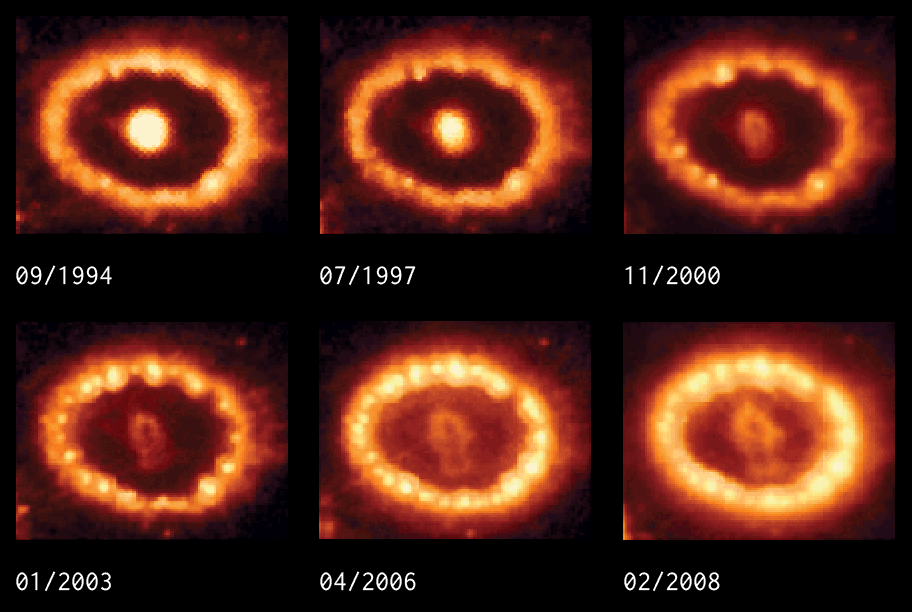
The three bright rings around SN 1987A that were visible after a few months in images by the Hubble Space Telescope are material from the stellar wind of the progenitor. These rings were ionized by the ultraviolet flash from the supernova explosion, and consequently began emitting in various emission lines. These rings did not "turn on" until several months after the supernova and the process can be very accurately studied through spectroscopy. The rings are large enough that their angular size can be measured precisely: the inner ring is 0.808 arcseconds (3.92 microradians) in radius. The time light traveled to brighten the inner ring gives its radius of 0.66 (ly) light years. Using this as the base of a right angle triangle and the angular size as seen from the Earth for the local angle, one can use basic trigonometry to calculate the distance to SN 1987A, which is about 168,000 light-years.
Around 2001, the expanding (7,000 km/s) supernova ejecta collided with the inner ring. This caused its heating and the generation of x-rays—the x-ray flux from the ring increased by a factor of three between 2001 and 2009. A part of the x-ray radiation, which is absorbed by the dense ejecta close to the center, is responsible for a comparable increase in the optical flux from the supernova remnant in 2001–2009. This increase of the brightness of the remnant reversed the trend observed before 2001, when the optical flux was decreasing due to the decaying of 44Ti isotope.
A study reported in June 2015, |access-date=June 13, 2015 |archive-url=https://web.archive.org/web/20150611202711/http://www.newscientist.com/article/mg22630254.500-supernova-prized-by-astronomers-begins-to-fade-from-view.html#.VXt0YOeqdYP |archive-date=June 11, 2015 |url-status=dead The model also shows that X-ray emission from ejecta heated up by the shock will be dominant very soon, after which the ring would fade away. As the shock wave passes the circumstellar ring it will trace the history of mass loss of the supernova's progenitor and provide useful information for discriminating among various models for the progenitor of SN 1987A. |display-authors=etal
In 2018, radio observations from the interaction between the circumstellar ring of dust and the shockwave confirmed that the shockwave has now left the circumstellar material. It also shows that the speed of the shockwave, which slowed down to 2,300 km/s while interacting with the dust in the ring, has now re-accelerated to 3,600 km/s. |display-authors=etal |doi-access=free
Condensation of warm dust in the ejecta

Soon after the SN 1987A outburst, three major groups embarked in a photometric monitoring of the supernova: the South African Astronomical Observatory (SAAO), |display-authors=etal |doi-access=free |display-authors=etal |doi-access=free |display-authors=etal |display-authors=etal |display-authors=etal |display-authors=etal
However, none of these three groups had sufficiently convincing proofs to claim for a dusty ejecta on the basis of an IR excess alone.

|display-authors=etal ]] An independent Australian team advanced several arguments in favour of an echo interpretation. |display-authors=etal To discriminate between the two interpretations, they considered the implication of the presence of an echoing dust cloud on the optical light curve, and on the existence of diffuse optical emission around the SN. |display-authors=etal |editor-last1=Woosley |editor-first1=S.E.
Although it had been thought more than 50 years ago that dust could form in the ejecta of a core-collapse supernova, |display-authors=etal |display-authors=etal |display-authors=etal
ALMA observations
Following the confirmation of a large amount of cold dust in the ejecta, ALMA has continued observing SN 1987A. Synchrotron radiation due to shock interaction in the equatorial ring has been measured. Cold (20–100K) carbon monoxide (CO) and silicate molecules (SiO) were observed. The data show that CO and SiO distributions are clumpy, and that different nucleosynthesis products (C, O and Si) are located in different places of the ejecta, indicating the footprints of the stellar interior at the time of the explosion. |display-authors=etal |display-authors=etal |display-authors=etal |doi-access=free
Gallery
File:New Hubble Observations of Supernova 1987A Trace Shock Wave (4954621859).jpg|The remnant of SN 1987A File:Composite image of Supernova 1987A.jpg|Composite of ALMA, Hubble and Chandra data, showing newly formed dust in the center of the remnant and the expanding shock wave. File:SN 1987A (NIRCam image) (SN1987a-1).jpg|NASA/ESA/CSA James Webb Space Telescope image of the supernova remnant File:Light echo from Supernova 1987A (eso8802a).jpg|The light echo of Supernova 1987A
References
Sources
- {{cite journal |display-authors=1
-
Notes
References
- (23 February 2025). "Toolkit calculation". dCode.
- (1987-04-06). "Observation of a neutrino burst from the supernova SN1987A". [[Physical Review Letters]].
- AAVSO 1987A
- (2024-02-23). "Emission lines due to ionizing radiation from a compact object in the remnant of Supernova 1987A". Science.
This article was imported from Wikipedia and is available under the Creative Commons Attribution-ShareAlike 4.0 License. Content has been adapted to SurfDoc format. Original contributors can be found on the article history page.
Ask Mako anything about SN 1987A — get instant answers, deeper analysis, and related topics.
Research with MakoFree with your Surf account
Create a free account to save articles, ask Mako questions, and organize your research.
Sign up freeThis content may have been generated or modified by AI. CloudSurf Software LLC is not responsible for the accuracy, completeness, or reliability of AI-generated content. Always verify important information from primary sources.
Report