From Surf Wiki (app.surf) — the open knowledge base
Smokey Bear
U.S. Forest Service mascot used to raise awareness about wildfires

U.S. Forest Service mascot used to raise awareness about wildfires
| Field | Value | |
|---|---|---|
| name | Smokey Bear | |
| image | Uncle Sam style Smokey Bear Only You.jpg | |
| caption | Smokey Bear in a poster based on the "Uncle Sam/Lord Kitchener Wants You" poster | |
| first | ||
| creator | U.S. Forest Service, Advertising Council, National Association of State Foresters | |
| lbl1 | Life | |
| voice | {{Plain list | |
| data1 | Spring 1950 | |
| Capitan, New Mexico | ||
| (living mascot) | ||
| November 11, 1976 | ||
| Washington, District of Columbia | ||
| info-hdr | Biological Classification | |
| lbl21 | Species | |
| lbl22 | Sex | |
| data21 | Ursus americanus (American black bear) | |
| data22 | Male |
- Jackson Weaver (1947–1992)
- Dallas McKennon (1957)
- George Walsh (1960)
- Roger C. Carmel (1969–1986)
- Gene Moss (1992–2002)
- Jim Cummings (1993–2008)
- Frank Welker (briefly)
- Jack Angel (2002–2012)
- Sam Elliott (2008–2023)
- Stephen Colbert (2019)
- Jeff Foxworthy (2019)
- Al Roker (2019)
- Brian Tyree Henry (2024–present) Capitan, New Mexico (living mascot) November 11, 1976 Washington, District of Columbia | info-hdr = Biological Classification Smokey Bear is an American campaign and advertising icon of the U.S. Forest Service in the Wildfire Prevention Campaign, which is the longest-running public service announcement campaign in United States history. The Ad Council, the Forest Service, and the National Association of State Foresters, in partnership with the creative agency FCB, use the character of Smokey Bear to educate the public about the dangers of unplanned human-caused wildfires.
The first campaign featuring Smokey began in 1944; it used the slogan "Smokey Says – Care Will Prevent 9 out of 10 Forest Fires". (Smokey's name has always intentionally been spelled differently from the adjective "smoky".) In 1947, the slogan was changed to "Remember... Only YOU Can Prevent Forest Fires." This version of the slogan was used continually in Smokey Bear campaigns until April 2001, when the message was officially updated to "Only You Can Prevent Wildfires." This change was made in response to a massive outbreak of wildfires occurring in natural areas other than forests (such as grasslands), and to clarify that Smokey was promoting the prevention of unplanned outdoor fires, not prescribed burns. Smokey has also been given additional lines to say throughout the years.
According to the Ad Council, in 2018, 80% of outdoor recreationists correctly identified Smokey Bear's image, and 8 in 10 recognized the campaign’s public service announcements.
Smokey Bear's name and image are protected by the Smokey Bear Act of 1952 (16 U.S.C. 580 (p-2); previously also 18 U.S.C. 711).
History
Origins
Although the U.S. Forest Service had been fighting wildfires long before the outbreak of World War II, the war brought a new importance and urgency to the effort. At the time, many experienced firefighters and other able-bodied men were serving in the armed forces, leaving fewer at home to fight wildfires. U.S. planners hoped that, if Americans knew how wildfires would harm the war effort, they would work with the Forest Service to reduce their occurrence. The Forest Service began using colorful posters to educate Americans about the dangers of wildfires in the hope that local communities could prevent them from starting in the first place. Careless citizens were not the only fire threat, however; the Empire of Japan considered using wildfires as a weapon, and in the spring of 1942, Japanese submarines surfaced near the coast of Santa Barbara, California, and fired shells that exploded on an oil field close to Los Padres National Forest. The Japanese military implemented a concerted wildfire strategy later in the war, launching some 9,000 fire balloons into the jet stream; an estimated 11% of these reached the U.S. between November 1944 and April 1945. Only one balloon bomb is known to have caused fatalities: Elsie Mitchell (the wife of Archie E. Mitchell) and five children were killed by one near Bly, Oregon, on May 5, 1945. A memorial was erected at what was later named the Mitchell Monument Historic Site.
Campaign beginnings
In 1942, the U.S. Forest Service established the Cooperative Forest Fire Prevention program, and on August 13 of that year, Disney's full-length animated motion picture Bambi premiered in New York City. Soon after, Walt Disney allowed his characters to appear in fire-prevention public service campaigns. However, Bambi was only loaned to the government for a year, so after that the Forest Service needed a new symbol. His name was inspired by "Smokey" Joe Martin, a New York City Fire Department hero who had suffered burns and blindness during a bold fire rescue in 1922.
On August 9, 1944, the Forest Service authorized the creation of Smokey Bear as its official symbol. This date has since been considered the character's birthday. The first Smokey Bear poster was delivered on October 10 by artist Albert Staehle. In the first poster, overseen by the Cooperative Forest Fire Prevention Campaign, Smokey was depicted wearing jeans and a campaign hat, pouring a bucket of water on a campfire. The message underneath read, "SMOKEY SAYS;– Care will prevent 9 out of 10 forest fires!"
In 1947, the Wartime Advertising Council (later the Ad Council) coined the slogan that was associated with Smokey Bear thereafter for more than five decades: "Remember...only YOU can prevent forest fires." In 2001, the slogan was officially amended to replace "forest fires" with "wildfires" in response to numerous outbreaks of wildfires in natural areas other than forests, and to clarify that the campaign was advocating for the prevention of unplanned fires, not of controlled burns or of fires prescribed for conservation purposes.
Living symbol
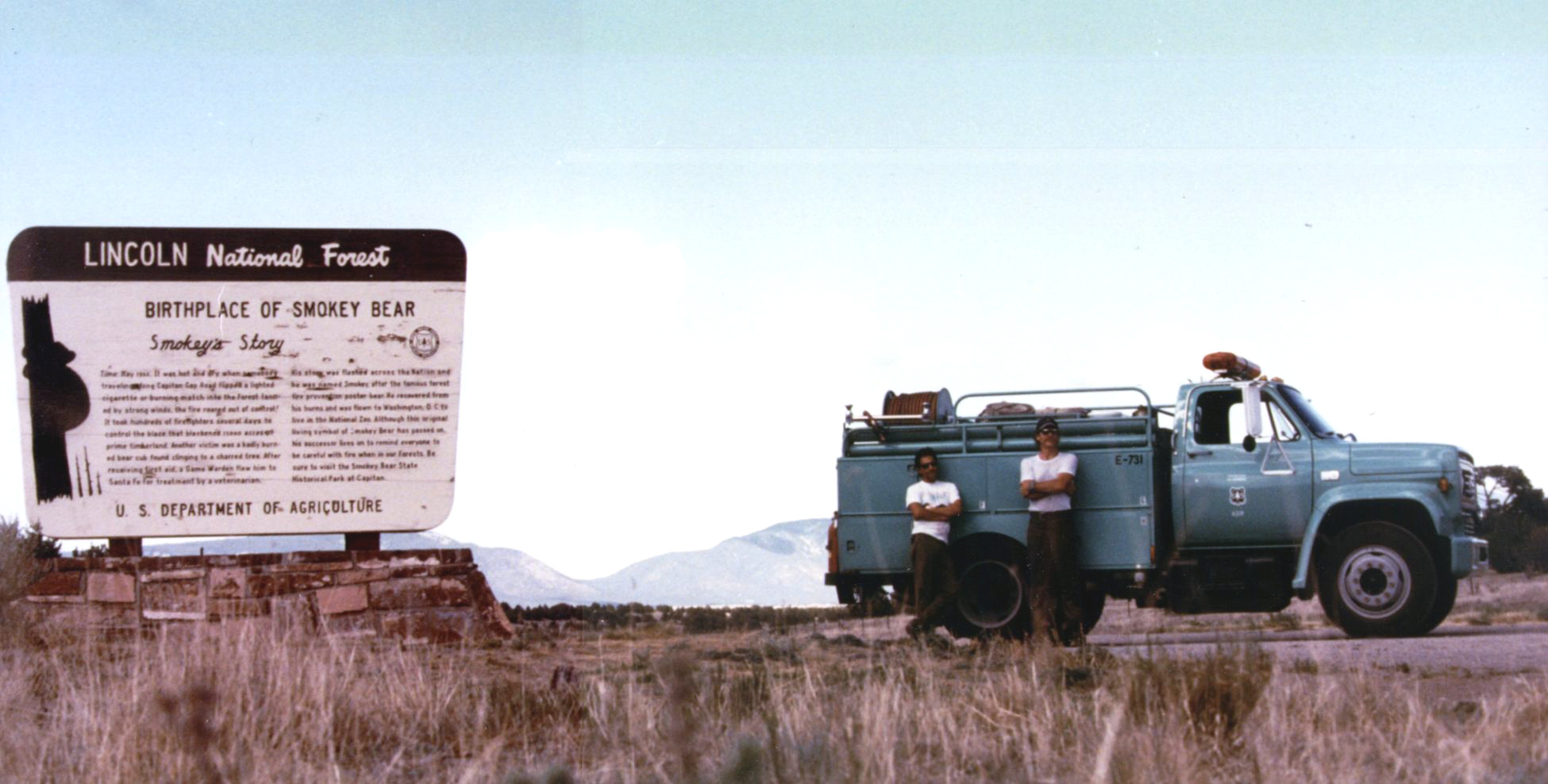
The living symbol of Smokey Bear was a five-pound, three-month-old American black bear cub who was found in the spring of 1950 after the Capitan Gap fire, a wildfire that burned in the Capitan Mountains of New Mexico. Smokey had climbed a tree to escape the blaze, yet his paws and hind legs had been burned.

At first, he was called Hotfoot Teddy, but he was later renamed Smokey, after the character created a few years prior. Ranger Ray Bell of the New Mexico Department of Game and Fish heard about the cub and took him to Santa Fe. Bell, his wife Ruth, and their children, Don and Judy, cared for the little bear with the help of local veterinarian Dr. Edwin J. Smith. The story was covered by the national news services and Smokey became a celebrity. Many people wrote and called asking about the cub's recovery. The state game warden wrote to the chief of the US Forest Service, offering to present the cub to the agency as long as the cub would be dedicated to a conservation and wildfire prevention publicity program. According to The New York Times obituary for Homer C. Pickens, then assistant director of the New Mexico Department of Game and Fish, he kept the cub on his property for a while before flying with the bear to Washington D.C.

Smokey Bear lived at the National Zoo for 26 years. During that time, he received millions of visitors and so many letters addressed to him (more than 13,000 a week) that in 1964, the United States Postal Service gave him his own ZIP Code (20252), which is still in use. He developed a love for peanut butter sandwiches in addition to his daily diet of bluefish and trout.
In 1962, Smokey was paired with a female bear, "Goldie Bear," with the hope that perhaps Smokey's descendants would take over the Smokey Bear title. In 1971, the zoo added "Little Smokey," another orphaned bear cub from the Lincoln Forest, to their cage, announcing that the pair had "adopted" this cub.
On May 2, 1975, Smokey Bear officially retired from his role as living icon, and his adopted son, Little Smokey, was given the title of "Smokey Bear II" in an official ceremony. Little Smokey died August 11, 1990.
Upon the death of the original bear on November 9, 1976, his remains were returned by the government to Capitan, New Mexico, and buried at Smokey Bear Historical Park, operated by the New Mexico State Forestry Division. The facility is now a wildfire and Smokey interpretive center. The bear is interred in the adjacent garden.
The Washington Post ran a semi-humorous obituary for Smokey, labeled "Bear," calling him a transplanted New Mexico native who had resided for many years in Washington, D.C., with many years of government service. It also mentioned his family, including his wife, Goldie Bear, and "adopted son," Little Smokey. The obituary noted that Smokey and Goldie were not blood relatives, despite the fact that they shared the same "last name" of "Bear." The Wall Street Journal included an obituary for Smokey Bear on the front page of the paper on November 11, 1976. The New York Times published one as well; in fact, so many newspapers published articles and obituaries that the National Zoo archives include four complete scrapbooks devoted to them (Series 12, boxes 66–67).
Peak in popularity

Smokey quickly became a part of American popular culture, appearing on radio programs, in comic strips, in cartoons, and as merchandise. Knickerbocker Bears acquired the license to produce Smokey Bear dolls in 1944. In 1949, Forest Service worker Rudy Wendelin became the campaign's full-time artist and was considered Smokey Bear's "manager" until Wendelin retired in 1973.
By 1952, because Smokey Bear had attracted considerable commercial interest, the United States Congress passed the Smokey Bear Act to remove the character from the public domain and place it under the control of the United States Secretary of Agriculture. The act provided that Smokey's royalties would be used to fund education about wildfire prevention.
In 1939, after local high school students helped fight a forest fire in the Black Hills, Hill City High School in South Dakota became the only school district in the United States authorized to use Smokey Bear as their mascot.
A Smokey Bear doll was produced by Ideal Toy Company beginning in 1952; the doll included a mail-in card for children to enable them to sign up to be designated Junior Forest Rangers. Children could also apply by writing to the U.S. Forest Service or Smokey Bear at his ZIP Code. Within three years, half a million children had applied. Also in 1952, songwriters Steve Nelson and Jack Rollins produced a successful song, titled "Smokey the Bear," and performed by Eddy Arnold. The pair said that the word "the" was added to Smokey's name to keep the song's rhythm. During the 1950s, that variant of the name became widespread both in popular speech and in print, including in at least one standard encyclopedia, even though Smokey Bear's name was never officially changed. A 1955 book in the Little Golden Books series was called Smokey the Bear, and he calls himself by this name in the book. It depicted him as an orphaned cub rescued in the aftermath of a forest fire, loosely following the true story of the bear who had been chosen as Smokey's "living symbol". This was the first book about him, and it was followed by many sequels and coloring books. Soon, thousands of dolls, toys, and other collectibles were on the market.
During the 1950s and 1960s, the Ad Council sponsored radio advertisements featuring Smokey Bear "in conversation" with prominent American celebrities such as Bing Crosby, Art Linkletter, Dinah Shore and Roy Rogers. Smokey's name and image are used for the Smokey Bear Awards, which are awarded by the U.S. Forest Service, the National Association of State Foresters (NASF) and the Ad Council, to "recognize outstanding service in the prevention of human-caused wildfires and to increase public recognition and awareness of the need for continuing fire prevention efforts".
The face of Smokey Bear occasionally appeared (usually on jumpers) in some episodes of the Canadian television series The Forest Rangers.
In 1959, a 14-foot-tall animatronic version of Smokey Bear was unveiled at the Ohio State Fairgrounds in Columbus, Ohio, at the Ohio Department of Natural Resources (ODNR) Natural Resources Park. It was installed to help teach fire prevention to children and their families. In 2015, it was replaced by a new Smokey Bear version in the same location. Both iterations of the animatronic figure have asked visitors to take the pledge to "never, ever play with matches or leave any fire unattended".
The Beach Boys quote Smokey Bear in their 1964 song "Drive-In": "If you say you watch the movie you're a couple of liars / and 'Remember only you can prevent forest fires'". Though Smokey was originally drawn wearing the campaign hat of the U.S. Forest Service, the hat alone later became famous by association with the Smokey cartoon character. Today, it is sometimes called a "Smokey Bear hat" and is still used by the U.S. Forest Service, some branches of the military, and the state police.
Recent history


For Smokey's 40th anniversary in 1984, he was honored with a U.S. postage stamp, illustrated by Rudy Wendelin, that pictured a cub hanging onto a burned tree. The same year, the U.S. Forest Service began to transfer Smokey Bear materials that had been collected from the Cooperative Forest Fire Prevention Campaign to the National Agricultural Library to be maintained in their special collections as documentation of the program. The National Archives and Records Administration transferred their materials concerning Smokey to the National Agricultural Library's special collections in 1990. The library continues to accept and maintain donations from various Forest Service offices. The collection consists of posters, proofs, mechanicals, original artwork, motion pictures, sound recordings, and various pieces of memorabilia, some of which are available online; all the pieces are accessible in Beltsville, MD, through the library.
The commercial for his 50th anniversary portrayed woodland animals about to have a surprise birthday party for Smokey, including a cake with candles. Smokey comes blindfolded, smells smoke and not realizing the source is his birthday candles, he uses his shovel to destroy the cake. When he takes off his blindfold, he sees that it was a birthday cake for him and apologizes. That same year, a poster of the bear with a cake full of extinguished candles was issued. It reads "Make Smokey's Birthday Wish Come True".
In 2004, Smokey's 60th anniversary was celebrated in several ways, including a Senate resolution designating August 9, 2004, as "Smokey Bear's 60th Anniversary", requesting that the President issue a proclamation "calling upon the people of the United States to observe the day with appropriate ceremonies and activities". According to Richard Earle, author of The Art of Cause Marketing, the Smokey Bear campaign is among the most powerful and enduring of all public service advertising:"Smokey is simple, strong, straightforward. He's a denizen of those woods you're visiting, and he cares about preserving them. Anyone who grew up watching Bambi realizes how terrifying a forest fire can be. But Smokey wouldn't run away. Smokey's strong. He'll stay and fight the fire if necessary, but he'd rather have you douse it and cover it up so he doesn't have to."In 2011, the campaign launched its first mobile application, or app, to provide critical information about wildfire prevention, including a step-by-step guide to safely building and extinguishing campfires, as well as a map of current wildfires across America.
In 2012, NASA, the U.S. Forest Service, the Texas Forest Service and Smokey Bear teamed up to celebrate Smokey's 68th birthday at NASA's Johnson Space Center in Houston. The popular mascot toured the center and recorded a promotional announcement for NASA Television. NASA astronaut Joe Acaba and the Expedition 31 crew chose a plush Smokey doll to be the team's launch mascot, celebrating their trip to the International Space Station. During his tour about 250 miles above Earth, Smokey turned 68 years old.
In 2014, the campaign celebrated Smokey's 70th birthday, with new birthday-themed television, radio, print, outdoor, and digital PSAs that continued the 2013 campaign "Smokey Bear Hug". The campaign depicted Smokey rewarding his followers with a hug, in acknowledgement of using the proper actions to prevent wildfires. In return, outdoor–loving individuals across the nation were shown reciprocating with a birthday bear hug in honor of his 70 years of service. Audiences were encouraged to join in by posting their own #SmokeyBearHug online. The campaign also did a partnership with Disney's Planes that same year. In 2016, the campaign launched a new series of PSAs that aimed to increase awareness about less commonly known ways that wildfires can start. The new "Rise from the Ashes" campaign featured art by Bill Fink, who used wildfire ashes as an artistic medium to illustrate the devastation caused by wildfires and highlight less obvious wildfire causes. In 2017, the campaign launched new videos and artwork inspired by Smokey Bear posters to continue to raise awareness of lesser-known wildfire starts. The new artwork was created by Brian Edward Miller, Evan Hecox, Janna Mattia, and Victoria Ying, portraying Smokey Bear in each of their unique styles.

For his 75th birthday in 2019, the Smithsonian's National Zoo in Washington D.C. opened an outdoor exhibit on May 23, 2019. Fourteen posters and multiple archival photographs of the original bear line the pathway in front of Smokey Bear's original habitat. At the entrance stands a 6-foot-tall statue of his cartoon persona. Along with the exhibit, new commercials and promotional materials were released, and events were held throughout the U.S. The NAL showcased movies, commercials, and paintings at their Beltsville location, materials were loaned to government agencies, and materials were provided to travel to various National Forests across the country throughout 2019.
On August 1, 2019, Oregon Department of Motor Vehicles released a Smokey Bear License Plate, just a few days before Smokey Bear's 75th birthday. The plate was sponsored by Keep Oregon Green, and costs an extra $40 per registration period, $35 of which goes to Keep Oregon Green.
Commercialization and cultural impact
Use of the Smokey Bear symbol in popular culture is often unauthorized. Clothing, accessories, and memorabilia depicting Smokey Bear are common in American fashion and culture. The chief of the Forest Service can authorize use of the Smokey Bear symbol for noncommercial educational purposes, and for "the commercial manufacture, importation, reproduction, or use of Smokey Bear upon the following findings: (1) That the use to which the article or published material involving Smokey Bear is to be put shall contribute to public information concerning the prevention of forest fires. (2) That the proposed use is consistent with the status of Smokey Bear as the symbol of forest fire prevention and does not in any way detract from such status. (3) That a use or royalty charge which is reasonably related to the commercial enterprise has been established. (c) Such other conditions shall be included as the Chief deems necessary in particular cases."
Some state police forces are nicknamed "Smokeys" (particularly by truck drivers) because their patrolmen wear the same type of campaign hat that Smokey Bear does.
Voice portrayal
Washington, D.C., radio station WMAL personality Jackson Weaver served as the primary voice representing Smokey until Weaver's death in October 1992. Dallas McKennon voiced Smokey in the 1957 Woody Woodpecker short film, Red Riding Hoodlum. George Walsh voiced Smokey in the 1960 animated short film, Smokey the Bear and the Little Boy. After Weaver's death, Gene Moss took over the role and voiced him until his death in 2002. In later years, Smokey has also been voiced by Roger C. Carmel (1969–1986), Jim Cummings (1993–2008), and Jack Angel (2002–2012). Frank Welker also briefly voiced Smokey in a few commercials. In June 2008, the Forest Service launched a new series of public service announcements voiced by actor Sam Elliott, simultaneously giving Smokey a new visual design intended to appeal to young adults. (coincidentally, Elliott was born on the very same day that Smokey was created). In celebration of Smokey's 75th birthday in 2019, public service announcements featuring emoji-based versions of the character were introduced, with the voices of Stephen Colbert, Jeff Foxworthy, and Al Roker. In 2024, in celebration of Smokey's 80th birthday, actor Brian Tyree Henry took over as the new voice.
Adaptations


Smokey Bear—and parodies of the character—have been appearing in animation for more than fifty years. In 1956, Smokey made a cameo appearance in the Walt Disney short film In the Bag with a voice provided by Jackson Weaver. Rankin/Bass Productions, in cooperation with Tadahito Mochinaga's MOM Production in Japan, produced an "Animagic" stop-motion animated television special, Ballad of Smokey the Bear, narrated by James Cagney. It was broadcast on Thanksgiving Day, November 24, 1966, as part of the General Electric Fantasy Hour on NBC. The same day, a Smokey Bear balloon was featured in the Macy's Thanksgiving Day Parade, and it was advertised as "Thanksgiving is Smokey Bear Day on NBC TV".
During the 1969–1970 television season, Rankin/Bass also produced a weekly Saturday Morning cartoon series for ABC, called The Smokey Bear Show. This series was animated by Toei Animation in Japan.
Despite his real name being Smokey Bear, the name "Smokey the Bear" has been perpetuated in popular culture. Steve Nelson and Jack Rollins' song "Smokey the Bear" has been covered by the group Canned Heat, among others. The track is on their CD The Boogie House Tapes 1969–1999.
The online battle royale game Fortnite: Battle Royale parodies Smokey and his motto in a loading screen featuring Cuddle Team Leader, a woman dressed in a teddy bear costume replacing Smokey and doing his signature finger-pointing pose. Below her is the message "Only YOU can prevent V-Buck scams", warning players not to risk security compromises by attempting to obtain free virtual currency offered by hackers as bait.
Slogan
Main article: Fire ecology
Although the goal of reducing human-caused wildfires has never changed, the tagline of the Smokey Bear campaign was adjusted in the 2000s, from "Only you can prevent forest fires" to "Only you can prevent wildfires". The main reason was to accurately expand the category beyond just forests to include wildlands, which include grasslands. Another reason was to respond to criticism from wildfire experts, and to distinguish 'bad' intentional or accidental wildfires from the needs of sustainable forests via natural "good" fire ecology.
Decades of fire suppression and lack of indigenous fire ecology can contribute to dense forests with a lot of understory "fuel" and many dead standing trees. When a forest fire eventually does occur, the increased fuel creates a crown fire, which destroys all vegetation and affects surface soil chemistry. Although such fires have been occurring sporadically for 100 million years, and are part of the natural ecological rhythm of forests, frequent and small "natural" ground fires do prevent the accumulation of fuel and allow large, slow-growing vegetation, e.g., trees, to survive.
Periodic low-intensity wildfires are also an integral component of certain ecosystems that evolved to take advantage of natural fires, such as Douglas fir, chaparral and closed-cone conifer forest habitats, which need fire for cones to open and seeds to sprout, and germinate and grow better in open burn sites. Wildfires also play a role in the preservation of pine barrens, which are well adapted to small ground fires and rely on periodic fires to remove competing species.
SmokeyBear.com's current site has a section on "Benefits of Fire" that includes this information: "Fire managers can reintroduce fire into fire-dependent ecosystems with prescribed fire. Under specific, controlled conditions, the beneficial effects of natural fire can be recreated, fuel buildup can be reduced, and we can prevent the catastrophic losses of uncontrolled, unwanted wildfire." Prescribed or controlled fire is an important resource management tool. It is a way to efficiently and safely provide for fire's natural role in the ecosystem. However, the goal of Smokey Bear will always be to reduce the number of human-caused wildfires and reduce the loss of resources, homes and lives.
References
References
- (2024-09-23). "Smokey Bear: More Than an Icon".
- "About Wildfires". SmokeyBear.com.
- Newswire, MultiVu – PR. "Creative features new digital-first videos and artwork in a continuation of the longest running PSA campaign in U.S. history".
- "Wildfire Prevention". Ad Council.
- "Explore Smokey Bear's History (1940s)". Ad Council.
- "Wildfire Prevention". AdCouncil.
- "Wildfire Prevention". AdCouncil.
- (May 23, 1952). "Smokey Bear Act of 1952". Government Printing Office.
- "History of Smokey Bear". U.S. Department of Agriculture Forest Service.
- "Conservation Education – Smokey Bear – USDA Forest Service".
- "About the Campaign". Ad Council.
- "Campaign History – Forest Fire Prevention". SmokeyBear.com.
- (May 27, 2013). "Japan's Secret WWII Weapon: Balloon Bombs".
- (May 5, 2005). "Japanese balloon bomb killed six 60 years ago today".
- "Mitchell Monument Historic Site". [[Fremont-Winema National Forests]].
- "United States Department of Agriculture".
- Morrison, Ellen Earnhardt. (1989). "Guardian of the forest : a history of the Smokey Bear program". Morielle Press.
- Oliver, Myrna. (March 3, 1999). "Harry Rossoll; Creator of Smokey Bear".
- Ralph Blumenthal. (November 20, 2002). "Books of the Times: Their Battle Is Joined With an Inhuman Enemy". The New York Times.
- "Smokey Bear Celebrates 70th Birthday Awards Smokey Bear Hugs In New Wildfire Prevention PSAs". AdCouncil.
- "About the Campaign". SmokeyBear.com, Ad Council.
- [http://toonopedia.com/smbear.htm Smokey Bear] at [[Don Markstein's Toonopedia]] [https://archive.today/20240528043831/https://www.webcitation.org/6r0HvXLRn?url=http://toonopedia.com/smbear.htm Archived] from the original on June 5, 2017.
- Howe, Irving. (July 13, 1978). ["A Margin of Hope"](https://archive.org/details/marginofhopeint00howe}} excerpted in {{cite web). Harvest Books.
- "The story of the creation of Smokey Bear, told by the late Albert Staehle's wife". South-florida.us.
- "Campaign History — American Icon". SmokeyBear.com.
- Kelly, John. (April 25, 2010). "The biography of Smokey Bear: the cartoon came first". [[The Washington Post]].
- "The Orphan Cub". SmokeyBear.com.
- Long, Trish. "Smokey Bear originally was called Hotfoot Teddy".
- Lawter, William Clifford. (1994). "Smokey Bear 20252: a biography". Lindsay Smith Publishers.
- (February 23, 1995). "Homer Pickens, 91 – Saved Smokey Bear". The New York Times.
- Lawter, William Clifford. (1994). "Smokey Bear 20252: a biography". Lindsay Smith Publishers.
- Tad Bennicoff. (May 27, 2010). "Bearly Survived to become an Icon". Smithsonian Institution Archives.
- Alex Hawes. (December 2002). "Smokey Comes to Washington". Smithsonian National Zoological Park.
- "Welcome to Smokey Bear Historical Park!". Smokeybearpark.com.
- John Kelly. (April 25, 2010). "The biography of Smokey Bear: the cartoon came first". The Washington Post.
- Larry Bleiberg. (June 29, 1997). "New Mexico – Town Still Celebrates Smokey Bear's Legend". Seattle Times.
- Charlton, Linda. (November 10, 1976). "Smokey Bear Dies in Retirement". The New York Times.
- "National Zoological Park, Office of Public Affairs, Records". [[Smithsonian Institution Archives]].
- "Knickerbocker Bears antique teddy bear encyclopedia". Luckybears.com.
- {{United States Code with description. 16. 580p-2. Deposit of fees collected under regulations relating to "Smokey Bear"; availability.
- "School History".
- Morrison, Ellen Earnhardt. (1989). "Guardian of the forest : a history of the Smokey Bear program". Morielle Press.
- "Letters to Smokey Bear Reveal Promise of Hope for the Future".
- "Explore Smokey Bear's History (1950s)". SmokeyBear.com.
- "Explore Smokey Bear's History (1960s)". SmokeyBear.com.
- "Forest Fire Prevention-Smokey Bear (1944–Present)".
- "About the Awards". SmokeyBear.com.
- "Smokey Bear Awards Fact Sheet". National Symbols Cache.
- [[The Forest Rangers (TV series)]]; Canadian television series; 1963 - 1965
- "Smokey Bear".
- "Index of /im/directives/fsh/1309.13".
- Kathryn Sosbe. (August 7, 2014). "Smokey Bear, Iconic Symbol of Wildfire Prevention, Still Going Strong at 70".
- "Smokey Bear · Special Collections Exhibits".
- "Explore Smokey Bear's History (1990s)". SmokeyBear.com.
- "Explore Smokey Bear's History (1980s)". SmokeyBear.com.
- (July 22, 2004). "S.Res.404 – A resolution designating August 9, 2004, as 'Smokey Bear's 60th Anniversary'".
- Richard Earle. (2000). "The Art of Cause Marketing". McGraw-Hill.
- "Smokey Bear Returns to Remind Americans...". AdCouncil.
- (2023-12-22). "The Stories Behind 8 Iconic Brand Mascots".
- (2014-07-19). "East Texas children meet Smokey the Bear at 'Planes 2' premier".
- "National Association of State Foresters {{!}} Wildfire Prevention Resource: New Smokey Bear PSAs Unveiled". National Association of State Foresters.
- Newswire, MultiVu – PR. "Creative features new digital-first videos and artwork in a continuation of the longest running PSA campaign in U.S. history".
- (May 23, 2019). "Smokey Bear Exhibit Opens at Smithsonian's National Zoo".
- "Historic Art Exhibit on Display in Honor of Smokey Bear's 75th Birthday – KASL Radio".
- (9 July 2019). "Oregon's Smokey Bear license plate available just in time for his 75th birthday".
- "Smokey Bear License Plate".
- "Smokey The Bear Makeover".
- "Use of "SMOKEY BEAR" Symbol".
- for example the 1977 film [[Smokey and the Bandit]]
- (October 22, 1992). "Jackson Weaver, 72, Voice of Smokey Bear". [[The New York Times]].
- Valerie J. Nelson. (January 11, 2006). "George Walsh, 88; Voice of "Gunsmoke," KNX Newsman".
- Dennis Mclellan. (July 22, 2002). "Gene Moss, 75; Children's TV Writer, Smokey Bear's Voice".
- Knowling, Doug. (2016). "Ecological Restoration: Wildfire Ecology Reference Manual". Knowling.
- "'Scoob' actor Frank Welker doesn't have a recognizable face. But he likely ruled your childhood. – The Washington Post". [[The Washington Post]].
- Fisher, Ellyn. (August 7, 2014). "Smokey Bear Celebrates 70th Birthday and Reminds Americans... "Only You Can Prevent Wildfires"". [[Ad Council]].
- "Smokey Bear turns 75 and gets new voices from Stephen Colbert, Al Roker and others". The Drum.
- Council, The Ad. "Smokey Bear Celebrates 80th Birthday with New PSA Honoring His Legacy of Wildfire Prevention".
- "Walt Disney – In The Bag – 1956".
- dandydeal. (January 11, 2016). "The Ballad of Smokey the Bear (1966)".
- Morrison, Ellen Earnhardt. (1995). "Guardian of the forest : a history of Smokey Bear and the Cooperative Forest Fire Prevention Program". Morielle Press.
- (1969). "The Smokey Bear Show".
- Woolery, George W.. (1983). "Children's Television, the First Thirty-five Years, 1946–1981 – Part 1: Animated Cartoon Series". Scarecrow Press.
- Kelly, John. (April 25, 2010). "The biography of Smokey Bear: the cartoon came first". The Washington Post.
- [[Canned Heat]]. "''The Boogie House Tapes 1969–1999''".
- (September 26, 2017). "Fortnite: Battle Royale". Epic Games.
- Aakrit. (April 20, 2022). "Fortnite V-Bucks scammers are getting smarter: Exposing a new fraudulent scheme to scam players".
- Mike Anton. (July 24, 2009). "At 65, Smokey Bear is still fighting fires". Los Angeles Times.
- Swenson, Kyle. (August 15, 2018). "Was Smokey Bear wrong? How a beloved character may have helped fuel catastrophic fires". [[The Washington Post]].
- "The Ecological Benefits of Fire".
- McPhee, John. (1968). "The Pine Barrens". Farrar, Straus and Giroux.
- "Fire's Legacy". SmokeyBear.com.
This article was imported from Wikipedia and is available under the Creative Commons Attribution-ShareAlike 4.0 License. Content has been adapted to SurfDoc format. Original contributors can be found on the article history page.
Ask Mako anything about Smokey Bear — get instant answers, deeper analysis, and related topics.
Research with MakoFree with your Surf account
Create a free account to save articles, ask Mako questions, and organize your research.
Sign up freeThis content may have been generated or modified by AI. CloudSurf Software LLC is not responsible for the accuracy, completeness, or reliability of AI-generated content. Always verify important information from primary sources.
Report