From Surf Wiki (app.surf) — the open knowledge base
Smegma
Secretion of mammalian genitals

Secretion of mammalian genitals
Smegma (from Ancient Greek ) is a cheesy substance composed of shed skin cells, skin oils, and moisture that occurs in male and female mammalian genitalia. In males, smegma collects under the foreskin; in females, it collects around the clitoris and in the folds of the labia minora.
Females
The accumulation of sebum combined with dead skin cells forms smegma. Smegma clitoridis is defined as the secretion of the apocrine (sweat) and sebaceous (sebum) glands of the clitoris in combination with desquamating epithelial cells.
If smegma is not removed frequently it can lead to clitoral adhesion which can make clitoral stimulation (such as masturbation) painful (clitorodynia).
Males
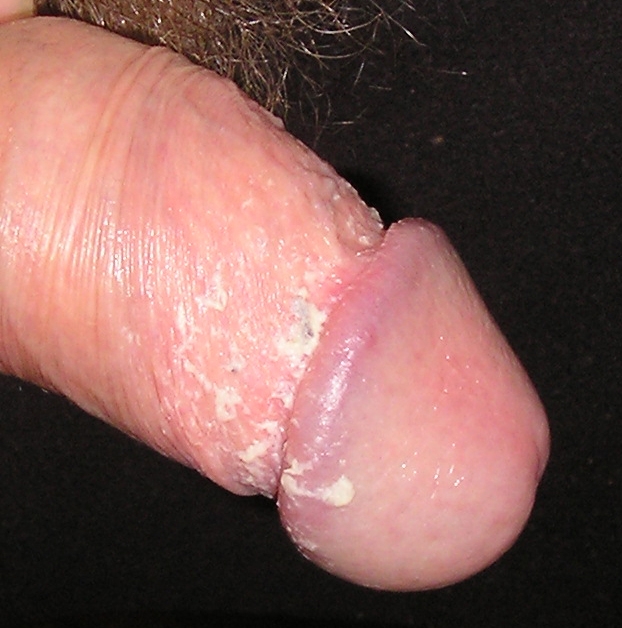
In males, smegma helps keep the glans moist and facilitates sexual intercourse by acting as a lubricant. |name-list-style=vanc |name-list-style=vanc |url-access=subscription |name-list-style=vanc
Smegma was originally thought to be produced by sebaceous glands near the frenulum called Tyson's glands; however, subsequent studies have failed to find these glands. |name-list-style=vanc |url-access=subscription
Newly produced smegma has a smooth, moist texture. It is thought to be rich in squalene |name-list-style=vanc |name-list-style=vanc |name-list-style=vanc
According to Wright, the production of smegma, which is low in childhood, increases from adolescence until sexual maturity when the function of smegma for lubrication assumes its full value. From middle-age, production starts to decline and in old age virtually no smegma is produced. Jakob Øster reported that the incidence of smegma increased from 1% among 6- to 9-year-olds to 8% among 14- to 17-year-olds (amongst those who did not present with phimosis and could be examined).
Smegma can cause irritation and inflammation in males, which can increase the risk of penile cancer.
Other animals
In healthy animals, smegma helps clean and lubricate the genitals. In veterinary medicine, analysis of this smegma is sometimes used for detection of urogenital tract pathogens, such as Tritrichomonas foetus. |name-list-style=vanc
References
References
- {{cite Merriam-Webster. smegma
- (June 2018). "Retrospective Study of the Prevalence and Risk Factors of Clitoral Adhesions: Women's Health Providers Should Routinely Examine the Glans Clitoris". Sexual Medicine.
- (April 2017). "PD25-02 Taking Responsibility for Female Prepucial Disorders: Urologic Management of Phimosis-Based Clitorodynia". Journal of Urology.
- (August 2015). "Clitorodynia: A Descriptive Study of Clitoral Pain". The Journal of Sexual Medicine.
- (November 2000). "The Role of the Levator Ani Muscle in Evacuation, Sexual Performance and Pelvic Floor Disorders". International Urogynecology Journal.
- (25 June 2018). "Risk Factors for Penile Cancer". [[American Cancer Society]].
- Primary Industries Ministerial Council of Australia and New Zealand (2002). [http://www.animalhealthaustralia.com.au/fms/Animal%20Health%20Australia/AUSVETPLAN/cemfinal.pdf Disease strategy: Contagious equine metritis] {{Webarchive. link. (2008-07-21 (Version 1.0). In: Australian Veterinary Emergency Plan (AUSVETPLAN), Edition 3, PIMCANZ, Canberra, ACT.)
- (1 September 2001). "A Clean Sheath Is A Healthy Sheath". Horse City.
This article was imported from Wikipedia and is available under the Creative Commons Attribution-ShareAlike 4.0 License. Content has been adapted to SurfDoc format. Original contributors can be found on the article history page.
Ask Mako anything about Smegma — get instant answers, deeper analysis, and related topics.
Research with MakoFree with your Surf account
Create a free account to save articles, ask Mako questions, and organize your research.
Sign up freeThis content may have been generated or modified by AI. CloudSurf Software LLC is not responsible for the accuracy, completeness, or reliability of AI-generated content. Always verify important information from primary sources.
Report