From Surf Wiki (app.surf) — the open knowledge base
Small interfering RNA
Biomolecule

Biomolecule
Small interfering RNA (siRNA), sometimes known as short interfering RNA or silencing RNA, is a class of double-stranded non-coding RNA molecules, typically 20–24 base pairs in length, similar to microRNA (miRNA), and operating within the RNA interference (RNAi) pathway. It interferes with the expression of specific genes with complementary nucleotide sequences by degrading messenger RNA (mRNA) after transcription, preventing translation. It was discovered in 1998 by Andrew Fire at the Carnegie Institution for Science in Washington, D.C. and Craig Mello at the University of Massachusetts in Worcester.
Structure

Naturally occurring siRNAs have a well-defined structure that is a short (usually 20 to 24-bp) double-stranded RNA (dsRNA) with phosphorylated 5' ends and hydroxylated 3' ends with two overhanging nucleotides. The Dicer enzyme catalyzes production of siRNAs from long dsRNAs and small hairpin RNAs. siRNAs can also be introduced into cells by transfection. Since in principle any gene can be knocked down by a synthetic siRNA with a complementary sequence, siRNAs are an important tool for validating gene function and drug targeting in the post-genomic era.
History
In 1998, Andrew Fire at Carnegie Institution for Science in Washington DC and Craig Mello at University of Massachusetts in Worcester discovered the RNAi mechanism while working on the gene expression in the nematode, Caenorhabditis elegans. They won the Nobel prize for their research with RNAi in 2006. siRNAs and their role in post-transcriptional gene silencing (PTGS) was discovered in plants by David Baulcombe's group at the Sainsbury Laboratory in Norwich, England and reported in Science in 1999. Thomas Tuschl and colleagues soon reported in Nature that synthetic siRNAs could induce RNAi in mammalian cells. In 2001, the expression of a specific gene was successfully silenced by introducing chemically synthesized siRNA into mammalian cells (Tuschl et al.) These discoveries led to a surge in interest in harnessing RNAi for biomedical research and drug development. Significant developments in siRNA therapies have been made with both organic (carbon based) and inorganic (non-carbon based) nanoparticles, which have been successful in drug delivery to the brain, offering promising methods to deliver therapeutics into human subjects. However, human applications of siRNA have had significant limitations to its success. One of these being off-targeting. There is also a possibility that these therapies can trigger innate immunity. Animal models have not been successful in accurately representing the extent of this response in humans. Hence, studying the effects of siRNA therapies has been a challenge.
In recent years, siRNA therapies have been approved and new methods have been established to overcome these challenges. There are approved therapies available for commercial use and several currently in the pipeline waiting to get approval.
Mechanism
The mechanism by which natural siRNA causes gene silencing through repression of translation occurs as follows:
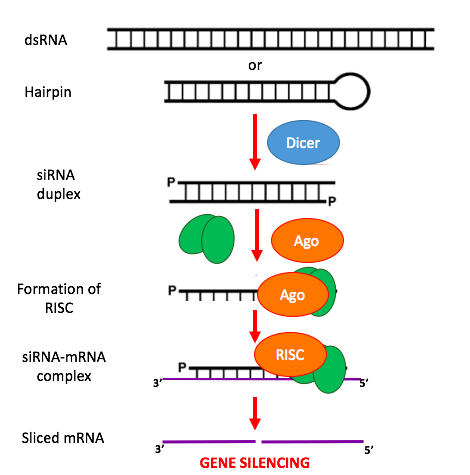
- Long dsRNA (which can come from hairpin, complementary RNAs, and RNA-dependent RNA polymerases) is cleaved by an endo-ribonuclease called Dicer. Dicer cuts the long dsRNA to form short interfering RNA or siRNA; this is what enables the molecules to form the RNA-Induced Silencing Complex (RISC).
- Once siRNA enters the cell it gets incorporated into other proteins to form the RISC.
- Once the siRNA is part of the RISC complex, the siRNA is unwound to form single stranded siRNA.
- The strand that is thermodynamically less stable due to its base pairing at the 5´end is chosen to remain part of the RISC-complex
- The single stranded siRNA which is part of the RISC complex now can scan and find a complementary mRNA
- Once the single stranded siRNA (part of the RISC complex) binds to its target mRNA, it induces mRNA cleavage.
- The mRNA is now cut and recognized as abnormal by the cell. This causes degradation of the mRNA and in turn no translation of the mRNA into amino acids and then proteins. Thus silencing the gene that encodes that mRNA. siRNA is also similar to miRNA, however, miRNAs are derived from shorter stemloop RNA products. miRNAs typically silence genes by repression of translation and have broader specificity of action, while siRNAs typically work with higher specificity by cleaving the mRNA before translation, with 100% complementarity.
RNAi induction using siRNAs or their biosynthetic precursors

Gene knockdown by transfection of exogenous siRNA is often unsatisfactory because the effect is only transient, especially in rapidly dividing cells. This may be overcome by creating an expression vector for the siRNA. The siRNA sequence is modified to introduce a short loop between the two strands. The resulting transcript is a short hairpin RNA (shRNA), which can be processed into a functional siRNA by Dicer in its usual fashion. Typical transcription cassettes use an RNA polymerase III promoter (e.g., U6 or H1) to direct the transcription of small nuclear RNAs (snRNAs) (U6 is involved in RNA splicing; H1 is the RNase component of human RNase P). It is theorized that the resulting siRNA transcript is then processed by Dicer.
The gene knockdown efficiency can also be improved by using cell squeezing.
The activity of siRNAs in RNAi is largely dependent on its binding ability to the RNA-induced silencing complex (RISC). Binding of the duplex siRNA to RISC is followed by unwinding and cleavage of the sense strand with endonucleases. The remaining anti-sense strand-RISC complex can then bind to target mRNAs for initiating transcriptional silencing.
RNA activation
Main article: RNA activation
In addition to their role in RNAi, siRNAs can also activate gene expression, a phenomenon termed "RNA activation" or RNAa. This was first observed when synthetic siRNAs, termed "small activating RNA" (saRNA), targeting gene promoters were found to induce potent transcriptional activation of target genes. RNAa has been demonstrated to be a conserved mechanism, observed across species from insects, C. elegans, and plants, to mammals (including humans).
The mechanism of RNAa involves the targeting of promoter regions by saRNAs, leading to the recruitment of transcriptional machinery and epigenetic changes that promote gene expression. This process often involves the RNA-induced transcriptional activation (RITA) complex, which includes Argonaute proteins (particularly Ago2), RNA helicase A (RHA), and CTR9. Endogenous miRNAs can also mediate RNAa, expanding the regulatory roles of these small RNAs beyond gene silencing.
Several saRNA-based therapeutics are currently in clinical development. MTL-CEBPA, developed by MiNA Therapeutics, targets the CEBPA gene and is in Phase II trials for liver cancer. RAG-01, developed by Ractigen Therapeutics, targets the p21 gene and is in Phase I trials for non-muscle invasive bladder cancer (NMIBC). These clinical trials represent a significant step towards translating the RNAa phenomenon into novel therapeutic strategies.
Post-transcriptional gene silencing
The siRNA-induced post transcriptional gene silencing is initiated by the assembly of the RNA-induced silencing complex (RISC). The complex silences certain gene expression by cleaving the mRNA molecules coding the target genes. To begin the process, one of the two siRNA strands, the guide strand (anti-sense strand), will be loaded into the RISC while the other strand, the passenger strand (sense strand), is degraded. Certain Dicer enzymes may be responsible for loading the guide strand into RISC. Then, the siRNA scans for and directs RISC to perfectly complementary sequence on the mRNA molecules. The cleavage of the mRNA molecules is thought to be catalyzed by the Piwi domain of Argonaute proteins of the RISC. The mRNA molecule is then cut precisely by cleaving the phosphodiester bond between the target nucleotides which are paired to siRNA residues 10 and 11, counting from the 5'end. This cleavage results in mRNA fragments that are further degraded by cellular exonucleases. The 5' fragment is degraded from its 3' end by exosome while the 3' fragment is degraded from its 5' end by 5' -3' exoribonuclease 1(XRN1). Dissociation of the target mRNA strand from RISC after the cleavage allow more mRNA to be silenced. This dissociation process is likely to be promoted by extrinsic factors driven by ATP hydrolysis.
Sometimes cleavage of the target mRNA molecule does not occur. In some cases, the endonucleolytic cleavage of the phosphodiester backbone may be suppressed by mismatches of siRNA and target mRNA near the cleaving site. Other times, the Argonaute proteins of the RISC lack endonuclease activity even when the target mRNA and siRNA are perfectly paired. In such cases, gene expression will be silenced by an miRNA induced mechanism instead
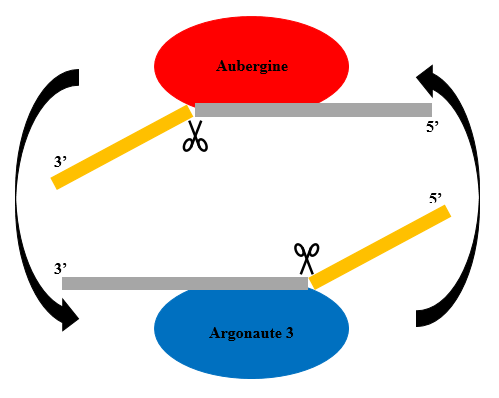
Piwi-interacting RNAs are responsible for the silencing of transposons and are not siRNAs. PIWI-interacting RNAs (piRNAs) are a recently discovered class of small non-coding RNAs (ncRNAs) with a length of 21-35 nucleotides. They play a role in gene expression regulation, transposon silencing, and viral infection inhibition. Once considered as "dark matter" of ncRNAs, piRNAs emerged as important players in multiple cellular functions in different organisms.
Transcriptional Gene Silencing
Many model organism, such as plants (Arabidopsis thaliana), yeast (Saccharomyces cerevisiae), flies (Drosophila melanogaster) and worms (C. elegans), have been used to study small non coding RNA-directed Transcriptional gene silencing. In human cell, RNA-directed transcriptional gene silencing was observed a decade ago when exogenous siRNAs silenced a transgenic elongation factor 1 α promoter driving a Green Fluorescent Protein (GFP) reporter gene. The main mechanisms of transcriptional gene silencing (TGS) involving the RNAi machinery include DNA methylation, histone post-translational modifications, and subsequent chromatin remodeling around the target gene into a heterochromatic state. SiRNAs can be incorporated into a RNA-induced transcriptional silencing (RITS) complex. An active RITS complex will trigger the formation of heterochromatin around DNA matching the siRNA, effectively silencing the genes in that region of the DNA.
Applications: Allele-specific gene silencing
One of the potent applications of siRNAs is the ability to distinguish the target versus non-target sequence with a single-nucleotide difference. This approach has been considered as therapeutically crucial for the silencing dominant gain-of-function (GOF) disorders, where mutant allele causing disease is differed from wt-allele by a single nucleotide (nt). These types of siRNAs with the capability to distinguish a single-nt difference, are termed as, allele-specific siRNAs.
ASP-RNAi is an innovative category of RNAi with the objective of suppressing the dominant mutant allele while sparing expression of the corresponding normal allele with the specificity of single-nucleotide differences between the two. ASP-siRNAs are potentially a novel and better remedial alternative for the treatment of autosomal dominant genetic disorders especially in cases where wild-type allele expression is crucial for organism survival such as Huntington disease (HD),DYT1 dystonia (Gonzalez-Alegre et al. 2003, 2005), Alzheimer's disease (Sierant et al. 2011), Parkinson's disease (PD) (Takahashi et al. 2015), amyloid lateral sclerosis (ALS) (Schwarz et al. 2006), and Machado–Joseph disease (Alves et al. 2008). Their therapeutic potential has also been assessed for various skin disorders like epidermolysis bullosa simplex (Atkinson et al. 2011), epidermolytic palmoplantar keratoderma (EPPK) (Lyu et al. 2016), and lattice corneal dystrophy type I (LCDI) (Courtney et al. 2014).
Challenges: avoiding nonspecific effects
RNAi intersects with a number of other pathways; as of 2010 it was not surprising that on occasion, nonspecific effects are triggered by the experimental introduction of an siRNA. When a mammalian cell encounters a double-stranded RNA such as an siRNA, it may mistake it as a viral by-product and mount an immune response. Furthermore, because structurally related microRNAs modulate gene expression largely via incomplete complementarity base pair interactions with a target mRNA, the introduction of an siRNA may cause unintended off-targeting. Chemical modifications of siRNA may alter the thermodynamic properties that also result in a loss of single nucleotide specificity.
Innate immunity
Introduction of too many siRNA can result in nonspecific events due to activation of innate immune responses. Most evidence to date suggests that this is probably due to activation of the dsRNA sensor PKR, although retinoic acid-inducible gene I (RIG-I) may also be involved. The induction of cytokines via toll-like receptor 7 (TLR7) has also been described. Chemical modification of siRNA is employed to reduce in the activation of the innate immune response for gene function and therapeutic applications. One promising method of reducing the nonspecific effects is to convert the siRNA into a microRNA. MicroRNAs occur naturally, and by harnessing this endogenous pathway it should be possible to achieve similar gene knockdown at comparatively low concentrations of resulting siRNAs. This should minimize nonspecific effects.
Off-targeting
Off-targeting is another challenge to the use of siRNAs as a gene knockdown tool. The tool of siRNA off-target predition is available at http://crdd.osdd.net/servers/aspsirna/asptar.php and published as ASPsiRNA resource.
Adaptive immune responses
Plain RNAs may be poor immunogens, but antibodies can easily be created against RNA-protein complexes. Many autoimmune diseases see these types of antibodies. There haven't yet been reports of antibodies against siRNA bound to proteins. Some methods for siRNA delivery adjoin polyethylene glycol (PEG) to the oligonucleotide reducing excretion and improving circulating half-life. However recently a large Phase III trial of PEGylated RNA aptamer against factor IX had to be discontinued by Regado Biosciences because of a severe anaphylactic reaction to the PEG part of the RNA. This reaction led to death in some cases and raises significant concerns about siRNA delivery when PEGylated oligonucleotides are involved.
Saturation of the RNAi machinery
siRNAs transfection into cells typically lowers the expression of many genes, however, the upregulation of genes is also observed. The upregulation of gene expression can partially be explained by the predicted gene targets of endogenous miRNAs. Computational analyses of more than 150 siRNA transfection experiments support a model where exogenous siRNAs can saturate the endogenous RNAi machinery, resulting in the de-repression of endogenous miRNA-regulated genes. Thus, while siRNAs can produce unwanted off-target effects, i.e. unintended downregulation of mRNAs via a partial sequence match between the siRNA and target, the saturation of RNAi machinery is another distinct nonspecific effect, which involves the de-repression of miRNA-regulated genes and results in similar problems in data interpretation and potential toxicity.
Chemical modification

siRNAs have been chemically modified to enhance their therapeutic properties, Short interfering RNA (siRNA) must be delivered to the site of action in the cells of target tissues in order for RNAi to fulfill its therapeutic promise. A detailed database of all such chemical modifications is manually curated as siRNAmod in scientific literature. Chemical modification of siRNA can also inadvertently result in loss of single-nucleotide specificity.
Therapeutic applications and challenges
Given the ability to knock down, in essence, any gene of interest, RNAi via siRNAs has generated a great deal of interest in both basic and applied biology.
One of the biggest challenges to siRNA and RNAi based therapeutics is intracellular delivery. siRNA also has weak stability and pharmacokinetic behavior. Delivery of siRNA via nanoparticles has shown promise. siRNA oligos in vivo are vulnerable to degradation by plasma and tissue endonucleases and exonucleases and have shown only mild effectiveness in localized delivery sites, such as the human eye. Delivering pure DNA to target organisms is challenging because its large size and structure prevents it from diffusing readily across membranes. siRNA oligos circumvent this problem due to their small size of 21-23 oligos. This allows delivery via nano-scale delivery vehicles called nanovectors.
A good nanovector for siRNA delivery should protect siRNA from degradation, enrich siRNA in the target organ and facilitate the cellular uptake of siRNA. The three main groups of siRNA nanovectors are: lipid based, non-lipid organic-based, and inorganic. Lipid based nanovectors are excellent for delivering siRNA to solid tumors, but other cancers may require different non-lipid based organic nanovectors such as cyclodextrin based nanoparticles.
siRNAs delivered via lipid based nanoparticles have been shown to have therapeutic potential for central nervous system (CNS) disorders. Central nervous disorders are not uncommon, but the blood brain barrier (BBB) often blocks access of potential therapeutics to the brain. siRNAs that target and silence efflux proteins on the BBB surface have been shown to create an increase in BBB permeability. siRNA delivered via lipid based nanoparticles is able to cross the BBB completely.
A huge difficulty in siRNA delivery is the problem of off-targeting. Since genes are read in both directions, there exists a possibility that even if the intended antisense siRNA strand is read and knocks out the target mRNA, the sense siRNA strand may target another protein involved in another function.
Phase I results of the first two therapeutic RNAi trials (indicated for age-related macular degeneration, aka AMD) reported at the end of 2005 that siRNAs are well tolerated and have suitable pharmacokinetic properties.
In a phase 1 clinical trial, 41 patients with advanced cancer metastasised to liver were administered RNAi delivered through lipid nanoparticles. The RNAi targeted two genes encoding key proteins in the growth of the cancer cells, vascular endothelial growth factor, (VEGF), and kinesin spindle protein (KSP). The results showed clinical benefits, with the cancer either stabilized after six months, or regression of metastasis in some of the patients. Pharmacodynamic analysis of biopsy samples from the patients revealed the presence of the RNAi constructs in the samples, proving that the molecules reached the intended target.
Proof of concept trials have indicated that Ebola-targeted siRNAs may be effective as post-exposure prophylaxis in humans, with 100% of non-human primates surviving a lethal dose of Zaire Ebolavirus, the most lethal strain.
Legal categorization and legal issues in a near future
Currently, SiRNA are currently chemically synthesized and so, are legally categorized inside EU and in USA as simple medicinal products. But as bioengineered siRNA (BERAs) are in development, these would be classified as biological medicinal products, at least in EU. The development of the BERAs technology raises the question of the categorization of drugs having the same mechanism of action but being produced chemically or biologically. This lack of consistency should be addressed.
Intracellular delivery
Main article: Intracellular delivery
There is great potential for RNA interference (RNAi) to be used therapeutically to reversibly silence any gene. For RNAi to realize its therapeutic potential, small interfering RNA (siRNA) must be delivered to the site of action in the cells of target tissues. But finding safe and efficient delivery mechanisms is a major obstacle to achieving the full potential of siRNA-based therapies. Unmodified siRNA is unstable in the bloodstream, has the potential to cause immunogenicity, and has difficulty readily navigating cell membranes. As a result, chemical alterations and/or delivery tools are needed to safely transfer siRNA to its site of action. There are three main techniques of delivery for siRNA that differ on efficiency and toxicity.
Transfection
In this technique siRNA first must be designed against the target gene. Once the siRNA is configured against the gene it has to be effectively delivered through a transfection protocol. Delivery is usually done by cationic liposomes, polymer nanoparticles, and lipid conjugation. This method is advantageous because it can deliver siRNA to most types of cells, has high efficiency and reproducibility, and is offered commercially. The most common commercial reagents for transfection of siRNA are Lipofectamine and Neon Transfection. However, it is not compatible with all cell types and has low in vivo efficiency.
Electroporation
Main article: Electroporation
Electrical pulses are also used to intracellularly deliver siRNA into cells. The cell membrane is made of phospholipids which makes it susceptible to an electric field. When quick but powerful electrical pulses are initiated the lipid molecules reorient themselves, while undergoing thermal phase transitions because of heating. This results in the making of hydrophilic pores and localized perturbations in the lipid bilayer cell membrane also causing a temporary loss of semipermeability. This allows for the escape of many intracellular contents, such as ions and metabolites as well as the simultaneous uptake of drugs, molecular probes, and nucleic acids. For cells that are difficult to transfect electroporation is advantageous however cell death is more probable under this technique.
This method has been used to deliver siRNA targeting VEGF into the xenografted tumors in nude mice, which resulted in a significant suppression of tumor growth.
Viral-mediated delivery
The gene silencing effects of transfected designed siRNA are generally transient, but this difficulty can be overcome through an RNAi approach. Delivering this siRNA from DNA templates can be done through several recombinant viral vectors based on retrovirus, adeno-associated virus, adenovirus, and lentivirus. The latter is the most efficient virus that stably delivers siRNA to target cells as it can transduce nondividing cells as well as directly target the nucleus. These specific viral vectors have been synthesized to effectively facilitate siRNA that is not viable for transfection into cells. Another aspect is that in some cases synthetic viral vectors can integrate siRNA into the cell genome which allows for stable expression of siRNA and long-term gene knockdown. This technique is advantageous because it is in vivo and effective for difficult to transfect cell. However problems arise because it can trigger antiviral responses in some cell types leading to mutagenic and immunogenic effects.
This method has potential use in gene silencing of the central nervous system for the treatment of Huntington's disease.
Therapies
A decade after the discovery of RNAi mechanism in 1993, the pharmaceutical sector heavily invested in the research and development of siRNA therapy. There are several advantages that this therapy has over small molecules and antibodies. It can be administered quarterly or every six months. Another advantage is that, unlike small molecule and monoclonal antibodies that need to recognize specific conformation of a protein, siRNA functions by Watson-Crick basepairing with mRNA. Therefore, any target molecule that needs to be treated with high affinity and specificity can be selected if the right nucleotide sequence is available. One of the biggest challenges researchers needed to overcome was the identification and establishment of a delivery system through which the therapies would enter the body. And that the immune system often mistakes the RNAi therapies as remnants of infectious agents, which can trigger an immune response. Animal models did not accurately represent the degree of immune response that was seen in humans and despite the promise in the treatment investors divested away from RNAi.
However, there were a few companies that continued with the development of RNAi therapy for humans. Alnylam Pharmaceuticals, Sirna Therapeutics and Dicerna Pharmaceuticals are few of the companies still working on bringing RNAi therapies to market. It was learned that almost all siRNA therapies administered in the bloodstream accumulated in the liver. That is why most of the early drug targets were diseases that affected the liver. Repeated developmental work also shed light on improving the chemical composition of the RNA molecule to reduce the immune response, subsequently causing little to no side effects. Listed below are some of approved therapies or therapies in pipeline.
Alnylam Pharmaceuticals
In 2018, Alnylam Pharmaceuticals became the first company to have a siRNA therapy approved by the FDA. Onpattro (patisiran) was approved for the treatment of polyneuropathy of hereditary transthyretin-mediated (hATTR) amyloidosis in adults. hATTR is a rare, progressively debilitating condition. During hATTR amyloidosis, misfolded transthyretin (TTR) protein is deposited in the extracellular space. Under typical folding conditions, TTR tetramers are made up of four monomers. Hereditary ATTR amyloidosis is caused by a fault or mutation in the transthyretin (TTR) gene which is inherited. Changing just one amino-acid changes the tetrameric transthyretin proteins, resulting in unstable tetrameric transthyretin protein that aggregates in monomers and forms insoluble extracellular amyloid deposits. Amyloid buildup in various organ systems causes cardiomyopathy, polyneuropathy, gastrointestinal dysfunction. It affects 50,000 people worldwide. To deliver the drug directly to the liver, siRNA is encased in a lipid nanoparticle. The siRNA molecule halts the production of amyloid proteins by interfering with the RNA production of abnormal TTR proteins. This prevents the accumulation of these proteins in different organs of the body and helps the patients manage this disease.
Traditionally, liver transplantation has been the standard treatment for hereditary transthyretin amyloidosis, however its effectiveness may be limited by the persistent deposition of wild-type transthyretin amyloid after transplantation. There are also small molecule medications that provide temporary relief. Before Onpattro was released, the treatment options for hATTR were limited. After the approval of Onpattro, FDA awarded Alnylam with the Breakthrough Therapy Designation, which is given to drugs that are intended to treat a serious condition and are a substantial improvement over any available therapy. It was also awarded Orphan Drug Designations given to those treatments that are intended to safely treat conditions affecting less than 200,000 people.
Along with Onpattro, another RNA interference therapeutic drug has also been discovered (Partisiran) which has property of inhibiting hepatic synthesis of transthyretin. Target messenger RNA (mRNA) is cleaved as a result by tiny interfering RNAs coupled to the RNA-induced silencing complex. Patisiran, an investigational RNAi therapeutic drug, uses this process to decrease the production of mutant and wild-type transthyretin by cleaving on 3-untranslated region of transthyretin mRNA.
In 2019, FDA approved the second RNAi therapy, Givlaari (givosiran) used to treat acute hepatic porphyria (AHP). The disease is caused due to the accumulation of toxic porphobilinogen (PBG) molecules which are formed during the production of heme. These molecules accumulate in different organs and this can lead to the symptoms or attacks of AHP.
Givlaari is an siRNA drug that downregulates the expression of aminolevulinic acid synthase 1 (ALAS1), a liver enzyme involved in an early step in heme production. The downregulation of ALAS1 lowers the levels of neurotoxic intermediates that cause AHP symptoms.
Years of research has led to a greater understanding of siRNA therapies beyond those affecting the liver. As of 2019, Alnylam Pharmaceuticals was involved in therapies that may treat amyloidosis and CNS disorders like Huntington's disease and Alzheimer's disease. They have also partnered with Regeneron Pharmaceuticals to develop therapies for CNS, eye and liver diseases.
As of 2020, ONPATTRO and GIVLAARI, were available for commercial application, and two siRNAs, lumasiran (ALN-GO1) and inclisiran, have been submitted for new drug application to the FDA. Several siRNAs are undergoing phase 3 clinical studies, and more candidates are in the early developmental stage. In 2020, Alnylam and Vir pharmaceuticals announced a partnership and have started working on a RNAi therapy that would treat severe cases of COVID-19.
Other companies that have had success in developing a pipeline of siRNA therapies are Dicerna Pharmaceuticals, partnered Eli Lilly and Company and Arrowhead Pharmaceuticals partnered with Johnson and Johnson. Several other big pharmaceutical companies such as Amgen and AstraZeneca have also invested heavily in siRNA therapies as they see the potential success of this area of biological drugs.
References
References
- (2015). "RNA Bioinformatics".
- (2017). "ASPsiRNA: A Resource of ASP-siRNAs Having Therapeutic Potential for Human Genetic Disorders and Algorithm for Prediction of Their Inhibitory Efficacy". [[G3: Genes, Genomes, Genetics]].
- (January 2001). "Role for a bidentate ribonuclease in the initiation step of RNA interference". Nature.
- (16 October 2019). "Pharma's roller-coaster relationship with RNA therapies". Nature.
- (October 1999). "A species of small antisense RNA in posttranscriptional gene silencing in plants". Science.
- (May 2001). "Duplexes of 21-nucleotide RNAs mediate RNA interference in cultured mammalian cells". Nature.
- (March 2020). "Theranostic small interfering RNA nanoparticles in cancer precision nanomedicine". WIREs Nanomedicine and Nanobiotechnology.
- (10 August 2018). "New Kind of Drug, Silencing Genes, Gets FDA Approval". [[The Wall Street Journal]].
- (1 January 2014). "VIRmiRNA: a comprehensive resource for experimentally validated viral miRNAs and their targets". Database.
- (June 2007). "MicroRNA gets down to business". Nature Biotechnology.
- "RNA Interference (RNAi)".
- (February 2013). "A vector-free microfluidic platform for intracellular delivery". Proceedings of the National Academy of Sciences of the United States of America.
- Daneholt, B.. (2006). "Advanced Information: RNA interference". The Novel Prize in Physiology or Medicine.
- (November 2006). "Small dsRNAs induce transcriptional activation in human cells". Proceedings of the National Academy of Sciences of the United States of America.
- (January 2010). "RNAa is conserved in mammalian cells". PLOS ONE.
- (2020). "RNA activation in insects: The targeted activation of endogenous and exogenous genes". Insect Biochem Mol Biol.
- (2009). "The Argonaute CSR-1 and its 22G-RNA cofactors are required for holocentric chromosome segregation". Cell.
- (2009). "RNA-directed DNA methylation induces transcriptional activation in plants". Proc Natl Acad Sci U S A.
- (March 2016). "saRNA-guided Ago2 targets the RITA complex to promoters to stimulate transcription". Cell Research.
- (December 2017). "Development and Mechanism of Small Activating RNA Targeting CEBPA, a Novel Therapeutic in Clinical Trials for Liver Cancer". Molecular Therapy.
- (2020). "MTL-CEBPA, a Small Activating RNA Therapeutic Upregulating C/EBP-alpha, in Patients with Advanced Liver Cancer: A First-in-Human, Multicenter, Open-Label, Phase I Trial". Clin Cancer Res.
- Ractigen (2024.4). Ractigen Therapeutics Announces FDA Approval for RAG-01, a First-in-Class saRNA Therapy for BCG-Unresponsive NMIBC https://www.ractigen.com/ractigen-therapeutics-announces-fda-approval-for-rag-01-a-first-in-class-sarna-therapy-for-bcg-unresponsive-nmibc/.
- (April 2004). "Distinct roles for Drosophila Dicer-1 and Dicer-2 in the siRNA/miRNA silencing pathways". Cell.
- (February 2009). "Origins and Mechanisms of miRNAs and siRNAs". Cell.
- (March 2005). "Perspective: machines for RNAi". Genes & Development.
- (April 2005). "Decay of mRNAs targeted by RISC requires XRN1, the Ski complex, and the exosome". RNA.
- (2019). "PIWI-interacting RNAs: small RNAs with big functions". [[Nature Reviews Genetics]].
- (2019). "Computational Identification of piRNAs Using Features Based on RNA Sequence, Structure, Thermodynamic and Physicochemical Properties". [[Current Genomics]].
- (Aug 2016). "Transcriptional gene silencing in humans". Nucleic Acids Research.
- (January 2010). "Recognizing and avoiding siRNA off-target effects for target identification and therapeutic application". Nature Reviews Drug Discovery.
- (August 1992). "Specificity of antisense oligonucleotides in vivo". Proceedings of the National Academy of Sciences of the United States of America.
- (September 2011). "Modified siRNA structure with a single nucleotide bulge overcomes conventional siRNA-mediated off-target silencing". Molecular Therapy.
- (17 June 2011). "Silencing or stimulation? siRNA delivery and the immune system". Annual Review of Chemical and Biomolecular Engineering.
- (2010). "Function and regulation of retinoic acid-inducible gene-I". Critical Reviews in Immunology.
- (June 2010). "shRNA expression constructs designed directly from siRNA oligonucleotide sequences". Molecular Biotechnology.
- (March 2006). "3' UTR seed matches, but not overall identity, are associated with RNAi off-targets". Nature Methods.
- (2017). "ASPsiRNA: A Resource of ASP-siRNAs Having Therapeutic Potential for Human Genetic Disorders and Algorithm for Prediction of Their Inhibitory Efficacy". [[G3: Genes, Genomes, Genetics ]].
- (September 2015). "Knocking down disease: a progress report on siRNA therapeutics". Nature Reviews. Genetics.
- (June 2009). "Transfection of small RNAs globally perturbs gene regulation by endogenous microRNAs". Nature Biotechnology.
- (May 2006). "Fatality in mice due to oversaturation of cellular microRNA/short hairpin RNA pathways". Nature.
- (January 2016). "siRNAmod: A database of experimentally validated chemically modified siRNAs". Scientific Reports.
- (March 2008). "Single-nucleotide-specific siRNA targeting in a dominant-negative skin model". The Journal of Investigative Dermatology.
- (May 2009). "Analysis of gene expression profiles in HeLa cells in response to overexpression or siRNA-mediated depletion of NASP". Reproductive Biology and Endocrinology.
- (August 2022). "Designing potential siRNA molecules for silencing the gene of the nucleocapsid protein of Nipah virus: A computational investigation". Infection, Genetics and Evolution: Journal of Molecular Epidemiology and Evolutionary Genetics in Infectious Diseases.
- (February 2011). "Promise and challenge of RNA interference-based therapy for cancer". Journal of Clinical Oncology.
- (June 2020). "Therapeutic siRNA: state of the art". Signal Transduction and Targeted Therapy.
- (June 2012). "Nanovector delivery of siRNA for cancer therapy". Cancer Gene Therapy.
- (January 2012). "RNA-based therapeutics: current progress and future prospects". Chemistry & Biology.
- (January 2001). "RNA interference is mediated by 21- and 22-nucleotide RNAs". Genes & Development.
- (April 2007). "Administration in non-human primates of escalating intravenous doses of targeted nanoparticles containing ribonucleotide reductase subunit M2 siRNA". Proceedings of the National Academy of Sciences of the United States of America.
- (April 2016). "A new approach for a blood-brain barrier model based on phospholipid vesicles: Membrane development and siRNA-loaded nanoparticles permeability". Journal of Membrane Science.
- (October 2014). "Peptides used in the delivery of small noncoding RNA". Molecular Pharmaceutics.
- (11 August 2006). "Promising eye drug from S.F. firm / Macular degeneration treatment interferes with RNA messages". SFGATE.
- (11 February 2013). "First-in-man study demonstrates the therapeutic effect of RNAi gene silencing in cancer treatment". Vall d'Hebron Institute of Oncology.
- (April 2013). "First-in-humans trial of an RNA interference therapeutic targeting VEGF and KSP in cancer patients with liver involvement". Cancer Discovery.
- (May 2010). "Postexposure protection of non-human primates against a lethal Ebola virus challenge with RNA interference: a proof-of-concept study". Lancet.
- (2022). "RNA-based drugs and regulation: Toward a necessary evolution of the definitions issued from the European union legislation". Frontiers in Medicine.
- (2013). "Delivery materials for siRNA therapeutics". Nat Mater.
- (2016). "Transfection: ''In Vitro'' Transfection".
- (April 2014). "Comparison of small interfering RNA (siRNA) delivery into bovine monocyte-derived macrophages by transfection and electroporation". Veterinary Immunology and Immunopathology.
- (2012). "Textbook of Medical Biochemistry". Jaypee Brothers Medical Publishers.
- (2016-10-13). "siRNA Delivery Methods into Mammalian Cells".
- (2014). "Electroporation Protocols".
- (January 2016). "Textbook of Biochemistry, Biotechnology, Allied and Molecular Medicine". PHI Learning Private Limited.
- (March 2006). "Lentiviral-mediated delivery of siRNAs for antiviral therapy". Gene Therapy.
- (2013). "Trinucleotide Repeat Protocols".
- (June 2009). "RNAi-based therapeutics-current status, challenges and prospects". EMBO Molecular Medicine.
- (2020). "Recent advances in siRNA delivery mediated by lipid-based nanoparticles". Advanced Drug Delivery Reviews.
- Commissioner, Office of the. (2020-03-24). "FDA approves first-of-its kind targeted RNA-based therapy to treat a rare disease".
- (10 August 2018). "FDA approves first-of-its kind targeted RNA-based therapy to treat a rare disease". U.S. Food and Drug Administration.
- (July 5, 2018). "Patisiran, an RNAi Therapeutic, for Hereditary Transthyretin Amyloidosis". The New England Journal of Medicine.
- "Vir and Alnylam Expand Collaboration to Advance Investigational RNAi Therapeutics Targeting Host Factors for t".
- "Alnylam and Dicerna are pals now, which could spell trouble for Arrowhead".
This article was imported from Wikipedia and is available under the Creative Commons Attribution-ShareAlike 4.0 License. Content has been adapted to SurfDoc format. Original contributors can be found on the article history page.
Ask Mako anything about Small interfering RNA — get instant answers, deeper analysis, and related topics.
Research with MakoFree with your Surf account
Create a free account to save articles, ask Mako questions, and organize your research.
Sign up freeThis content may have been generated or modified by AI. CloudSurf Software LLC is not responsible for the accuracy, completeness, or reliability of AI-generated content. Always verify important information from primary sources.
Report