From Surf Wiki (app.surf) — the open knowledge base
Slalom skiing
Alpine skiing discipline

Alpine skiing discipline
Slalom is an alpine skiing and alpine snowboarding discipline, involving skiing between poles or gates. These are spaced more closely than those in giant slalom, super giant slalom and downhill, necessitating quicker and shorter turns. Internationally, the sport is contested at the FIS Alpine World Ski Championships, and at the Olympic Winter Games.
History
Main article: History of skiing

The term slalom comes from the Morgedal/Seljord dialect of the Norwegian word "slalåm": "sla", meaning "slightly inclining hillside", and "låm", meaning "track after skis". The inventors of modern skiing classified their trails according to their difficulty:
- Slalåm was a trail used in Telemark by boys and girls not yet able to try themselves on the more challenging runs.
- Ufsilåm was a trail with one obstacle (ufse) like a jump, a fence, a difficult turn, a gorge, a cliff (often more than 10 m high), et cetera.
- Uvyrdslåm was a trail with several obstacles.
A Norwegian military downhill competition in 1767 included racing downhill among trees "without falling or breaking skis". Sondre Norheim and other skiers from Telemark practiced uvyrdslåm or "disrespectful/reckless downhill" where they raced downhill in difficult and untested terrain (i.e., off piste). The 1866 "ski race" in Oslo was a combined cross-country, jumping and slalom competition. In the slalom participants were allowed use poles for braking and steering, and they were given points for style (appropriate skier posture). During the late 19th century Norwegian skiers participated in all branches (jumping, slalom, and cross-country) often with the same pair of skis. Slalom and variants of slalom were often referred to as hill races. Around 1900 hill races were abandoned in the Oslo championships at Huseby and Holmenkollen. Mathias Zdarsky's development of the Lilienfeld binding helped change hill races into a specialty of the Alps region.
The rules for the modern slalom were developed by Arnold Lunn in 1922 for the British National Ski Championships, and adopted for alpine skiing at the 1936 Winter Olympics. Under these rules gates were marked by pairs of flags rather than single ones, were arranged so that the racers had to use a variety of turn lengths to negotiate them, and scoring was on the basis of time alone, rather than on both time and style.
Course

A course is constructed by laying out a series of gates, formed by alternating pairs of red and blue poles. The skier must pass between the two poles forming the gate, with the tips of both skis and the skier's feet passing between the poles. A course has 55 to 75 gates for men and 40 to 60 for women. The vertical drop for a men's course is 180 to and measures slightly less for women. The gates are arranged in a variety of configurations to challenge the competitor.
Clearing the gates
Traditionally, bamboo poles were used for gates, the rigidity of which forced skiers to maneuver their entire body around each gate. In the early 1980s, rigid poles were replaced by hard plastic poles, hinged at the base. The hinged gates require, according to FIS rules, only that the skis and boots of the skier go around each gate.
The new gates allow a more direct path down a slalom course through the process of cross-blocking or shinning the gates. Cross-blocking is a technique in which the legs go around the gate with the upper body inclined toward, or even across, the gate; in this case the racer's outside pole and shinguards hit the gate, knocking it down and out of the way. Cross-blocking is done by pushing the gate down with the arms, hands, or shins. By 1989, most of the top technical skiers in the world had adopted the cross-block technique.
If both feet and ski tips have not crossed the gate line, a fault is committed. This could be due to a straddle or other factors.
Equipment
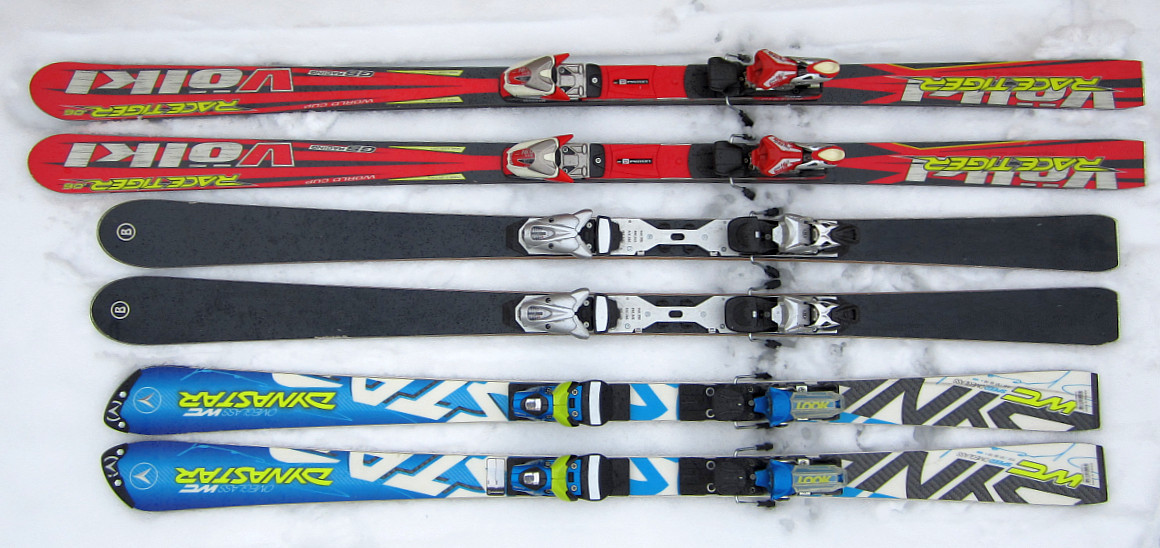
With the innovation of shaped skis around the turn of the 21st century, equipment used for slalom in international competition changed drastically. World Cup skiers commonly skied on slalom skis at a length of 203 - in the 1980s and 1990s but by the 2002 Olympic Winter Games in Salt Lake City, the majority of competitors were using skis measuring 160 cm or less.
The downside of the shorter skis was that athletes found that recoveries were more difficult with a smaller platform underfoot. Out of concern for the safety of athletes, the FIS began to set minimum ski lengths for international slalom competition. The minimum was initially set at 155 cm for men and 150 cm for women, but was increased to 165 cm for men and 157 cm for women for the 2003–2004 season.
The equipment minimums and maximums imposed by the International Ski Federation (FIS) have created a backlash from skiers, suppliers, and fans. The main objection is that the federation is regressing the equipment, and hence the sport, by two decades.
American Bode Miller hastened the shift to the shorter, more radical sidecut skis when he achieved unexpected success after becoming the first Junior Olympic athlete to adopt the equipment in giant slalom and super-G in 1996. A few years later, the technology was adapted to slalom skis as well.
Men's slalom World Cup podiums
In the following table men's slalom World Cup podiums in the World Cup since first season in 1967.
| Season | 1st | 2nd | 3rd |
|---|---|---|---|
| 1967 | FRA Jean-Claude Killy | FRA Guy Perillat | AUT Heinrich Messner |
| 1968 | SUI Dumeng Giovanoli | FRA Jean-Claude Killy | FRA Patrick Russel |
| 1969 | FRA Alain Penz | ||
| AUT Alfred Matt | |||
| FRA Jean-Noel Augert | |||
| FRA Patrick Russel | |||
| 1970 | FRA Alain Penz | FRA Jean-Noël Augert | |
| FRA Patrick Russel | |||
| 1971 | FRA Jean-Noël Augert | ITA Gustav Thöni | USA Tyler Palmer |
| 1972 | FRA Jean-Noël Augert | POL Andrzej Bachleda | ITA Roland Thöni |
| 1973 | ITA Gustav Thöni | GER Christian Neureuther | FRA Jean-Noël Augert |
| 1974 | ITA Gustav Thöni | GER Christian Neureuther | AUT Johann Kniewasser |
| 1975 | SWE Ingemar Stenmark | ITA Gustav Thöni | ITA Piero Gros |
| 1976 | SWE Ingemar Stenmark | ITA Piero Gros | ITA Gustav Thöni |
| AUT Hans Hinterseer | |||
| 1977 | SWE Ingemar Stenmark | AUT Klaus Heidegger | LIE Paul Frommelt |
| 1978 | SWE Ingemar Stenmark | AUT Klaus Heidegger | USA Phil Mahre |
| 1979 | SWE Ingemar Stenmark | USA Phil Mahre | GER Christian Neureuther |
| 1980 | SWE Ingemar Stenmark | YUG Bojan Križaj | GER Christian Neureuther |
| 1981 | SWE Ingemar Stenmark | USA Phil Mahre | YUG Bojan Križaj |
| USA Steve Mahre | |||
| 1982 | USA Phil Mahre | SWE Ingemar Stenmark | USA Steve Mahre |
| 1983 | SWE Ingemar Stenmark | SWE Stig Strand | LIE Andreas Wenzel |
| 1984 | LUX Marc Girardelli | SWE Ingemar Stenmark | AUT Franz Gruber |
| 1985 | LUX Marc Girardelli | LIE Paul Frommelt | SWE Ingemar Stenmark |
| 1986 | YUG Rok Petrovič | YUG Bojan Križaj | |
| SWE Ingemar Stenmark | |||
| LIE Paul Frommelt | |||
| 1987 | YUG Bojan Križaj | SWE Ingemar Stenmark | GER Armin Bittner |
| 1988 | ITA Alberto Tomba | AUT Günther Mader | USA Felix McGrath |
| 1989 | GER Armin Bittner | ITA Alberto Tomba | LUX Marc Girardelli |
| NOR Ole Kristian Furuseth | |||
| 1990 | GER Armin Bittner | ITA Alberto Tomba | |
| NOR Ole Kristian Furuseth | |||
| 1991 | LUX Marc Girardelli | NOR Ole Kristian Furuseth | AUT Rudolf Nierlich |
| 1992 | ITA Alberto Tomba | SUI Paul Accola | NOR Finn Christian Jagge |
| 1993 | SWE Thomas Fogdö | ITA Alberto Tomba | AUT Thomas Stangassinger |
| 1994 | ITA Alberto Tomba | AUT Thomas Stangassinger | SLO Jure Košir |
| 1995 | ITA Alberto Tomba | AUT Michael Tritscher | SLO Jure Košir |
| 1996 | FRA Sebastien Amiez | ITA Alberto Tomba | AUT Thomas Sykora |
| 1997 | AUT Thomas Sykora | AUT Thomas Stangassinger | NOR Finn Christian Jagge |
| 1998 | AUT Thomas Sykora | AUT Thomas Stangassinger | NOR Hans Petter Buraas |
| 1999 | AUT Thomas Stangassinger | SLO Jure Košir | NOR Finn Christian Jagge |
| 2000 | NOR Kjetil André Aamodt | NOR Ole Kristian Furuseth | SLO Matjaž Vrhovnik |
| 2001 | AUT Benjamin Raich | AUT Heinz Schilchegger | AUT Mario Matt |
| 2002 | CRO Ivica Kostelić | USA Bode Miller | FRA Jean-Pierre Vidal |
| 2003 | FIN Kalle Palander | CRO Ivica Kostelić | AUT Rainer Schönfelder |
| 2004 | AUT Rainer Schönfelder | FIN Kalle Palander | AUT Benjamin Raich |
| 2005 | AUT Benjamin Raich | AUT Rainer Schönfelder | AUT Manfred Pranger |
| 2006 | ITA Giorgio Rocca | FIN Kalle Palander | AUT Benjamin Raich |
| 2007 | AUT Benjamin Raich | AUT Mario Matt | SWE Jens Byggmark |
| 2008 | ITA Manfred Mölgg | FRA Jean-Baptiste Grange | AUT Reinfried Herbst |
| 2009 | FRA Jean-Baptiste Grange | CRO Ivica Kostelić | FRA Julien Lizeroux |
| 2010 | AUT Reinfried Herbst | FRA Julien Lizeroux | SUI Silvan Zurbriggen |
| 2011 | CRO Ivica Kostelić | FRA Jean-Baptiste Grange | SWE André Myhrer |
| 2012 | SWE André Myhrer | CRO Ivica Kostelić | AUT Marcel Hirscher |
| 2013 | AUT Marcel Hirscher | GER Felix Neureuther | CRO Ivica Kostelić |
| 2014 | AUT Marcel Hirscher | GER Felix Neureuther | NOR Henrik Kristoffersen |
| 2015 | AUT Marcel Hirscher | GER Felix Neureuther | RUS Alexander Khoroshilov |
| 2016 | NOR Henrik Kristoffersen | AUT Marcel Hirscher | GER Felix Neureuther |
| 2017 | AUT Marcel Hirscher | NOR Henrik Kristoffersen | ITA Manfred Mölgg |
| 2018 | AUT Marcel Hirscher | NOR Henrik Kristoffersen | SWE André Myhrer |
| 2019 | AUT Marcel Hirscher | FRA Clément Noël | SUI Daniel Yule |
| 2020 | NOR Henrik Kristoffersen | FRA Clément Noël | SUI Daniel Yule |
| 2021 | AUT Marco Schwarz | FRA Clément Noël | SUI Ramon Zenhäusern |
| 2022 | NOR Henrik Kristoffersen | AUT Manuel Feller | NOR Atle Lie McGrath |
| 2023 | NOR Lucas Braathen | NOR Henrik Kristoffersen | SUI Ramon Zenhäusern |
| 2024 | AUT Manuel Feller | GER Linus Straßer | NOR Timon Haugan |
Women's slalom World Cup podiums
In the following table women's slalom World Cup podiums in the World Cup since first season in 1967.
| Season | 1st | 2nd | 3rd |
|---|---|---|---|
| 1967 | FRA Annie Famose | FRA Marielle Goitschel | CAN Nancy Greene |
| 1968 | FRA Marielle Goitschel | AUT Gertrud Gabl | |
| FRA Florence Steurer | |||
| 1969 | AUT Gertrud Gabl | USA Kiki Cutter | AUT Ingrid Lafforgue |
| 1970 | FRA Ingrid Lafforgue | USA Barbara Cochran | |
| FRA Michèle Jacot | |||
| 1971 | CAN Betsy Clifford | FRA Britt Lafforgue | USA Barbara Cochran |
| AUT Annemarie Moser-Pröll | |||
| 1972 | FRA Britt Lafforgue | FRA Françoise Macchi | |
| FRA Florence Steurer | |||
| 1973 | FRA Patricia Emonet | GER Rosi Mittermaier | AUT Monika Kaserer |
| 1974 | GER Christa Zechmeister | GER Rosi Mittermaier | FRA Fabienne Serrat |
| 1975 | SUI Lise-Marie Morerod | LIE Hanni Wenzel | GER Christa Zechmeister |
| 1976 | GER Rosi Mittermaier | SUI Lise-Marie Morerod | FRA Danièle Debernard |
| 1977 | SUI Lise-Marie Morerod | FRA Perrine Pelen | ITA Claudia Giordani |
| 1978 | LIE Hanni Wenzel | FRA Perrine Pelen | FRA Fabienne Serrat |
| 1979 | AUT Regina Sackl | AUT Annemarie Moser-Pröll | AUT Lea Sölkner |
| 1980 | FRA Perrine Pelen | LIE Hanni Wenzel | AUT Annemarie Moser-Pröll |
| 1981 | SUI Erika Hess | USA Christin Cooper | ITA Daniela Zini |
| 1982 | SUI Erika Hess | LIE Ursula Konzett | USA Christin Cooper |
| 1983 | SUI Erika Hess | AUT Roswitha Steiner | ITA Maria Rosa Quario |
| 1984 | USA Tamara McKinney | AUT Roswitha Steiner | FRA Perrine Pelen |
| 1985 | SUI Erika Hess | USA Tamara McKinney | FRA Perrine Pelen |
| 1986 | AUT Roswitha Steiner | SUI Erika Hess | FRA Perrine Pelen |
| 1987 | SUI Corinne Schmidhauser | USA Tamara McKinney | SUI Erika Hess |
| 1988 | AUT Roswitha Steiner | SUI Vreni Schneider | AUT Anita Wachter |
| 1989 | SUI Vreni Schneider | AUT Monika Maierhofer | USA Tamara McKinney |
| 1990 | SUI Vreni Schneider | AUT Claudia Strobl | AUT Ida Ladstätter |
| 1991 | AUT Petra Kronberger | SWE Pernilla Wiberg | SPA Blanca Fernández Ochoa |
| 1992 | SUI Vreni Schneider | SWE Pernilla Wiberg | SPA Blanca Fernández Ochoa |
| 1993 | SUI Vreni Schneider | NZL Annelise Coberger | FRA Patricia Chauvet |
| 1994 | SUI Vreni Schneider | SWE Pernilla Wiberg | SVN Urska Hrovat |
| 1995 | SUI Vreni Schneider | SWE Pernilla Wiberg | GER Martina Ertl |
| 1996 | AUT Elfi Eder | SVN Urska Hrovat | SWE Pernilla Wiberg |
| 1997 | SWE Pernilla Wiberg | NZL Claudia Riegler | ITA Deborah Compagnoni |
| 1998 | SWE Ylva Nowén | USA Kristina Koznick | GER Hilde Gerg |
| 1999 | AUT Sabine Egger | SWE Pernilla Wiberg | SWE Anja Pärson |
| 2000 | SVN Špela Pretnar | FRA Christel Pascal | SWE Anja Pärson |
| 2001 | HRV Janica Kostelić | SUI Sonja Nef | GER Martina Ertl |
| 2002 | FRA Laure Pequegnot | USA Kristina Koznick | SWE Anja Pärson |
| 2003 | HRV Janica Kostelić | SWE Anja Pärson | FIN Tanja Poutiainen |
| 2004 | SWE Anja Pärson | AUT Marlies Schild | GER Monika Bergmann-Schmuderer |
| 2005 | FIN Tanja Poutiainen | HRV Janica Kostelić | AUT Marlies Schild |
| 2006 | HRV Janica Kostelić | AUT Marlies Schild | SWE Anja Pärson |
| 2007 | AUT Marlies Schild | AUT Nicole Hosp | CZE Veronika Zuzulová |
| 2008 | AUT Marlies Schild | AUT Nicole Hosp | CZE Veronika Zuzulová |
| 2009 | GER Maria Riesch | CZE Šárka Záhrobská | USA Lindsey Vonn |
| 2010 | GER Maria Riesch | AUT Kathrin Zettel | AUT Marlies Schild |
| 2011 | AUT Marlies Schild | FIN Tanja Poutiainen | GER Maria Riesch |
| 2012 | AUT Marlies Schild | AUT Michaela Kirchgasser | SVN Tina Maze |
| 2013 | USA Mikaela Shiffrin | SVN Tina Maze | SVK Veronika Velez-Zuzulová |
| 2014 | USA Mikaela Shiffrin | SWE Frida Hansdotter | AUT Marlies Schild |
| 2015 | USA Mikaela Shiffrin | SWE Frida Hansdotter | SVN Tina Maze |
| 2016 | SWE Frida Hansdotter | SVK Veronika Velez-Zuzulová | SUI Wendy Holdener |
| 2017 | USA Mikaela Shiffrin | SVK Veronika Velez-Zuzulová | SUI Wendy Holdener |
| 2018 | USA Mikaela Shiffrin | SUI Wendy Holdener | SWE Frida Hansdotter |
| 2019 | USA Mikaela Shiffrin | SVK Petra Vlhová | SUI Wendy Holdener |
| 2020 | SVK Petra Vlhová | USA Mikaela Shiffrin | AUT Katharina Liensberger |
| 2021 | AUT Katharina Liensberger | USA Mikaela Shiffrin | SVK Petra Vlhová |
| 2022 | SVK Petra Vlhová | USA Mikaela Shiffrin | GER Lena Dürr |
| 2023 | USA Mikaela Shiffrin | SUI Wendy Holdener | SVK Petra Vlhová |
| 2024 | USA Mikaela Shiffrin | GER Lena Dürr | SVK Petra Vlhová |
References
References
- ''Kunnskapsforlagets idrettsleksikon''. Oslo: Kunnskapsforlaget, 1990, p.273.
- [http://www.stolaf.edu/naha/pubs/nas/volume29/vol29_12.htm NAHA // Norwegian-American Studies]
- Bergsland, E.: ''På ski''. Oslo: Aschehoug, 1946, p.27.
- Hussey, Elisabeth. "The Man Who Changed the Face of Alpine Skiing", ''Skiing Heritage'', December 2005, p. 9.
- Bergsland, Einar (1952). ''Skiing: a way of life in Norway.'' Oslo: Aschehoug.
- Slade, Daryl. (February 12, 1988). "Alpine evolution continues". Ocala (FL) Star-Banner.
- (February 13, 1994). "Alpine skiing: Stenmark on slalom". Observer-Reporter.
- McMillan, Ian. (February 28, 1984). "A new line in slalom poles". Glasgow Herald.
- "A matter of course". The Guardian.
- "To Cross-Block or Not To Cross-Block?".
- (2021-12-01). "THE INTERNATIONAL SKI COMPETITION RULES (ICR) BOOK IV JOINT REGULATIONS FOR ALPINE SKIING".
- (22 November 2011). "Giant Slalom Racers Object to a Mandate on New Equipment". The New York Times.
- "Winter Sports Chart - Alpine Skiing". wintersport-charts.info.
- "Winter Sports Chart - Alpine Skiing". wintersport-charts.info.
This article was imported from Wikipedia and is available under the Creative Commons Attribution-ShareAlike 4.0 License. Content has been adapted to SurfDoc format. Original contributors can be found on the article history page.
Ask Mako anything about Slalom skiing — get instant answers, deeper analysis, and related topics.
Research with MakoFree with your Surf account
Create a free account to save articles, ask Mako questions, and organize your research.
Sign up freeThis content may have been generated or modified by AI. CloudSurf Software LLC is not responsible for the accuracy, completeness, or reliability of AI-generated content. Always verify important information from primary sources.
Report