From Surf Wiki (app.surf) — the open knowledge base
Skolion
Song form in ancient Greece
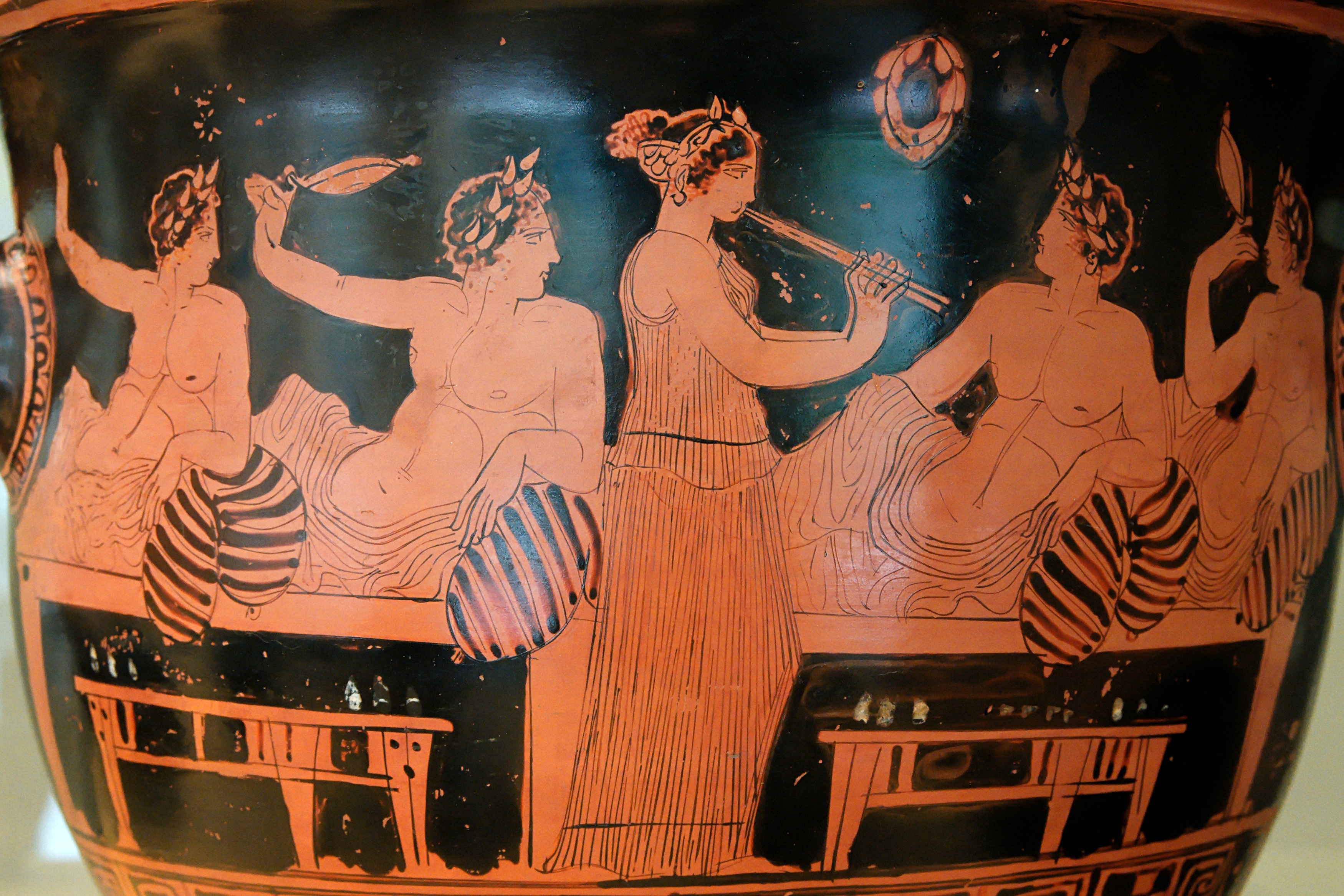
Song form in ancient Greece
A skolion (from ) (pl. skolia), also scolion (pl. scolia), was a song sung by invited guests at banquets in ancient Greece. Often extolling the virtues of the gods or heroic men, skolia were improvised to suit the occasion and accompanied by a lyre, which was handed about from singer to singer as the time for each scolion came around. "Capping" verses were exchanged, "by varying, punning, riddling, or cleverly modifying" the previous contribution.
Etymology
Although Greek folk etymology connects skolion with δύσκολος 'difficult', the likeliest connection is with σκέλος 'bent limb, part' as joined verse or repartee. This use is comparable to Japanese renga 'linked verse'.
Background
Skolia are often referred to as 'banquet songs', 'convivial songs", or 'drinking songs'. The term also refers to poetry composed in the same form. In later use, the form was used in a more stately manner for chorus poetry in praise of the gods or heroes.
Terpander is said to have been the inventor of this poetic form, shows in what high esteem skolia were held by the Greeks.
The Epitaph of Seikilos, dated to the first century AD, found with the original music in the ancient Greek notation, is the oldest complete example of ancient Greek music. Although often referred to as a skolion, its context as a short tombstone inscription scarcely suggests such a characterisation. It is, rather, an epigram. The confusion about this piece in modern scholarship is due to the association made by the scholiast to Plato's Gorgias 451e between the epigram and the skolion.
Other uses
- At Balliol College, Oxford, the "Skoliasts" are the undergraduate Classics society.
Sources
- Richard Reitzenstein, Epigramm und Skolion, Ein Beitrag zur Geschichte der Alexandrinischen Dichtung. Giessen (1893); Olms, Hildesheim (1970).
- Herbert Weir Smyth, Greek Melic Poets, (1900); New York, Biblo and Tannen (1963)
- Gregory Jones, "Non-Elite Origins of the Attic Skolia and the Birth of Democracy", Abstracts of Papers for the Annual Meeting, American Philological Association (APA) (2005)
- Elena Fabbro, Carmina Convivalia Attica, Rome 1995
References
- {{cite EB1911
- Christian Werner. (2005-05-18). "review of Derek Collins". Bryn Mawr Classical Review.
- D. S. Robertson. (June 1961). "Pindar's Skolia - B. A. Van Groningen: Pindare au Banquet. Les fragments des scolies édités avec un commentaire critique et explicatif. Pp. 132. Leiden: Sijthoff. 1960. Cloth, fl. 16". The Classical Review.
- {{YouTube. IxXHLXkdO8c&watch_response. The Song of Seikilos
- (22 April 2006). "Skolion of Seikilos". The Session.
- Thomas Mathiesen. (1999). "Apollo's Lyre: Greek Music and Music Theory in Antiquity and the Middle Ages". University of Nebraska Press.
- "Societies | Balliol JCR".
This article was imported from Wikipedia and is available under the Creative Commons Attribution-ShareAlike 4.0 License. Content has been adapted to SurfDoc format. Original contributors can be found on the article history page.
Ask Mako anything about Skolion — get instant answers, deeper analysis, and related topics.
Research with MakoFree with your Surf account
Create a free account to save articles, ask Mako questions, and organize your research.
Sign up freeThis content may have been generated or modified by AI. CloudSurf Software LLC is not responsible for the accuracy, completeness, or reliability of AI-generated content. Always verify important information from primary sources.
Report