From Surf Wiki (app.surf) — the open knowledge base
Sixth generation of video game consoles
Gaming generation from 1998 to 2013
Gaming generation from 1998 to 2013
In the history of video games, the sixth generation era (in rare occasions called the 128-bit era; see "bits and system power" below) is the era of computer and video games, video game consoles, and handheld gaming devices available at the turn of the 21st century, starting on November 27, 1998. Platforms in the sixth generation include consoles from four companies: Sega's Dreamcast (DC), Sony's PlayStation 2 (PS2), the Nintendo GameCube (GC), and Microsoft's Xbox. This era began on November 27, 1998, with the Japanese release of the Dreamcast, which was joined by the PlayStation 2 on March 4, 2000, the GameCube on September 14, 2001, and the Xbox on November 15, 2001, respectively. The Dreamcast was among the first to be discontinued in 2001, followed by GameCube in 2007, Xbox in 2009, and PlayStation 2 in 2013. Meanwhile, the seventh generation of consoles started on November 22, 2005, with the launch of the Xbox 360.
The major innovation of this generation was of full utilization of the internet to allow a fully online gaming experience. While the prior generation had some systems with internet connectivity, such as the Apple Pippin, these had little market penetration and thus had limited success in the area. Services such as Microsoft's Xbox Live became industry standard in this, and future, generations. Other innovations of the Xbox was its being the first system with an internal ethernet port and the first to utilize an internal hard disk drive to store game data. This led to many improvements to the gaming experience, including the ability to store program data (rather than just save game data) that allowed for faster load times, as well as the ability to download games directly from the internet rather than to purchase physical media such as a disk or cartridge. Soon after its release other systems, like the Sony PlayStation 2, produced peripheral storage devices to allow similar capabilities, and by the next generation internal storage became industry standard.
Bit ratings (i.e. "64-bit" or "32-bit" for the previous generation) for most consoles largely fell by the wayside during this era, with the notable exceptions being promotions for the Dreamcast and PS2 that advertised "128-bit graphics" at the start of the generation. The number of "bits" cited in this way in console names refers to the CPU word size, and had been used by hardware marketing departments as a "show of power" for many years. However, there is little to be gained from increasing the word size much beyond 32 or 64 bits because, once this level is reached, performance depends on more varied factors, such as processor clock speed, bandwidth, and memory size.
The sixth generation of handhelds began with the release of Bandai's WonderSwan, launched in Japan in 1999. Nintendo maintained its dominant share of the handheld market with the release in 2001 of the Game Boy Advance, which featured many upgrades and new features over the Game Boy. The Game Boy Advance was discontinued in early 2010. The next generation of handheld consoles began in November 2004, with the North American introduction of the Nintendo DS.
The last official Dreamcast games were released in 2002 (North America and Europe) and 2007 (Japan). The last GameCube games were released in 2006 (Japan) and 2007 (North America and Europe). The last Xbox games were released in 2006 (Japan), 2007 (Europe) and 2008 (North America). The last PlayStation 2 games were released in 2013; The last game released in Japan was Final Fantasy XI: Seekers of Adoulin in March, the last game released in North America was FIFA 14 in September, and last game released in Europe was Pro Evolution Soccer 2014 in November, marking the end of this generation.
Home systems
The PlayStation 2 achieved sales dominance in this generation, becoming the best-selling console in history, with over 160 million units sold . The Microsoft Xbox had sold over 24 million units as of May 2006, and the GameCube had sold 22 million units as of September 2010. The Dreamcast, which arrived prior to all of the others and was discontinued in 2001, came in fourth with 9.13 million sold.
The sixth generation began to end when the Xbox was succeeded by the Xbox 360 in late 2005. GameCube hardware was still being produced when the Wii was released in late 2006, but as of June 2008 had also been ceased. PlayStation 2 sales continued to be strong through to the end of 2010, due to the system's large software library, continuing software support, and affordable price.
In February 2008, the PlayStation 2 outsold both the PlayStation 3 and Xbox 360 in the United States. Games were still being produced for the PlayStation 2, Xbox, and GameCube as of 2008, while Dreamcast games were officially discontinued in 2003. There were still a few games being produced for the Dreamcast in 2004, but they are essentially NAOMI arcade ports released only in Japan, with small print runs. The PlayStation 2 was still being produced after the launch of the Wii U in 2012, making the sixth generation the second longest generation of all time.
Dreamcast
Main article: Dreamcast
Sega's Dreamcast was the first console of the generation and had several features to show an advantage from the competition, including Internet gaming as an optional feature through its built-in modem, and a web browser.
The console is credited with restoring Sega's reputation, which had been damaged by the earlier failures of the Sega Saturn, Sega 32X, Genesis Nomad and Sega CD. Despite this, the Dreamcast was discontinued prematurely due to numerous factors. The impending and much-hyped PlayStation 2 slowed Dreamcast sales, mostly due to the fact that the PlayStation 2 had a built-in DVD player and a huge number of PS1 owners looking to upgrade to the new, backward compatible console. In addition, Sega's short-lived support/success of its post-Mega Drive products the Mega-CD, 32X and Saturn had left developers and customers skeptical, with some holding out to see whether the Dreamcast or PlayStation 2 would come out on top.
Sega's decision to implement a GD-ROM (though publicly advertised as a CD-ROM) for storage medium did save costs but it did not compare well against the PS2's much-touted DVD capabilities. Sega was either unable or unwilling to spend the advertising money necessary to compete with Sony, who themselves took massive losses on the PlayStation 2 to gain market share. With the announcements of the Xbox and GameCube in late 2000, Sega's console was considered by some to be outdated only two years after its release. The previous losses from the Saturn, 32X, and Sega/Mega-CD, stagnation of sales due to the PlayStation 2, and impending competition from Microsoft and Nintendo caused Sega's revenue to shrink and announce their intention on killing the system in early 2001, dropping the system entirely and leaving the console market in early 2004 in Japan and much earlier in other countries. Sega also announced it would shut down SegaNet, an online gaming community that supported online-capable Dreamcast titles. Due to user outcry over the decision, Sega delayed the service's closure by an additional 6 months. Since the Dreamcast's discontinuation, Sega transitioned to software developing making games as a third-party company.
PlayStation 2
Main article: PlayStation 2
The brand Sony had established with the original PlayStation was a major factor in the PlayStation 2's dominance, both in terms of securing a consumer base and attracting third-party developers, with the gradual increase in one reinforcing the other. The PlayStation 2 was also able to play DVDs and was backward compatible with PlayStation games, which many say helped the former's sales. Sony Computer Entertainment secured licensing for key games such as Final Fantasy X, Grand Theft Auto III, and Metal Gear Solid 2: Sons of Liberty, enabling the PS2 to outperform its competitors' launches. The console ended up becoming the top-selling console of this generation, while its competing consoles, the Xbox and the GameCube, went on to be modestly successful consoles.
GameCube
Main article: GameCube
Nintendo struggled with conflicting brand images, particularly the family-friendly one developed during the 1990s. Its arsenal of franchises and history in the industry, though earning it a loyal fan base, failed to give it an advantage against the Xbox and PlayStation 2 which captured audiences seeking 'Mature' titles of which Nintendo had fewer. Nintendo also made little headway into online gaming (releasing a small handful of online-capable games, the most popular of which was Phantasy Star Online Episode I and II, which was an enhanced port of the Dreamcast game with various new features and content), instead emphasizing Game Boy Advance connectivity. As a result, the GameCube failed to match the sales of its predecessor, the Nintendo 64, but the console wasn't a financial failure. Nintendo did however rejuvenate its relationship with many developers, often working in close collaboration with them to produce games based upon its franchises, in contrast to the past where it was frequently seen as bullying developers in the late 1980s, back when the Nintendo Entertainment System was out on the market. As a result, the GameCube had more first and second party releases than its competitors, whose most successful titles were mainly products of third-party developers.
Xbox
Main article: Xbox (console)
Although the Xbox had the formidable financial backing of Microsoft, it was unable to significantly threaten the dominance of the PlayStation 2 as market leader. However, the Xbox attracted a large fanbase and strong third-party support in the United States and Europe and became a recognizable brand amongst the mainstream. The Xbox Live online service with its centralized model proved particularly successful, prompting Sony to boost the online capabilities of the PlayStation 2. Xbox Live also gave the Xbox an edge over the GameCube, which had a near-total lack of online games. The flagship of Xbox Live was the game Halo 2, which was the best-selling Xbox game with over 8 million copies sold worldwide. However, the Xbox failed to gain a following in Japan, with reasons cited including lack of brand recognition, lack of commitment to the console from Japanese publishers and developers, failure of Microsoft staff to fully understand important cultural differences, and ethnocentric preferences of the Japanese public for native products.
Comparison
| Name | Dreamcast | PlayStation 2 | GameCube | Xbox | Logo | [[File:Dreamcast logo.svg | frameless | center | 100x100px | class=skin-invert]] | [[File:PlayStation 2 logo.svg | frameless | center | 100x100px | class=skin-invert]] | [[File:Nintendo Gamecube Logo.svg | frameless | center | 100x100px | class=skin-invert]] | [[File:Xbox original logo black.png | frameless | center | 100x100px | class=skin-invert]] | Manufacturer | Image(s) | Release date | Launch prices | US$ | € | GBP | A$ | JP¥ | Discontinued | Media | Type | Regional lockout | Backward compatibility | Best-selling game | Accessories (retail) | CPU | GPU | RAM | Audio | Video outputs | Online service | System software |
|---|---|---|---|---|---|---|---|---|---|---|---|---|---|---|---|---|---|---|---|---|---|---|---|---|---|---|---|---|---|---|---|---|---|---|---|---|---|---|---|---|---|---|---|---|---|---|---|---|
| Sega | Sony (SCE) | Nintendo | Microsoft | |||||||||||||||||||||||||||||||||||||||||||||
| [[File:Dreamcast-Console-Set.jpg | 200px | Dreamcast console and controller with VMU.]] | [[File:PS2-Versions.jpg | 190px | Slimline (right) and Original (left) PS2 consoles]] | [[File:GameCube-Set.jpg | 200px | Indigo GameCube and controller]] | [[File:Xbox-Classic-Console-wBoth.jpg | 200px | Xbox console with "Controller S"]] | |||||||||||||||||||||||||||||||||||||
| Dreamcast and controller with VMU | Left: Original PlayStation 2 | |||||||||||||||||||||||||||||||||||||||||||||||
| Right: Slimline PlayStation 2 with DualShock 2 controller | GameCube and controller | Xbox and controllers | ||||||||||||||||||||||||||||||||||||||||||||||
| US$199.99 () | US$299.99 () | US$199.99 () | US$299.99 () | |||||||||||||||||||||||||||||||||||||||||||||
| DEM499.99 (Equivalent to €255.64 in 1999 or € in ) | DEM869.99 (Equivalent to €444.31 in 2000 or € in ) | €199.99 () | €479.99 (Changed to €399.99 shortly before Launch and ) | |||||||||||||||||||||||||||||||||||||||||||||
| £199.99 () | £299.99 () | £129.99 () | £299.99 () | |||||||||||||||||||||||||||||||||||||||||||||
| () | () | ¥25,000 (equivalent to ¥25,800 in 2019) | ||||||||||||||||||||||||||||||||||||||||||||||
| GD-ROM, CD | DVD, CD | GameCube Game Disc | DVD, CD | |||||||||||||||||||||||||||||||||||||||||||||
| Sonic Adventure, 2.5 million (as of June 2006) | Grand Theft Auto: San Andreas, 20.81 million (as of August 24, 2013) | Super Smash Bros. Melee, 7.5 million (as of August 24, 2013) | Halo 2, 8.49 million (as of August 24, 2013) | |||||||||||||||||||||||||||||||||||||||||||||
| 200 MHz SuperH SH-4 | 294 MHz MIPS "Emotion Engine" 299 MHz later models | 485 MHz PowerPC "Gekko" | 733 MHz x86 Intel Celeron/Pentium III Custom Hybrid | |||||||||||||||||||||||||||||||||||||||||||||
| 100 MHz NEC/VideoLogic PowerVR CLX2 "Holly" | 147 MHz "Graphics Synthesizer" | 162 MHz ATI "Flipper" | 233 MHz Custom Nvidia NV2A | |||||||||||||||||||||||||||||||||||||||||||||
| Main RAM 16 MB SDRAM | ||||||||||||||||||||||||||||||||||||||||||||||||
| Video RAM 8 MB | ||||||||||||||||||||||||||||||||||||||||||||||||
| Sound RAM 2 MB | Main RAM 32 MB dual-channel, RDRAM | |||||||||||||||||||||||||||||||||||||||||||||||
| Video RAM 4 MB eDRAM | ||||||||||||||||||||||||||||||||||||||||||||||||
| Sound RAM 2 MB | Main RAM 24 MB 1T-SRAM, | |||||||||||||||||||||||||||||||||||||||||||||||
| Video RAM 3 MB embedded 1T-SRAM | ||||||||||||||||||||||||||||||||||||||||||||||||
| Audio/Alternative RAM 16 MB DRAM | 64 MB unified DDR SDRAM | |||||||||||||||||||||||||||||||||||||||||||||||
| Stereo audio, with: | 5.1 ch. surround sound audio, with: | Stereo audio, with: | 5.1 ch. surround sound audio, with: | |||||||||||||||||||||||||||||||||||||||||||||
| VGA (RGBHV), SCART (RGBS), S-Video, composite | Component (YPBPR, RGsB), VGA (RGsB; progressive scan games/PS2 Linux only), SCART (RGBS), S-Video, composite | Component (YCBCR), SCART (RGBS; PAL consoles only), S-Video (NTSC consoles only), composite | Component (YPBPR), SCART (RGBS), S-Video, composite | |||||||||||||||||||||||||||||||||||||||||||||
| JP: Dricas (1998–2007) | ||||||||||||||||||||||||||||||||||||||||||||||||
| NA: Sega Net (2000–2002) | ||||||||||||||||||||||||||||||||||||||||||||||||
| EU: Dreamarena (2000–2003) | Non-unified services (2002–2016) | Non-unified services (2003–2009) | Xbox Live (2002–2010) | |||||||||||||||||||||||||||||||||||||||||||||
| Proprietary OS | Proprietary OS, PS2 Linux | Proprietary OS | Proprietary OS, Xbox Windows Media Center |
Worldwide sales standings
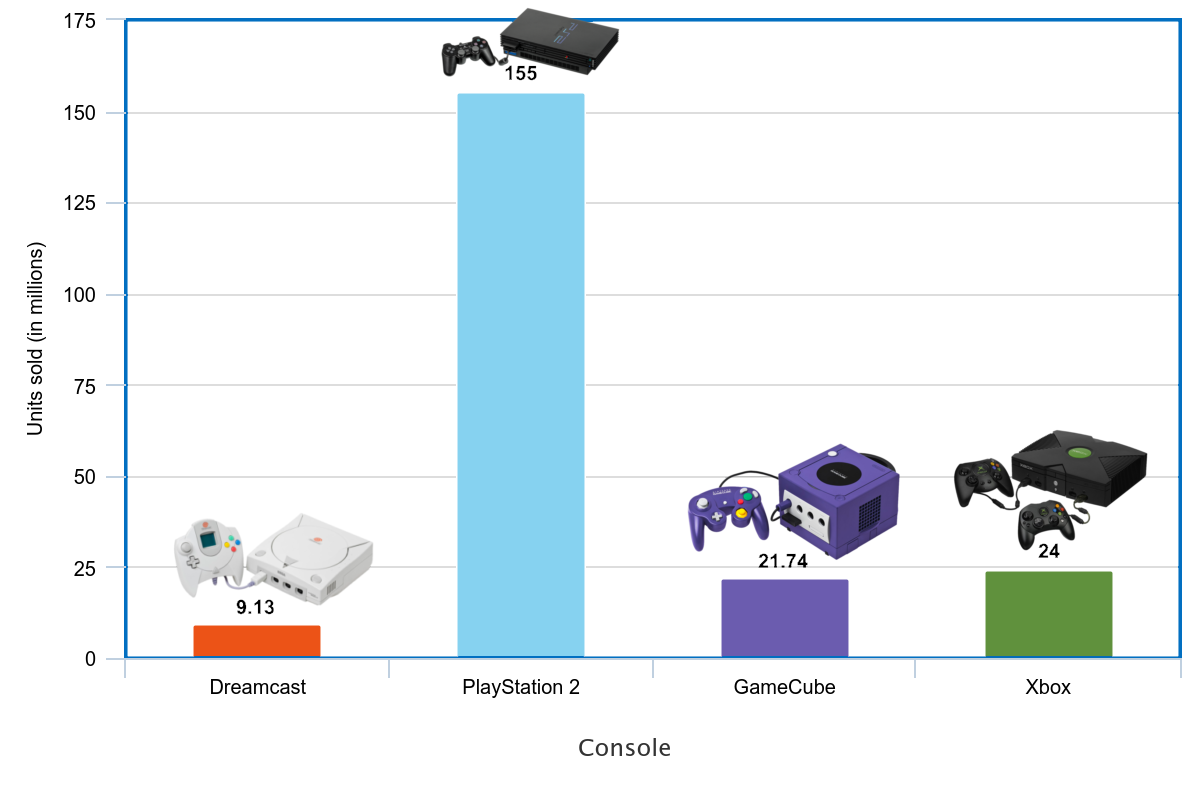
| Console | Units sold | |||||||||||
|---|---|---|---|---|---|---|---|---|---|---|---|---|
| PlayStation 2 | 160 million (as of November 26, 2024) | |||||||||||
| Xbox | 24 million (as of May 10, 2006) | |||||||||||
| GameCube | 21.74 million (as of September 30, 2010) | |||||||||||
| V.Smile | 11 million | |||||||||||
| Dreamcast | last1=Zackariasson | first1=Peter | last2=Wilson | first2=Timothy L. | last3=Ernkvist | first3=Mirko | title=The Video Game Industry: Formation, Present State, and Future | chapter=Console Hardware: The Development of Nintendo Wii | publisher=Routledge | year=2012 | isbn=978-1-138-80383-1 | page=158}} |
Other consoles
These consoles were created for the mass market, like the 4 consoles listed above. However, they are less often noted, never saw a worldwide release, and/or have sold fewer units overall, and are therefore listed as 'Other'. File:Nuon-N2000-wController-L.jpg|link=File:Nuon-N2000-wController-L.jpg|Nuon, a hybrid DVD player/gaming system that had a very small game library. Released by VM Labs in 2000. File:Panasonic-Q-Console-Set.jpg|Panasonic Q, a DVD player hybrid version of the GameCube. Released by Panasonic in 2001. Console_psx.jpg|PSX, a PlayStation compatible digital video recorder. Released by Sony in 2003. File:XaviX-XaviXPORT-Console-FL.jpg|XaviX, a video gaming base console for the XaviX Interactive System. Released by SSD Company Limited in 2004. File:Vtech Vsmile French version.JPG|V.Smile, an educational video game console. Released by VTech in 2004.
Bits and system power
Bit ratings for consoles largely fell by the wayside after the fifth generation (32/64-bit) era. The number of "bits" cited in console names referred to the CPU word size, but there was little to be gained from increasing the word size much beyond 32 bits; performance depended on other factors, such as central processing unit speed, graphics processing unit speed, channel capacity, data storage size, and memory speed, latency, and size.
The importance of the number of bits in the modern console gaming market has thus decreased due to the use of components that process data in varying word sizes. Previously, console manufacturers advertised the "n-bit talk" to overemphasize the hardware capabilities of their system. The Dreamcast and the PlayStation 2 were the last systems to use the term "128-bit" in their marketing to describe their capability.
It is not easy to compare the relative "power" of the different systems. Having a larger CPU word size does not necessarily make one console more powerful than another. Likewise, the operating frequency (clock rate, measured in terms of Hertz) of a system's CPU is not an accurate measure of performance either, except between systems of the same or similar architecture.
The Microsoft Xbox uses a 32-bit (general purpose) CISC x86 architecture CPU, with an instruction set equal to that of the Coppermine core Mobile Celeron, though it has less cache (128 kB) than the PC equivalent. It has 64 MB RAM (shared) and runs at 733 MHz. Because the Pentium 3 introduced SSE, the Xbox also had 128-bit SIMD capabilities. Its NV2A GPU, which is very similar to the GeForce 3 series of desktop GPUs, makes it the only console in its time with traditional vertex and pixel shaders.
The GameCube's CPU is a PowerPC CPU codenamed Gekko that runs at 485 MHz and was built by IBM. Its graphics processor, codenamed "Flipper", is comparable to the original ATI Radeon. The console has 43 MB of non-unified memory (24 MB of 1T-SRAM, 3 MB embedded 1T-SRAM, and 16 MB DRAM).
The PlayStation 2's CPU (known as the "128-bit Emotion Engine") has a 64-bit core with a 32-bit FPU. Coupled to two 128-bit Vector Units, this hybrid R5900 CPU is based on MIPS architecture. The PS2 also has an internal 10 Channel DMA Bus which is fully 128 bits wide. Paths between the Emotion Engine, RAM and the Graphics Synthesizer (GS) are also 128 bits wide. The PS2's unique hardware arrangement with no less than 10 processing units were difficult to come to grips with. Many developers struggled initially with programming the hardware. The PS2's Graphics Synthesizer (GS) has fast dedicated video memory, though it is limited in the amount of data it can hold. The 10 Channel 128 bit wide DMA bus could pump data to GS Memory as fast as the screen could update. Consequently, with the main memory being limited to 32MB, many of the PS2's games have reduced textures compared with versions for other consoles. It also does not have a hardware dedicated transform and lighting unit like the ones found in the Xbox and GameCube GPUs.
However the PS2's design allows a remarkable degree of flexibility and choice. For example, program control and general arithmetic could be handled by the CPU, while the Vector Units 0 and 1, could provide parallel processing of physics, clipping and transform and lighting to the scene. The Vector units were noted to be so versatile that Shadow of The Colossus used one of the vector units to do full Pixel shading for the fur of the Collossi.
The Dreamcast features a SuperH-4 32-bit reduced instruction set computing (RISC) instruction set architecture (ISA) using 16-bit fixed-length instructions, alongside a 64-bit double-precision superscalar unit, a 64-bit data bus allowing a variable width of either 8, 16, 32 or 64-bits, and a 128-bit floating-point bus. The PowerVR 2DC CLX2 chipset uses a unique method of rendering a 3D scene called Tile Based Deferred Rendering (TBDR): while storing polygons in triangle strip format in memory, the display is split into tiles associated with a list of visibly overlapping triangles onto which, using a process similar to ray tracing, rays are cast and a pixel is rendered from the triangle closest to the camera. After calculating the depths associated with each polygon for one tile row in 1 cycle, the whole tile is flushed to video memory before passing on to render the next tile. Once all information has been collated for the current frame, the tiles are rendered in turn to produce the final image.
Handheld systems
During the sixth generation era, the handheld game console market expanded with the introduction of new devices from many different manufacturers. Nintendo maintained its dominant share of the handheld market with the release in 2001 of the Game Boy Advance, which featured many upgrades and new features over the Game Boy. Two redesigns of this system followed, the Game Boy Advance SP in 2003 and the Game Boy Micro in 2005. Also introduced was the Bandai's WonderSwan, launched in Japan in 1999. South Korean company Game Park introduced its GP32 handheld in 2001, and with it came the dawn of open source handheld consoles. The Game Boy Advance line of handhelds has sold 81.51 million units worldwide as of September 30, 2010.
A major new addition to the market was the trend for corporations to include a large number of "non-gaming" features into their handheld consoles, including cell phones, MP3 players, portable movie players, and PDA-like features. The handheld that started this trend was Nokia's N-Gage, which was released in 2003 and doubled primarily as a mobile phone. It went through a redesign in 2004 and was renamed the N-Gage QD. A second handheld, the Zodiac from Tapwave, was released in 2004; based on the Palm OS, it offered specialized gaming-oriented video and sound capabilities, but it had an unwieldy development kit due to the underlying Palm OS foundation.
A fairly uncommon handheld of the 6th generation was the vtech V.SMILE Pocket. A handheld version of their V.SMILE home console.
With more and more PDAs arriving during the previous generation, the difference between consumer electronics and traditional computing began to blur and cheap console technology grew as a result. It was said of PDAs that they were "the computers of handheld gaming" because of their multi-purpose capabilities and the increasingly powerful computer hardware that resided within them. This capability existed to move gaming beyond the last generation's 16-bit limitations; however, PDAs were still geared towards the typical businessman, and lacked new, affordable software franchises to compete with dedicated handheld gaming consoles.
Handheld comparison
| Product Line | WonderSwan | Game Boy Advance | N-Gage | Name | WonderSwan | WonderSwan Color | SwanCrystal | Game Boy Advance | Game Boy Advance SP | Game Boy Micro | N-Gage | N-Gage QD | Logo | [[File:Bandai WonderSwan horizontal logo.svg | 200px | class=skin-invert]] | [[File:Game Boy Advance logo.svg | 200px]] | [[File:N-Gage console logo.svg | 200px | class=skin-invert]] | Manufacturer | Console | Release dates | Launch prices | US$ | - | - | - | € | - | - | - | GBP | - | - | - | A$ | - | - | - | JP¥ | Discontinued | Media | Type | Regional lockout | Backward compatibility | Best-selling game | Accessories | |||||||||||||||||
|---|---|---|---|---|---|---|---|---|---|---|---|---|---|---|---|---|---|---|---|---|---|---|---|---|---|---|---|---|---|---|---|---|---|---|---|---|---|---|---|---|---|---|---|---|---|---|---|---|---|---|---|---|---|---|---|---|---|---|---|---|---|---|---|---|---|---|
| (retail) | OS | CPU | Memory | Display | Resolutions | Audio | Interface | Dimensions | Weight | Online service | Storage | Battery life | Units sold (all models combined) | |||||||||||||||||||||||||||||||||||||||||||||||||||||
| Bandai | Nintendo | Nokia | ||||||||||||||||||||||||||||||||||||||||||||||||||||||||||||||||
| [[File:WonderSwan-Black-Left.jpg | 100px]] | [[File:WonderSwan-Color-Blue-Left.png | 100px]] | [[File:Wonder-Swan-Crystal.jpg | 100px]] | [[File:Nintendo-Game-Boy-Advance-Purple-FL_cropped.jpg | Nintendo-Game-Boy-Advance-Purple-FL | 120px]] | [[File:Game-Boy-Advance-SP-Mk1-Blue.jpg | 100px]] | [[File:Game-Boy-Micro.jpg | 100px]] | [[File:Nokia-NGage-LL.jpg | 100px]] | [[File:Nokia-NGage-QD.jpg | 100px]] | ||||||||||||||||||||||||||||||||||||||||||||||||||
| October 7, 2003 | May 26, 2004 | |||||||||||||||||||||||||||||||||||||||||||||||||||||||||||||||||
| US$99.99 () | US$99.99 () | US$99.99 () | US$299.99 () | US$179.99 () | ||||||||||||||||||||||||||||||||||||||||||||||||||||||||||||||
| DEM249.99 (Equivalent to €127.82 in 2001 or € in ) | €129.99 () | €289.99 () | €229.99 () | |||||||||||||||||||||||||||||||||||||||||||||||||||||||||||||||
| () | () | |||||||||||||||||||||||||||||||||||||||||||||||||||||||||||||||||
| AU$199.99 () | ||||||||||||||||||||||||||||||||||||||||||||||||||||||||||||||||||
| ¥9,800 () | ¥12,500 () | |||||||||||||||||||||||||||||||||||||||||||||||||||||||||||||||||
| 2003 | 2007 | 2006 | ||||||||||||||||||||||||||||||||||||||||||||||||||||||||||||||||
| WonderSwan cartridge | Game Boy Advance Game Pak | MultiMediaCard (MMC) | ||||||||||||||||||||||||||||||||||||||||||||||||||||||||||||||||
| colspan="3" style="text-align:center;" | Unrestricted}} | Unrestricted}} | ||||||||||||||||||||||||||||||||||||||||||||||||||||||||||||||||
| style="text-align:center;" | WonderSwan}} | Game Boy, Game Boy Color}} | colspan="2" style="text-align:center;" | |||||||||||||||||||||||||||||||||||||||||||||||||||||||||||||||
| Final Fantasy | Pokémon Ruby and Sapphire, 16.22 million combined (as of November 25, 2004) | ? | ||||||||||||||||||||||||||||||||||||||||||||||||||||||||||||||||
| Symbian S60 | ||||||||||||||||||||||||||||||||||||||||||||||||||||||||||||||||||
| 16-bit, NEC V30 MZ | 16.8 MHz, 32-bit, ARM7TDMI with embedded memory | 104 MHz, 32-bit, RISC based on ARM9 series | ||||||||||||||||||||||||||||||||||||||||||||||||||||||||||||||||
| 512 kbit (64 KB) RAM | 32 kilobyte + 96 kilobyte VRAM (internal to the CPU), 256 kilobyte WRAM (outside the CPU) | 16 megabyte RAM, 16 megabyte ROM (3.4 MB accessible for storage) | ||||||||||||||||||||||||||||||||||||||||||||||||||||||||||||||||
| 2.49-inch liquid-crystal display (LCD) | 2.8-inch LCD | 2.8-inch LCD | 2.9-inch LCD | 2.9-inch LCD | 2-inch LCD | |||||||||||||||||||||||||||||||||||||||||||||||||||||||||||||
| 224 x 144 | 240 × 160 | 176 × 208 | ||||||||||||||||||||||||||||||||||||||||||||||||||||||||||||||||
| 4-bit PCM channels | Stereo audio, with: | Stereo audio (using headphones), with: | ||||||||||||||||||||||||||||||||||||||||||||||||||||||||||||||||
| 12.8 × 24.5 × 82mm (5.04 in × 2.93 in × 0.96 in) | 144.5 × 24.5 × 82 mm (5.69 × 0.96 × 3.2 inches) | 84 × 82 × 24.4 mm (3.3 × 3.23 × 0.96 inches) | 50 × 101 × 17.2 mm (2 × 4 × 0.7 inches) | 70 mm (h) 134 mm (w) 20 mm (d): | 118 mm (w) 68 mm (h) 22 mm (d) | |||||||||||||||||||||||||||||||||||||||||||||||||||||||||||||
| 96 g (3.4 oz) | 140 g | 142 g | 80 g | 137 g | 143 g | |||||||||||||||||||||||||||||||||||||||||||||||||||||||||||||
| N-Gage Arena | ||||||||||||||||||||||||||||||||||||||||||||||||||||||||||||||||||
| 3.4 MB internal storage, MMC | ||||||||||||||||||||||||||||||||||||||||||||||||||||||||||||||||||
| 40 hours | 15 hours | GBA: 15 hours | ||||||||||||||||||||||||||||||||||||||||||||||||||||||||||||||||
| GBA SP: | ||||||||||||||||||||||||||||||||||||||||||||||||||||||||||||||||||
| GB Micro: | 10 hours continuous play with light on, 18 hours with light off | 5 hours with top brightness and sound, 8 hours with both features on default | 2 hours continuous play | 4 hours continuous play | ||||||||||||||||||||||||||||||||||||||||||||||||||||||||||||||
| Japan: 3.5 million (combined) | ||||||||||||||||||||||||||||||||||||||||||||||||||||||||||||||||||
| Worldwide: 81.51 million (as of September 30, 2010) | ||||||||||||||||||||||||||||||||||||||||||||||||||||||||||||||||||
| Worldwide: 3 million (as of July 30, 2007) |
Note: First year of release is the first year of the system's worldwide availability.
Other handhelds
File:Sega-Dreamcast-VMU.jpg|VMU (1998) Created by Sega as a memory card for the Dreamcast File:Cybiko.jpg|Cybiko (2000) File:Pokémon mini system.jpg|Pokémon Mini (2001) File:Gp32.jpg|GP32 Released in 2001, discontinued around 2005 – South Korea only File:LeapFrog Leapster WBackdrop0593.jpg|Leapster Learning Game System (2003) File:Tapwave-Zodiac2-FL.jpg|Tapwave Zodiac (2003)
Sales
| Console | Units sold | ||||||||||
|---|---|---|---|---|---|---|---|---|---|---|---|
| Game Boy Advance | |||||||||||
| (figure includes GBA SP and Game Boy Micro) | 81.51 million | ||||||||||
| Leapster | |||||||||||
| 4 million | |||||||||||
| WonderSwan | |||||||||||
| 3.5 million | |||||||||||
| N-Gage | url=http://www.gamepro.com/gamepro/domestic/games/features/125748.shtml | title=The 10 Worst-Selling Handhelds of All Time | access-date=December 3, 2008 | author=Blake Snow | magazine=GamePro | date=July 30, 2007 | page=1 | archive-url=https://web.archive.org/web/20071012194600/http://gamepro.com/gamepro/domestic/games/features/125748.shtml | archive-date=October 12, 2007}} | ||
| Cybiko | url=https://www.telegraph.co.uk/finance/personalfinance/4478896/Vesta-pours-9m-into-new-console.html | title=Vesta pours $9m into new console | last1=Ringshaw | first1=Grant | date=January 2001 | website=The Telegraph | publisher=Telegraph Media Group Limited | accessdate=February 23, 2016 | archive-date=February 28, 2016 | archive-url=https://web.archive.org/web/20160228105125/http://www.telegraph.co.uk/finance/personalfinance/4478896/Vesta-pours-9m-into-new-console.html | url-status=live }} |
| Tapwave Zodiac | url=http://www.gamepro.com/gamepro/domestic/games/features/125749.shtml | title=The 10 Worst-Selling Handhelds of All Time | access-date=December 3, 2008 | author=Blake Snow | magazine=GamePro | date=July 30, 2007 | page=2 | archive-url=https://web.archive.org/web/20071013043037/http://www.gamepro.com/gamepro/domestic/games/features/125749.shtml | archive-date=October 13, 2007}} | ||
| GP32 | 30,000 |
Trends
Market convergence
Major publishers, such as Activision, Electronic Arts, and Ubisoft adopted a cross-platform strategy, releasing versions of their games for PC, all major consoles, and in some cases, handhelds as well. The sixth generation was the first to help console and computer software grow closer together as well as outperform the arcade market in features, graphics and business. The Dreamcast, which had an official Windows CE Development Kit to help porting games from PCs to Dreamcast, and the Xbox, which was made from off-the-shelf PC parts and hosted many PC ports, factored into this also.
Controversial games
Main article: Video game controversies
While the sixth generation was not the first to have its share of controversial games, this generation was noted to have extensive criticism by public figures of "objectionable" content in gaming such as sex, crime, violence, profanity, and drug use as well as topics of debate such as religion, politics and economics.
The sixth generation was also notable because it saw the continuation of lawmakers taking actions against the video game industry. The most famous were Rockstar Games' Manhunt and Grand Theft Auto games (Grand Theft Auto III and Grand Theft Auto: Vice City) facing lawsuits over allegedly influencing minors to commit crimes, while Grand Theft Auto: San Andreas was briefly given an adult rating and removed from most stores over the availability of an abandoned sex mini-game using the Hot Coffee mod.
The sixth generation also coincided with the September 11 attacks in New York City and the Pentagon, which had a huge impact on the entertainment industry, including the video game industry; in the subsequent market climate, multiple games were edited in response to the sensitivity surrounding the event. Prior to its release, Metal Gear Solid 2: Sons of Liberty depicted a submersible mobile fortress hijacked by terrorists destroying a good portion of Manhattan in view of the twin towers (this can be found in the "Document of Metal Gear Solid 2" making-of feature). Similarly, several undisclosed modifications were made in Grand Theft Auto III, such as a change to the police cars' color scheme (the old scheme resembled that of NYPD's older blue and white design) and altered cover art (the European release featured the original artwork); Rockstar Games estimates that the changes amounted to 1% in changed content. The Dreamcast game Propeller Arena was never officially released, possibly due to a certain level which was visually very similar to the September 11 attacks.
Emulation and retro gaming
Because of the increased computing power of video game consoles and the widespread usage of emulators, the sixth generation saw the rise of console emulation and retro gaming on a vast scale. Many games for older systems were updated with superior graphics or sound and re-released for current consoles. Commonly emulated games included those released for the Nintendo Entertainment System, the Super Nintendo Entertainment System, the Mega Drive/Genesis, the PlayStation (the PS2 can play PS1 games natively), and the Nintendo 64.
Also during this generation, the computing power of handheld consoles became capable of supporting games made for some of the earliest gaming consoles and several companies released remakes of classic games for the handhelds. Nintendo introduced a line of NES and SNES games for its Game Boy Advance handheld, including remakes such as Final Fantasy I & II: Dawn of Souls and Nintendo's Metroid: Zero Mission. Also, an increasing number of third-party developers, including Midway Games, Capcom, Namco, Atari, Tecmo, and Sega, released anthology collections of some of their old games. Additionally, many video games and video game series that were originally confined to Japan were released in North America and Europe for the first time.
Rise of online gaming
Online gaming, which in previous generations had been almost an exclusive domain of PC games, became more prominent in video game consoles during this generation. The Dreamcast initiated this change with its built in modem, internet browsing software, and ability to play certain games online. The PlayStation 2, Xbox and GameCube also offered online gaming, though their approaches and commitment to it varied greatly. The Xbox offered an integrated service called Xbox Live that cost $50 per year and was only compatible with a broadband internet connection. Its ability to connect gamers for online multi-player matches and its ideal experience was a considerable factor in allowing the Xbox to gain a foothold in the western market, especially in the first-person shooter genre. The PlayStation 2 left its online gaming service up to each individual game publisher, and though it was free to use, it was not always an ideal experience, especially with games published by small developers. The SOCOM series was one of the most popular online competitive games for the PS2. The GameCube did not offer online play for any of its first-party titles, with only Sega's Phantasy Star Online series and Homeland making official use of the console's online capabilities. In addition, online capability was not out-of-the-box; an adapter was needed to hook the GameCube to the internet.
Mergers
Many game publishing companies with a long established history merged with their competitors: Microsoft bought second-party developer Rare in 2002; Square merged with Enix to form Square Enix in 2003 and then later bought Taito; Sega merged with Sammy to form Sega Sammy Holdings in 2004; Konami bought a majority share of Hudson Soft; Namco merged with Bandai to form Bandai Namco Holdings in 2006.
Software
Main article: List of video game franchises
Milestone titles
- Burnout 3: Takedown (PS2, Xbox) by Criterion Games and EA Games was released to universal acclaim from critics, for their addictive gameplay, visuals and a shift to a more aggressive style of racing game in comparison to its predecessors. Retrospective coverage of the game has been highly positive with some publications declaring it as the greatest arcade racer game ever made and the peak of the Burnout series.
- Dead or Alive 2 (Arcade, DC, PS2) by Team Ninja and Tecmo received universal acclaim with a GameRankings and Metacritic score of 91/100, and is considered as one of the greatest fighting games of all time. It was notable for improving and popularizing the concept of multi-tierd environments. Dead or Alive 3 (Xbox) also received acclaim and was a bestseller with over 2 million units sold worldwide, scoring 37 out of 40 on Famitsu. It was notable for improving and expanding on what the previous game offered, praised for its advanced graphics and was declared "The most technologically advanced fighting game ever made".
- Final Fantasy X (PS2) by Square (now Square Enix) refined many elements found in its predecessors, adding a completely different battle system. Within four days of its release in Japan the game had sold over 1.4 million copies in pre-orders, setting the record for the fastest-selling console RPG.
- Forza Motorsport (Xbox) by Turn 10 Studios and Microsoft Studios received universal critical acclaim and is considered to have set a new standard for the racing genre. This game received universal acclaim according to the review aggregation website Metacritic.
- God of War and God of War II (PS2) by Santa Monica Studio and Sony Computer Entertainment (SCE) were both released to universal acclaim from critics for their gameplay, graphics and story.
- Grand Theft Auto III, Vice City, and San Andreas (PS2, Xbox, PC) by Rockstar popularized "sandbox" style gameplay in an urban crime setting, which has since been widely imitated. In addition, it brought violence and other potentially objectionable content in video games back into the mainstream spotlight, thus reviving the video game controversy.
- Half-Life 2 (PC, Xbox) by Valve was praised for its advanced physics, animation, sound, AI, graphics, gameplay, and narrative, and was named Game of the Decade at the Spike Video Game Awards.
- Halo: Combat Evolved (Xbox, PC) by Bungie and Microsoft Studios was by far the most successful launch title for the Xbox. Halo 2 set records as the fastest grossing release in entertainment history and was still very successful on the Xbox Live online gaming service until support was dropped in April 2010.
- Jet Set Radio (DC) by Smilebit and Sega received universal acclaim for its arcade-style gameplay, up-tempo music and cel-shaded visuals. It popularized the use of cel-shaded visuals in video games. Jet Set Radio Future (Xbox) improved and expanded on what the original game offered, and also received critical acclaim.
- The Legend of Zelda: The Wind Waker (GC) by Nintendo EAD and Nintendo remains one of the most critically acclaimed games of the generation. Critics praised the vivid artistry and timeless gameplay. It has a score of 96% on Metacritic, and it is the fourth game to obtain a perfect score from video game reviewer Famitsu. Likewise, The Legend of Zelda: Twilight Princess (GC) proved to be another important title in the series released this generation. The title is perhaps best remembered for the excitement caused by its announcement trailer at E3 2004. It was released to widespread critical acclaim with an average of 96% on Metacritic. The game drew much praise for its scale and cinematic style with many reviewers declaring it the best game in the series. Likewise, it was seen as a transitional title being released on both the GameCube and Wii – which resulted in it being the best-selling title in the series since Ocarina of Time.
- Metal Gear Solid 2: Sons of Liberty (PS2, Xbox, PC) and Metal Gear Solid 3: Snake Eater (PS2) by Konami Computer Entertainment Japan and Konami improved upon the stealth genre by adding many new abilities, and for the first time in its respective genre made the surroundings nearly completely interactive. Both games achieved widespread critical acclaim, as they improved many elements from their predecessor.
- Metroid Prime (GC) by Retro Studios and Nintendo is one of the generation's highest-rated titles, with a score of 96.3 on GameRankings and a 97 on Metacritic. The game garnered critical praise and commercial success, selling more than a million units in North America alone. It was also the eighth best-selling GameCube game in Australia, and more than 78,000 copies were sold in Japan. It won a number of Game of the Year awards, and it is considered by many critics and gamers to be one of the greatest video games ever made, remaining one of the highest-rated games on Metacritic.
- NFL 2K1 (DC) by Visual Concepts and Sega was the first football game to feature online play.
- Ninja Gaiden (Xbox) by Team Ninja and Tecmo received universal acclaim with a GameRankings score of 93% and Metacritic score of 91/100, praised for its intense difficulty and attention to detail, selling over 1.5 million copies worldwide. Ninja Gaiden Black (Xbox), an update to the original, also received acclaim and praised for its additional content along with the addition of an easy mode difficulty setting.
- Phantasy Star Online (DC, GC, Xbox, PC) by Sonic Team and Sega, the first console MMORPG, has been cited as one of the most groundbreaking and influential games of the generation. It received "generally favorable" reviews per ratings aggregator Metacritic.
- Pokémon Ruby and Sapphire (GBA) Despite the fact that the games received some backlash due to connectivity issues with the older games, which was resolved with the release of future games, these games still received positive reception from critics and a loyal fanbase for adding much more features innovation to the Pokémon series that are still a part of the franchise to this very day. They eventually became the best-selling games for the Game Boy Advance, selling roughly over 16.22 million copies worldwide as of October 2013.
- Resident Evil 4 (GC, PS2, PC) by Capcom Production Studio 4 and Capcom revamped the franchise in a new, more action-oriented direction. It remains one of the highest rated games of the generation.
- Rez (DC, PS2) by United Game Artists and Sega received significant critical acclaim. The game, about a computer virus named Swayzak invading the mainframe of a computer, has been cited as one of the greatest videogames ever made and a significant example of videogames as art.
- Shadow of the Colossus (PS2) by Team Ico and SCE has been frequently cited as an example of video games as art. Many reviewers consider the game's soundtrack to be one of its greatest aspects. In addition to Roar of the Earth won the award for "Soundtrack of the Year" in the US-based video game magazine Electronic Gaming Monthly, GameSpot commented that the musical score conveyed, and often intensified, the mood of any given situation, while it was described as "one of the finest game soundtracks ever" by a reviewer from Eurogamer.
- Shenmue (DC) by Sega AM2 and Sega is regarded as a major step forward for 3D open-world gameplay, introduced the quick time event mechanic in its modern form, and has been widely cited as one of the best and most influential games ever made.
- Sonic Adventure (DC, GC, PC) by Sonic Team was the first main Sonic the Hedgehog game to feature 3D gameplay. It received a perfect score from Computer and Video Games, who called it one of the greatest video games of all time, and GamesRadar wrote it "changed the gaming world forever".
- Soulcalibur (Arcade, DC) by Project Soul and Namco is the first fighting game on any platform to have ever received a perfect 10.0 rating from IGN and GameSpot and also a perfect 40/40 (second of only fifteen games) from Japanese gaming magazine, Famitsu. Soul Calibur II (Arcade, PS2, GC, Xbox) was a bestseller for all three home consoles on which it was released and was notable for featuring exclusive characters for every version released.
- Star Wars: Knights of the Old Republic (PC, Xbox) by BioWare and LucasArts has been cited as one of the best games of the generation and greatest games of all time. Its sequel, Star Wars Knights of the Old Republic II: The Sith Lords, also garnered critical acclaim.
- Super Mario Sunshine (GC) by Nintendo Entertainment Analysis & Development (Nintendo EAD) and Nintendo is the highest-rated 3D platformer of the generation with a Metacritic score of 92/100. This game was the first 3D Super Mario game which included the ability to ride Yoshi. This feature reappeared in Super Mario Galaxy 2 where the Twisty Trials Galaxy in World S is another recurring theme from Super Mario Sunshine, based on one of the missions "The Secret of Ricco Tower".
- Super Smash Bros. Melee (GC) by Hal Laboratory and Nintendo went on to become one of the most popular and most played games on the GameCube console which is a widely played competitive video game and has been featured in several high-profile tournaments. Many consider it to be the most competitively viable game in the series.
- Tekken Tag Tournament (PS2) was a launch title for the PlayStation 2 and is regarded as one of the best PS2 titles ever, and is also considered one of if not the most significant entry to the Tekken series. Throughout the sixth generation, Tekken Tag was the fighting game of choice for many tournaments. The game was also praised for its graphical leap from the arcade on to the then, new generation of consoles, on the PlayStation 2.
- Virtua Fighter 4 (Arcade, PS2) by Sega AM2 and Sega received universal acclaim, with a Metacritic score of 94/100, and is considered to have set a new standard for 3D fighting games. In Japan, the PlayStation 2 version sold 356,897 during its first week on sale in early 2002. Worldwide sales of the PS2 port exceeded 1.5 million by June 2002. On release, Famitsu magazine scored the PlayStation 2 version of the game a 37 out of 40.
Notes
References
References
- (January 4, 2013). "PlayStation 2 manufacture ends after 12 years". The Guardian.
- kesavva. (June 22, 2012). "Sega Dreamcast UK advert".
- "ECTS: The Truth About the Dreamcast...". [[ZDNet]].
- (August 22, 2013). "The Last PS2 Game to Launch for the System Might not be FIFA 14 as PES 2014 is Confirmed for PS2 & PSP". PlayStation LifeStyle.
- Yin-Poole, Wesley. (2015-03-19). "PS2 and Xbox 360 versions of Final Fantasy 11 come to an end March 2016".
- "PlayStation 2: PlayStation 2 System Specs at Ps2Fantasy.com".
- "Console Specs".
- "The Dreamcast & PlayStation 2 Comparison Page.".
- (January 8, 2010). "SONY COMPUTER ENTERTAINMENT ASIA STARTS ITS PLAYSTATION BUSINESS IN REPUBLIC OF INDONESIA". [[SCEI]].
- "2000 PlayStation 2 - PSP PlayStation Portable {{!}} PlayStation History timeline".
- (May 10, 2006). "Gamers Catch Their Breath as Xbox 360 and Xbox Live Reinvent Next-Generation Gaming". Xbox.com.
- (September 8, 2007). "Xbox". [[BusinessWeek]].
- (October 27, 2010). "Consolidated Sales Transition by Region". Nintendo.
- Yin-Poole, Wesley. (February 14, 2011). "PlayStation 2 ships over 150 million".
- Lewis, Nick. (December 19, 2007). "Gaming's best releases promise hours of fun – and mayhem". Calgary Herald.
- Shiau, Brian. (March 13, 2008). "the simExchange – February 2008 NPD Data". Simexchange.com.
- Luis, J.. (February 26, 2014). "Sales Charts – February 2008". GAMbIT Magazine.
- Kent, Steven L.. (February 18, 2004). "PlayStation 2 Timeline". IGN.
- (March 1999). "Sonic Adventure".
- "Sega Genesis Nomad".
- Whitehead, Dan. (January 2, 2009). "Dreamcast: A Forensic Retrospective".
- "9.9.99, A Dreamcast Memorial".
- [http://www.technobuffalo.com/gaming/what-ever-happened-to-the-dreamcast/ What Ever Happened To The Dreamcast?] {{Webarchive. link. (February 3, 2013 . TechnoBuffalo. Retrieved on August 23, 2013.)
- (October 30, 2002). "Playstation 2 is 'console champion'".
- (December 3, 2004). "Decade of dominance for PlayStation".
- Reese, Mark. (19 Nov 2011). "Feature: Remembering the GameCube".
- Richtel, Matt. (2003-02-16). "Business; Who's Blocking the Xbox? Sony and Its Games". The New York Times.
- Chris Morris. (May 9, 2006). "Grand Theft Auto, Halo 3 headed to Xbox 360". CNN.
- Asher Moses. (August 30, 2007). "Prepare for all-out war". [[The Sydney Morning Herald]].
- "Why Xbox failed in Japan".
- (2022-03-07). "In Twenty Years, Microsoft Has Only Sold 2.3 Million Xboxes In Japan".
- (April 16, 1959). "BBC – Sega Dreamcast to spark price war". BBC.
- "Business Development/Europe". [[Sony Computer Entertainment]].
- (May 2, 2002). "BBC – GameCube gets midnight launch". BBC.
- Sam Pettus. (2013). "Service Games: The Rise and Fall of SEGA: Enhanced Edition". Smashwords Edition.
- (December 31, 2012). "BBC News - Sony stops production of PlayStation 2". BBC.
- (January 31, 2013). "PlayStation 2 manufacture ends after 12 years". [[Famitsu]].
- (February 22, 2007). "Nintendo ends GameCube support". [[MCV (magazine).
- Garratt, Patrick. (August 5, 2011). "The Xbox Story, Part 1: The Birth of a Console". vg247.com.
- "Nvidia ends shipments of chips for Xbox". [[Financial Times]].
- Daniel Boutros. (August 4, 2006). "sega smash pack". [[Gamasutra]].
- (2012). "The Video Game Industry: Formation, Present State, and Future". Routledge.
- [http://www.anandtech.com/show/853/14 AnandTech.com: Hardware Behind the Consoles – Microsoft's Xbox vs. Sony PlayStation 2] {{Webarchive. link. (July 20, 2017 , November 21, 2001)
- [http://www.anandtech.com/show/858/13 AnandTech.com: Hardware Behind the Consoles – Nintendo GameCube vs. Sony PlayStation 2 vs. Microsoft Xbox] {{Webarchive. link. (September 16, 2012 , December 7, 2001)
- [http://www.segatech.com/technical/cpu/index.html Technology Partner – Design Solutions from Hitachi Semiconductor (America) Inc.: SH7750 (SH-4 Series) MPU] {{Webarchive. link. (March 6, 2001 (November/December 1997))
- (November 25, 2004). "Consolidated Financial Statements". Nintendo.
- Blake Snow. (July 30, 2007). "The 10 Worst-Selling Handhelds of All Time".
- (January 2001). "Vesta pours $9m into new console". Telegraph Media Group Limited.
- Blake Snow. (July 30, 2007). "The 10 Worst-Selling Handhelds of All Time".
- (2006-01-30). "Rockstar sued over Hot Coffee". Eurogamer.net.
- (July 14, 2005). "Hot Coffee controversy grows as Hilary Clinton weighs in".
- Cavalli, Earnest. "'Hot Coffee' Class Action Settled, $35 Rewarded For Outrage".
- "Rockstar Games".
- "Decommission of SOCOM servers".
- "Dead or Alive 2 - Hardcore Gaming 101". hardcoregaming101.net.
- (August 5, 2004). "Dead or Alive".
- Romano, Sal. (January 17, 2021). "Dead or Alive and modern Ninja Gaiden creator Tomonobu Itagaki establishes Itagaki Games [Update]".
- Itagaki, Tomonobu. (January 16, 2021). "Full Tomonobu Itagaki 2021 Bloomberg Interview (shared via Facebook)".
- (14 April 2019). "Pages - OXM Dec 2001".
- (2001-07-19). "Final Fantasy X Sells Like Crazy; World Not Shocked".
- "Forza Motorsport".
- Perry, Douglass. (May 4, 2005). "Forza Motorsport".
- Chou, Che. (May 3, 2005). "Forza Motorsport".
- Fischer, Russ. (May 3, 2005). "Forza Motorsport". [[GameSpy]].
- "Forza Motorsport for Xbox Reviews".
- "'Halo 2' clears record $125 million in first day". News.cnet.com.
- "What Today's Video Games Could Learn from 'Jet Set Radio'".
- "The Legend of Zelda: Twilight Princess". Metacritic.
- "Metroid Prime on GameRankings".
- "Metroid Prime on Metacritic".
- "US Platinum Videogame Chart". The Magic Box.
- (October 16, 2006). "Australia's Choice". Vooks.
- "GID 1215 – Metroid Prime – GCN". Garaph.
- "Metroid Prime reviews".
- Cork, Jeff. (November 16, 2009). "Game Informer's Top 100 Games of All Time (Circa Issue 100)".
- Ray Huling. (October 2007). "Ninja Playground". [[The Brooklyn Rail]].
- Rus McLaughlin. (2008-01-28). "IGN Presents The History of Ninja Gaiden".
- Kotaro Tsunetomi. (2007-07-06). "Bloomberg Politics - Bloomberg". [[Bloomberg L.P..
- Erik Brudvig. (2005-09-19). "''Ninja Gaiden Black'' Review".
- [[Greg Kasavin]]. (2005-09-20). "Ninja Gaiden Black for Xbox Review".
- Parish, Jeremy. (February 2010). "Phantasy Star Online". [[1UP.com]].
- "Phantasy Star Online Reviews". CBS Interactive.
- Hilliard, Kyle. (2018-05-11). "Why Ruby And Sapphire Were The Most Challenging Pokémon To Make - Features - www.gameinformer.com".
- Leane, Rob. (2020-10-23). "How Pokemon Ruby and Sapphire Saved Poke-Mania {{!}} Den of Geek".
- Lewis, Catherine. (2023-11-02). "Pokémon Ruby and Sapphire are the series' most groundbreaking titles".
- Rochlin, Jason. (2023-01-03). "Pokemon Ruby and Sapphire Marked Evolutions for the Series that Continue 20 Years Later".
- "Pokemon Sapphire Version".
- "Pokemon Ruby Version".
- (October 15, 2013). "Pokemon X & Y sell 4M copies in first weekend".
- (June 21, 2019). "How Pokemon Ruby and Sapphire Saved Poke-Mania".
- (October 17, 2008). "Gateway to Horror". [[UGO Networks]].
- Anon.. (November 29, 2001). "Rez Review".
- Simon Parkin. (January 30, 2008). "Reviews = ''Rez HD'' // Xbox 360".
- Sam Kennedy. (January 29, 2008). "Rez HD (Xbox 360)".
- Edge Staff. (March 13, 2012). "The Untouchables: Rez". Edge Magazine.
- (May 5, 2011). "The Art of Video Games Voting Results". Smithsonian American Art Museum.
- (2007). "Edge Presents The 100 Best Video games". Future Publishing.
- Ciccoricco, Dave.. (2008). "New Perspectives on Digital Literature".
- "Okay, kids, play on my lawn". Chicago Sun-Times.
- (November 2005). "Shadow of the Colossus Electronic Gaming Monthly". Find Articles.
- Shoemaker, Brad. (October 17, 2005). "Shadow of the Colossus for PlayStation 2 Review". GameSpot.
- Reed, Kristan. (2005). "Review – Shadow of the Colossus". Eurogamer.
- Scott Sharkey. "Top 5 Underappreciated Innovators: Five genre-defining games that didn't get their due".
- Brendan Main, [http://www.escapistmagazine.com/articles/view/issues/issue_285/8455-Lost-in-Yokosuka Lost in Yokosuka] {{Webarchive. link. (October 22, 2013 , ''[[The Escapist (magazine)). The Escapist]]''
- [http://www.nowgamer.com/features/1148/interview-with-shenmue-creator-yu-suzuki Shenmue: Creator Yu Suzuki Speaks Out] {{webarchive. link. (January 2, 2011 , ''[[GamesTM]]'')
- "Yu Suzuki".
- "The Disappearance of Yu Suzuki: Part 1". 1Up.com.
- Adam LaMosca, [http://www.escapistmagazine.com/articles/view/columns/waypoints/1310-On-Screen-Help-In-Game-Hindrance On-Screen Help, In-Game Hindrance] {{Webarchive. link. (February 1, 2014 , ''[[The Escapist (magazine)). The Escapist]]''
- [http://uk.top100.ign.com/2006/081-090.html Readers' Picks Top 100 Games: 81–90] {{webarchive. link. (November 3, 2013 , [[IGN]], 2006)
- [http://www.game.co.uk/greatestgames/ Greatest Games of All Time] {{Webarchive. link. (December 20, 2008 , [[Game (retailer)). Game]], May 22, 2008
- link. (October 8, 2014 , ''[[Empire (magazine)). Empire]]'', accessed February 25, 2011
- Furfari, Paul. (August 2010). "15 Games Ahead of Their Time".
- (September 1999). "Dreamcast Special: Sonic Adventure". Computer and Video Games.
- (June 23, 2012). "Top 7... horrendously buggy games we loved anyway". [[GamesRadar]].
- (September 21, 1999). "Soulcalibur Review".
- (September 8, 1999). "Soul Calibur for Dreamcast Review – Dreamcast Soul Calibur Review". Gamespot.com.
- (March 9, 2008). "'''Gamespot''' "SSBB gets perfect score from Famitsu" ''includes list of perfect score recipients in order''". Gamespot.com.
- "Best Games and Movies of 2000 – 2009". IGN.
- ''Game Informer'' Issue #200 November 2010
- (November 15, 2012). "All-TIME 100 Video Games".
- "Star Wars: Knights of the Old Republic II – The Sith Lords".
- "Super Mario Sunshine reviews".
- Tboy. "Super Mario Sunshine review". GamersHell.com.
- (June 2, 2009). "Super Mario Galaxy 2 E3 09: Debut Trailer". GameTrailers.
- (December 5, 2016). "Why 'Super Smash Bros. Melee' Is Still the King". [[Wenner Media]].
- Myers, Andy. (October 2005). "Smash Takes Over".
- Beauchamp, Travis. (2013). "The Smash Brothers". EastPointPictures.
- Khan, Imad. (June 13, 2014). "Will Wii U's 'Smash Bros.' win over the 'Melee' crowd?".
- Steven Hopper. (November 23, 2011). "Tekken Hybrid Review". IGN.
- [[Jeff Gerstmann]]. "Tekken Tag Tournament Review". GameSpot.
- "Virtua Fighter 4". Metacritic.
- ''Game Informer,'' May 2002, p.78: "Underneath its silky shine is a feast of fighting goodies that will change everything you have ever come to expect from this genre." cf. ''Game Informer,'' January 2004, p.64: "Absolutely ingenious....The most balanced and challenging fighting game the world has ever seen."
- "PS2 Japanese Ranking". Japan-GameCharts.
- Gantayat, Anoop. (2002-06-11). "Hands on: ''Virtua Fighter 4: Evolution''". IGN.
- ''プレイステーション2 – バーチャファイター4''. Weekly Famitsu. No.915 Pt.2. Pg.71. 30 June 2006.
- (May 22, 2003). "Nintendo to bundle Game Boy Player with GameCube in Japan".
- (June 28, 2004). "Limited-edition GameCube bundle hitting Japan".
This article was imported from Wikipedia and is available under the Creative Commons Attribution-ShareAlike 4.0 License. Content has been adapted to SurfDoc format. Original contributors can be found on the article history page.
Ask Mako anything about Sixth generation of video game consoles — get instant answers, deeper analysis, and related topics.
Research with MakoFree with your Surf account
Create a free account to save articles, ask Mako questions, and organize your research.
Sign up freeThis content may have been generated or modified by AI. CloudSurf Software LLC is not responsible for the accuracy, completeness, or reliability of AI-generated content. Always verify important information from primary sources.
Report