From Surf Wiki (app.surf) — the open knowledge base
Sivalik Hills
Mountain range in India, Pakistan and Nepal
Mountain range in India, Pakistan and Nepal
| Field | Value |
|---|---|
| name | Sivalik Hills |
| photo | Ganges_and_the_Shivalik_ranges,_near_Rishikesh.jpg |
| photo_caption | Sivalik Hills and Ganges River |
| image_map | Sivallik Hills map.svg |
| image_map_caption | Sivalik Hills, highlighted in light red |
| range_coordinates | |
| length_km | 2400 |
| location | northern Indian subcontinent |
| parent | outer Himalayas |
| geology | Tertiary |
The Sivalik Hills, also known as Churia Hills, are a mountain range of the outer Himalayas. The literal translation of "Sivalik" is 'tresses of Shiva'. The hills are known for their numerous fossils, and are also home to the Soanian Middle Paleolithic archaeological culture.
Geography
The Sivalik Hills are a mountain range of the outer Himalayas that stretches over about 2400 km from the Indus River eastwards close to the Brahmaputra River; they are 10 - wide with an average elevation of 1500 -. Between the Teesta and Raidāk Rivers is a gap of about 90 km. They are known for their Neogene and Pleistocene aged vertebrate fossils.
Geology
Geologically, the Sivalik Hills belong to the Tertiary deposits of the outer Himalayas. They are chiefly composed of sandstone and conglomerate rock formations, which are the solidified detritus of the Himalayas
They are bounded on the south by a fault system called the Main Frontal Thrust, with steeper slopes on that side. Below this, the coarse alluvial Bhabar zone makes the transition to the nearly level plains. Rainfall, especially during the summer monsoon, percolates into the Bhabar, then is forced to the surface by finer alluvial layers below it in a zone of springs and marshes along the northern edge of the Terai or plains.
Prehistory
The Sivalik Hills are well known for fossils of vertebrates, spanning from the Early Miocene, until the Middle Pleistocene, around 18 million to 600,000 years ago.
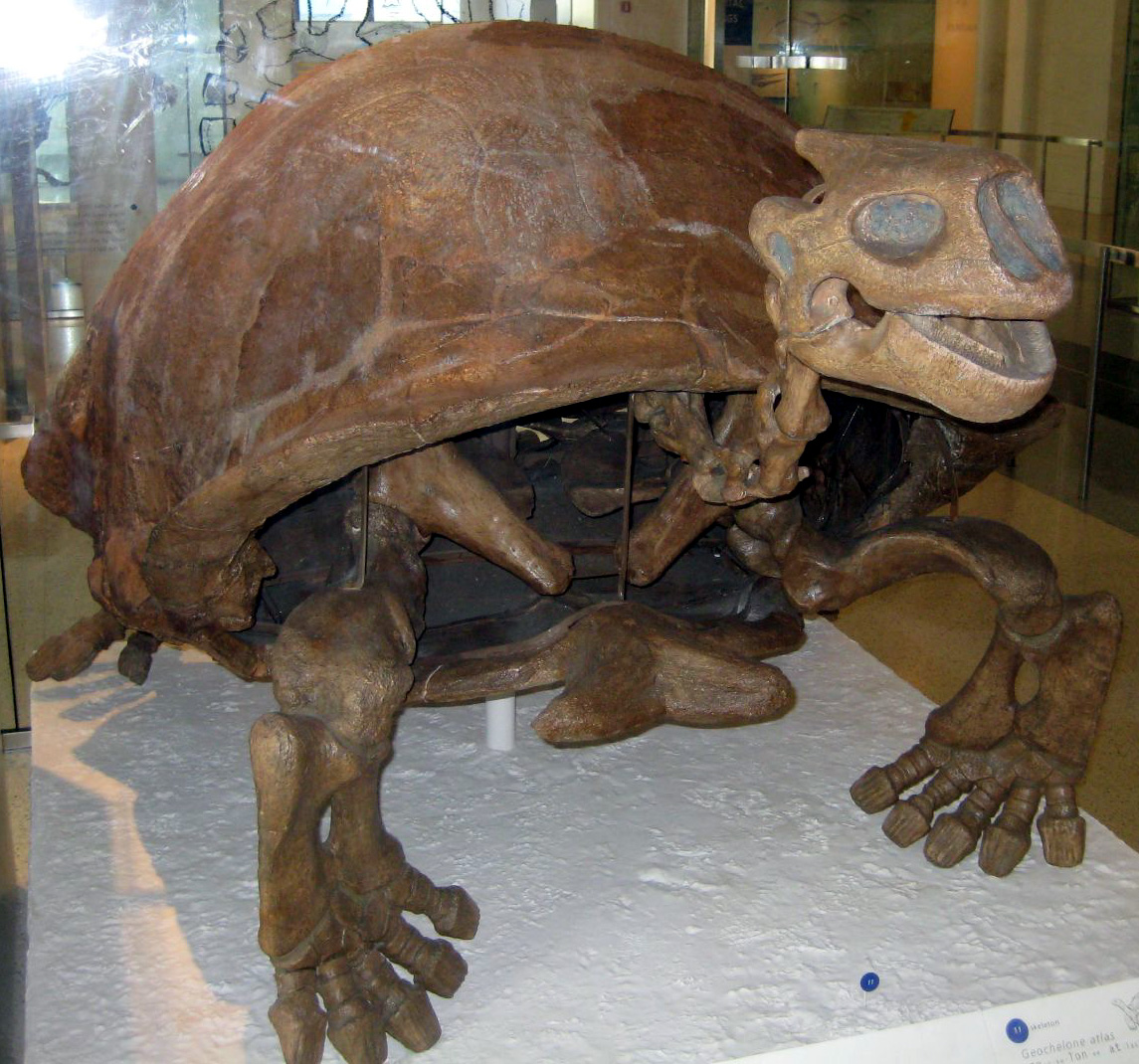
Some of the best known fossils from the hills include Megalochelys atlas, the largest known tortoise to have ever existed, the sabertooth cat Megantereon falconeri,** Sivatherium giganteum, the largest known giraffid, and the ape Sivapithecus.
Remains of the Lower-Middle Paleolithic Soanian culture dating to around 500,000 to 125,000 years Before Present were found in the Sivalik region. Contemporary to the Acheulean, the Soanian culture is named after the Soan Valley in the Sivalik Hills of Pakistan. The Soanian archaeological culture is found across Sivalik region in present-day India, Nepal and Pakistan.
Ecosystem
The carbon stock and carbon sequestration rates of the Churia forests differ among different forest management regimes and are highest in protected areas.
References
References
- (1999). "The Wonderland of Himachal Pradesh". H. G. Publications.
- Kohli, M. S.. (2002). "Mountains of India: Tourism, Adventure and Pilgrimage". Indus Publishing.
- Kaur, A. P.. (2022). "New fossil mammalian assemblages and first record of ostrich from the Pinjore (Pinjor) formation (2.58–0.63 Ma) of Siwalik Hills near Chandigarh, northern India". Quaternary Science Reviews.
- {{cite EB1911
- (2000). "Magnetic polarity stratigraphy of Siwalik Group sediments of Karnali River section in western Nepal". Geophysical Journal International.
- Mani, M.S.. (2012). "Ecology and Biogeography in India". Springer Science & Business Media.
- Nanda, A.C.. (2002). "Upper Siwalik mammalian faunas of India and associated events". Journal of Asian Earth Sciences.
- Patnaik, R.. (2013). "Fossil Mammals of Asia". Columbia University Press.
- (2015). "Turtles and tortoises of the world during the rise and global spread of humanity: first checklist and review of extinct Pleistocene and Holocene chelonians.". Chelonian Research Monographs.
- Stimpson, Christopher M.. (May 2024). "Siwalik sabrecats: review and revised diagnosis of Megantereon fossils from the foothills of the Himalaya". Royal Society Open Science.
- (January 2016). "The extinct, giant giraffid ''Sivatherium giganteum'': skeletal reconstruction and body mass estimation". [[Biology Letters]].
- (1988). "A new large species of Sivapithecus from the Siwaliks of Pakistan". Journal of Human Evolution.
- (2007). "Is the Soanian techno-complex a Mode 1 or Mode 3 phenomenon? A morphometric assessment". Journal of Archaeological Science.
- Chauhan, P.. (2016). "A Companion to South Asia in the Past". John Wiley & Sons.
- (2014). "Churia forests of Nepal". Forest Resource Assessment Nepal, Department of Forest Research and Survey, Ministry of Forests and Soil Conservation, Government of Nepal.
- (2022). "Aboveground carbon stocks and sequestration rates of forests under different management regimes in Churia region of Nepal". Banko Janakari.
This article was imported from Wikipedia and is available under the Creative Commons Attribution-ShareAlike 4.0 License. Content has been adapted to SurfDoc format. Original contributors can be found on the article history page.
Ask Mako anything about Sivalik Hills — get instant answers, deeper analysis, and related topics.
Research with MakoFree with your Surf account
Create a free account to save articles, ask Mako questions, and organize your research.
Sign up freeThis content may have been generated or modified by AI. CloudSurf Software LLC is not responsible for the accuracy, completeness, or reliability of AI-generated content. Always verify important information from primary sources.
Report